
- Updated:
- Published:
Chile’s iGaming market grew 2.5x in four years

Blask data and operator insights reveal what drives one of Latin America’s largest iGaming markets.
Chile has been developing a regulatory framework for online gambling since 2022, but the law has not been finalized yet. The market kept growing in the meantime — and most of that growth went to a handful of operators.
The booming market
According to Blask data, Chile’s CEB (projected revenue of all tracked brands) rose 2.5x from 2022 and exceeded $1B in 2025. That makes it the fourth largest iGaming market in Latin America after Brazil, Mexico and Argentina.
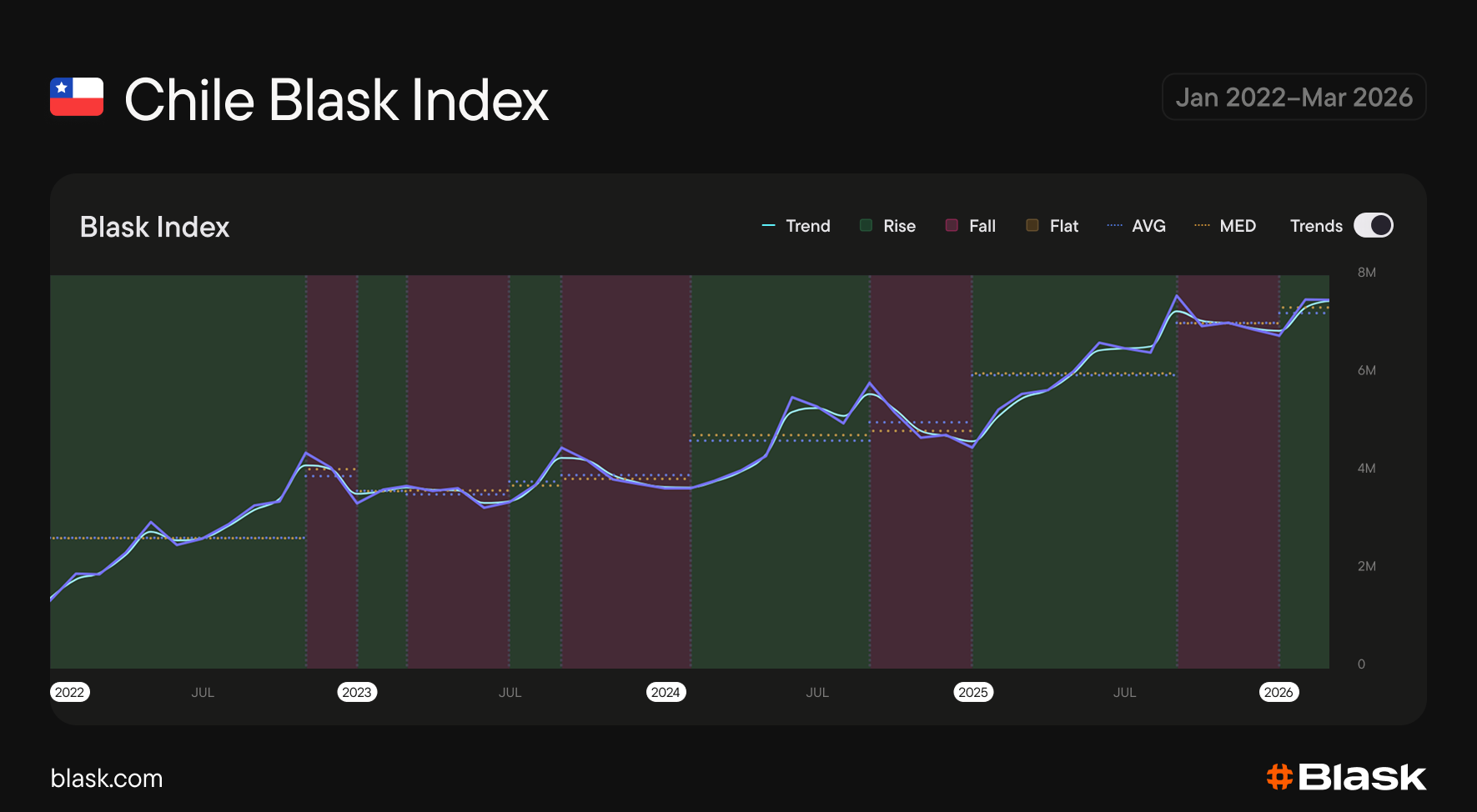
Demand for iGaming, measured by Blask Index, rose in Chile even more sharply — 5.4x from January 2022 to March 2026, and currently sits near its peak. The all-time high came in September 2025, during a busy football window — World Cup qualifiers against Brazil and Uruguay and the opening of the FIFA U-20 World Cup on home soil. February 2026 came close to that peak as the domestic football season restarted.
Most of the growth went to a few brands. The total number of tracked operators barely changed over four years — 146 now versus 136 in early 2022 — but market shares shifted dramatically.
Javier Cabrera, CMO at Juegalo.com, a Chilean online casino and sports betting operator, says the concentration follows a clear logic.
“A significant part of the growth has been captured by the players with the greatest visibility, investment and ability to consolidate. The expansion of the sector does not always translate into more brands with real competitive weight”.
Javier Cabrera CMO at Juegalo.com
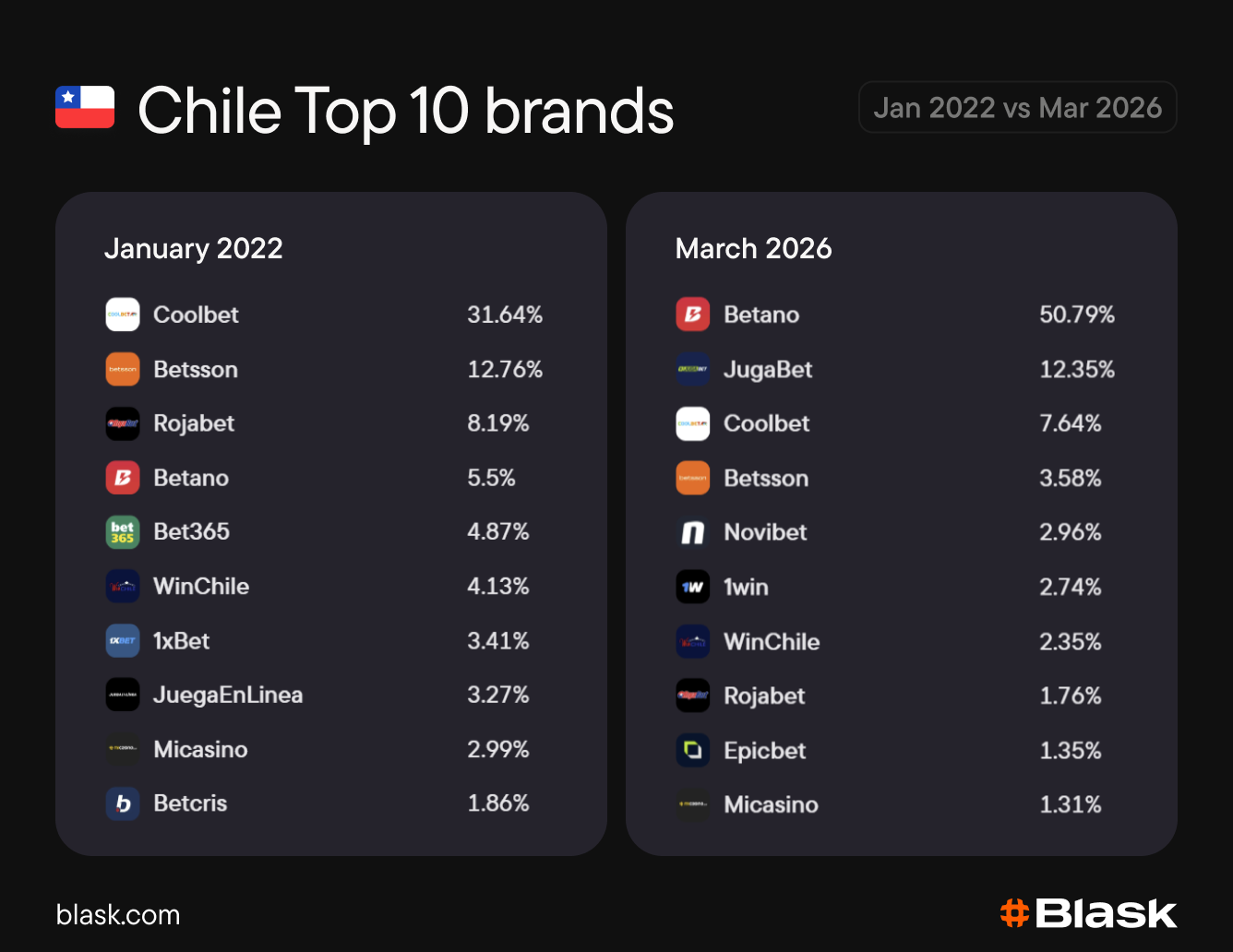
The market grew, but the audience consolidated around a handful of platforms. Javier Cabrera notes that the industry itself grew broader than the brand count suggests.
“Today the industry’s impact goes far beyond operators, reaching media, agencies, payment platforms, influencers and many other service providers. We have also seen progress in maturity, professionalization and greater visibility of practices linked to responsible gaming”.
Javier Cabrera CMO at Juegalo.com
Predictable audience
Chile’s iGaming market grew through a weak economy. According to the Central Bank of Chile, the country’s GDP growth slowed after 2022 and only recovered gradually. In 2025, Chile’s GDP was about 6.1% higher than in 2022. 94% of Chileans were already online in 2023, as per World Bank data. The market grew because they gambled more, not because more people got connected.
Blask’s customer profile data shows who these users are. 60% are 18–34. Half are employed, another 15% self-employed. Income is concentrated in the middle bands. Live casino is almost as popular as sports betting — and that matters for how operators think about growth.
Javier Cabrera says sports is a natural entry point, but casino is where the depth is.
“Sports bring together passion and familiarity — for someone just getting started, it tends to feel closer and simpler. But the real challenge is to support the user through a journey that evolves into a deeper relationship with the platform. Cross-sell between sportsbook and casino is not just a commercial opportunity — it is part of a broader strategy where user experience and segmentation play a key role”.
Javier Cabrera CMO at Juegalo.com
Users gamble for money first, but also for excitement and to break routine.
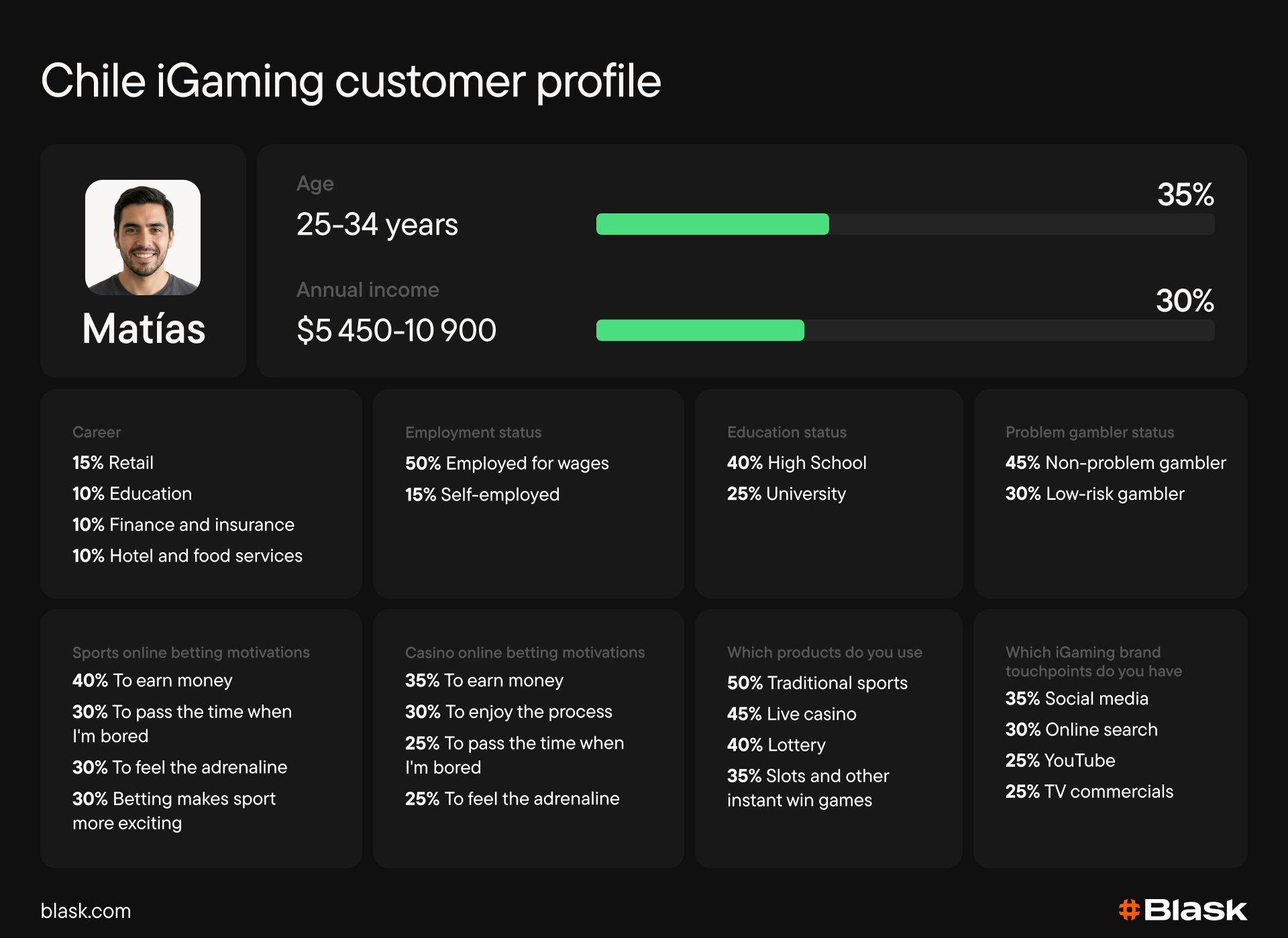
Most users discover brands through social media, search, YouTube and TV — not through recommendations from friends. That makes visibility expensive and gives an advantage to operators who can spend at scale. But visibility alone does not explain retention.
“Loyalty no longer depends on a single factor. Trust remains the foundation, but today it is just as important to offer a simple experience, seamless payments, a strong product and a differentiated value proposition. In a market as concentrated as Chile, loyalty is built through the consistency of the brand experience”.
Javier Cabrera CMO at Juegalo.com
Bottom line
Chile’s iGaming market exceeded $1B in CEB and keeps growing. Demand is concentrated around a few platforms, but the operators competing for it say the game is more complex than scale alone. Sports drives acquisition, casino drives depth, and user retention depends on the full experience.
Regulation would give this market a framework for player safety, responsible gambling standards, and clear rules for operators — on top of the economic benefits of tax collection and licensed competition.