

- Updated:
- Published:
Prediction markets: Polymarket’s monopoly, Kalshi’s niche

Blask BAP data across five Anglophone markets reveals a two-player category — and the second player only competes in two of them.
Prediction markets have been one of the more discussed formats in iGaming and fintech over the past two years. The underlying question — can users bet on real-world outcomes through a regulated or semi-regulated platform — has attracted dozens of operators. Blask’s BAP data across five markets gives a cleaner answer than most commentary: who entered the category before it became mainstream, are the leaders now.
The five markets covered are the United States, Canada, the United Kingdom, Australia, and Ireland. All share a language, a common-law regulatory tradition, and varying degrees of familiarity with both traditional iGaming and fintech-adjacent financial products.
Polymarket’s position is near-monopoly in three markets and dominant in two
In every tracked market, Polymarket holds the #1 position by BAP.
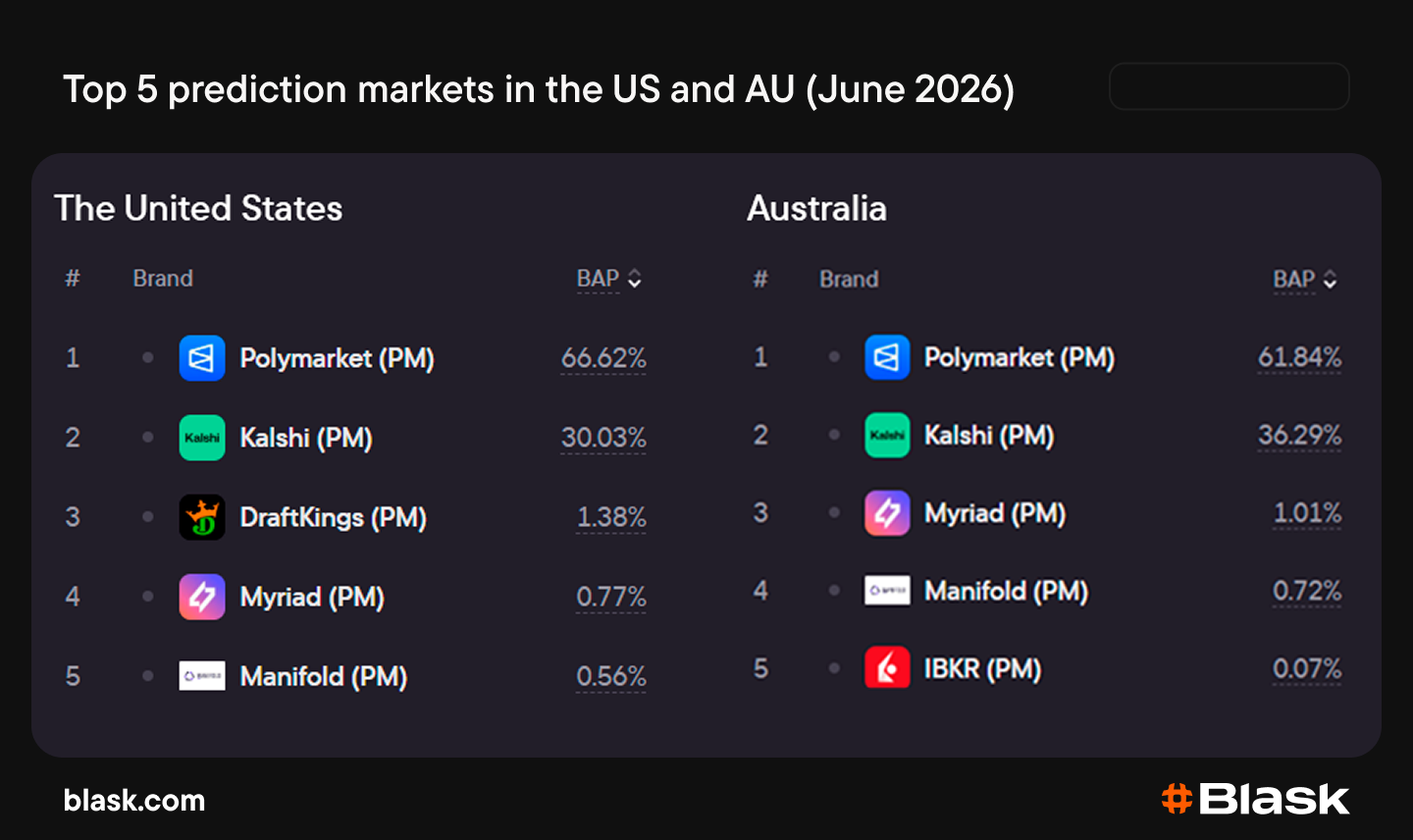
The 65-67% readings in the United States and Australia are the weakest positions of Polymarket. These two GEOs are the only places where the data shows any competitive pressure, Kalshi has nearly 30% of the BAP here.
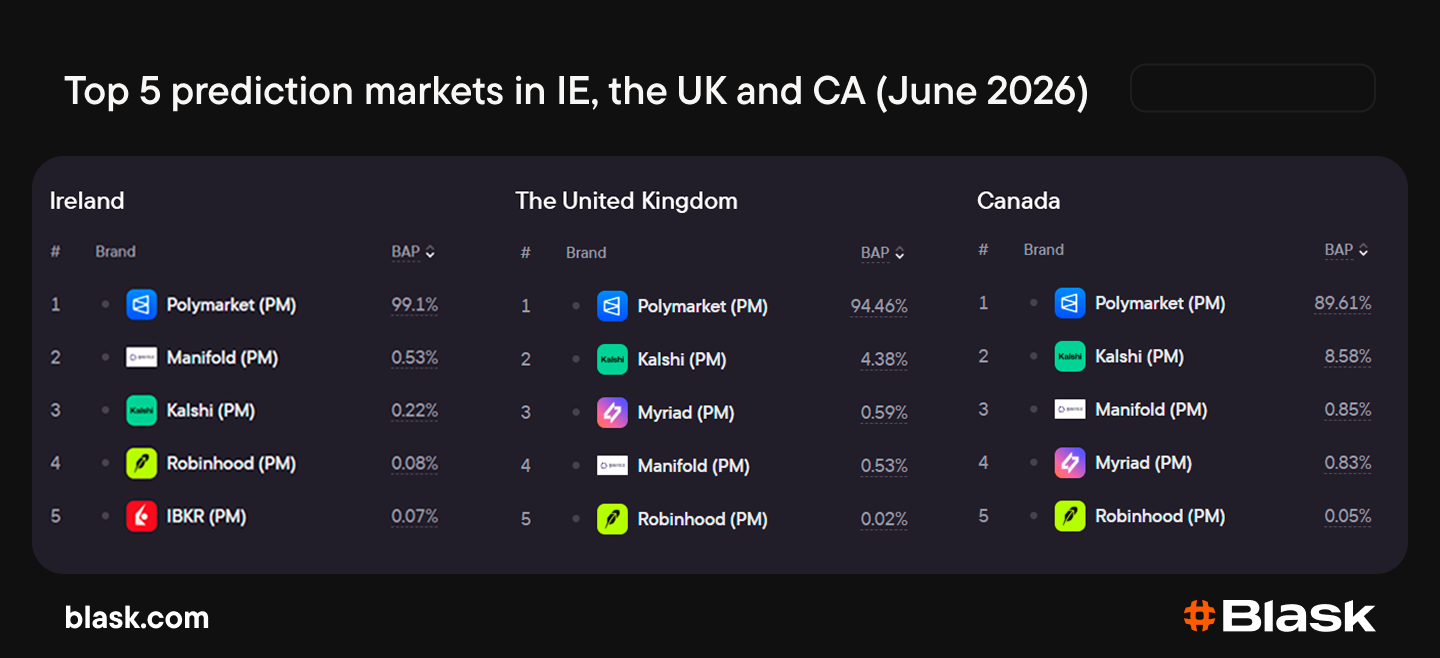
In three of the five markets — Ireland, Great Britain, and Canada — Polymarket almost reaches or even exceeds 90% BAP. It absorbed the category entirely.
Kalshi competes in two markets and barely exists in the other three
Kalshi is the clear #2 across all five markets.
In Ireland, Great Britain, and Australia it has the BAP from 4% to 8%. Kalshi demonstrates the best results in the United States (28.91%) and Australia (32.79%), having different legal status.
This brand’s relatively strong position (compared to other markets) in the US can be explained by CFTC approval. Kalshi received CFTC designation as a regulated prediction market in the United States and has built its commercial positioning around regulated financial product status. This identity resonates in the US market where regulatory legitimacy functions as a genuine acquisition signal.
The practical implication is a two-speed competitive map: USA and Australia have a functioning duopoly, with the top two platforms capturing more than 95% of BAP. Great Britain, Ireland, and Canada are effectively Polymarket monopolies where Kalshi captures a residual 4–8%.
Every other platform is rounding error
Below the top two, the data collapses. The highest BAP reading for any #3 platform across all five markets is DraftKings at 1.31% in the United States. That is the ceiling for every non-Polymarket, non-Kalshi player in the entire dataset.
DraftKings’ prediction market product ranked fourth in the US by BAP last month, a category leader in the most lucrative regulated iGaming market in the world. Its prediction market product has access to millions of existing users and substantial marketing infrastructure. However, it converts only into a 1.31% BAP share — and near-zero presence in every other market in the dataset.
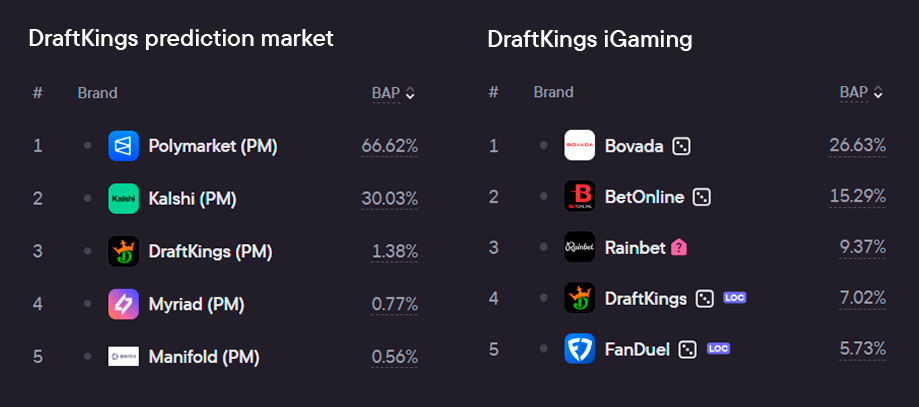
DraftKings PM vs Sportsbook brand
In every other market, #3 is held by Manifold (0.67–0.9%) or Myriad (0.63–1.13%). PredictIt — a platform with years of US regulatory history and established user base — holds 0.12% in its home market. Novig, Robinhood, IBKR, Opinion, Triad, and Hedgehog appear and disappear across the rankings, rarely exceeding 0.1% and frequently registering as less than 0.01%.
Bottom line
Polymarket holds a near-monopoly position in the prediction markets category — its weakest performance is still 67%. Kalshi is the only platform that generates meaningful competition, and only in two markets. In one of them it can be explained by its legal status. Now there are two open questions: whether Kalshi can extend its competitive position beyond the US and Australia and whether any other prediction brand can build a meaningful footprint.