

The Balogun scandal turned an elimination match into the tournament’s biggest pre-match story.
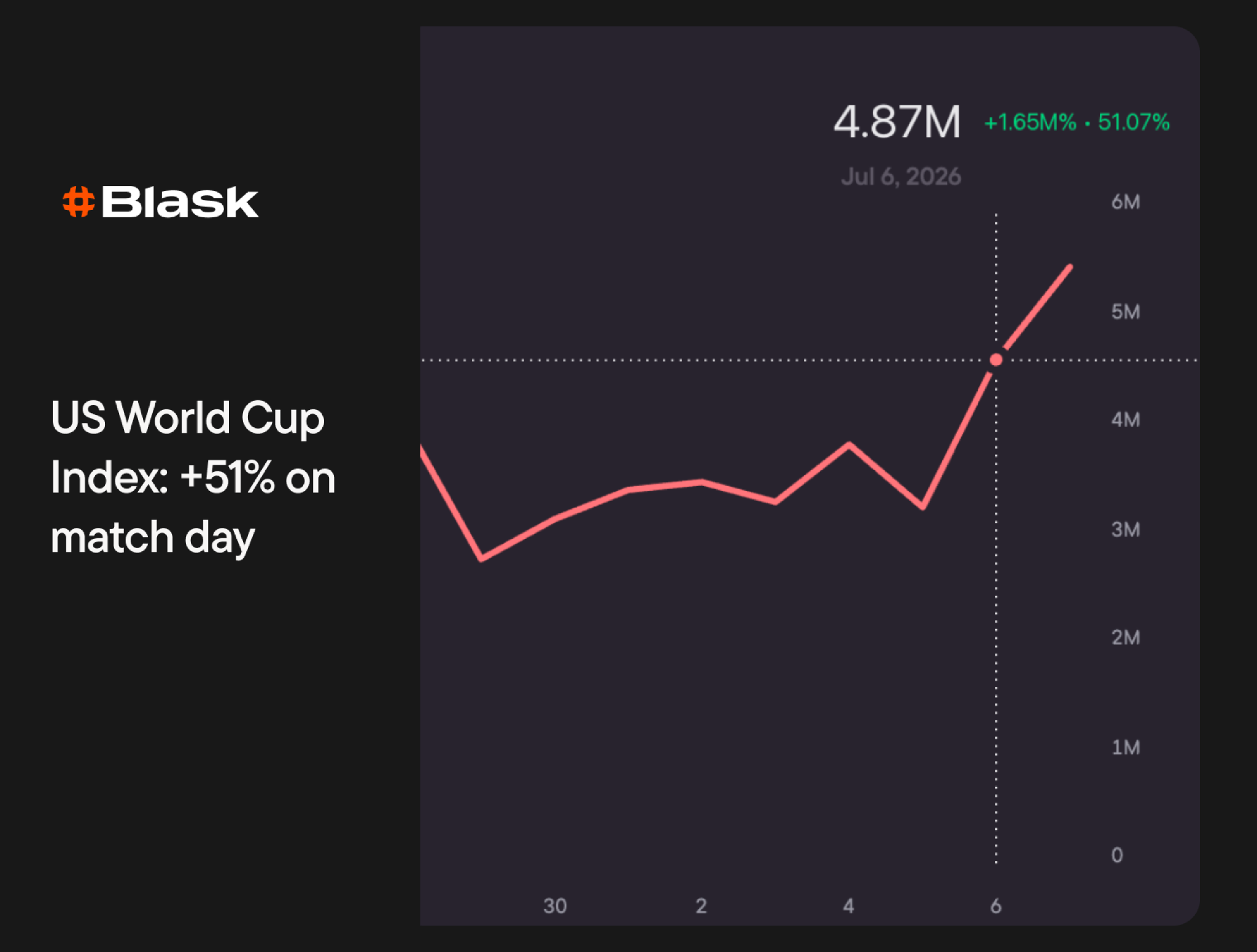
The US are out of the 2026 World Cup, beaten 4–1 by Belgium. But before a ball was kicked, the game had already become the most politically charged event of the tournament — and Blask data captures the market response: US World Cup Index jumped 51% on match day.
Trump, Balogun and FIFA’s disputed red-card loophole
Folarin Balogun received a red card in the previous match against Bosnia and Herzegovina, which automatically triggered a suspension for the following game. Under standard FIFA rules, he was due to miss the Belgium fixture — a significant blow, as Balogun is the US team’s starting centre-forward.
What followed was described by UEFA as “unprecedented”: Donald Trump personally called FIFA president Gianni Infantino to request a review of the disciplinary ruling. The red card itself was not overturned, but the ban was suspended — and Balogun took to the field.
The Belgian Football Association accused FIFA of contradicting its own regulations after Balogun was cleared to play. Technically, the ruling was legal: the governing body merely suspended the ban rather than cancelling the red card. But that is precisely what made it a scandal — the RBFA contends that a sending-off should automatically result in missing the next match, and Sepp Blatter publicly asked “Quo vadis, FIFA?” — where is the organisation heading if a standard punishment can be frozen mid-knockout-stage?
The decision may have been technically permissible under FIFA’s disciplinary procedures. What turned it into a scandal was its source: a sitting head of state intervening in a football disciplinary matter during a home World Cup.
US World Cup Index jumps 51% as Balogun controversy fuels pre-match demand
US World Cup Index peaked on match day — +51% from the previous day — even after Balogun was cleared to play. The surge was driven not by uncertainty over his participation, but by the intervention itself: a host nation, a president calling FIFA, and a striker whose status had become the tournament’s dominant pre-match narrative. The scandal drove player activity up before the first whistle — and its influence ended there.
On the pitch, Belgium quickly returned the story to football: they controlled the game, capitalised on American defensive errors and scored four. Balogun was not the decisive factor — the US won the disciplinary battle before kick-off and lost the footballing one convincingly on the night.
The pattern holds across the tournament: demand spikes track drama, national engagement and media tension more than results. The surges ahead of England–Ghana, Colombia–DR Congo and US–Belgium all confirm the same logic — the higher the attention around a game, the stronger the iGaming activity grows.