
Blask Index dynamics for the week ending 6 July maps almost exactly onto the Round of 32 and Round of 16 fixture schedule.
Blask Index recorded near-perfect alignment between the knockout-stage calendar and weekly audience activity. Seven of the ten national markets with the strongest week-on-week growth had their national teams competing at that stage of the tournament.
The paradoxes of player engagement
The central finding is that iGaming audiences respond to participation in a major event, not to the result. A painful national elimination often produced a stronger activity spike than a pragmatic progression.
Japan is the clearest example, recording the second-largest weekly gain globally, with Blask Index up +47.5%. The surge occurred during the match week itself, not in the days that followed, despite the squad being knocked out in the Round of 32. The market reacted to anticipation and real-time engagement, not to a winning outcome.
Germany’s Blask Index rose +24.3%, while Paraguay gained +20.9% after the two sides met in the same round, with the European side losing on penalties. Yet the German market still outgrew its opponent’s, and both countries simultaneously entered the global top 10 for Blask Index growth on the back of the same fixture.
France and Paraguay met again in the Round of 16 on 4 July, producing the same bilateral spike: France’s Blask Index rose +21.1%, while Paraguay gained +20.9%. Norway also entered the top-growth group, with Blask Index up +25.9% after Erling Haaland’s brace in a 2–1 win over Brazil. Ecuador and Switzerland both exited in the first knockout round, yet each generated a sharp local spike before the final whistle, with Blask Index up +19.1% in both markets.
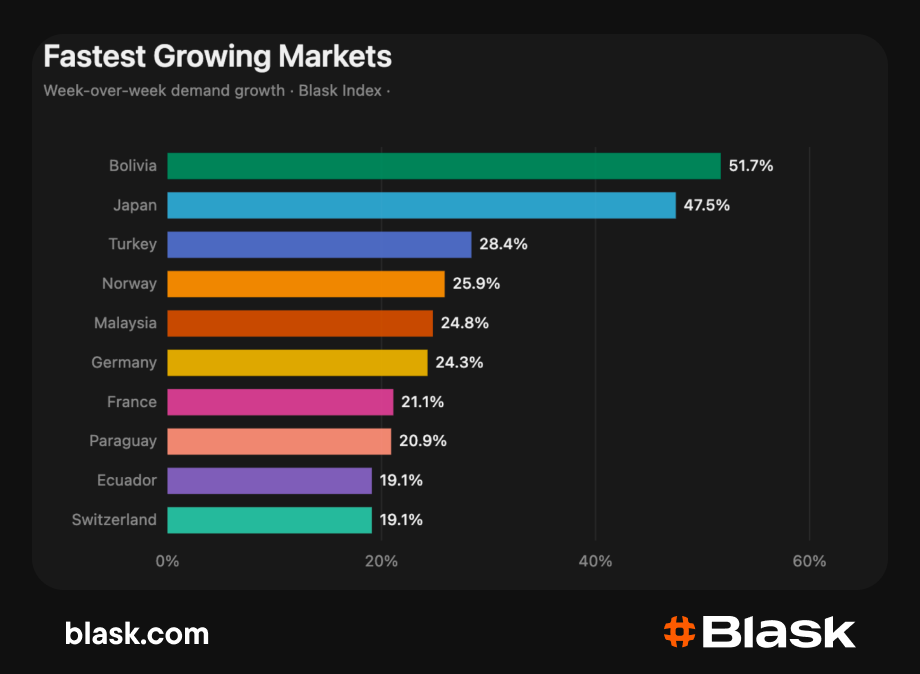
The pattern holds across the full dataset. In a week when global attention was fixed on knockout football, 70% of the largest iGaming demand spikes came from countries whose teams were competing.