

- Updated:
- Published:
US iGaming demand is falling fastest where it’s regulated

Blask data shows onshore operators lost user demand while the offshore segment held flat.
The regulated map in the US keeps expanding: Missouri launched legal online betting in December 2025, and Maine is preparing to open a licensed casino market. But demand is moving the other way. Over the last 12 months, user interest in US iGaming brands declined, and licensed operators absorbed nearly all of the drop.
The decline is concentrated in regulated states
User interest in iGaming brands in the US (measured by Blask Index) fell by 2.6% in the July 2025 – June 2026 period compared to a year ended in June 2025. On a country level the offshore segment was roughly stable (+0.9%), while interest in onshore operators dropped by 12.8%. The share of unregulated brands in the US Blask Index in the last 12 months rose by 2.6 percentage points, up to 77.6%.
Blask Index fell YoY in 27 states. Among them only 5 are the jurisdictions with no iGaming regulation (out of 19 such states). And not a single one of them sits in the bottom 10 ranks by YoY Blask Index change, with the worst, Oklahoma, placed 11th.
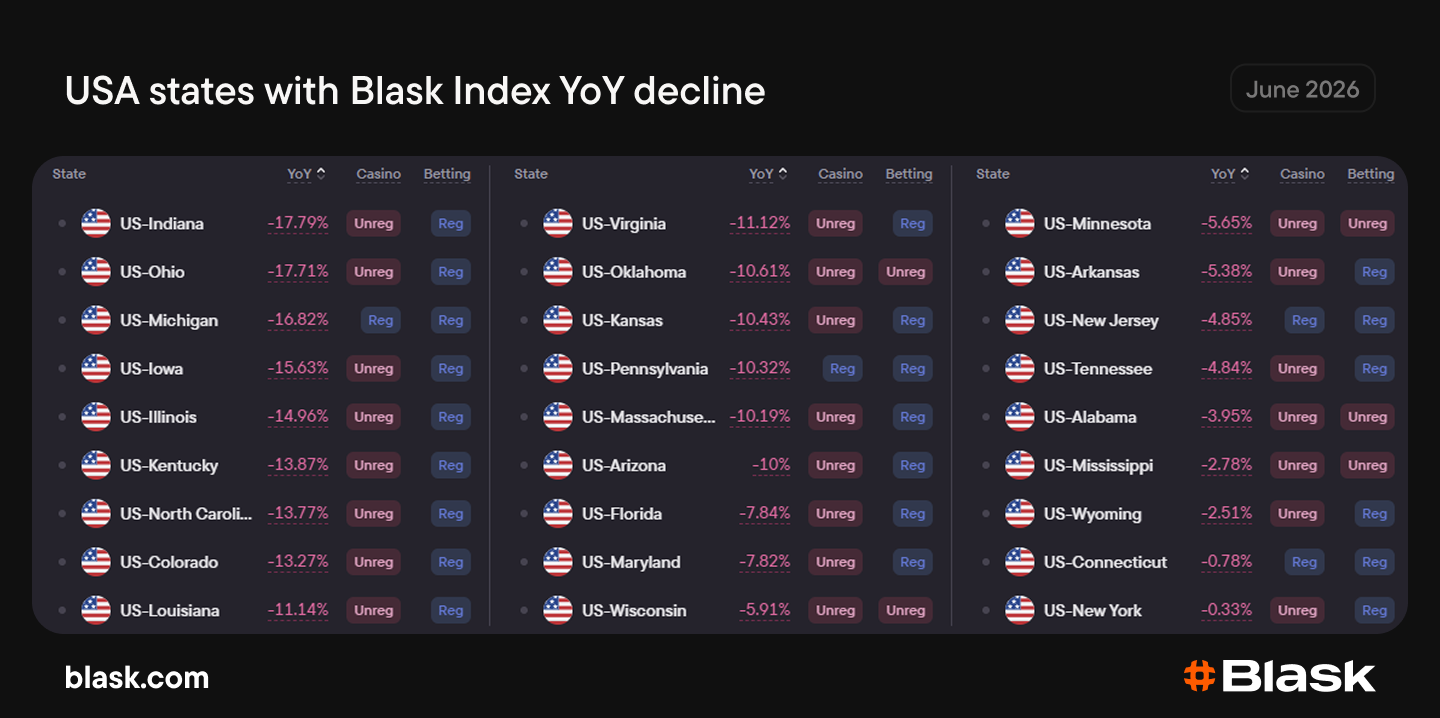
The biggest decline of iGaming demand was shown by Indiana and Ohio, which have only a regulated online betting vertical. The third worst is Michigan, which also regulates online casino.
Four of the seven full-regulation states lost demand
As of June 2026 there are 7 states with full iGaming regulation (an eighth, Maine is only preparing to launch a licensed online casino market). Among them, 4 registered YoY decline of Blask Index — besides Michigan, they are Pennsylvania, New Jersey and Connecticut.
In Michigan and Pennsylvania the decline was shown both by offshore and onshore segments. And only in the former the unregulated brands’ demand fell more than the same of the licensed operators.
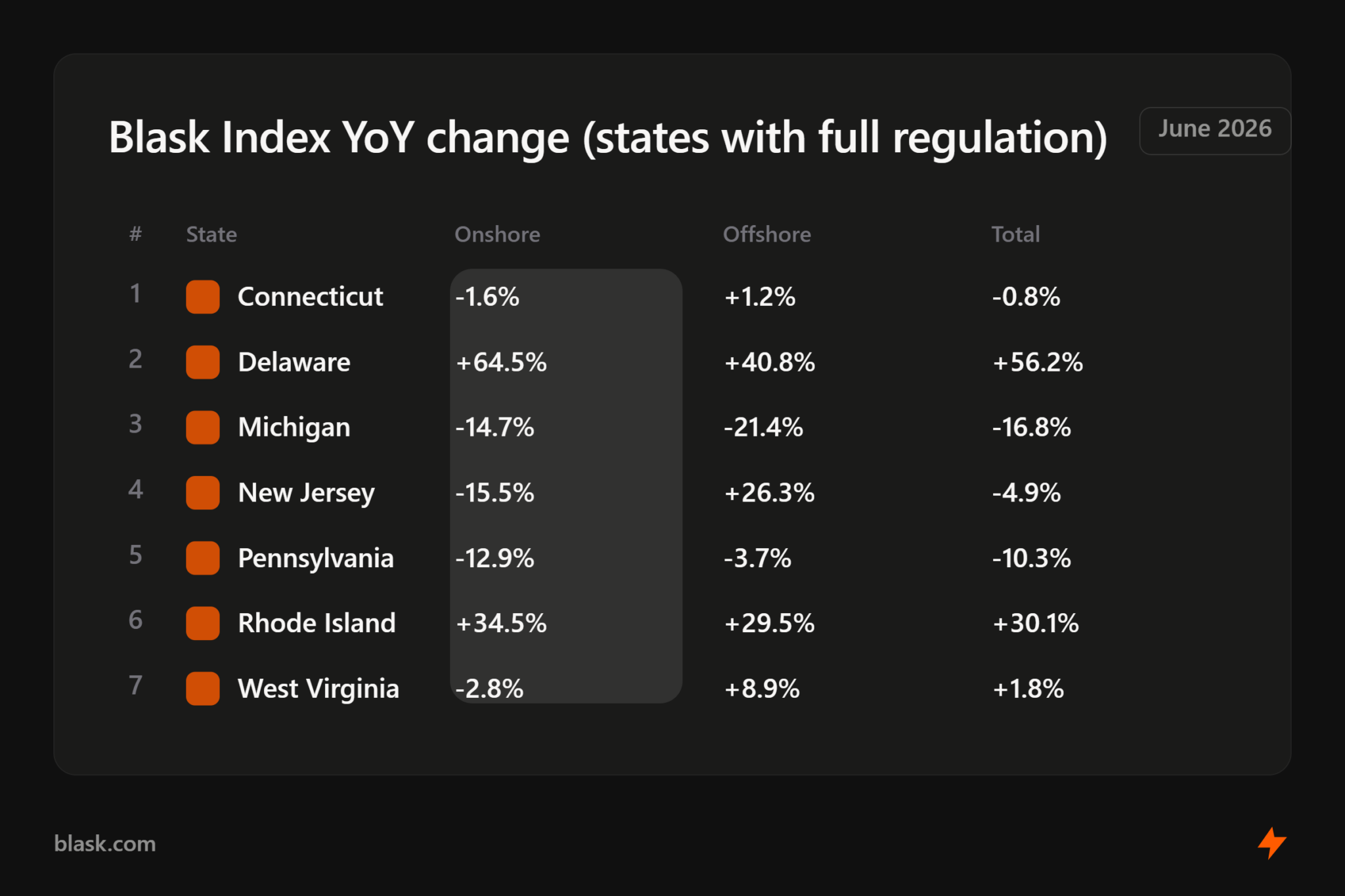
The decline of Blask Index in the onshore segment was registered in 5 out of 7 fully regulated states. The two exceptions are Delaware and Rhode Island, where both online casino and online sports betting operate through highly restricted, non-competitive models.
Betting-only states lost over a fifth of onshore demand
The aggregated Blask Index of 24 states, where only online betting is legal, declined by 8.2% YoY. While the offshore segment lost only 0.8% of the demand, the onshore brands’ Blask Index fell by 21.2%.
Only in 6 of those 24 states total Blask Index rose YoY. One of them is Missouri (+21.7%), which launched a legal online sports betting market just in December 2025. The other five are Vermont (+14.8%), Oregon (+10.2%), Maine (+9.5%), Nevada (+5.5%) and New Hampshire (+4.9%). In all of them the growth was driven by the offshore segment as it rose by 9-52% while onshore declined by 3-34%.
Moreover, the demand for licensed brands grew just in two states that regulate only online betting. In Wyoming Blask Index of licensed operators rose by 6.3% with the offshore segment declining by 4.3%. In Arkansas onshore brands posted 67% growth, with their unlicensed rivals losing 10.6%.
Besides these two jurisdictions, there was just one state with legal betting vertical only where regulated operators showed better Blask Index dynamics than offshore ones. It is Florida, whose total Blask Index declined by 7.8%. But licensed brands lost only 6.7% of the demand there, while the unregulated operators’ Blask Index fell by 8.1%.
Bottom line
On paper the US Blask Index barely shrank in the last 12 months, but the losses landed almost entirely on the licensed segment. Onshore demand fell in all but four of the 31 states that regulate iGaming in some form. Offshore brands held their ground and their share is growing.