
- Updated:
- Published:
Philippines iGaming consolidation: PlayTime leads after a 2,181% YoY surge

PAGCOR’s new Minimum Guaranteed Fee, $150K a month regardless of revenue, took effect June 1, 2026, and Blask data shows 24 of 48 licensed Philippine operators generated below the $500K monthly break-even floor in its first month. Arden Consult estimates 40 of 65 operators fall short of that level.
From 1 June 2026, PAGCOR required all licensed iGaming operators to pay a Minimum Guaranteed Fee — Php9M ($150K) per month regardless of actual revenue. The Philippines iGaming market 2026 break-even threshold is Php30M ($500K) per month.
MGF as a structural filter
The PAGCOR minimum guaranteed fee 2026 creates non-linear pressure on low-GGR operators. At that GGR level, the fee accounts for 30% of revenue. At half that volume, the same payment absorbs 60%. Arden Consult estimates around 40 of the 65 online casino operators fall short of that level. Each faces the same choice: grow quickly, find a buyer, or exit.
Blask data confirms the scale. In June 2026 — the fee’s first month in effect — 24 of the 48 licensed operators visible in Blask data generated below $500K in monthly CEB, the break-even floor. Nine of the top 32 licensed brands had already been running below that threshold on a 12-month average. Offshore operators — 68 of the Philippines top 100 brands by BAP — owe PAGCOR nothing.
Simultaneously, demand continues to shift from the unregulated to the licensed segment. PAGCOR estimates that offshore operators still account for around 60% of online gambling in the Philippines. Legal operators’ share of total online GGR grew from under 10% in 2022 to more than 50% by end of 2025, according to PAGCOR — a trajectory the MGF is designed to accelerate.
PlayTime holds the lead, Casino Plus closes the gap
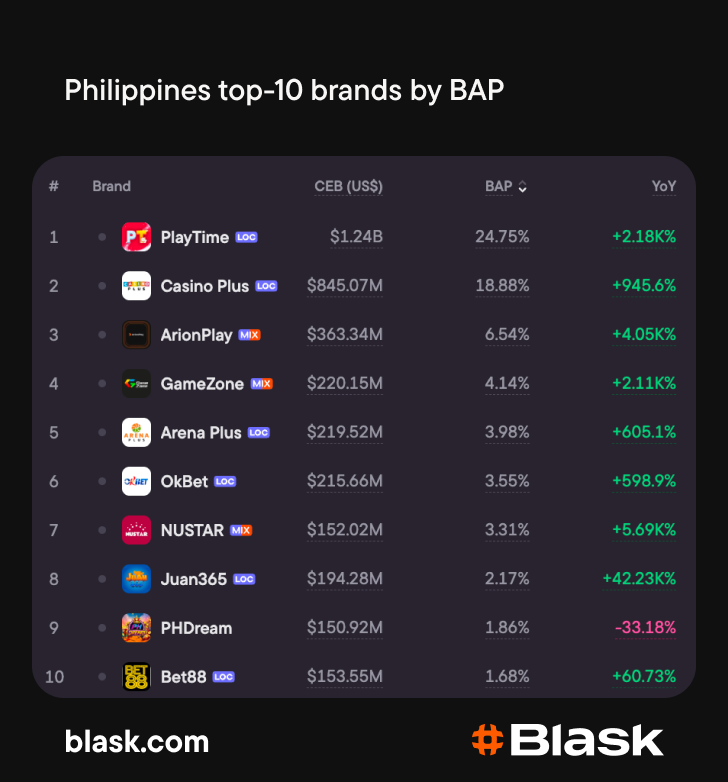
PlayTime, Philippines iGaming market leader by Blask data, is operated by Playmate Leisure Solutions Corp. under a local licence. Its BAP stands at 24.75% of total market share by demand — the largest of any individual operator.
A year ago PlayTime was tracking at mid-market levels; by June 2026 the brand was up 2,181% YoY and accounted for more than a quarter of aggregate demand. The Philippines remains its primary market, ahead of Saudi Arabia, the UAE and Qatar.
Casino Plus is also posting strong growth, up 945.6% YoY. Its expansion began in roughly the same period as PlayTime’s — the second half of 2025 — but PlayTime grew faster and has maintained the lead.
DigiPlus lost a quarter of its revenue — and first place in demand
DigiPlus Interactive Corp., parent company of BingoPlus, ArenaPlus and GameZone, reported first-quarter 2026 revenue of Php17.2B ($281M), down 25% YoY. Net income fell 33% to Php2.8B ($46M). The primary driver was the delinking of in-app e-wallet access from licensed gaming platforms, which disrupted transaction flows across the sector.
In Blask ranking, GameZone holds fifth place by BAP at 4.58%, and Arena Plus sixth at 4.26%. Together the two measurable DigiPlus brands account for around 8.9% of aggregate market BAP, compared with PlayTime’s 24.75% as a single brand. DigiPlus’s Php20.5B ($335M) cash position allows the group to absorb the new fees, while ArenaPlus strengthens its brand through a multi-year NBA partnership.
The next threshold — January 2027
The Philippines online casino consolidation will intensify when the second tranche of the MGF takes effect on 1 January 2027. Under the updated PAGCOR schedule, the GGR threshold for e-casino operators rises to Php35M ($580K) per month, with the minimum fee increasing to Php10.5M ($175K). Operators that are barely meeting the June floor face additional pressure two quarters from now.
FAQ
How much is PAGCOR’s new minimum fee for Philippine operators?
PAGCOR’s Minimum Guaranteed Fee, effective June 1, 2026, requires licensed operators to pay Php9M ($150K) a month regardless of actual revenue, with a break-even threshold of Php30M ($500K) in monthly GGR.
How many Philippine operators are at risk from the new fee?
Arden Consult estimates around 40 of the Philippines’ 65 online casino operators fall short of the Php30M break-even level. Blask found 24 of 48 licensed brands generated below $500K in monthly CEB during June 2026, the fee’s first month.
Which brand leads the Philippines iGaming market?
PlayTime, operated by Playmate Leisure Solutions Corp., leads with 24.75% BAP as of June 2026, up 2,181% year over year. Casino Plus follows with similarly strong growth of 945.6% YoY, though PlayTime maintains the lead.
How much of Philippine online gambling is still offshore?
PAGCOR estimates offshore operators account for around 60% of online gambling in the Philippines. Legal operators’ share of total online GGR grew from under 10% in 2022 to more than 50% by the end of 2025, a shift the new fee is designed to accelerate.