- Updated:
- Published:
What a retention manager is
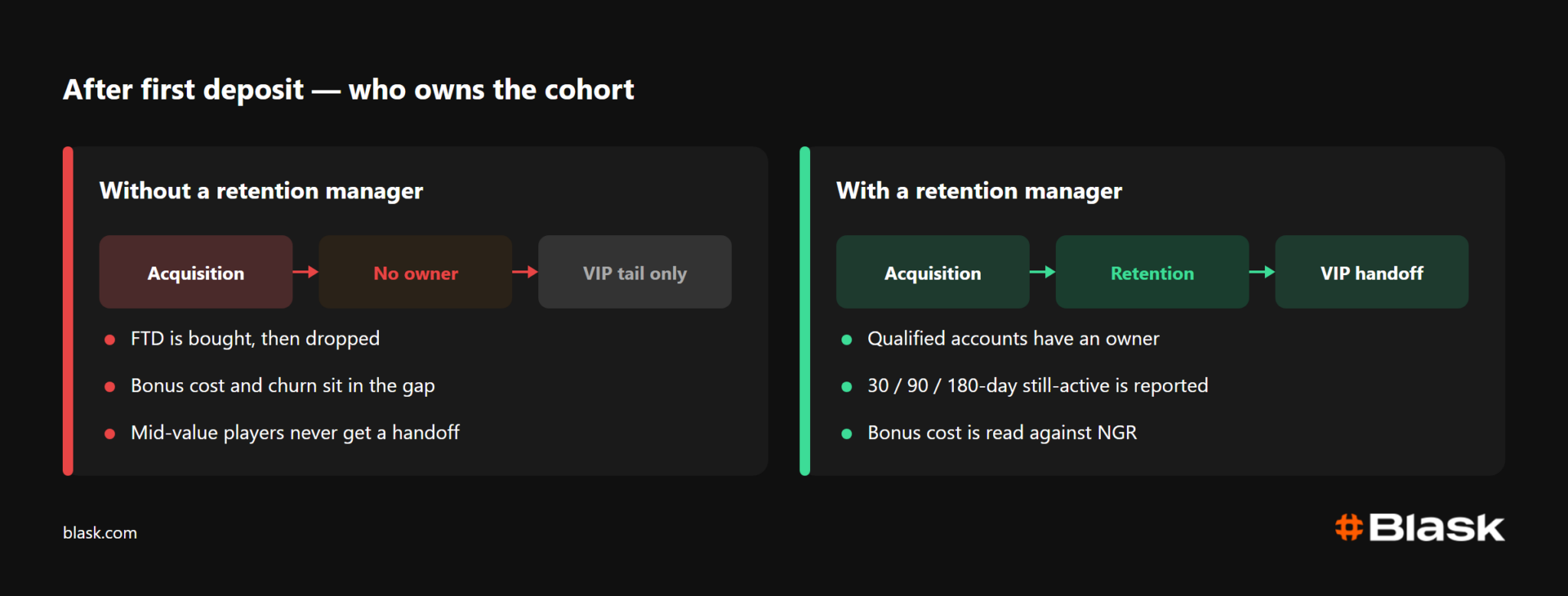
A retention manager is the operator employee who owns what happens after a player’s first qualifying deposit: who stays active, who is offered what, and how those cohorts are reported. The job sits with the player base, not with media buying and not with B2B account management at a supplier.
The commercial reason the role exists is simple arithmetic. A first-time deposit already has an acquisition cost attached. Every extra month that cohort still plays is revenue against a cost that has already been paid.
If nobody owns the post-deposit window, bonus cost and churn both sit in the gap between marketing and VIP.
Titles drift. Some operators print CRM manager on a job that is this role. Some print lifecycle marketing. The useful test is the object of the work.
💡 Key point: if the person is accountable for post-deposit cohorts, bonus cost against those cohorts, and the handoff into VIP, it is a retention role whatever the vacancy said.
Where the role sits
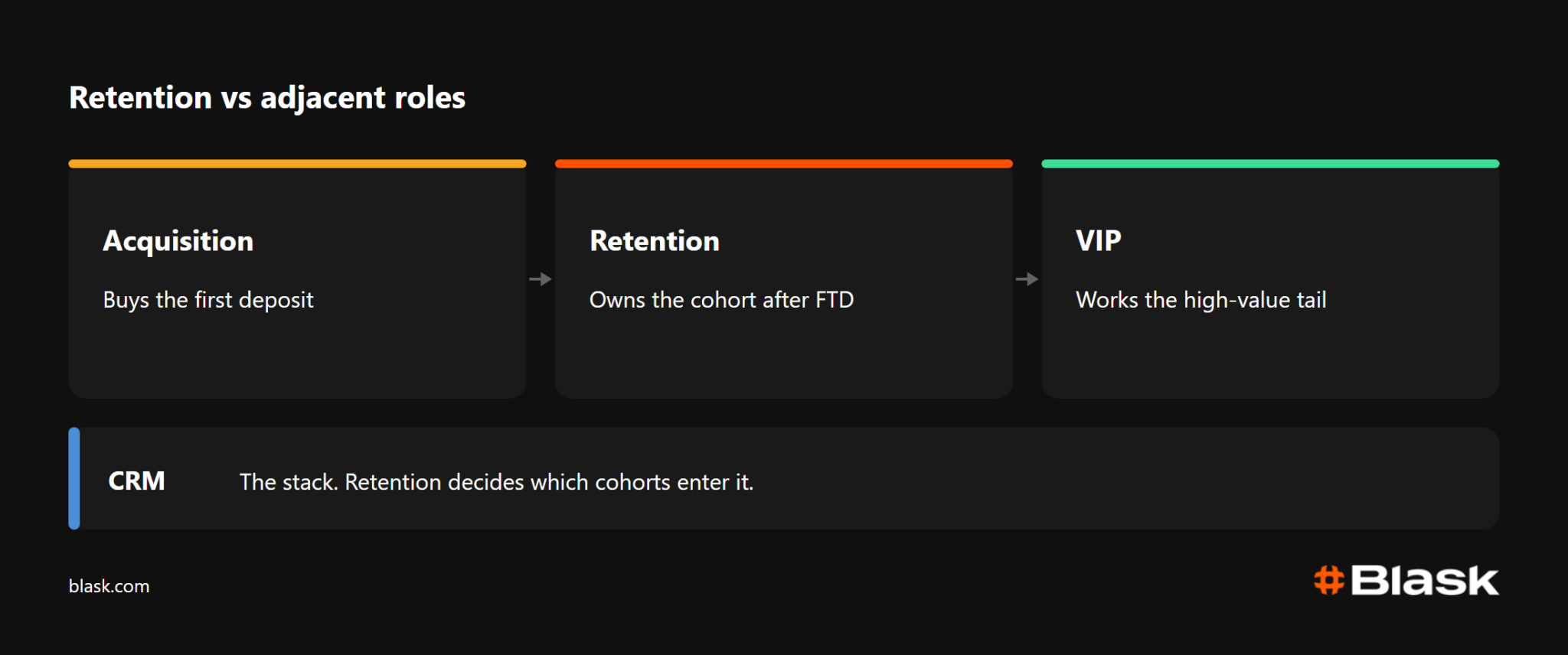
Acquisition teams buy first-time deposits. The retention manager inherits the accounts that cleared qualification and reports on whether those cohorts still play at 30, 90 and 180 days — the same windows that player LTV uses.
📚 Read more: How to calculate player LTV in iGaming: formula, benchmarks and what operators get wrong
CRM is the stack: journeys, suppressions, deliverability, the bonus engine connection. A CRM manager, where the title is distinct, keeps that stack running. A retention manager decides which cohorts enter which journeys and how the commercial result is read.
📚 Read more: What is CRM in iGaming?
A VIP manager takes the high-value tail on a one-to-one basis. Retention defines the threshold and works the mid-value base that has not crossed it.
📚 Read more: What is a VIP Manager in iGaming
What the work actually is
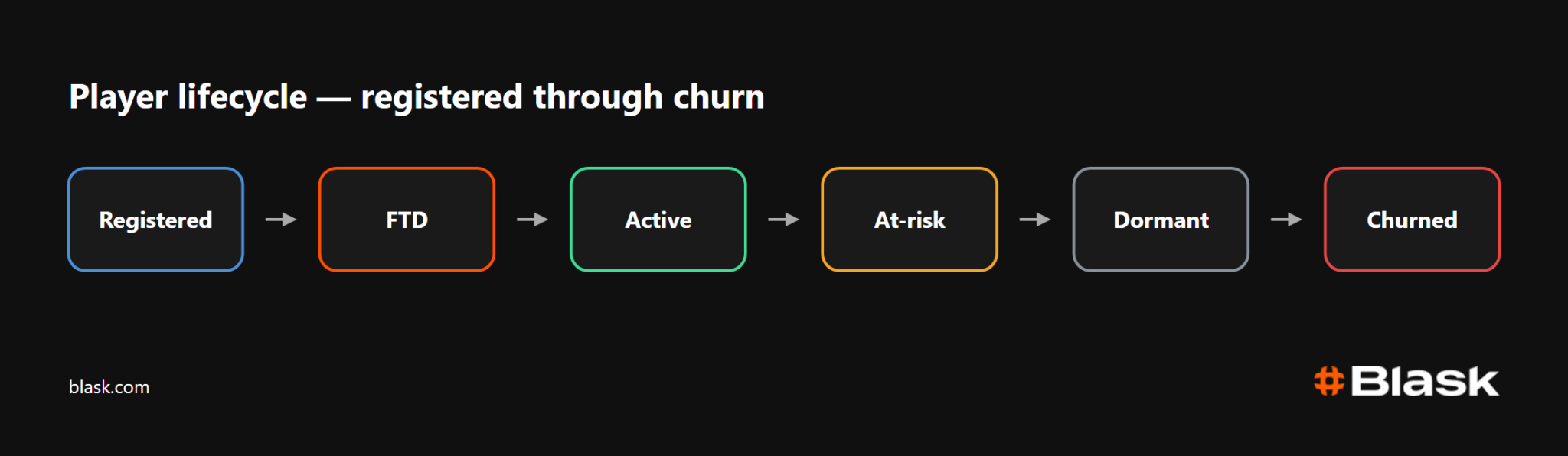
The base is split by behaviour — newly deposited, active, at-risk, dormant — using deposit frequency, product mix and recency, not a single average user. Campaigns are then tied to those stages: inactivity after first deposit, a sports calendar, a game launch.
Bonus cost is part of the job because an extra reload can raise activity and still leave net gaming revenue worse. Holdout groups are how that trade-off is observed. Open rate is not.
Responsible-gambling suppressions belong in the same journeys. A self-excluded or financially flagged account is not a reactivation target. In Great Britain that logic now sits next to financial vulnerability and financial risk tools described on Blask’s affordability check page.
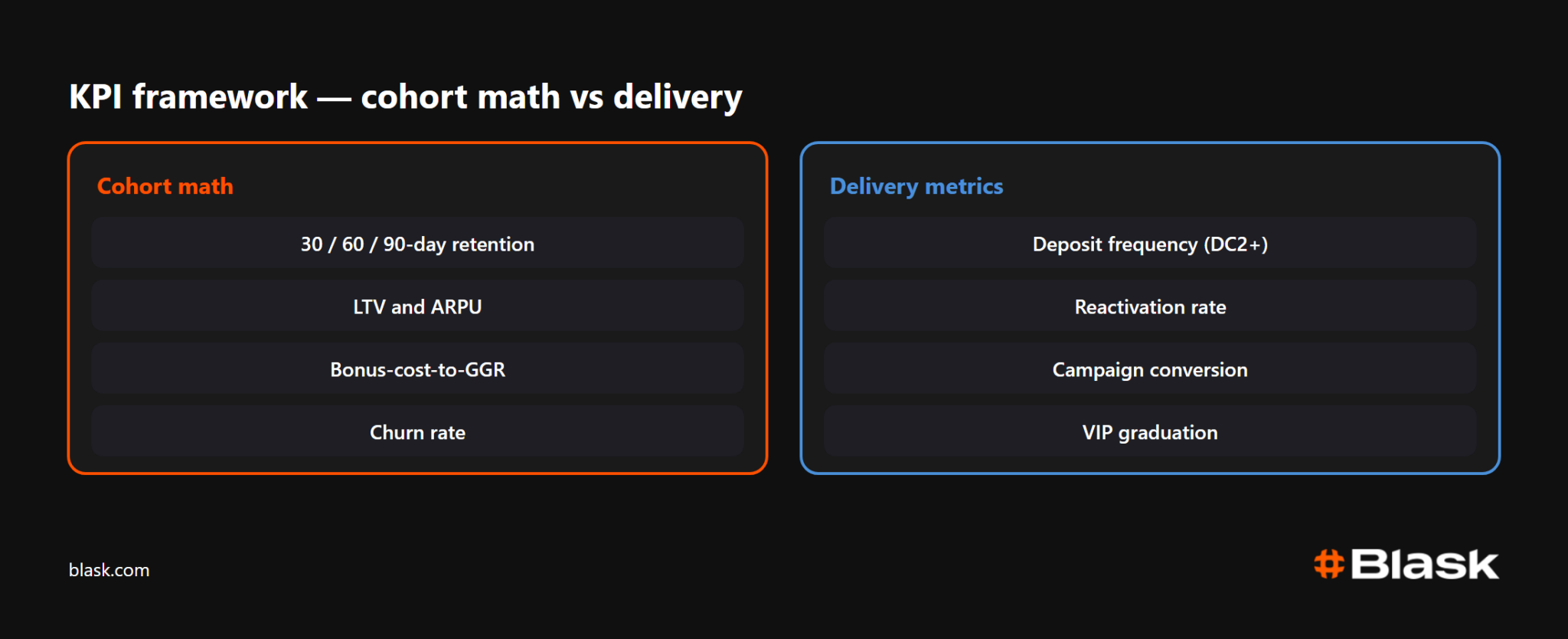
The reporting language for the role is cohort math:
- 30 / 90 / 180-day still-active rates
- deposit frequency after FTD
- bonus cost against NGR for the same cohort
- reactivation of dormant accounts
- the share of mid-value players who later meet a VIP threshold
Delivery metrics (opens, clicks) describe the channel. They do not describe whether the cohort paid.
What the role is not
- It is not performance marketing. Spend on media and affiliate CPA is a different budget and a different funnel stage.
- It is not customer support, even though support tickets are a useful churn signal.
- It is not a supplier “retention” job that means keeping operator clients from churning a platform contract.
Smaller operators often merge retention and CRM in one hire. That is a headcount fact, not a third definition. The work is still post-deposit cohorts plus the stack that sends the messages.
Confusion starts when the vacancy lists “CRM Manager”, the interview is about Mailchimp, and the bonus P&L still has no owner.
FAQ
What is a retention manager in iGaming?
The person accountable for post-deposit player cohorts, their campaigns and the commercial read of those cohorts.
Is a retention manager the same as a CRM manager?
Often in smaller operators. Where the titles split, CRM leans platform and retention leans cohort outcomes.
How is the role different from a VIP manager?
VIP is high-touch on the top of the value distribution. Retention covers the rest of the active base and the path up to that line.