
- Updated:
- Published:
Behind the US Maturity Index: a lottery demand domination with seven exceptions

Blask data shows what powers the world’s most category-driven iGaming market.
The United States is the only country where general gambling demand outweighs the branded iGaming interest. The leading category is Lottery. It accounts for the most unbranded demand in 43 states — including one where lottery is prohibited. In the other seven, the most popular categories are Online Betting, Fantasy and Live Dealer Online Casino.
Maturity Index is one of the latest Blask features. The metric is the ratio between two demand layers Blask tracks: brand-level search demand, measured by Blask Index, and generic category-level demand, measured by Categories Blask Index.
The Maturity Index compares total category-level demand against total brand-level demand within a GEO and maps the result to a scale of 0 to 100 — 0 means all brand search, 100 means all category search, 50 is an equal split. As of April 30, 2026, the feature is available for 57 of the 126 countries Blask currently tracks. Read more →
Where unbranded search wins
The US Maturity Index reached 70.3 in March 2026. Over the last twelve months (April 2025 – March 2026) it ranged from 65.9 in October to 74.2 in August. That makes the US the only country where unbranded gambling demand is higher than demand for online casino and online sports betting brands.
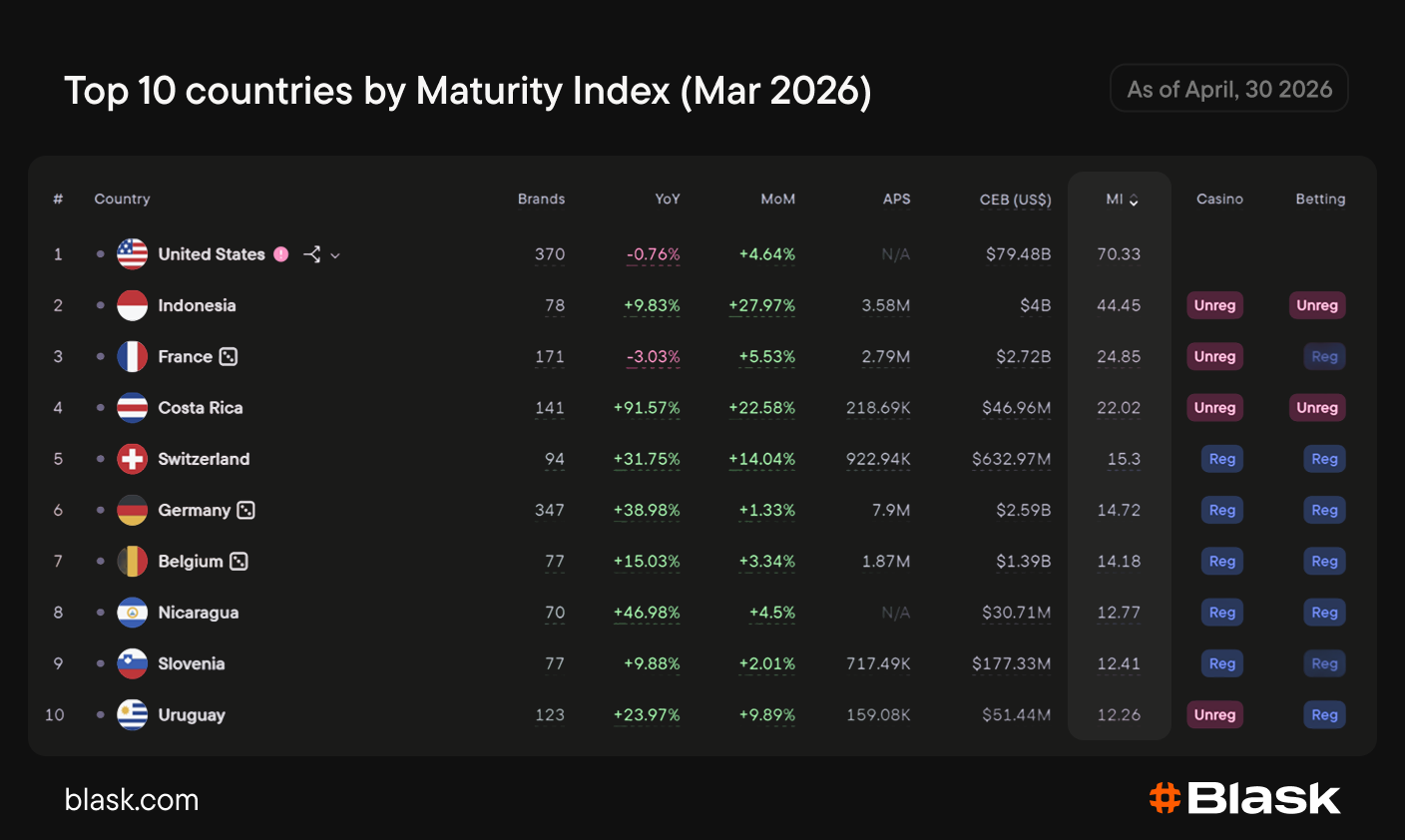
At the state level, 31 of the 50 states have a Maturity Index above 50. Eighteen of them are above the country average, with Maryland and Massachusetts at the top.
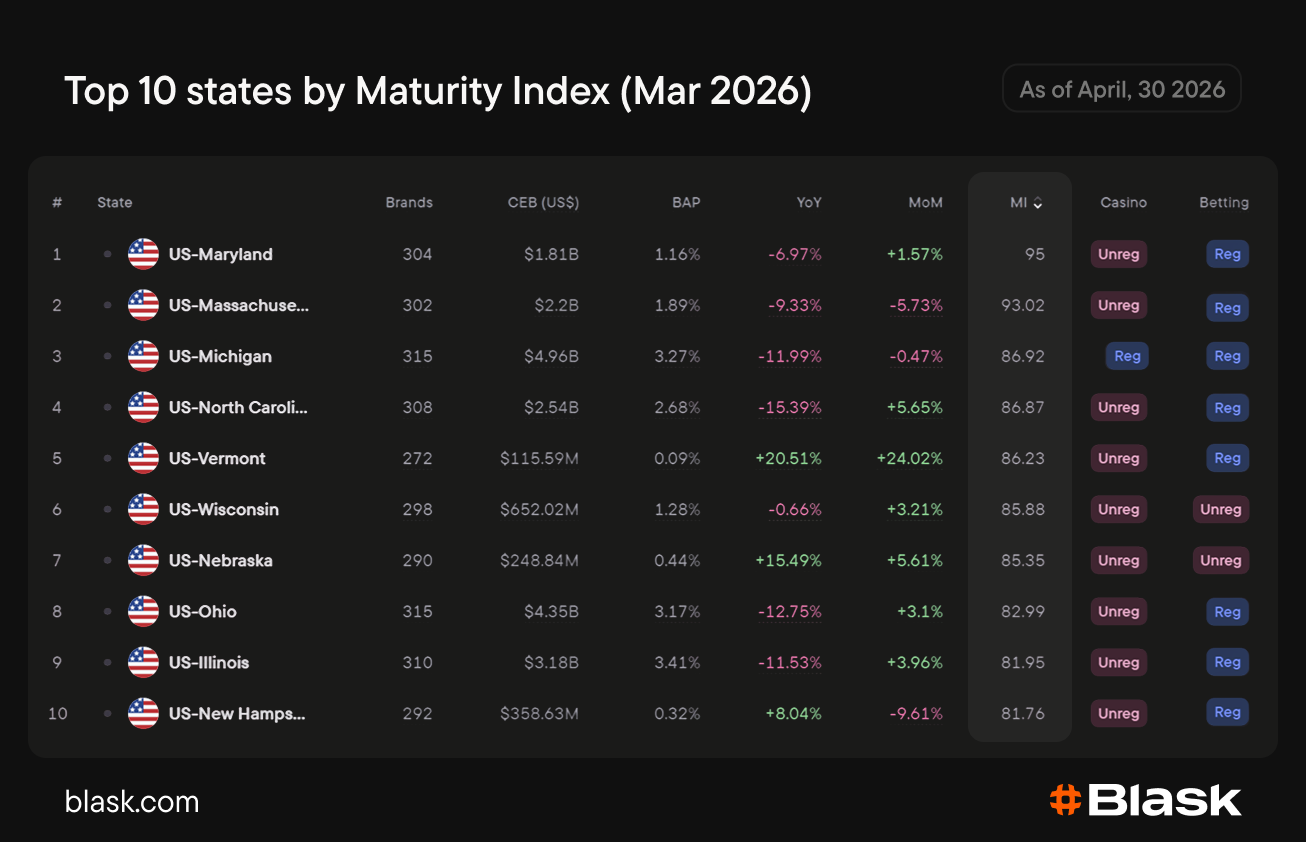
The states with a high Maturity Index are a complete mix of regulatory environments. Among the top ten, Michigan regulates both online casino and online sports betting. Seven states regulate betting only, two do not regulate iGaming at all. But they all still do have one thing in common — the leading category, which helps unbranded demand outweigh the branded.
Lottery dominates
Lottery is the dominant category in the US. Over the last twelve months it accounted for 82.8% of unbranded demand on average. It was the leading category in 43 states, and in 34 of them it accounted for over 50% of unbranded demand.
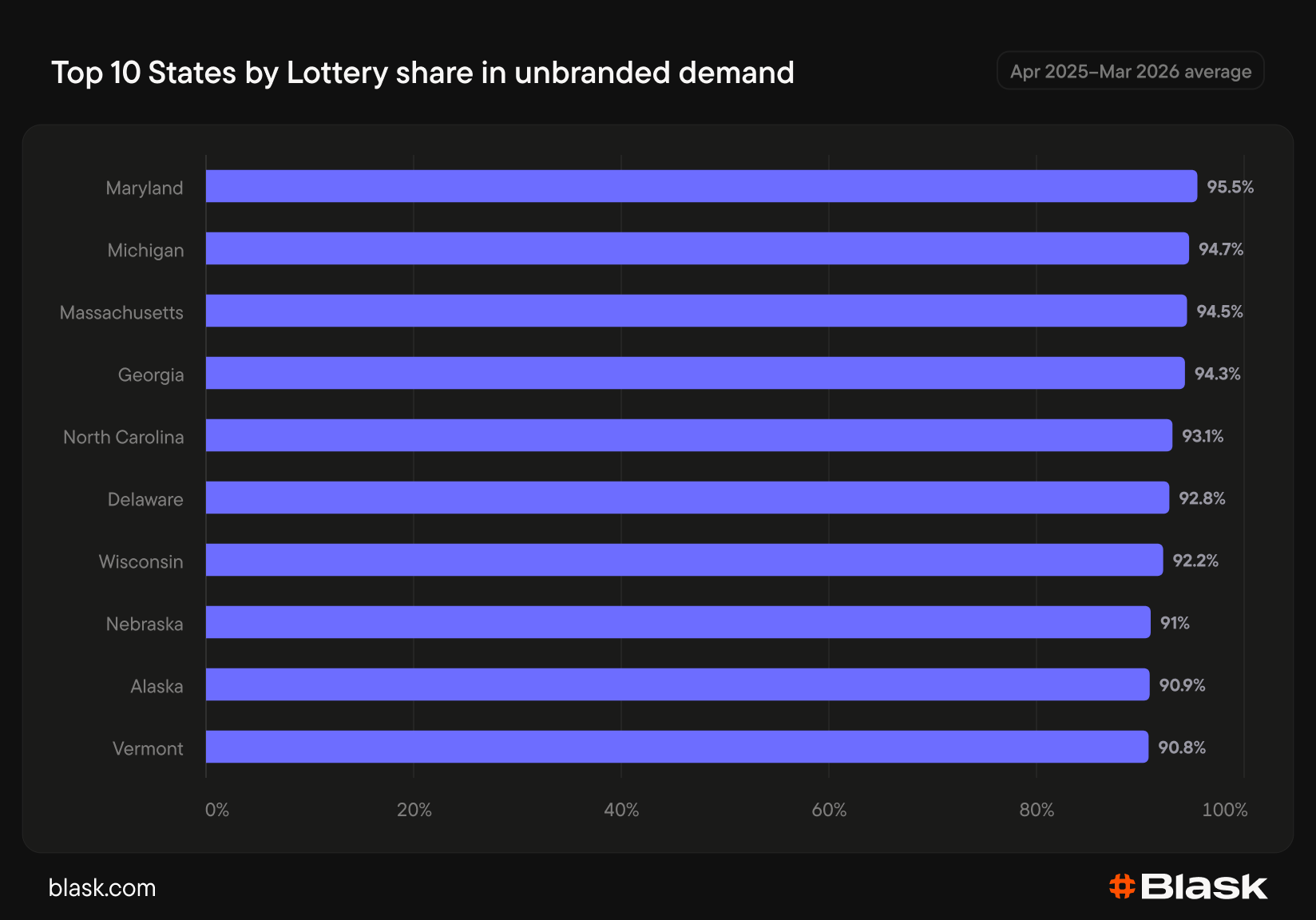
Surprisingly, one of the top ten states by lottery share is Alaska, although lottery there is prohibited. The state’s only lottery-style product is the PFD Education Raffle, a charity scheme tied to the Permanent Fund Dividend. Residents can donate part of their PFD in $100 increments, with each $100 buying one raffle entry. That does not make Alaska a lottery state, but it shows that lottery-related search demand can be significant even where a standard state lottery does not operate.
No other state where the lottery is prohibited has it as the leading category.
The seven exceptions
Besides Alaska, there are only four states where the lottery is prohibited — Alabama, Hawaii, Nevada and Utah. In all of them the lottery demand exists, but its share in the last twelve months was very low: 11.5% in Alabama, 8.2% in Utah, 7.8% in Nevada and 4.4% in Hawaii. In three of these states the leading category was Online Betting, while in Utah it was Fantasy.
Fantasy also led unbranded demand in Idaho and Texas. And Oregon was the only state where Live Dealer Online Casino was the leading category.
All seven states where Lottery was not the leader had Maturity Index below 50. That means no category other than Lottery lifts unbranded demand high enough to outweigh branded interest in any state.
Bottom line
Blask’s new feature reveals another proof that the US iGaming market is unique. The country is the only one where unbranded gambling demand outweighs branded interest. Lottery is the reason — strong enough to lead even in Alaska, where the product is prohibited. In the seven states where the lottery is not the leader, the unbranded demand does not outweigh the branded interest.