
- Updated:
- Published:
Top casino games in Peru 2026: Mines holds 26% of demand

Mines (Hacksaw Gaming) is the top casino game in Peru by share of interest, with 25.6% of measurable demand in June 2026. It has led every month since February 2026. Pragmatic Play owns catalog depth and Visibility among the top casino games in Peru; crash and live titles punch above their shelf weight on search.
Blask Games tracks about 6 300 titles across 162 brands serving Peru. MINCETUR licenses casino and sports betting, so the shelf Blask reads here is the regulated online market. That shelf is slot-heavy and Pragmatic-led at catalog level. Player attention is not. The split between a franchise-stocked lobby and a Mines-led search table is what makes this market worth reading up close.
Blask game metrics overview
Visibility — Shows how likely players will see a game in a given market (0–100%), based on which operators feature it and at what positions.
SoI (Share of Interest) — a search-based metric that shows how much player attention each game captures within a market, expressed as a percentage of total casino game interest.
Peru casino shelf July 2026: slots at 83%, Pragmatic far ahead
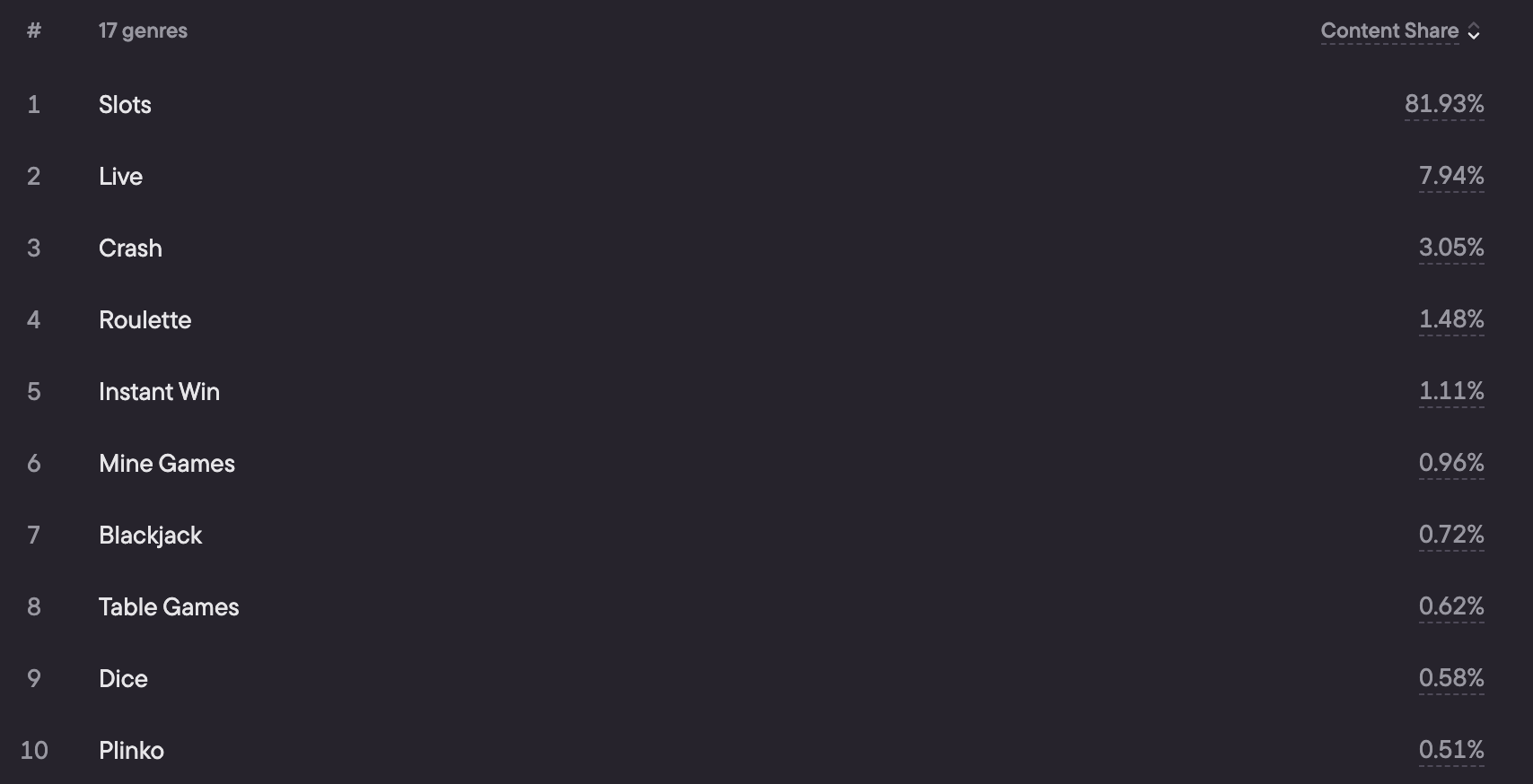
Slots account for about four in every five titles on the Peruvian catalog (83%). Live sits a distant second. Crash, Roulette, and Instant Win fill the next band; Mine Games, Blackjack, Dice, and Table Games stay under 1% each. Operators use slots for catalog depth and the non-slot layer for session variety, not for volume.
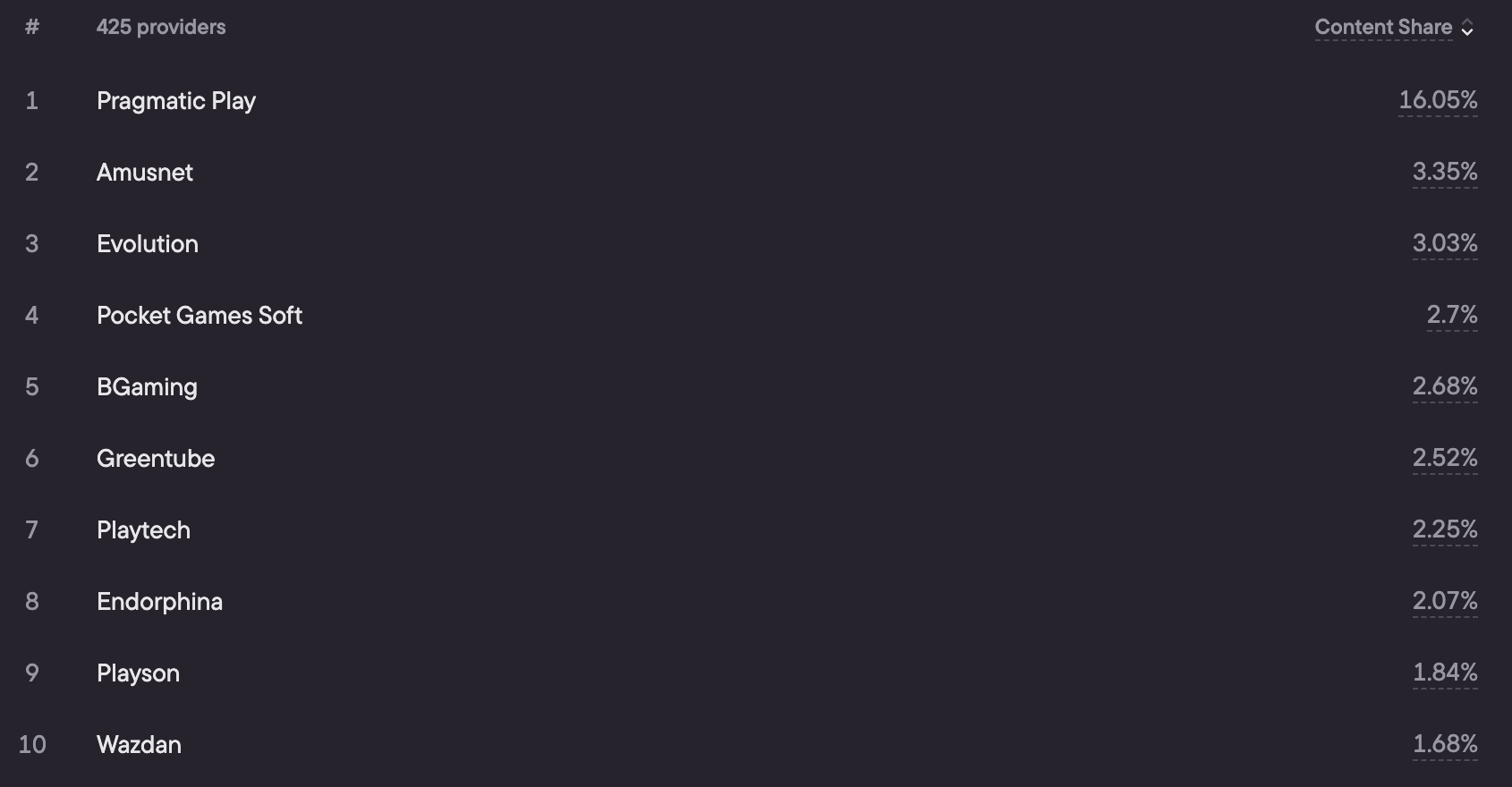
On the provider side, Pragmatic Play leads content share by a wide gap over Amusnet, Evolution, BGaming, and Pocket Games Soft. Positions two through five sit within a point of each other; below that the field fragments across more than 400 suppliers. Hacksaw Gaming, whose Mines title owns demand, sits outside the content-share top five. Visibility and SoI show next whether that depth converts into placement and search.
Aviator leads brand coverage; Pragmatic takes 14 of the top 20
Aviator (Spribe) leads brand presence as the single most-stocked title. Behind it, Pragmatic Play takes fourteen of the top twenty most-carried rows: the Gates of Olympus family, Sugar Rush and Sweet Bonanza lines, Spaceman and High Flyer on crash, Sweet Bonanza CandyLand and Money Time on live, plus the localized Peru Candyland. Evolution’s Crazy Time and InOut’s Chicken Road 2.0 join that non-slot group.
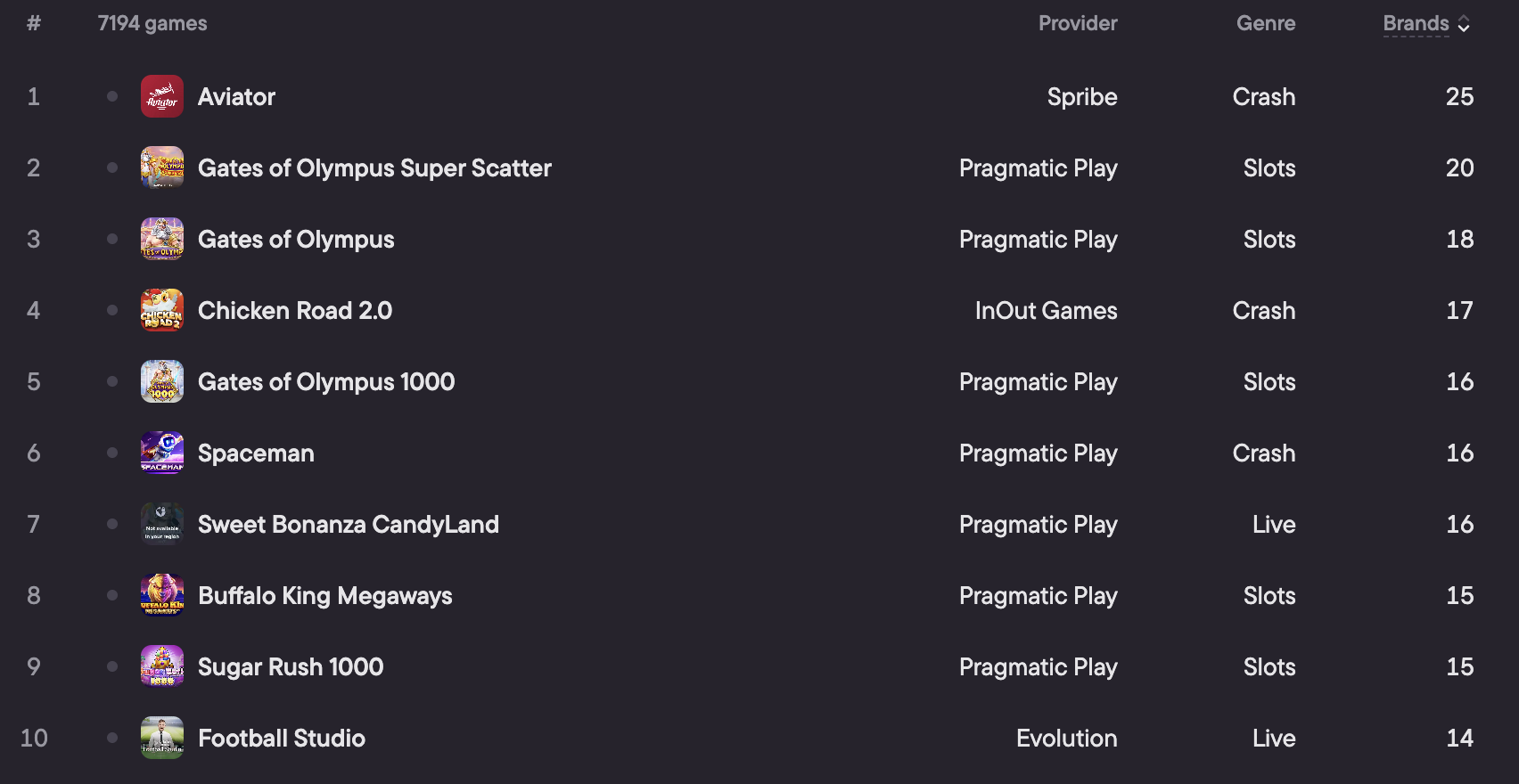
Operators treat Pragmatic franchises as default inventory and keep Aviator as the crash anchor. Mines does not appear in the most-carried twenty. Competitors face a distribution tier run by one house’s franchise coverage.
Visibility: Sweet Bonanza at 85%, Pragmatic owns the front rail
Sweet Bonanza leads Visibility. Gates of Olympus, Sugar Rush 1000, Fury of Anubis, Peru Candyland, and two further Pragmatic slots fill most of the rest of the top ten. Evolution’s First Person Blackjack is the only non-slot in the band. Amusnet’s Caramelo Sortudo and CT Interactive’s Lucky Clover close the list.
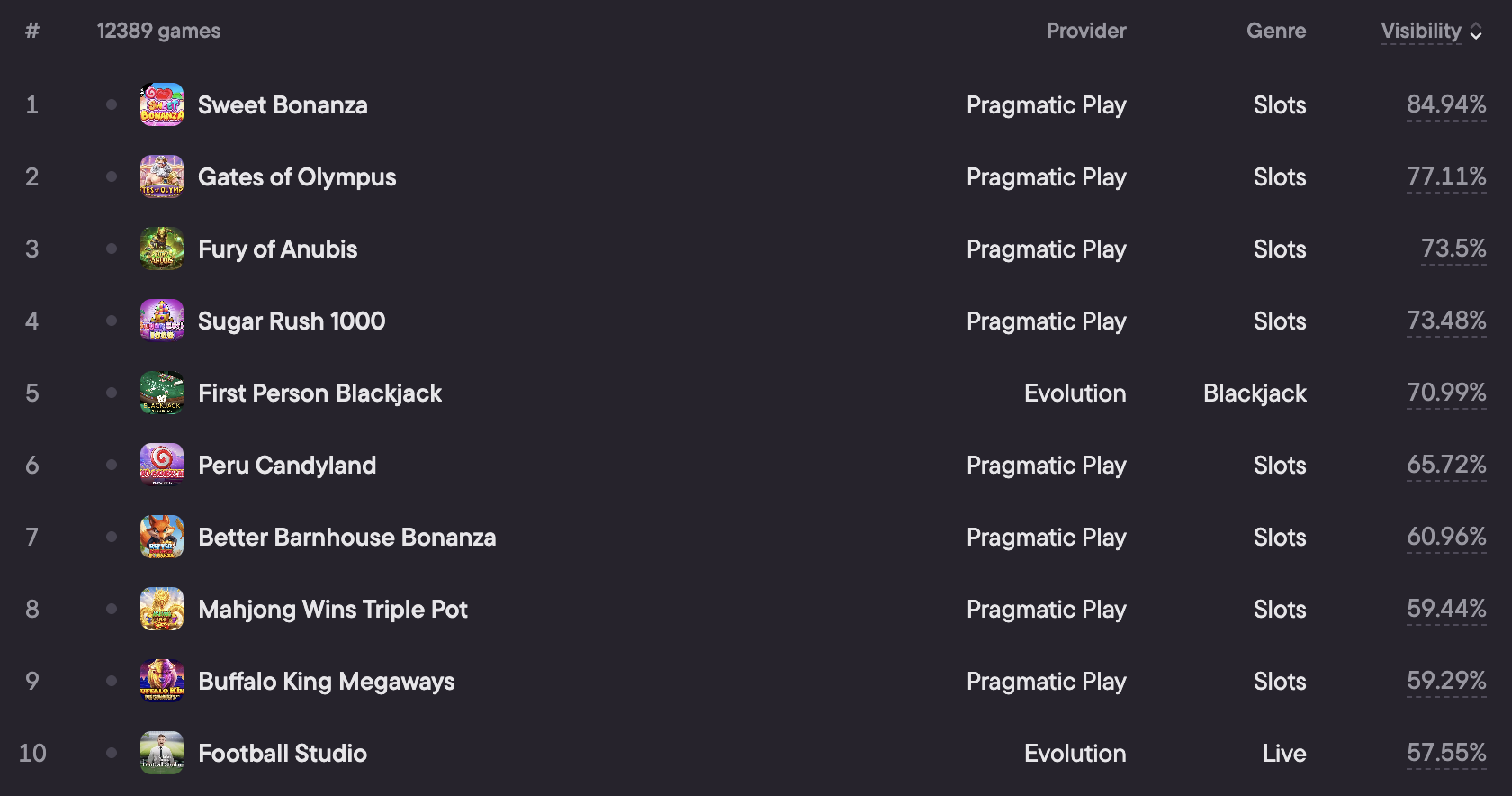
Pragmatic places seven of ten titles on the front rail. Operators are not only listing the franchise; they are anchoring it above the fold. Amusnet, second on content share, lands one Visibility seat. Hacksaw’s Mines is absent from both the most-carried and Visibility tables, so the demand leader does not show up as shelf exposure here. The SoI snapshot shows how far search diverges from what operators push to the grid.
Historical share of interest: Zeus yielded to Mines in early 2026
From July 2024 through January 2026, Zeus (TaDa Gaming) owned Peruvian casino game interest for most months, holding about a quarter to more than a third of measurable SoI. Balloon (SmartSoft Gaming) interrupted that run for three months at the end of 2024 and into January 2025, then Zeus returned and peaked above 37% in March 2025 before settling back into the mid-twenties.
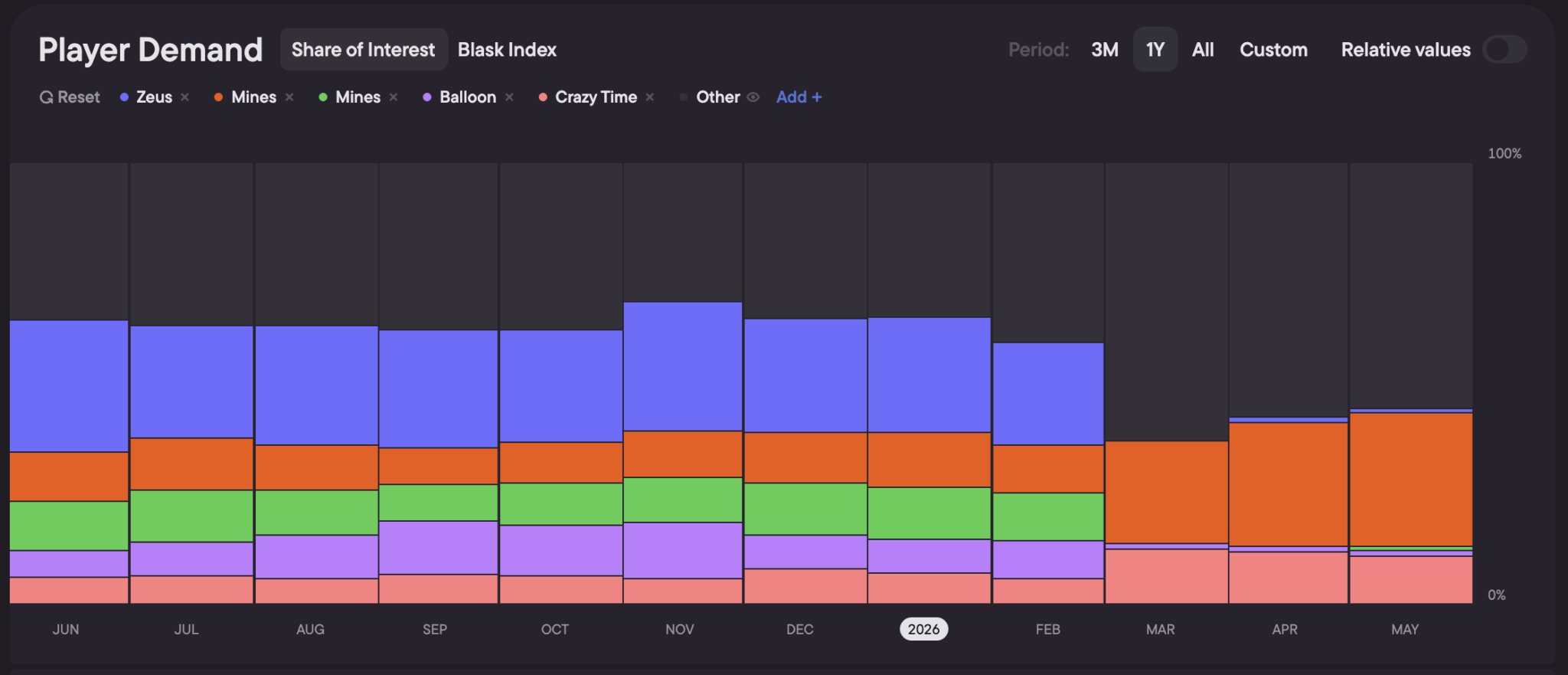
February 2026 broke the pattern. Mines took the lead and held it through June, with shares climbing into the high twenties by April before easing to about 26%. The eras here are succession, not continuity: a long TaDa slot era, a brief Balloon blip, then a Hacksaw title that reset the demand table while operators kept stocking Pragmatic and Aviator.
Top casino games by share of interest (June 2026)
Zeus holds 23.4% of measurable interest. Mines variations take the next seats; together the top three capture about 45.3% of demand.
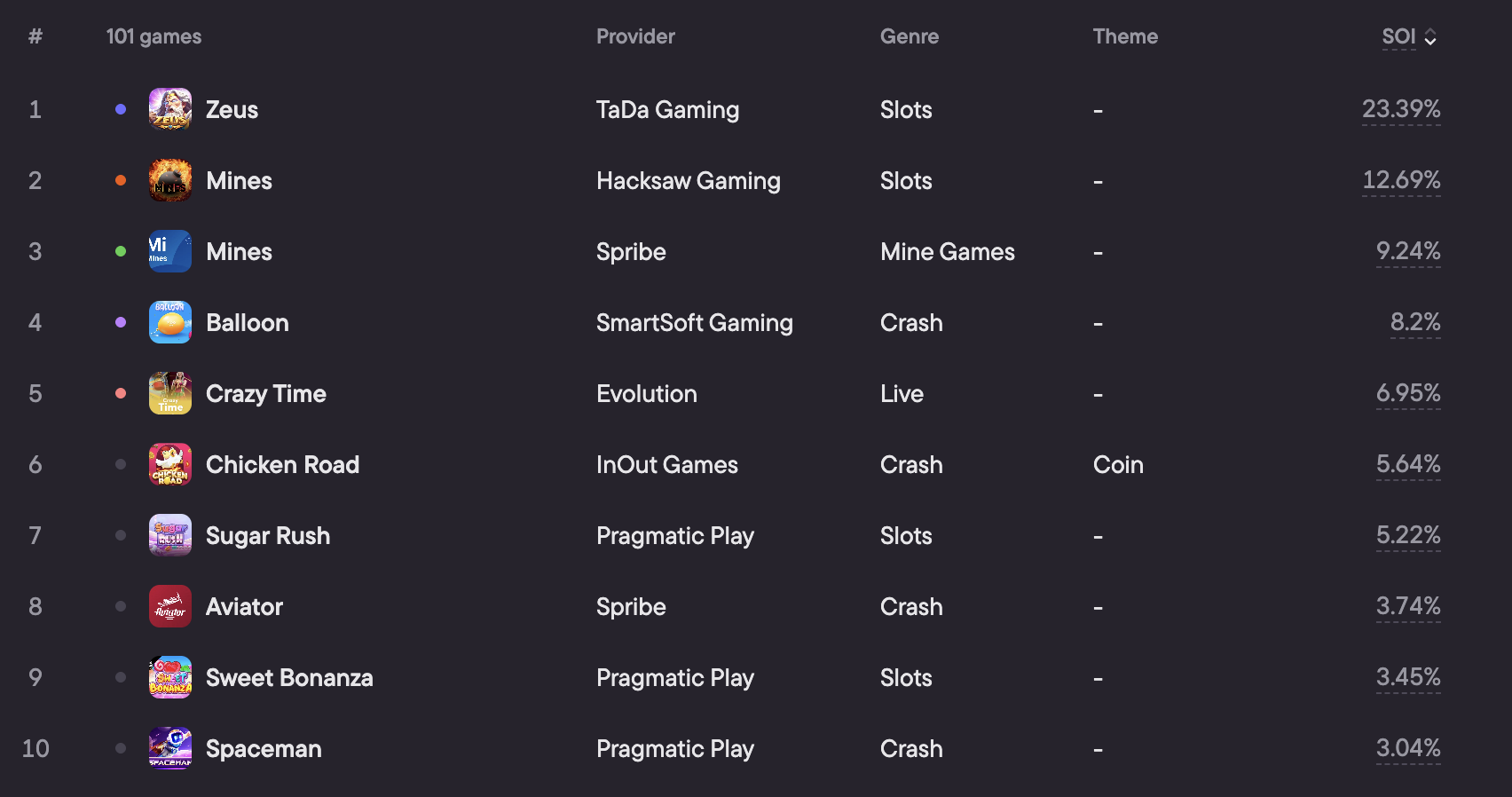
Against the supply picture the split is plain. Pragmatic Play’s titles are the supply and Visibility story; Hacksaw’s Mines, Evolution’s Crazy Time, and the crash cluster around Aviator and Chicken Road are the demand story. Pragmatic still places five titles inside the SoI top ten, but none of them leads. Operators built depth around Pragmatic franchises and Aviator coverage. Players keep searching for Mines.
Bottom line
Peru’s licensed casino shelf concentrates stocking around one provider’s franchises, while player attention sits on a different title that does not appear in distribution or Visibility.
That structure shifts if operators start merchandising Mines with the same front-rail confidence they already give Sweet Bonanza and Gates of Olympus, or if a new title unseats Mines the way Mines unseated Zeus.
Explore Peru market with Blask free analytics: blask.com/market/peru/
FAQ
What are the top casino games in Peru right now?
Mines (Hacksaw Gaming) leads by share of interest at 25.6% in June 2026, ahead of Crazy Time (Evolution) and Aviator (Spribe). The top three titles together hold about 46% of measurable casino game demand in Peru.
Which game provider leads the Peru casino catalog?
Pragmatic Play leads provider content share at about 17% of the tracked shelf, well ahead of Amusnet, Evolution, BGaming, and Pocket Games Soft. The same house places fourteen of the twenty most-carried titles and seven of the ten highest-Visibility games.
What is the most carried casino game in Peru?
Aviator (Spribe) is the most-carried title, listed by 25 brands. Gates of Olympus and Gates of Olympus Super Scatter (both Pragmatic Play) follow on 20 brands each.
How do crash and live games compare to slots in Peru?
Slots fill about 83% of the catalog, yet crash and live punch above that weight on demand: Aviator and Chicken Road sit in the SoI top five, and Crazy Time holds second place at about 12%. Mine Games stay under 1% of shelf share even while Mines leads search.