

- Updated:
- Published:
Prediction markets in the US: fast growth, disputed ground

Blask data reveals the dynamics of the booming events betting market as the regulators’ fight intensifies.
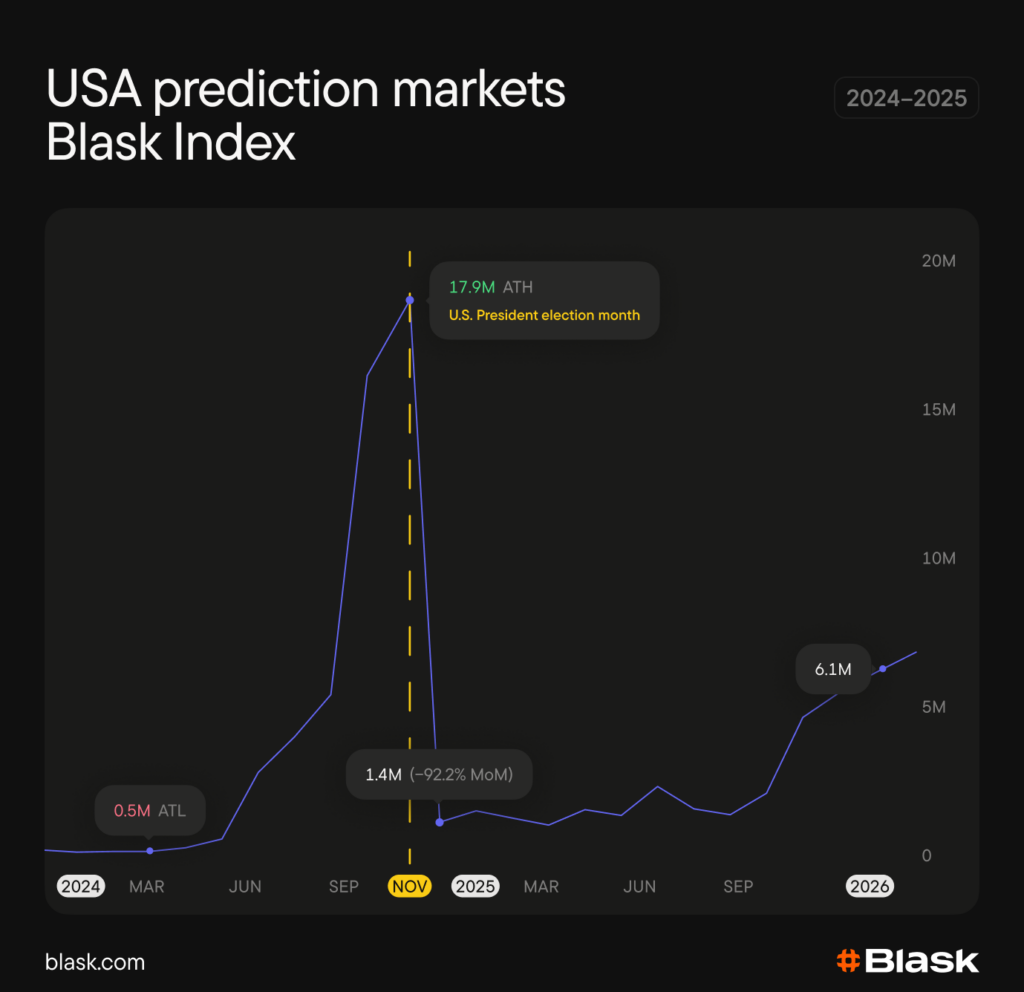
According to Blask, prediction markets are the fastest-growing vertical in US iGaming. Demand for them, measured by Blask Index, rose 3.5x in 2025 but still remained well below the peak registered during the US presidential elections in autumn 2024. The spread of sports event markets in 2025 ignited a dispute between the Commodity Futures Trading Commission (CFTC, the federal derivatives regulator) and state gambling regulators over who has the right to oversee them.
This article draws on findings from Blask’s comprehensive report covering the US and Canadian iGaming markets — state-by-state and province-by-province breakdowns, offshore vs. domestic dynamics, brand rankings, and expert commentary.
Familiar ideas in a disputed wrapper
What is known as prediction markets is not a clean invention. Bookmakers have long accepted bets on non-sporting events like Oscar winners, royal baby names and political outcomes. In some regulated markets, licensed operators are still not restricted to sports only. For example, in the UK and Ireland betting on real-life events has been legal for decades and still is. Offshore bookmakers have always offered it regardless of local rules.

The mechanics are not new either. Betting exchanges such as Betfair Exchange and Matchbook — the first peer-to-peer platforms, launched around 2000 — were built on users betting against each other rather than against the house. Unlike traditional betting, users on an exchange can back or lay an outcome and trade their position at any point before or during the event, closing out early without waiting for settlement. Prediction markets took that model and rebuilt it on modern infrastructure.
Polymarket settles through smart contracts on the Polygon blockchain. Kalshi presents itself as a CFTC-regulated designated contract market — a financial exchange, not a bookmaker. That dual nature of prediction markets drives the dispute about which regulator has the right to oversee them. And while that fight plays out, prediction markets keep growing.
Beyond the election hype
According to Blask data, after the 2024 US election spike, demand for prediction markets in the country slumped hard. By December 2025, Blask Index of prediction markets had fallen more than 92% month-over-month, exposing how dependent the category had been on the political cycle. Then it found a second leg. A move into sports prediction markets in the beginning of 2025 pushed the category’s Blask Index in the US up 256% from January to December 2025.
Blask data also show consolidation rather than fragmentation. Polymarket dominated through most of 2024 and 2025. Kalshi regained momentum later in 2025 as its sports markets expanded. Despite 10 new brands launching during the last year, the long tail kept shrinking. By early 2026, at least 17 platforms were active in the US, with roughly 20 more in launch or approval stages.
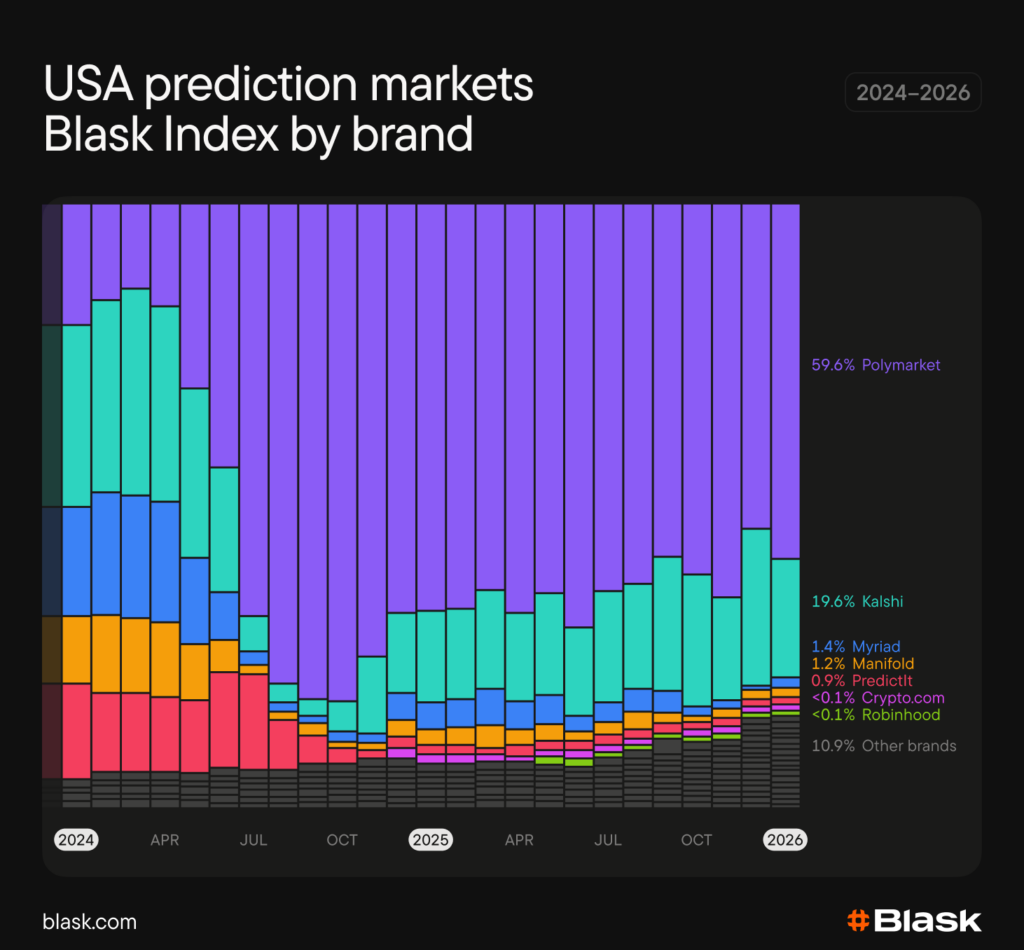
The market has hardened into a duopoly, while more and more brands emerge and the regulators’ fight is intensifying.
A gap in the licensing model
States have spent years building iGaming licensing frameworks, but Blask’s report shows that the channelisation problem persists. Even in fully regulated states, domestic licensed brands captured only 62% of CEB on average in 2025. In states with sports betting but no licensed online casino, offshore operators took 74%.
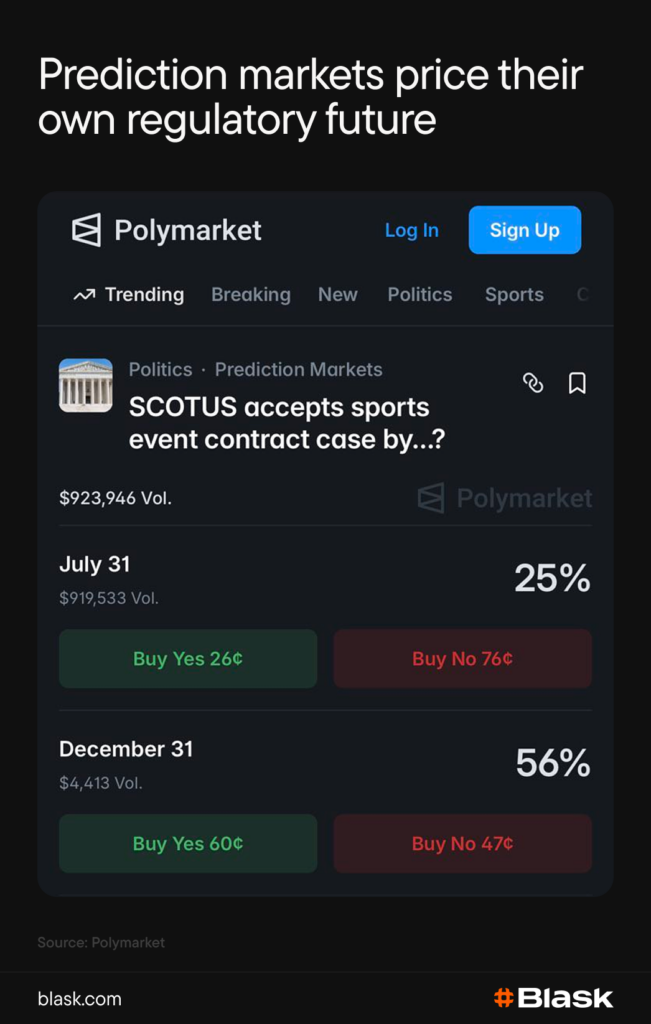
Prediction markets complicate things further, as they claim they are outside states’ jurisdiction. States disagree: more than 20 active legal and regulatory actions are pending, with courts reaching contradictory conclusions. The CFTC has formally declared it will defend its exclusive jurisdiction. The dispute is widely expected to reach the Supreme Court — Polymarket users are pricing it at 56% by the end of 2026.
Bottom line
Prediction markets did not invent betting on real-life events. They repackaged it with mechanics borrowed from exchanges. By presenting themselves as financial products rather than gambling, they claim to sit outside state regulation entirely. While that claim is tested, the market keeps expanding.