
After a tough start in Brazil, the operator is going all in on its Danish launch — with an acquisition, a national stadium HQ, and an Astralis jersey deal.
Stake went live in Denmark in February 2026, having secured a five-year licence from Spillemyndigheden. Over the following weeks, Stake established a headquarters inside Parken Stadium and launched stake.dk. It also became the main jersey sponsor of Astralis, Denmark’s most storied Counter-Strike organization and a four-time Major champion.
It was the most visible move in a market entry that had already been unusually aggressive for the operator. Stake had acquired MocinoPlay, the parent company behind licensed Danish brand VinderCasino, gaining a second domain (vindercasino.dk) in the process. And it appointed a local managing director, Peter Eugen Clausen, to run the operation.
For a company whose previous attempt at the Danish market ended with a court-backed domain block in 2023, this is a significantly different approach.
The market Stake is buying into
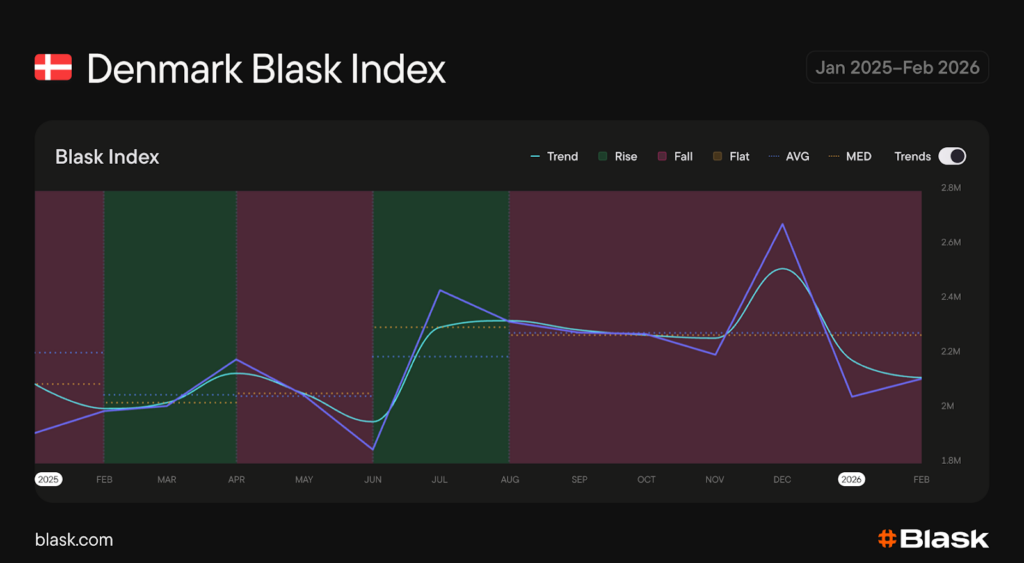
Denmark is a compact, mature market. It ranks 35th by CEB among the 126 markets Blask currently tracks, with an average CEB of $944.2M in 2025 (up 17.6% compared to 2024), consistent with an 11.5% rise in the country’s Blask Index over the same period.
That projected revenue is chased by 323 active brands, according to Blask’s count. Only five countries have more: Brazil, India, the United States, Germany and the United Kingdom, all of which sit far higher in the global ranking by CEB.
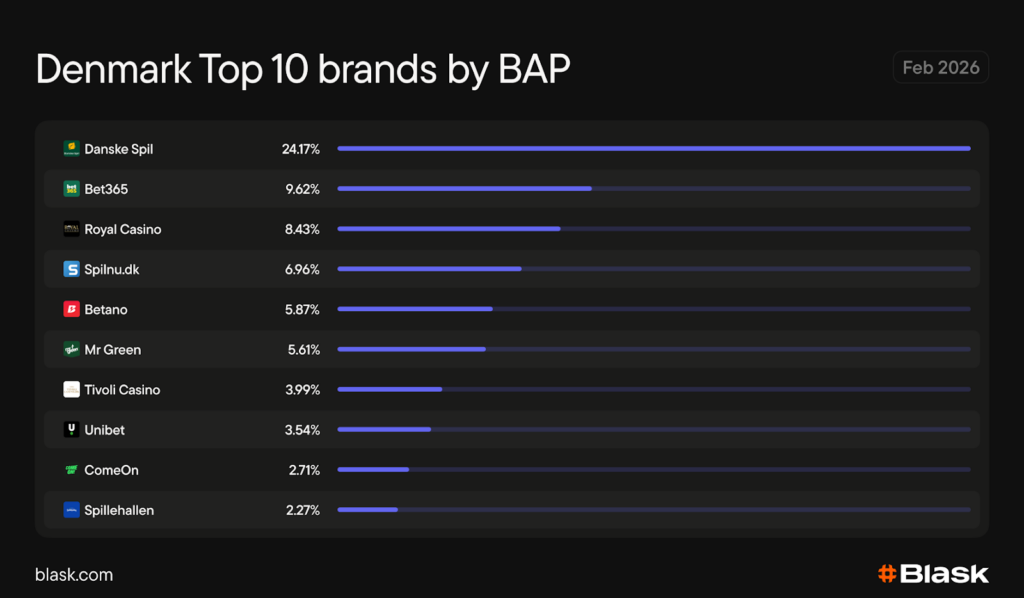
Offshore operators have made little headway. Blask estimates their share of Danish CEB at roughly 8% to 10% through 2025. Danske Spil, the state-owned operator, holds around a quarter of all BAP.
Stake was once part of that offshore share. The brand operated through stake.com until at least mid-2023, when the domain appeared on Spillemyndigheden’s court-backed blocking list. Blask data shows it held around 1% BAP during 2022–2023 — a notable footprint for an unlicensed operator in a tightly regulated jurisdiction.
That demand proved durable. Through 2025, Stake continued to register approximately 0.5% BAP without a licensed product to support it. The residual brand awareness is what Stake is now trying to convert.
What Brazil showed
Stake’s recent regulated launch offers a useful point of comparison. The operator entered Brazil in January 2025, when the country’s newly licensed market officially opened. Stake secured a federal licence, opened an office in São Paulo, hired a country manager, and invested in local visibility — including a sponsorship deal with Juventude, the Série A football club.
The initial numbers were solid: Stake recorded 0.46% BAP in its first month. By February 2026, that figure had fallen to 0.16%.
It is hard to draw strong conclusions from this alone. Brazil is one of the youngest licensed gambling markets in the world and by far the most crowded: Blask counts 533 active brands as of February 2026 — more than any other country it tracks. In that kind of environment, even well-funded operators struggle to hold share as hundreds of competitors fight for the same audience.
Denmark is a different proposition — smaller, more mature, and with a stable regulatory framework — but it is not short on competition either. Stake’s response has been to commit at a level the operator has not attempted in previous regulated entries.
A bigger bet on local presence
In Denmark, the operator has gone further than in previous launches on several fronts:
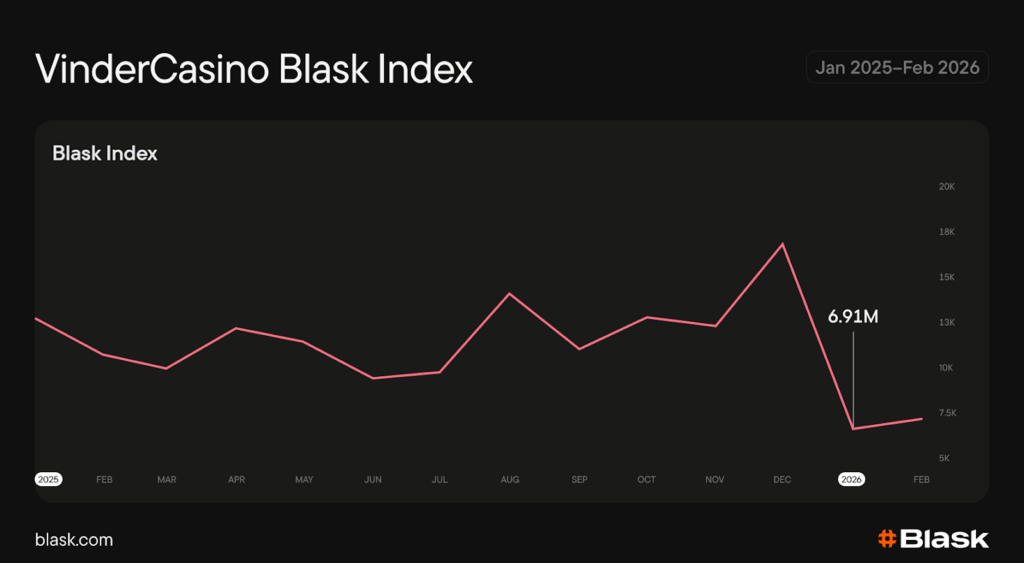
- An acquired local brand. VinderCasino gives Stake a second domain along with the brand’s residual audience. VinderCasino spent most of 2025 ranked in the mid-20s nationally, with BAP of around 0.5–0.6%. In January 2026, coinciding with news of the acquisition, its Blask Index fell 59.7% month on month and BAP dropped to 0.33%. By February, BAP remained at roughly the same level.
- A physical footprint in a symbolic location. Setting up headquarters inside Parken Stadium is a statement of permanence. It also puts the operator in proximity to FC Copenhagen’s commercial ecosystem — though no football sponsorship has been announced.
- A culturally specific sponsorship. Counter-Strike has deep roots in Denmark. The country has produced some of the game’s most successful players and organizations, and Astralis is the most decorated among them. For a digital-native brand, jersey visibility during ESL Pro League broadcasts offers a direct channel to an audience segment that overlaps with Stake’s core demographic.
The Astralis deal also fits an emerging pattern in Stake’s esports strategy. In July 2025, the operator signed a multi-year, seven-figure partnership with Team Vitality, France’s leading CS2 team, debuting at IEM Cologne. It also co-runs the Stake Ranked tournament series with StarLadder. Esports sponsorship is clearly becoming one of the core marketing channels for the brand — though the Astralis deal is the first to be explicitly tied to a specific market launch.
What to watch
Recapturing the offshore-era 1% BAP would place Stake inside Denmark’s top 20 — not a threat to the market leaders, but a credible licensed position in one of Europe’s most competitive gambling jurisdictions.
The meaningful comparison, though, is with Brazil. Three early indicators will matter. First, whether stake.dk’s BAP stabilizes above VinderCasino’s pre-acquisition baseline. Second, whether the Astralis partnership drives measurable brand search interest. And third, whether Stake’s crypto-native users convert to a regulated product built on KYC and fiat payment rails.
Brazil showed how hard it is for an offshore-born brand to gain traction in a newly regulated market, even with real investment on the ground. Denmark will show whether deeper local commitment can produce a different outcome in a more mature one.