Betano and Bet365 are the only top-5 Brazilian iGaming brands growing both year-over-year and month-over-month — the data shows why building local presence beats buying it.
Editorial contribution: Smart Social
Starting with the data
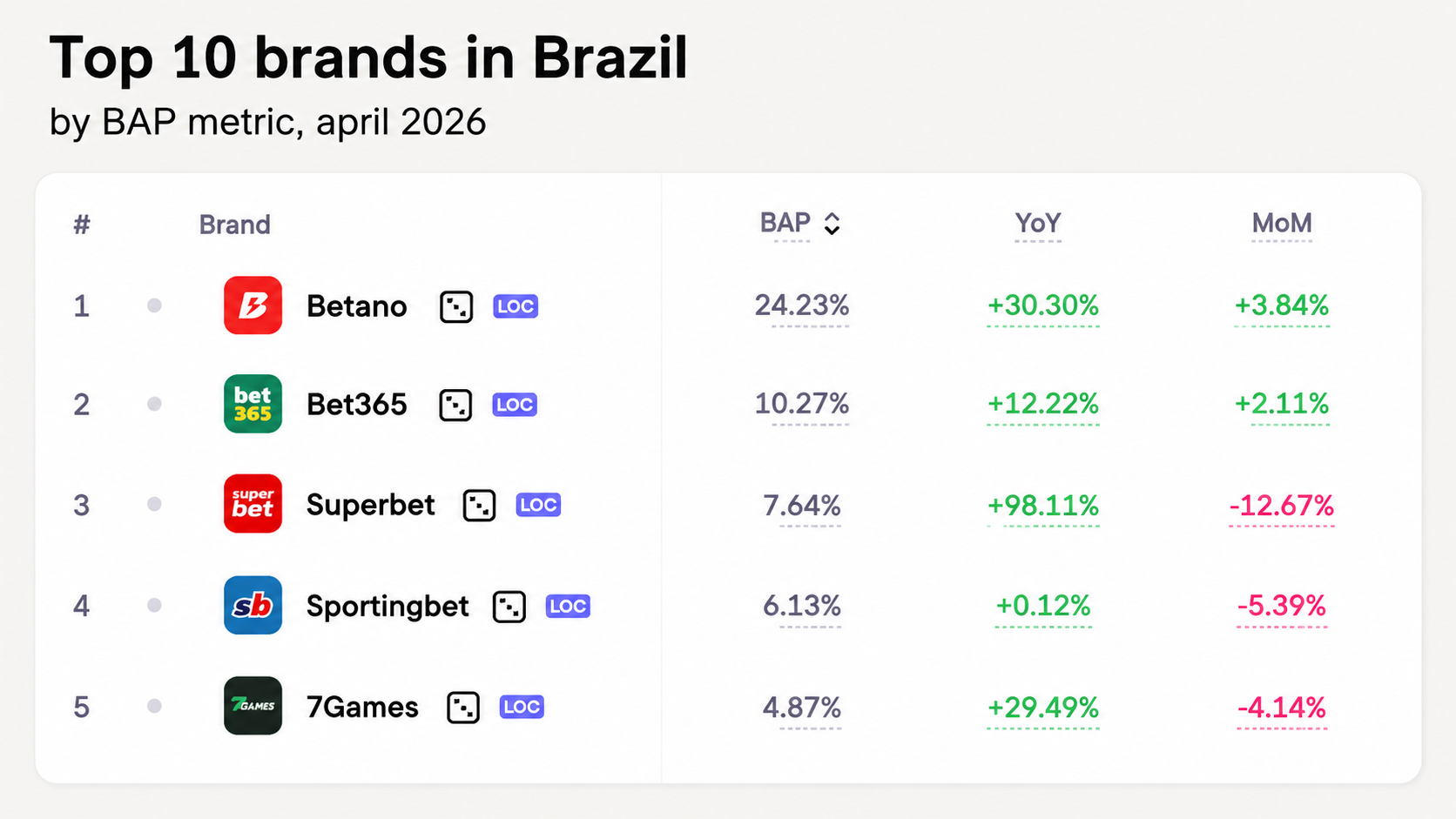
Of the five brands leading the Brazilian iGaming market in April 2026 by BAP (Brand Accumulated Power) — a metric that measures a brand’s share of total market demand in Brazil — only two are growing simultaneously in the long term and in the current month: Betano and Bet365.
The ranking:
YoY reflects who grew over the past year. MoM reflects who is growing right now. Three of the five leading brands grew over the year but are losing market share month over month. Betano and Bet365 are growing in both.
This pattern is not coincidental. It can be explained by the communication strategies each brand has built in the Brazilian market, and the differences between them show what actually works in highly competitive regulated environments.
Why annual growth does not guarantee monthly growth
BAP growth over a year can be driven by concentrated investment: major sponsorships, high-volume paid media, and high-reach event activations. The limitation of this approach is that it generates demand spikes, not a demand base.
Sustaining BAP month over month requires the market to keep searching for the brand even when no active campaign is driving that volume. This only happens when a brand has built local identity, not just media presence.
Luiz Felippe Correia
CEO of Smart Social
“Monthly BAP is a trust indicator. A brand can purchase visibility in the short term, but it cannot purchase spontaneous consumer search. When MoM falls while YoY rises, the data is signaling that the brand has not yet become part of the local consumer’s repertoire. In Brazil, that has a clear meaning: the brand is still being pushed, not pulled.”
Superbet recorded the highest annual growth in the top 5, nearly 100% in YoY, but also the steepest monthly decline in the group, at –12.67% in MoM. This is the clearest illustration of that dynamic: accelerated growth without the construction of a sustained base.
Influencer marketing in Brazil: what Betano’s data reveals
Betano is currently the brand with the highest BAP in the Brazilian iGaming market, and its trajectory offers a reference point for how influencer marketing operates effectively in regulated markets.
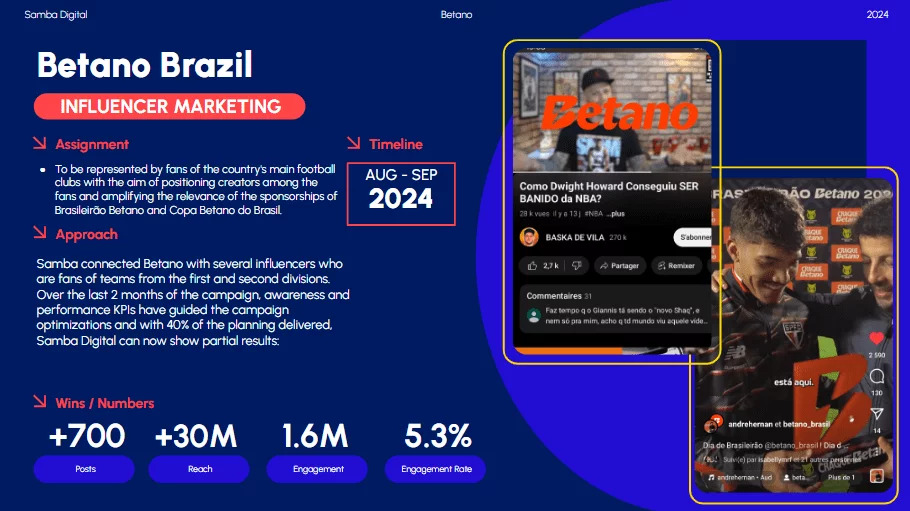
In August and September 2024, the brand ran an influencer campaign that generated 700 posts on Instagram and YouTube, reaching 30 million impressions with a 5.3% engagement rate. The differentiating factor was not the volume of content, but the selection logic: influencers were chosen based on their genuine connection to specific football clubs in the first and second divisions, not solely based on audience size.
This approach produces a result that conventional awareness campaigns cannot replicate: the brand appears embedded in conversations the audience is already having, rather than interrupting those conversations.
Luiz Felippe Correia states that the size of an influencer matters less than the relevance of the context in which they operate. According to him, the strongest results in the Brazilian iGaming market come from creators who have a genuine connection with specific communities, such as supporter groups, sports niches, and regional entertainment audiences.
In regulated markets, this authenticity also plays an important compliance role. A forced association between a brand and an influencer not only tends to deliver weaker results but can also create reputational risks for the company.
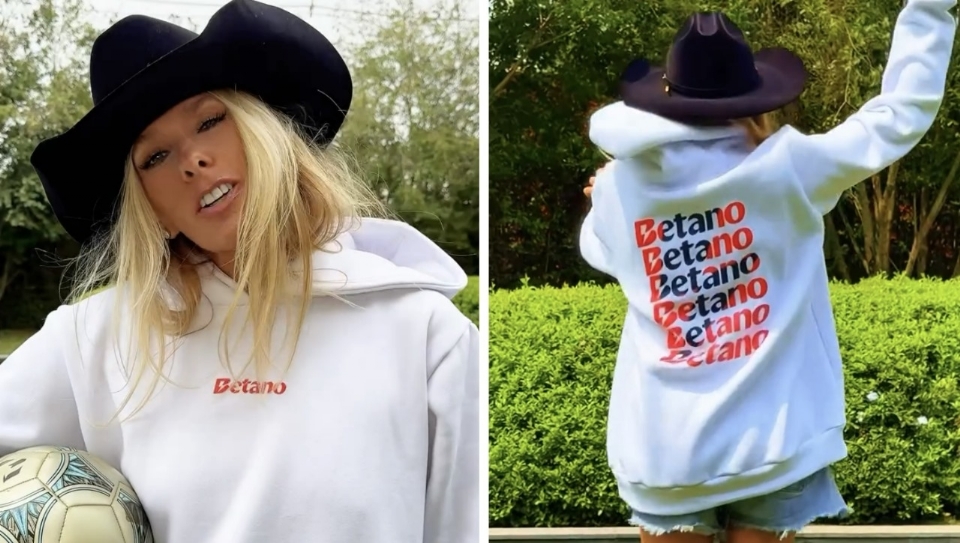
Beyond influencers, Betano built an ambassador network covering different cultural spaces: Felipe Massa and Minotouro for sports audiences, Adriane Galisteu for mainstream television entertainment, and streamers and gamers for digital-native audiences. This diversification reduces dependence on a single channel and ensures continuous presence across different cultural contexts.
The cumulative result of this strategy is reflected in the YoY and MoM data: a brand the Brazilian market keeps searching for regardless of the active campaign calendar.
Communication in regulated markets: what changes when the rules arrive
The Brazilian betting market was formally regulated with rules taking effect in January 2025. For brands already operating in the country before regulation, this moment brought two simultaneous challenges: adapting to the new requirements and competing for position in a market that was becoming officially legitimate.
Bet365, which had a presence in Brazil before regulation but had not made significant investments in local communication, took structural steps in January 2025: the official launch of its operation with its own headquarters in Barueri, São Paulo, and the appointment of a local agency to lead strategy and media buying in the Brazilian market.
The resulting campaign, “Always Extraordinary,” adapted the brand’s global positioning for the Brazilian context with local production and distribution across broadcast television, out-of-home, and digital channels.
“Regulation in Brazil did not create a new market. It formalized one that already existed and redistributed the rules of who can participate and how. For brands that had already built local structure, compliance, and brand identity before January 2025, regulation acted as a catalyst. For those arriving at the same time as the rules, the challenge is twofold: building local presence while adapting to a regulatory environment that is still taking shape. That carries both operational and communication costs.”
Luiz Felippe Correia
CEO of Smart Social
BAP data supports this reading. Betano, which formalized its Brazilian operation in October 2024 and had been executing a localized strategy for longer, entered the post-regulation period with 24.23% BAP. Bet365, beginning its localization process at the same moment as regulation, operates at 10.27%.
Both are growing. The distance between them reflects years of difference in building local presence.
Activation channels generating results in Brazil right now
Based on knowledge acquired through work in the Brazilian and Latin American markets, and on the movement of brands with the strongest BAP performance, three channels stand out for generating sustained organic demand:
Sports sponsorships with naming rights. Betano holds the naming rights to the Brasileirão Série A, Série Betano (second division), Copa do Brasil, and Supercopa. This type of sponsorship goes beyond logo placement: it integrates the brand into the vocabulary Brazilians use to refer to the competitions themselves. When a supporter says “the Copa Betano game,” the brand is present in the sentence without requiring any active media placement.
Influencers with thematic connection, not just reach. Selecting by contextual relevance rather than audience size produces higher engagement rates and lower customer acquisition costs. In Brazil, the most effective niches for iGaming are organized supporter communities, sports streaming content creators, and popular entertainment figures with audiences outside the major urban centers.
Entertainment as a brand-building channel. Betano’s partnership with the television program A Fazenda and the appointment of Adriane Galisteu as brand ambassador reflect a strategy of presence in high-reach popular entertainment. This channel reaches an audience that is not primarily composed of bettors, but represents significant new user volume in an expanding market.
What BAP data measures and why it matters for communication strategy
Brand Accumulated Power, as measured by the Blask Index, models external demand from normalized search data. It does not reflect media investment, but the market’s response to that investment.
Consistent BAP growth, particularly in MoM, indicates that a brand’s communication is generating organic demand: the market is searching for the brand beyond direct exposure.
Luiz Felippe Correia
CEO of Smart Social
“What makes BAP strategically relevant is that it measures market demand from external data, not from metrics reported by the brand itself. This removes self-reporting bias and enables genuine comparative analysis. For brands operating in regulated markets, where internal data transparency is limited, having an independent external indicator changes the quality of decision-making in communication.”
“What makes BAP strategically relevant is that it measures market demand from external data, not from metrics reported by the brand itself. This removes self-reporting bias and enables genuine comparative analysis. For brands operating in regulated markets, where internal data transparency is limited, having an independent external indicator changes the quality of decision-making in communication.” — Luiz Felippe Correia, CEO of Smart Social.
For any brand operating in the Brazilian market, the difference between growing in both indicators or only in one is, in practice, the difference between building sustained presence and depending permanently on new investment to hold position.
Halloween is still 10 days away, but the casino lobby is already in costume. And not all of the costumes are pumpkins. Blask analysts looked at Halloween slots and the darker titles gaining ground beside them: vampires, witches, demons. The snapshot is from October 12. 1. The season’s most visible title is vampire themed The […]
Two weeks of the decree gave back the gains made after 2022, and left the earlier boom in place. In Brazil, Blask Index rose about 30 times from January 2020 to the April 2026 peak. The licensed book under that climb is young: federal fixed-odds authorisations went live on 1 January 2025, under Law 14.790 […]
Brazil’s ban closed the same market for every licensed brand, but for most of them that market was the whole company. President Lula’s Provisional Measure 1,394 stopped new deposits and bets on 25 September, took licensed sites offline on 6 October and ends every federal licence on 25 October. Blask has estimated that the first […]