iGaming affiliate marketing is a performance channel: publishers send players to betting and casino operators, and are paid when those players complete an agreed action.
The vocabulary is where deals separate. RevShare, CPA, hybrid, CPL, fixed fee and sub-affiliate override each describe two things — when money is released, and what the amount is calculated from. Two contracts quoting the same percentage can pay differently, because the base underneath the percentage is defined in the agreement rather than by the industry.
What iGaming affiliate marketing is
An affiliate publishes content or media carrying a tracked link to an operator, and earns commission on players who arrive through it. Gambling.com Group, a listed affiliate, describes the arrangement in its annual filing: an online gambler who visits an operator from one of its websites, registers an account and deposits becomes a referred player, and each referred player entitles the affiliate to remuneration under the agreement with that operator.
The channel exists because acquisition risk moves. An operator paying per referred player converts part of its marketing budget from a fixed cost into a variable one; the publisher takes on the cost of building and holding the audience.
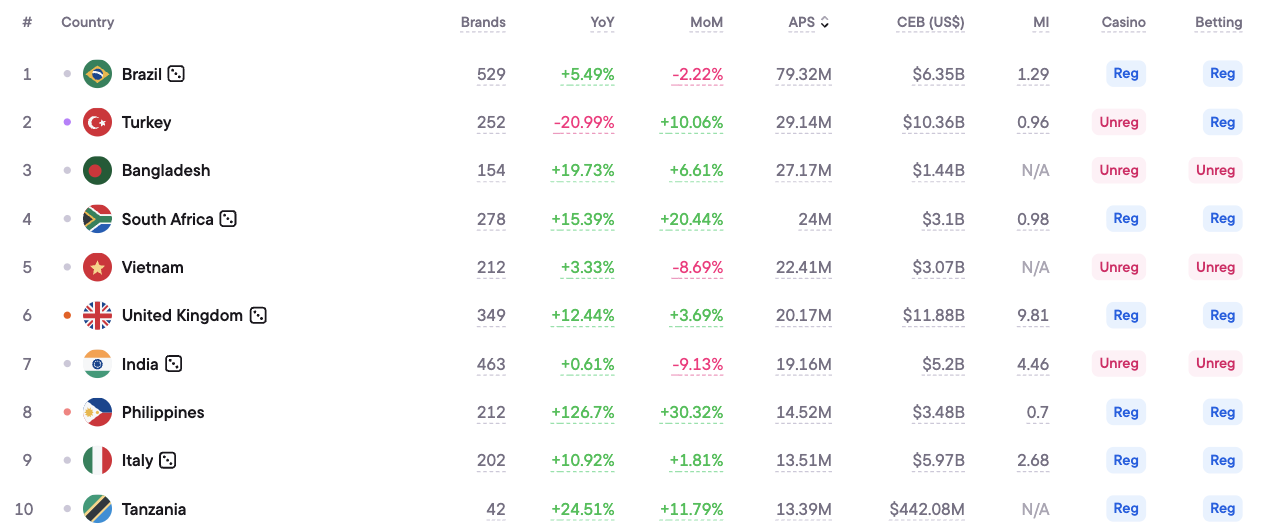
Blask data shows 79.3 million new player acquisitions in Brazil in 2025 and 20.2 million in the UK. A content site capturing even a fraction of those acquisitions through affiliate links generates commission income at scale without owning product, inventory, or customer relationships.
Top 10 countries by APS metric in Blask, 2025
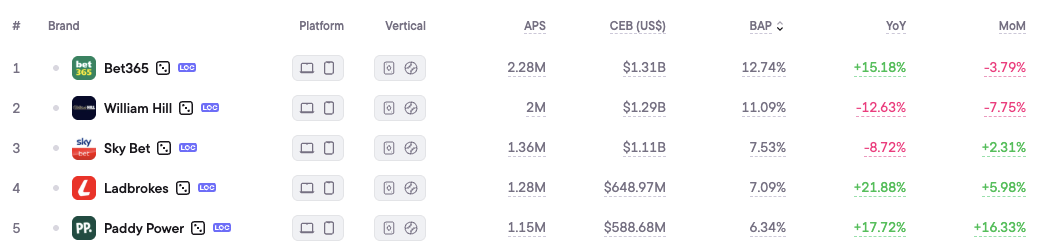
For operators, the model eliminates upfront acquisition cost. Bet365 ranked #1 in the UK in 2025 with a Blask Index of 75.6 million and an estimated 2.28 million new player acquisitions. The affiliate channel contributed to that position without Bet365 owning the review content, the SEO infrastructure, or the audience relationships.
Top 5 brands in UK by Blask Index metric, 2025
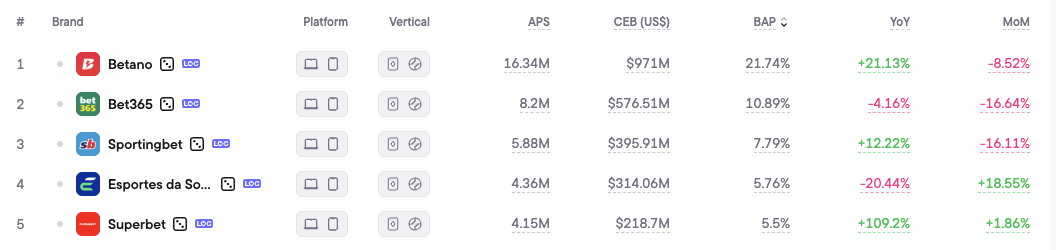
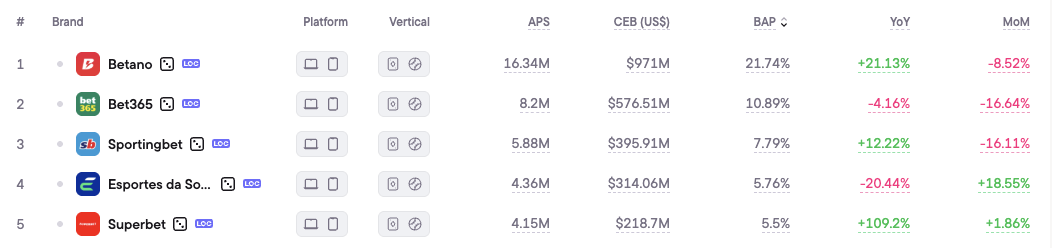
In Brazil, where Blask recorded 79.3 million new player acquisitions in 2025, operators like Betano and Superbet are growing affiliate budgets because building their own acquisition infrastructure in a new large market is slower and more expensive than activating networks of affiliates with Portuguese-language traffic. Superbet grew its Brazilian Blask Index by +109.2% YoY. That growth created affiliate opportunity before SEO competition caught up.
Top 5 brands in Brazil by Blask Index metric, 2025
Alexey Shostak
Owner at AFFCatalog
“Affiliates function as success multipliers, not as a rescue mechanism for a weak product. If a brand lacks established reputation, SEO visibility, and social proof, even quality traffic won’t convert, making CAC too high for affiliates to justify the relationship.”
How a referral becomes a payment
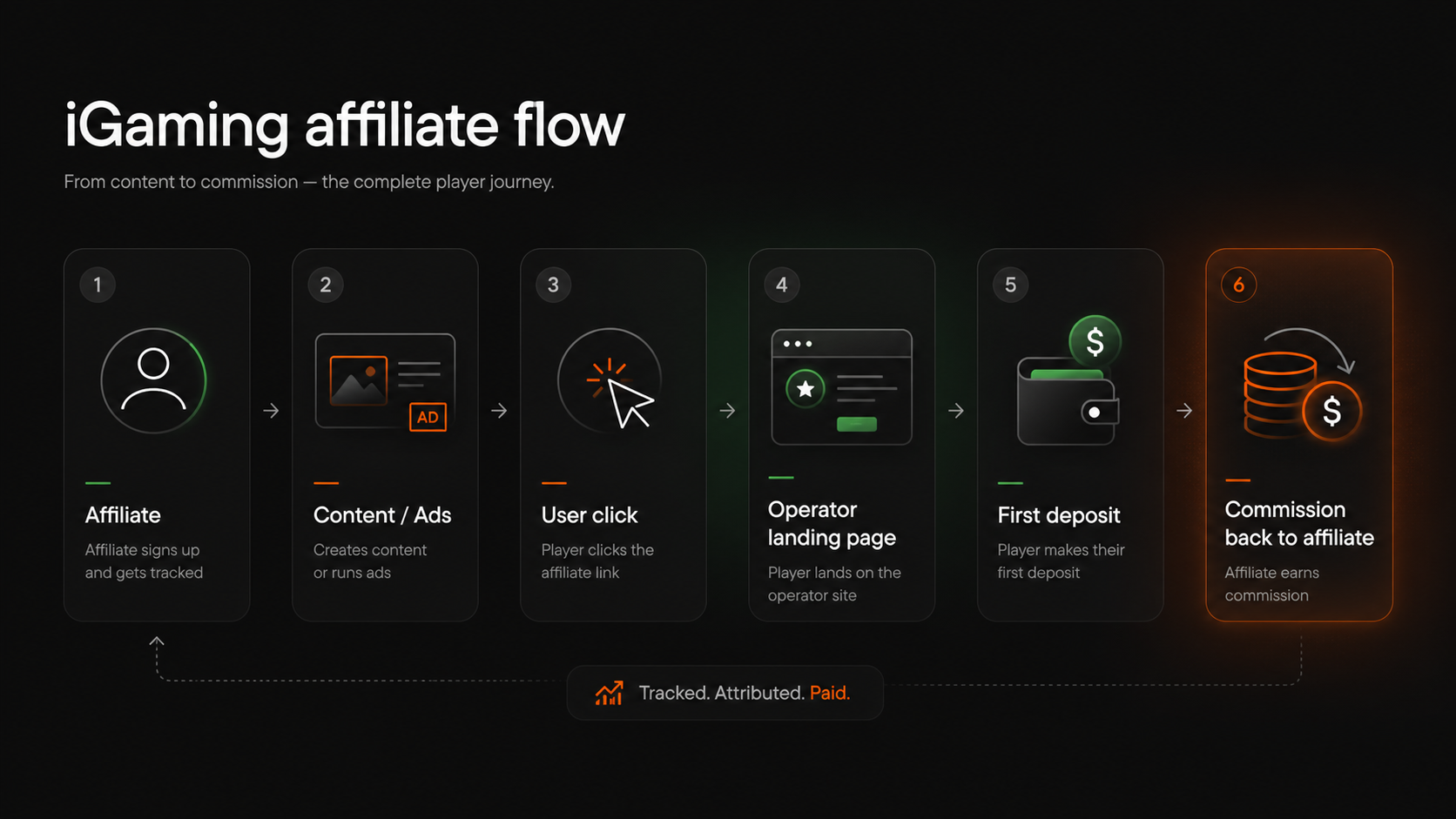
Four steps run between a click and a payout, and each is governed by the program’s terms rather than by convention.
An affiliate applies to a program, and regulated-market programs verify identity before activation. The affiliate receives a tracked link, with attribution handled by browser cookies, server-to-server postbacks or both. A referred user completes the qualifying action defined in the agreement — usually a first deposit meeting a minimum value and verification conditions. The program then calculates commission on its own reporting and pays on its own cycle.
Accounting treatment shows where certainty differs between models. Gambling.com Group recognises CPA fees when the referral is accepted by the operator, while revenue-share fees are treated as variable consideration and recognised only to the extent that a significant reversal is unlikely. One model settles at the point of referral; the other stays open to the referred players’ later results.
Commission models
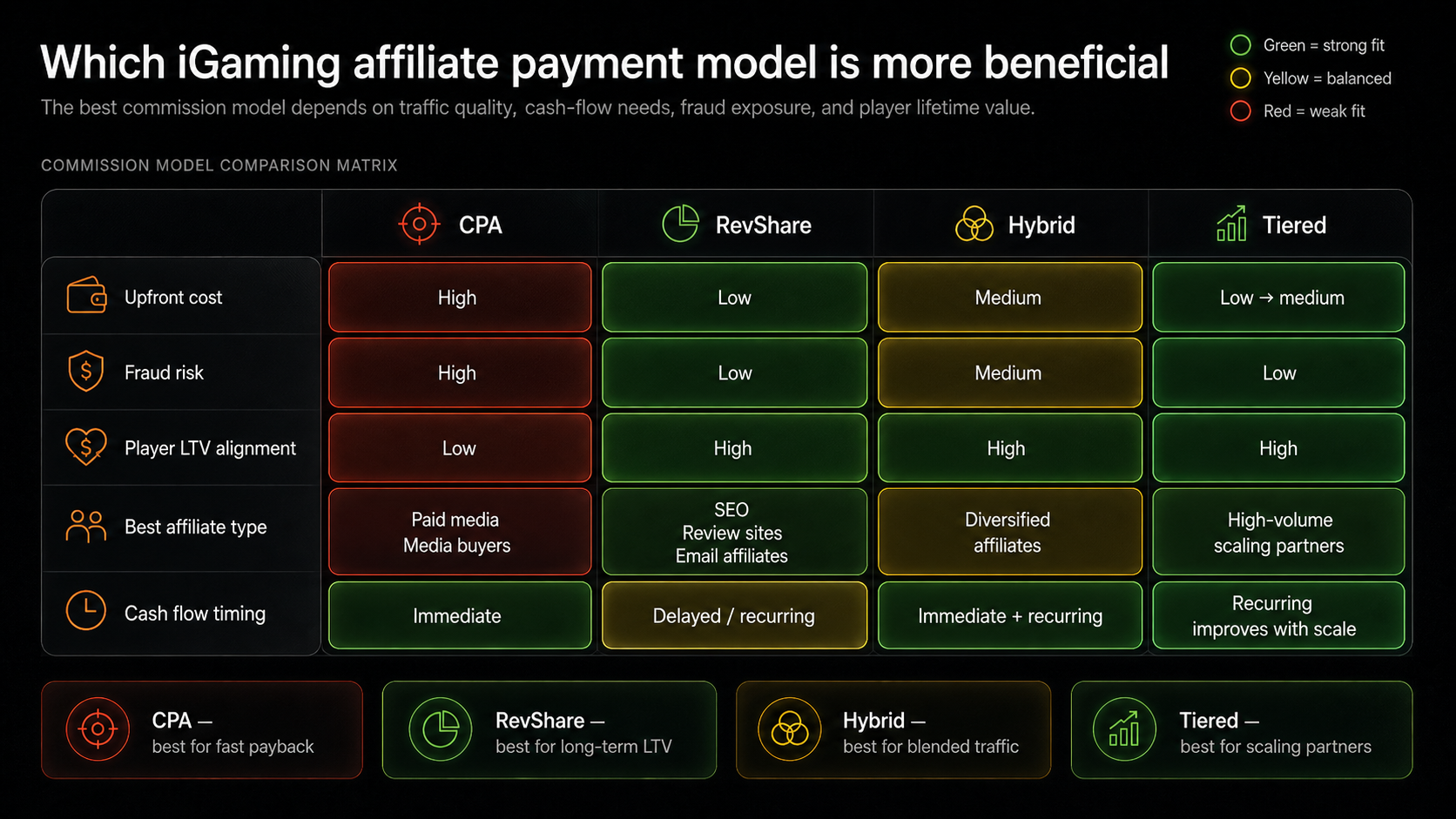
Six structures cover almost every iGaming affiliate agreement, and they differ in the trigger, the base and the risk each side carries.
Model
What releases the payment
What the amount is calculated from
Main contract risk
RevShare
A monthly settlement of the referred cohort
A percentage of net gaming revenue from referred players
The deduction list and pooling: one winning player can cancel the month
CPA
One qualifying first deposit
A fixed amount per referred player
Qualification conditions and clawback on reversed or fraudulent accounts
Hybrid
Both triggers, on the same referred player
A reduced CPA plus a share of net gaming revenue
Two sets of terms and two reporting lines to reconcile
CPL
A qualified lead, usually a registration
A fixed fee per lead
Lead quality; the model carries the widest bonus-abuse exposure
Fixed fee
A placement running for an agreed period
A sum agreed in advance, independent of player results
No upside from performance, and renewal sits with the operator
Sub-affiliate override
Commission earned by a recruited affiliate
A percentage of that affiliate’s commission
Rate and eligibility change at the program’s discretion
The first three definitions come from the same filing. Gambling.com Group defines CPA as a single cash payment for each referred player meeting agreed criteria, revenue share as a percentage of the NGR produced by a pool of referred players, and hybrid as a combination of both per referred player.
The other three appear in public program terms. Roobet’s affiliate terms define CPL as a one-time fee for referring a new customer under conditions agreed in writing. Roobet’s affiliate program set a sub-affiliate override at 5% of the commission generated by each approved affiliate a master affiliate recruits — released only after that sub-affiliate has referred five new depositing customers, and carrying any negative balance the sub-affiliate inherits. Fixed fee sits outside the referral logic: Better Collective reports banner revenue as either CPM or “direct fixed fee agreements” with customers.
The full comparison of CPA against RevShare on a single cohort — payback timing, clawback exposure and what happens as player value accumulates — sits on the RevShare page. The relevant point here is that a CPA rate and a RevShare percentage answer different questions and cannot be compared as numbers.
Types of iGaming affiliates
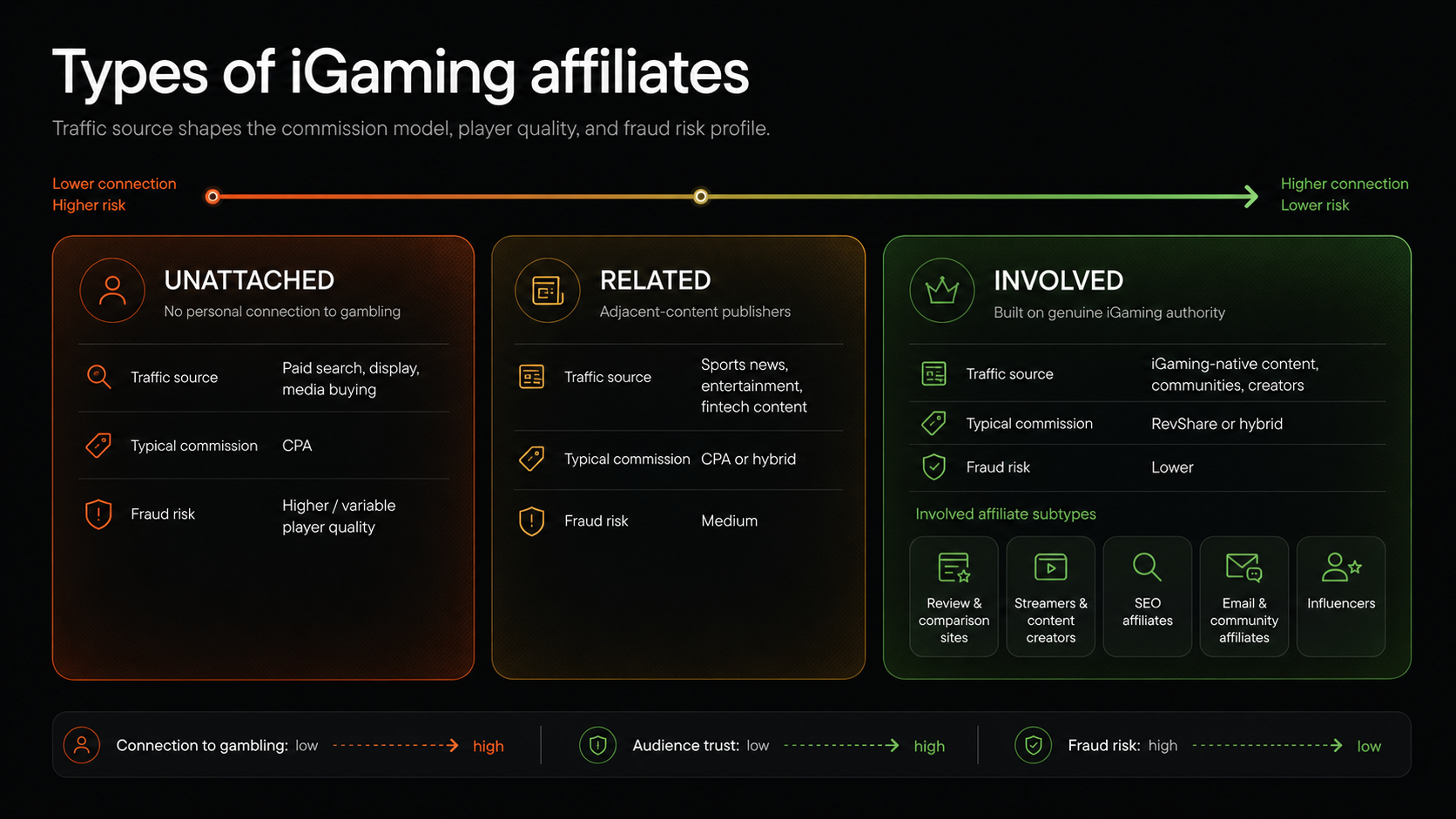
Not every iGaming affiliate operates the same way. The traffic source shapes the commission model, player quality, and fraud risk profile.
Unattached / Related / Involved
Unattached affiliates have no personal connection to gambling. They run paid search, display, or media-buy campaigns. Commission is typically CPA-based because player quality is variable and RevShare exposes them to unpredictable returns on ad spend.
Related affiliates operate in adjacent categories: sports news, entertainment, fintech content, and cross-promote iGaming offers. Traffic volumes can be large, but audience trust is lower than involved affiliates.
Involved affiliates build genuine authority around iGaming content:
Review and comparison sites. The core of iGaming SEO affiliate traffic. Sites ranking for “best online casino [country]” generate high-intent organic traffic with strong deposit conversion rates.
Streamers and content creators. Live streaming casino sessions on Twitch or YouTube. High audience trust, but subject to strict platform and regulatory rules in the UK and EU.
SEO affiliates. Focus on organic rankings for casino, betting, and poker keywords across multiple GEOs.
Email and community affiliates. Sports tipster newsletters, Telegram channels, casino forums: direct audience relationships with established trust.
Influencers. Social media personalities promoting operators to followers. UK advertising standards require sponsorship disclosures; MGA and UKGC apply equivalent rules across the EU.
Suitable iGaming affiliate traffic channels
Each traffic source carries different cost profiles, conversion rates, and compliance requirements.
SEO
The highest-LTV traffic channel. Organic rankings for “best casino [country]” or “sports betting bonus” attract players with verified deposit intent. SEO-acquired players produce 40–60% higher lifetime value than paid-traffic players because content affiliates pre-qualify their audience before the click. Limitation: SEO takes months to compound and is sensitive to Google algorithm updates.
Content marketing
Long-form review articles, game guides, strategy content. Works alongside SEO by targeting informational queries and building topical authority across a site’s full page portfolio.
Paid advertising
Paid search, display, and native ads. Fast to test and scale, but restricted in many regulated markets. Google requires certification for gambling advertising in each jurisdiction. High acquisition costs make RevShare less suitable; most paid media affiliates prefer CPA to close the payback cycle quickly.
Social media
Facebook, Instagram, TikTok, X. Most platforms require ad approval for gambling content. Platforms suppress organic reach for gambling topics in regulated markets. Social performs best in Tier-2 markets where platform policies are less restrictive and audience growth is faster.
Email marketing
Newsletter-based promotion to opted-in subscribers. High conversion rates due to existing audience trust. Must comply with GDPR in the EU and CAN-SPAM in the US. Operators in regulated markets require affiliates to maintain suppression lists for self-excluded players.
Push notifications
Web and mobile push messages. High open rates, low cost. Effective for sports betting affiliates promoting live odds and time-sensitive bonus offers to an already engaged audience.
Influencer marketing
Streamers and social creators. The fastest-growing channel in eSports betting and crypto casino segments. High audience trust, but subject to sponsorship disclosure requirements across the UK, EU, and Australian markets.
GEO tiers and market selection
Market selection determines commission rates, competition levels, and compliance requirements. Choosing the wrong GEO is expensive, either because competition is too high or because payouts don’t justify acquisition costs.
Tier-1: regulated, high-value markets
UK, Germany, Canada, Australia, Sweden, Netherlands. The UK market has 349 active iGaming brands tracked by Blask, with a combined Blask Index of 594 million. Estimated annual player acquisitions: 20.2 million. CPA rates run $150–$400. Competition for English-language casino SEO is high. Compliance requirements are strict. Player LTVs are the highest globally.
Blask data on UK top brands by 2025 growth: Ladbrokes +21.9% YoY, Paddy Power +17.7% YoY, Bet365 +15.2% YoY.
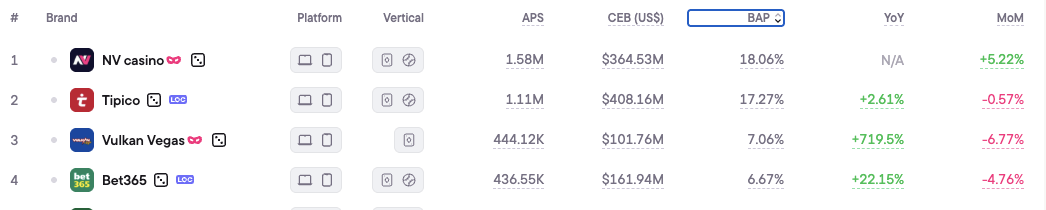
Germany has 349 active brands, 8.3 million annual player acquisitions, and notable demand growth. Vulkan Vegas grew its German Blask Index by +719.5% YoY in 2025 as it expanded from an offshore player base into the regulated market.
Top iGaming online brands in Germany, 2025
Tier-2: fast-growing, increasingly regulated
Brazil, Mexico, India, Poland, South Africa, Japan. Brazil leads all markets Blask tracks by organic consumer demand. Blask Index: 2.57 billion, more than four times the UK. Annual player acquisitions: 79.3 million. The regulated framework (Law 14,790) launched in January 2025. iGaming affiliates now operate in a structured, growing environment where Portuguese-language SEO competition remains far lower than English.
Top Brazilian brands by 2025 growth: Superbet +109.2% YoY, Betano +21.1% YoY, Sportingbet +12.2% YoY. Latin America is projected to grow at 34.6% CAGR through 2027. CPA rates in Brazil: $50–$120. RevShare: 25–35%.
Top iGaming online brands in Brazil, 2025
“The most successful case with Blask is entering a new market. You can replicate an already successful strategy and adapt it to a new audience.” — said Dmitry Belianin, co-founder, Blask
Tier-3: high volume, variable risk
Nigeria, Philippines, Kenya, Vietnam, Bangladesh. Largely unregulated or informally licensed. CPA rates: $15–$50. High traffic potential and high fraud risk. Best for affiliates with direct in-market audience relationships through social, push, or local-language SEO.
Tier-3 markets are not uniform. Blask data reveals structural differences that determine whether an affiliate can actually earn in a given market.
“Nigeria is a huge market that everyone talks about. However, in reality, the market isn’t growing. There is one dominant operator with 75% market share and the player switching rate between operators is almost zero.”
Dmitry Belianin
Co-founder Blask
Bangladesh is different. Traffic Connect used Blask to identify which operators were actively investing in marketing, visible through rising Blask Index scores, rather than defaulting to brands with the most name recognition. “In the Bangladeshi market, our partners identified the brands currently investing heavily in marketing and started driving traffic to them. Result: a 25% increase in revenue in the first month.” — saidBelianin.
The difference: Traffic Connect wasn’t picking brands by commission rate. They picked brands that were growin
What the revenue base does to a RevShare rate
RevShare is paid on net gaming revenue, and no universal definition of that base exists. Gambling.com Group states that NGR under its agreements is gross gaming revenue for a user adjusted for direct costs such as transaction fees, bonuses and taxation, and that those costs can rise — for example through new tax regulation — after a deal is signed. Roobet’s published terms define NGR as gross gaming revenue less progressive contributions, non-cash incentives, chargebacks, balance adjustments, costs and taxes. Two 30% deals written against those two definitions are not the same deal.
Pooling changes the arithmetic again. Referred players are typically pooled per affiliate account, so a single large winning player can zero out the commission payable on every other player in that account for the month. What happens next is contractual: Roobet resets a negative month to zero unless otherwise agreed in writing, then carries forward the deficit of any individual player who lost the program $10 000 or more, offset only against that same player’s future revenue.
Tiers are a modifier, not a model
A rate that rises as volume rises is a schedule attached to RevShare or CPA rather than a seventh structure. How the thresholds work, and what resets them, sits on the affiliate commission tier page.
What the mix looks like in public reporting
Two listed affiliates disclose their model split, and both figures describe one company’s contract mix in one year rather than a market average. Better Collective reported 2025 revenue of €336.7M, with revenue share at 47%, CPA at 24%, subscription sales at 5% and other income at 24%. Raketech reported for continued operations in 2025 that revenue share made up 47.4% of revenue, upfront payments 27.3% and flat fees 23.7%.
Neither split is a benchmark for a program negotiation. They show that the models coexist inside a single business and that the balance between them shifts year to year.
Where the demand behind a deal comes from
Affiliate contracts price acquisition, and the demand available to acquire is not evenly spread. Blask data for H1 2026 shows demand up 46.8% year on year in Nigeria and 15.8% in Brazil, against −5.3% in the United States and −11.6% in Germany.
Blask’s acquisition benchmark quantifies what a market position supports rather than what a program pays. Acquisition Power Score for the United States averaged 556.0K potential new customers a month across H1 2026, in a range of 306.8K to 1.30M. That figure is a market estimate, not a deposit count: an affiliate invoice settles on the operator’s record of a qualified first-time deposit, which no external model observes.
Affiliate tracking scripts, cookies and S2S postbacks
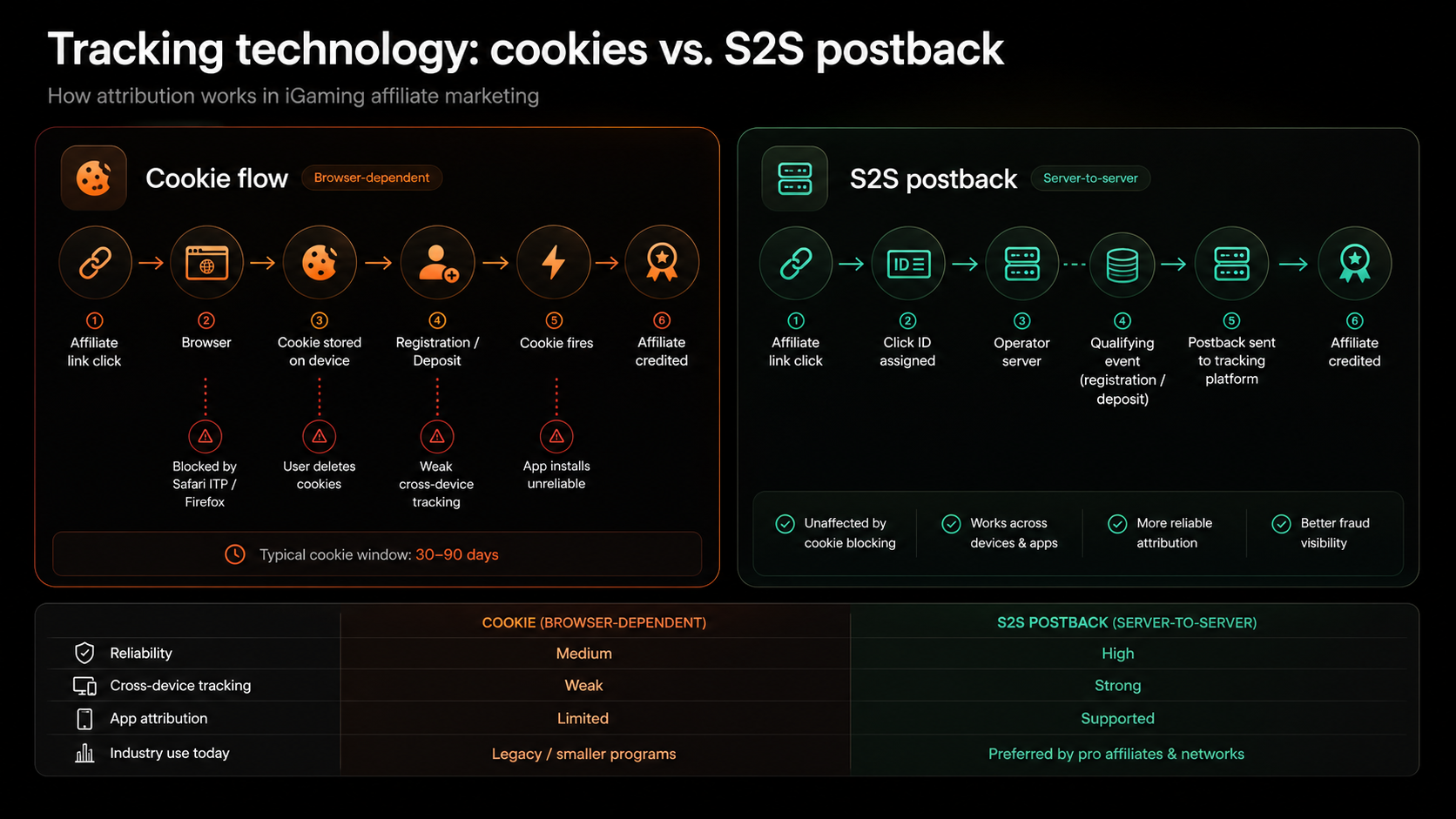
An affiliate tracking script records the click and assigns an identifier to the referred user. Browser-based setups store that identifier in a cookie. Server-to-server postbacks pass it between the affiliate platform and operator backend when a registration, deposit or other conversion occurs. The tracking method does not calculate commission by itself; it supplies the attribution data used by the program’s commission rules.
Accurate attribution is non-negotiable. Without it, affiliates cannot verify commissions and operators cannot detect fraud patterns.
Cookie-based tracking places a browser cookie on the user’s device when they click an affiliate link. If the user later registers and deposits, the cookie fires and credits the affiliate. Standard cookie windows in iGaming run 30–90 days. Limitations: Safari and Firefox restrict or block third-party cookies; users can delete cookies manually; cross-device tracking and app installs cannot be tracked reliably.
S2S (Server-to-Server) Postback tracking bypasses the browser entirely. When a qualifying event occurs — deposit, registration — the operator’s server sends a direct call to the affiliate’s tracking platform, passing a unique session ID assigned at the moment of the click. S2S works across devices and apps and is unaffected by cookie-blocking policies.
Most professional affiliates and performance networks use S2S postback as the primary attribution method. Cookie tracking persists in lower-tech programs and some direct affiliate relationships with smaller operators.
Who carries the compliance risk
Under the UK Gambling Commission’s social responsibility code 1.1.2, licensees are responsible for the actions of third parties they contract with for any aspect of the licensed business. They must contract on terms requiring those third parties to conduct themselves as if bound by the same licence conditions and codes of practice. Also, they must be able to terminate promptly — a provision that names affiliates who have breached an advertising code.
The commercial consequence is written into program terms. Because the licence risk sits with the operator, creative approval, content standards and immediate termination clauses appear alongside the commission schedule, and an affiliate manager enforces both.
Future trends in iGaming affiliate marketing for 2026
5 patterns are reshaping how affiliates build and scale programs in 2026.
AI content and E-E-A-T pressure. As AI-generated casino reviews multiply, Google’s quality signals shift toward demonstrated experience, expertise, authority, and trust. Affiliates who document genuine player experience, produce video content, and build authoritative backlink profiles hold search positions. Generic AI-written comparison pages face ranking pressure in competitive GEOs.
Alexey Shostak
Owner at AFFCatalog
“AI has stopped being just a text tool — it became part of the rules of the game. Solo affiliates now launch hundreds of thousands of sites a month. Teams use machine learning for traffic segmentation, creative testing, and player LTV prediction. Operators and networks apply AI algorithms for real-time clickbait moderation and detection of complex fraud schemes, including bot attacks.”
AI’s role in affiliate operations now extends well beyond content generation — raising traffic quality thresholds and enforcing them faster than at any previous point in the channel’s history
Brazil and LatAm as the primary growth opportunity. With a regulated framework operational since January 2025 and a Blask Index four times larger than the UK’s, Brazil is the highest-opportunity affiliate market right now. Operators including Betano, Superbet, and Sportingbet are scaling affiliate acquisition budgets. Portuguese-language SEO content competition remains lower than English-language casino content.
Crypto affiliates and alternative program structures. Crypto casino programs offer RevShare rates up to 60% with no-NCO policies. Growth is fastest in markets with limited regulated operator access: Southeast Asia, Africa, and parts of Latin America. Higher variance, higher ceiling.
Compliance automation. Operators in the UK and EU are adopting automated affiliate content monitoring tools to meet UKGC and MGA requirements at scale. Affiliates using pre-approved creatives, standardized responsible gambling frameworks, and compliance-ready content management get faster program approval and access to higher-value deals.
Personalized commission structures. Operators are moving from static RevShare rates toward deal structures driven by real-time player LTV prediction, assigning commission rates per affiliate cohort based on historical performance data. Affiliates with clean, well-attributed traffic data negotiate favorable terms as this becomes standard.
FAQ
What affiliate payout models exist in iGaming?
Six: RevShare, a percentage of net gaming revenue from referred players; CPA, a fixed payment per qualifying first deposit; hybrid, both on the same player; CPL, a fee per qualified lead; fixed fee, an agreed sum for a placement; and sub-affiliate override, a percentage of the commission earned by a recruited affiliate.
What is a hybrid deal?
A hybrid agreement pays a reduced CPA on the qualifying deposit and a share of net gaming revenue from the same player afterwards. It settles part of the value at referral and leaves the rest exposed to how that player performs.
Is RevShare calculated on GGR or NGR?
Almost always on NGR, and the deduction list is set in the contract rather than by a standard. Published examples deduct bonuses, transaction fees and taxation; others add chargebacks, progressive contributions and balance adjustments, which changes what the same percentage is worth.
Bottom line
An affiliate payout model is a rule about timing and base, not a rate. RevShare, CPA, hybrid, CPL, fixed fee and sub-affiliate override allocate acquisition risk differently between publisher and operator, and the deduction list, pooling rule and qualification conditions decide what the headline number turns into. The percentage is the last thing worth comparing.
“How long has the operator been on the market? On how many markets does this operator work? What is the general dynamics of this operator — is it growing, falling, stagnating? These are the questions you need to answer before you sign.”
Blind box gambling is a paid transaction in which chance decides which item of value the buyer receives, and the payment is made for that chance. A sealed retail box that always delivers a figurine from a published series remains a product sale; the hidden variant is a feature of the goods. A livestream spin, […]
Walk through any Japanese city and you will hear it before you see it: the metallic rain of steel balls, amplified jackpots, and LCD reels selling the latest anime tie-in. Neon facades say pachinko in katakana, foreigners call it pinball. Neither label captures the economics. This is Japan’s largest commercial gambling category, a vertical that […]
A retention manager is the operator employee who owns what happens after a player’s first qualifying deposit: who stays active, who is offered what, and how those cohorts are reported. The job sits with the player base, not with media buying and not with B2B account management at a supplier. The commercial reason the role […]