
- Updated:
- Published:
Net gaming revenue (NGR)
Two operators can report identical gross gaming revenue for the same month and publish different net gaming revenue. The difference sits in the deduction list, and no accounting standard fixes what belongs on it.
NGR is the number affiliate contracts pay from, the number supplier fees are charged against, and the number boards read as retained gaming revenue. It also travels without its formula, which is how two figures that are both correct end up compared as though they measured the same thing.
What NGR means in iGaming
| Net gaming revenue is gross gaming revenue after a defined set of gaming-related deductions. Bonus cost, gaming duty, payment fees, chargebacks, jackpot contributions and supplier fees are the items that appear most often, in combinations that change by operator, contract, jurisdiction and reporting purpose. |
Gross gaming revenue is the amount an operator retains from stakes after paying player winnings. NGR starts from that figure and removes whatever the governing document lists. An NGR number quoted without its deductions therefore carries no information beyond a direction of travel.
From turnover to operating profit
Four measures describe the same betting activity at four depths, and each strips out more than the one above it.
| Measure | Formula | What it shows | What it does not show |
|---|---|---|---|
| Turnover | Total stakes | Betting volume | Whether any of it was retained |
| GGR | Stakes − winnings | Gross win from gambling activity | Bonus, tax, payment or supplier cost |
| NGR | GGR − defined deductions | Retained gaming revenue under a stated formula | Anything outside that stated list |
| Operating profit | NGR − operating costs | Whether the business earns after all costs | The gaming margin behind it |
A worked example
The figures below are illustrative and are not Blask or operator data.
Stakes of $1 000 000 against player winnings of $920 000 leave GGR of $80 000. A formula deducting bonuses of $12 000, gaming duty of $10 000, payment fees of $3 000 and supplier fees of $5 000 leaves NGR of $50 000.
The same month supports a lower figure under a wider list. Adding chargebacks of $4 000 takes NGR to $46 000, and a 30% RevShare commission calculated on the narrow base pays $15 000 against $13 800 on the wide one. The advertised percentage is identical in both cases.
NGR margin
NGR margin states how much of GGR survives the deductions:
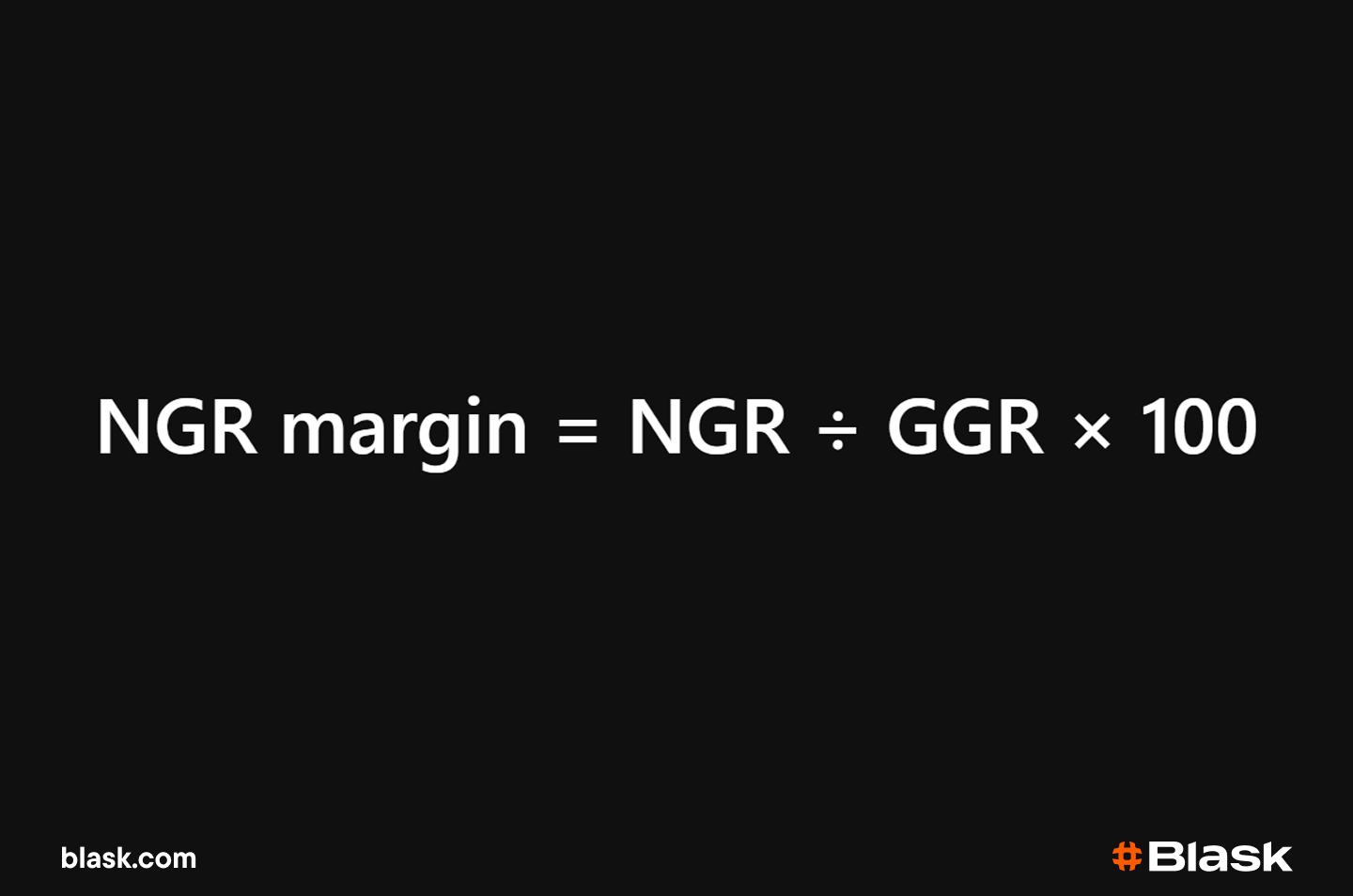
The example above gives 62.5%. Tracked over time against one unchanged formula, the ratio measures deduction pressure. Compared across two operators using different formulas, it measures the difference between the formulas.
Why the same GGR produces different NGR
Public documents show how far the definitions spread. Playtech’s 2024 annual report sets out its operating model with NGR as GGR minus bonuses to players and taxation. Entain defines NGR in its 2025 annual report as net revenue before charging for VAT and sales taxes, reconciled as a non-GAAP measure inside the income statement. The Casumo Partners affiliate terms take the widest of the three, defining net revenue as:
- monies received less winnings,
- bonuses and loyalty bonuses,
- administration fees,
- fraud costs,
- chargebacks,
- returned stakes,
- duties and taxes,
- jackpot contributions and third-party game or software fees.
Regulators add a further definition rather than settling the question. The Gambling Commission requires licensees to report gross gambling yield — stakes, plus other amounts accruing to the licensee, minus prizes and winnings — and states that operators must report GGY figures and not GGR. No regulator publishes a universal NGR deduction list, because NGR is a management and contractual measure rather than a statutory one.
NGR is not profit
NGR sits above salaries, property, technology, general marketing, interest and depreciation. A brand can hold a strong NGR margin and still lose money once those lines apply, which is why NGR maps to neither EBITDA nor net income. Where the deduction list runs wide enough to include affiliate commission and platform fees, NGR moves closer to a contribution measure, and still stops short of profit.
How a market baseline differs from reported revenue
GGR and NGR both describe one reporting entity, which leaves every competitor outside the figure. Blask models the market level instead. Competitive Earning Baseline estimates the revenue a brand or market could support at its current competitive position and publishes it as a range rather than a point.
For the United States across completed H1 2026, Blask data puts average monthly CEB at $6.78B ($3.94B–$15.28B), with offshore brands accounting for $4.56B of that average against $2.21B for onshore brands. CEB is a modelled baseline and not a reported result, so no NGR figure can be derived from it — the GGR and CEB comparison sets out why the two are read separately.
FAQ
What is the difference between GGR and NGR?
GGR is stakes minus player winnings. NGR is GGR minus a defined list of deductions, commonly bonus cost, gaming duty, payment fees, chargebacks, jackpot contributions and supplier fees. GGR varies far less as a concept, while NGR depends on the document that defines it.
Is NGR profit?
No. NGR excludes staff, property, technology, general marketing, interest and depreciation, so it describes retained gaming revenue under a stated formula rather than EBITDA, operating profit or net income.
Why do NGR figures differ between operators?
Because the deduction lists differ. A listed company’s non-GAAP NGR, an internal product KPI and an affiliate programme’s net revenue can describe the same activity and produce three different numbers.
Bottom line
NGR carries exactly as much meaning as the deduction list attached to it. Two figures built on different lists are not comparable, and the gap between a narrow and a wide definition lands on whoever is paid from the result — the supplier charging a percentage of it, the affiliate on revenue share, or the board reading the margin as performance.