
- Updated:
- Published:
Average revenue per paying user (ARPPU)
Average revenue per paying user shows what the players who spend are worth in a reporting period. What is ARPPU worth to an operator? It separates two questions that other metrics blur: how many players pay, and how much revenue each of them generates.
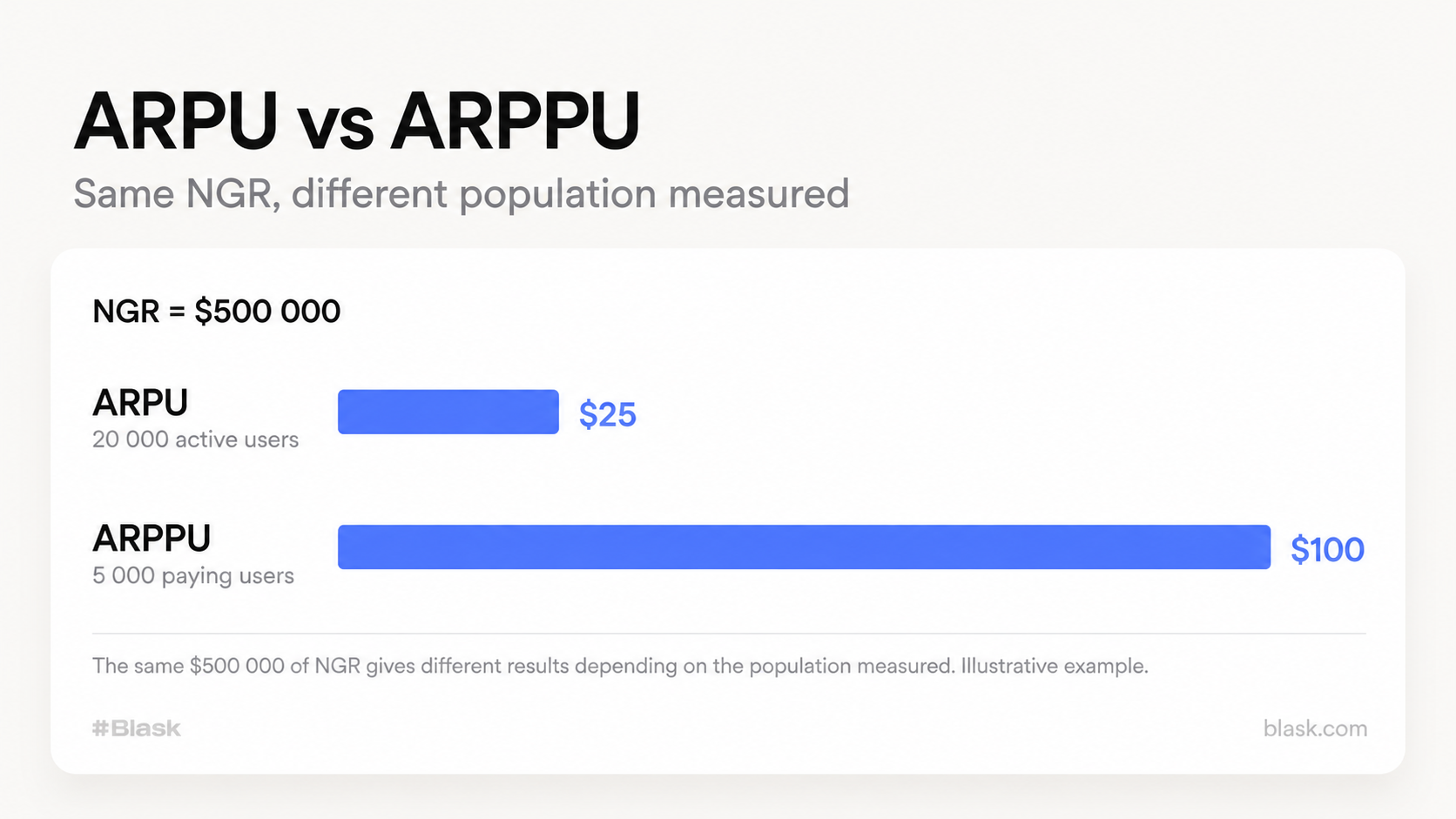
Two casinos can earn the same $500 000 of net gaming revenue (NGR) from very different audiences. One has 5 000 paying players, the other 20 000. Their ARPPU is $100 and $25.
What Is Average Revenue Per Paying User (ARPPU)?
ARPPU divides revenue earned in a period by the unique players who paid in that same period. It ignores registered users who never paid, so it describes monetization of the paying audience only.
Two definitions decide the result: what counts as revenue and who counts as a payer. If either changes between reports, the number moves without any change in player behavior.
Why ARPPU Matters in iGaming
The metric shows whether revenue moved because more players paid, because each payer generated more, or both. Operators use it to:
- Compare player segments and acquisition channels
- Judge CRM and bonus campaigns
- Turn payer forecasts into revenue plans
- Spot dependence on a few heavy spenders
Who Counts as a Paying User?
A paying user is a unique player with a qualifying payment in the period. Depositing and generating revenue are different events, so the rule must be explicit.
| Definition | Counts as paying | Main risk |
|---|---|---|
| Depositor | At least one successful real-money deposit | Includes players who never played |
| Real-money bettor | At least one settled bet or round | Excludes idle depositors |
| Revenue-generating | Any player with non-zero revenue | Drops players who won, inflating ARPPU |
Flutter, for example, counts players who had “a bet settled and/or contributed to rake or tournament fees during the month” and excludes those who used only new-player or retention incentives. Failed deposits, reversals and bonus-only activity never qualify.
How to Calculate ARPPU
The ARPPU calculation takes two inputs from the same period and the same business scope. The hard part is agreeing on the definitions behind them, not the division.
ARPPU Formula
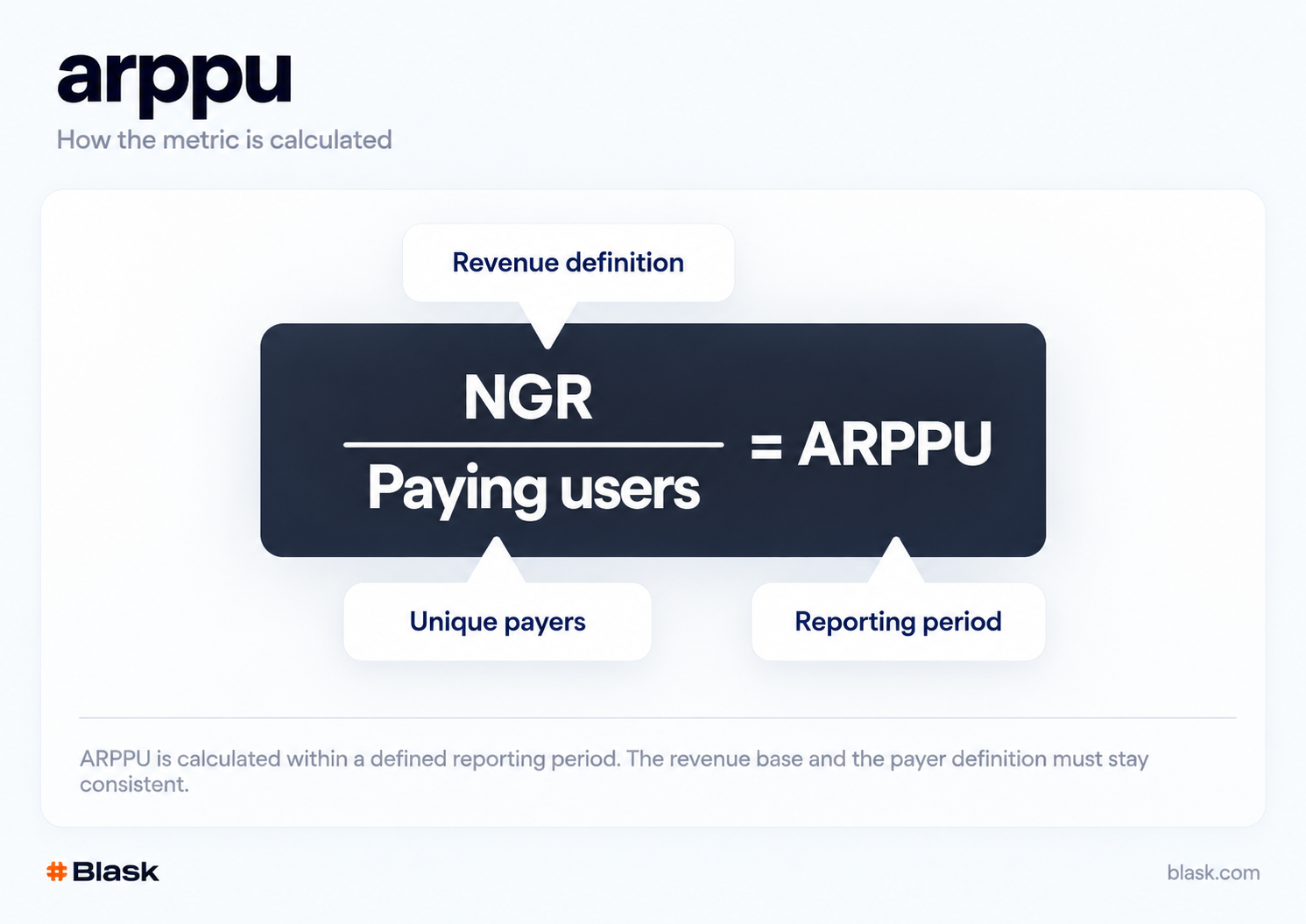
The average revenue per paying user formula is:
💡 Formula: ARPPU = Revenue in the period ÷ Unique paying users in the period
With NGR as the revenue base, it reads ARPPU = NGR ÷ Unique paying users. The ARPPU formula only works if both parts share one period: January NGR over monthly depositors cannot be compared with February GGR over active bettors.
Step-by-Step ARPPU Calculation Example
A hypothetical online casino, one calendar month. The figures illustrate the arithmetic and are not an industry benchmark.
| Metric | Value |
|---|---|
| Registered players | 50 000 |
| Monthly active players | 20 000 |
| Unique paying players (depositors) | 5 000 |
| Gross gaming revenue (GGR) | $650 000 |
| Net gaming revenue (NGR) | $500 000 |
With NGR, $500 000 ÷ 5 000 gives an ARPPU of $100. With GGR, the same casino shows $130. Both are valid, but they measure different bases. The $100 is an average, and no single player is “worth” it.
Daily, Monthly and Quarterly ARPPU
The period changes the figure, so values for different periods are not interchangeable.
| Period | Typical use |
|---|---|
| Daily | Event and campaign monitoring |
| Weekly | Promotion effects |
| Monthly | Management reporting, CRM analysis |
| Quarterly | Longer-term performance |
Monthly ARPPU smooths short-term noise but reacts to large wins and VIP activity. A quarterly figure uses quarterly revenue and quarterly unique payers. It is not the average of three monthly values, because one player can pay in several months.
GGR vs NGR: Which Revenue Should Be Used for ARPPU?
Revenue in gambling is neither the money deposited nor the money wagered. Two measures matter: gross and net gaming revenue.
Gross Gaming Revenue (GGR)
GGR is total stakes minus player winnings. If players stake $2M and receive $1.85M back, GGR is $150 000. It shows gaming performance before operating deductions. Treatment of bonuses and jackpots varies by product and jurisdiction, so label the basis on every chart.
Net Gaming Revenue (NGR)
NGR starts from GGR and subtracts the items in the operator’s methodology:
- Bonus and promotional costs
- Gaming taxes
- Payment processing fees
- Chargebacks
- Jackpot contributions
- Certain supplier or platform fees
No universal deduction list exists, so equal GGR can produce different NGR. For profitability work, NGR is usually the better base while its definition stays stable.
Why Deposits Are Not the Same as Revenue
A player deposits $200, wagers $500 through repeated play and receives $470 in winnings. The deposit was $200, but the gaming revenue is $30. Dividing deposits by payers gives deposit volume per payer, which is a different metric.
ARPPU vs Other iGaming Metrics
Each player-value metric answers its own question.
| Metric | What it measures | Main use |
|---|---|---|
| ARPPU | Revenue per payer | Monetization of payers |
| ARPU | Revenue per user in the defined population | Monetization of the whole audience |
| ARPDAU | Revenue per daily active user | Daily monetization |
| LTV | Value of a player over a defined lifetime | Acquisition economics |
| Average deposit | Value per deposit | Payment behavior |
ARPPU vs ARPU
ARPU divides revenue by all users, including non-payers. In the example, $500 000 over 20 000 active players gives an ARPU of $25, against an ARPPU of $100. The link between them is the payer rate: ARPU = payer rate × ARPPU.
ARPU can rise while ARPPU falls if more players start paying small amounts. Dmitry Belianin, co-founder of Blask, wrote on his Telegram channel about why the per-user view matters more than the total:
“The smartest operators I know don’t lose sleep over GGR. They lose sleep over ARPU (average revenue per user), because maximizing player value is always better than chasing volume. ARPU measures how effectively you generate revenue from each user, not just the total amount. It helps identify valuable players instead of simply pouring money into acquisition. And it makes you think about long-term retention, not only about more deposits and bets.”
Dmitry Belianin Co-founder Blask
ARPPU vs ARPDAU
ARPDAU divides one day’s revenue by that day’s active users. It suits tracking around sporting events and game launches. It counts active users whether or not they deposit, and its window is one day, so it cannot sit next to a monthly ARPPU as if both described one unit.
ARPPU vs Player Lifetime Value (LTV)
ARPPU vs LTV is snapshot against cohort. ARPPU photographs everyone who paid in a period, including players acquired years ago. LTV follows one acquisition cohort forward, usually at 30, 90 or 180 days.
A casino can print a strong monthly ARPPU because veterans carry revenue while new cohorts leave within weeks. Judge acquisition spend with LTV, CAC and payback. The LTV guide covers the cohort side.
ARPPU vs Average Deposit Amount
Average deposit measures transaction size. A player who makes five deposits of $50 has deposited $250, but revenue depends on the betting outcomes and deductions that follow. Deposit behavior explains habits and does not replace revenue.
What Affects ARPPU in Online Casinos and Sportsbooks?
ARPPU moves when the payer population changes, when revenue per payer changes, or both. Five factors drive most of it.
Player Activity and Betting Frequency
More wagering gives more chances to earn but not a proportional gain. During a major tournament, a sportsbook can see turnover jump while NGR barely moves, if bettors win more or promotional deductions rise.
Player Segments and VIP Activity
Revenue is concentrated. A GambleAware study of 140 000 accounts at seven British operators found that the 5% of accounts with the highest losses generated at least 70% of gross gambling yield in betting, virtual casino, live casino and slots. The data covers July 2018 to June 2019, in one market.
Equal ARPPU can hide different risk. Report the median and the top-group share beside the mean, and give VIP and high-roller segments their own line.
Casino vs Sportsbook Revenue Models
ARPPU in online casinos depends on game mix, return to player and wagering volume. Sportsbook revenue depends on turnover, odds, trading margins and sporting results, so it swings more from month to month. A football bettor and a slots player with equal deposits can differ widely in revenue.
Bonuses, Promotions and Revenue Margins
A promotion can attract more payers and raise GGR while bonus deductions push NGR per payer down. Judge campaigns on gross and net revenue together with promotional cost.
Geographic Markets and Player Behavior
Markets differ in product availability, income, taxation and regulation. Comparing euros with Brazilian reais needs an explicit conversion rule. Even then, markets with different NGR definitions or payer criteria are not comparable.
How to Analyze ARPPU
A headline average can rise because of stronger monetization, a changed player mix, or a smaller denominator. Splitting the metric shows which explanation fits.
ARPPU by Player Cohort
Group players by registration month or first-deposit date and compare equal windows. A January cohort measured over 30 days cannot be set against a February cohort measured over 10 days. See cohort analysis.
ARPPU by Acquisition Channel
Organic search, affiliates and paid media bring players with different habits. A high-ARPPU channel is not automatically the most profitable if its players cost more to acquire. Pair ARPPU with true CAC, retention and contribution margin.
ARPPU by Geography
Segment by country with one currency rule, period, revenue base and payer definition. A higher figure in one market does not prove it is more profitable or a better entry point.
ARPPU by Game Category
Compare players grouped by slots, live casino, crash games and other categories. Shared-wallet players use several categories in a period, so assign each to a primary category or allow overlap. Summing overlapping category counts overstates unique payers.
ARPPU Trends Over Time
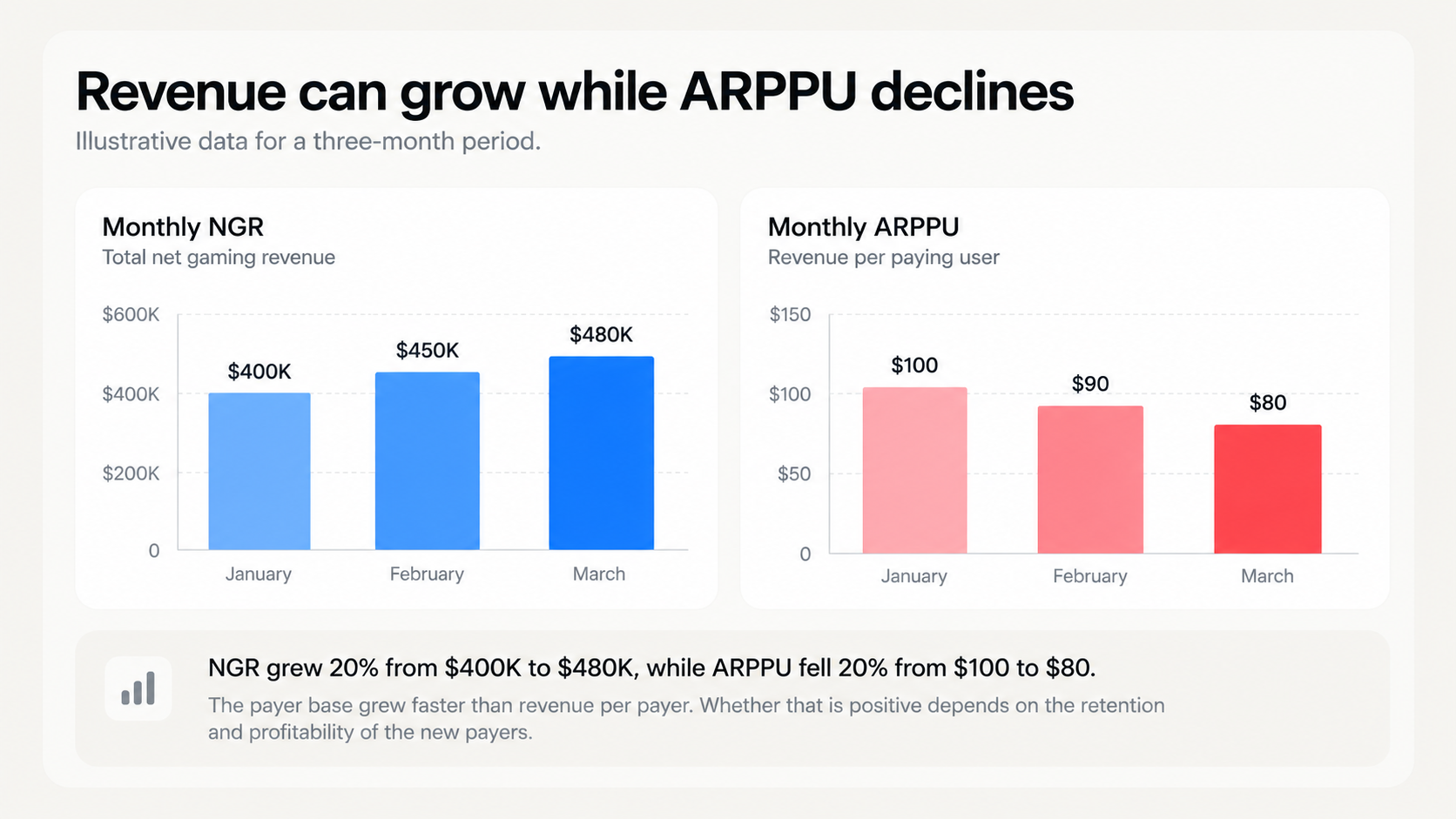
Read ARPPU together with the number of payers. A hypothetical quarter shows why.
| Month | NGR | Paying users | ARPPU |
|---|---|---|---|
| January | $400 000 | 4 000 | $100 |
| February | $450 000 | 5 000 | $90 |
| March | $480 000 | 6 000 | $80 |
NGR grew 20% while ARPPU fell 20%. The payer base grew faster than revenue per payer. Whether that is good depends on the retention and profitability of the new payers. The table below turns the pairing into a reading guide.
| Payers | ARPPU | Likely reading | What to check |
|---|---|---|---|
| Up | Up | Strong month or healthy growth | Are new payers real or bonus-only? |
| Up | Down | Cheaper acquisition dilutes the average | Cohort quality, bonus cost, 30-day retention |
| Down | Up | Weak payers left, strong ones stayed | Churn by segment, VIP concentration |
| Down | Down | Volume and value both fall | Market demand, competitors, product issues |
A real case sits in the second row. In the quarter ended June 30, 2026, DraftKings reported 3.6 million monthly unique payers, up about 9%, and revenue per payer of $132 a month, down about 13%. The company cited customer-friendly sports outcomes and new-customer promotions.
How to Increase ARPPU in iGaming
Raising ARPPU in iGaming should mean improving sustainable monetization, not pushing players to spend more. Revenue quality, retention, experience and responsible gambling set the limits.
Player Segmentation and Personalized CRM
Segment players by activity, product preferences and past campaign response, and send each group relevant offers instead of one message for all. Measure ARPPU beside retention, opt-outs, promotional cost and safer-gambling indicators.
Improving Player Retention
Players who stay longer pay across more periods. Check whether failed payments, technical faults or weak support push them out, and separate those from players who choose to gamble less. Track churn rate and retention by cohort.
Cross-Selling Between Casino and Sportsbook
A sportsbook customer may enjoy live casino. Offer the second product through relevant discovery, within local rules and responsible gambling controls. Judge it by retention and incremental net revenue. The cross-sell analysis covers timing and value.
Optimizing Bonus Efficiency
Bonuses lift engagement while cutting NGR through deductions. Measure incremental revenue after bonus cost, not deposit volume, and use control groups to separate real lift from activity that would have happened anyway.
Improving User Experience and Payment Flows
Payment failures, slow withdrawals and unclear account information erode trust and raise support costs. Track successful payment rate, withdrawal speed and complaints beside ARPPU.
Responsible Gambling Considerations
A higher ARPPU is not always desirable. A rise driven by a few customers showing harmful behavior is not successful monetization. In the GambleAware study, 1.2% of gaming accounts lost £5 000 or more over the year. Honor self-exclusion and marketing restrictions, and never target vulnerable players with spending incentives.
How Operators Use ARPPU for Business Decisions
ARPPU becomes useful when connected to other operating metrics.
Evaluating Acquisition Channels
Two affiliate campaigns each deliver 500 paying customers. Campaign A produces $40 000 of NGR and Campaign B $60 000. ARPPU is $80 and $120. Campaign B earns more per payer, but acquisition cost, retention and LTV decide which one pays back.
Measuring CRM Campaign Performance
A campaign can raise revenue without lifting ARPPU if it adds low-revenue payers. It can also appear to lift ARPPU because inactive players stopped depositing. Compare payer count and net revenue per paying user against a control group.
Forecasting Revenue and Player Value
Under a stable methodology, ARPPU links payer forecasts to revenue:
Projected revenue = Expected paying users × Expected ARPPU
10 000 monthly payers at an assumed ARPPU of $75 imply $750 000 a month. This is a planning formula, not a promise: adjust for seasonality, player mix and the variance of gaming results.
Identifying Changes in Player Monetization
When ARPPU jumps, ask:
- Did total NGR rise?
- Did the number of payers fall?
- Did a small group generate unusual revenue?
- Did bonus spending or the mix of casino and sportsbook change?
- Did the revenue or payer definition change?
Common ARPPU Calculation Mistakes
Most errors come from inconsistent inputs, not from the arithmetic.
- Using deposits instead of revenue. Deposits are transferred funds, not gaming revenue
- Mixing GGR and NGR. A switch between periods breaks the trend
- Counting transactions, not players. Five deposits from one person are one payer
- Mixing periods. Monthly NGR over weekly payers means nothing
- Ignoring shared wallets. One player may sit in both casino and sportsbook segments but counts once for the brand
- Comparing incompatible markets. Currency, taxes, bonus treatment and payer rules differ
- Ignoring negative or concentrated revenue. Large player wins can push a period below zero, and a few VIPs can distort the mean
- Treating ARPPU as LTV. A monthly snapshot is not a cohort value
ARPPU Benchmarks: Can Operators Compare Different Markets?
Operators often ask for an industry figure. None exists, for structural reasons.
Why There Is No Universal iGaming ARPPU Benchmark
Product mix, market maturity, tax, bonus accounting and payer definitions all differ. Two competitors in one country can report different figures from different definitions. A public reference point such as DraftKings’ $132 per monthly payer depends on that company’s own definitions and product mix, so treat it as context, not a target.
How to Compare ARPPU Across Operators and Markets
Compare like with like:
- The same product or a clearly defined mix
- The same period and payer definition
- The same GGR or NGR methodology
- The same currency and exchange-rate rule
- Similar cohorts and segments
Internal benchmarks are usually more actionable, because stable definitions remove most outside noise. A good ARPPU in iGaming is one you can reproduce year after year, not simply a high one.
How Blask Adds Market Context
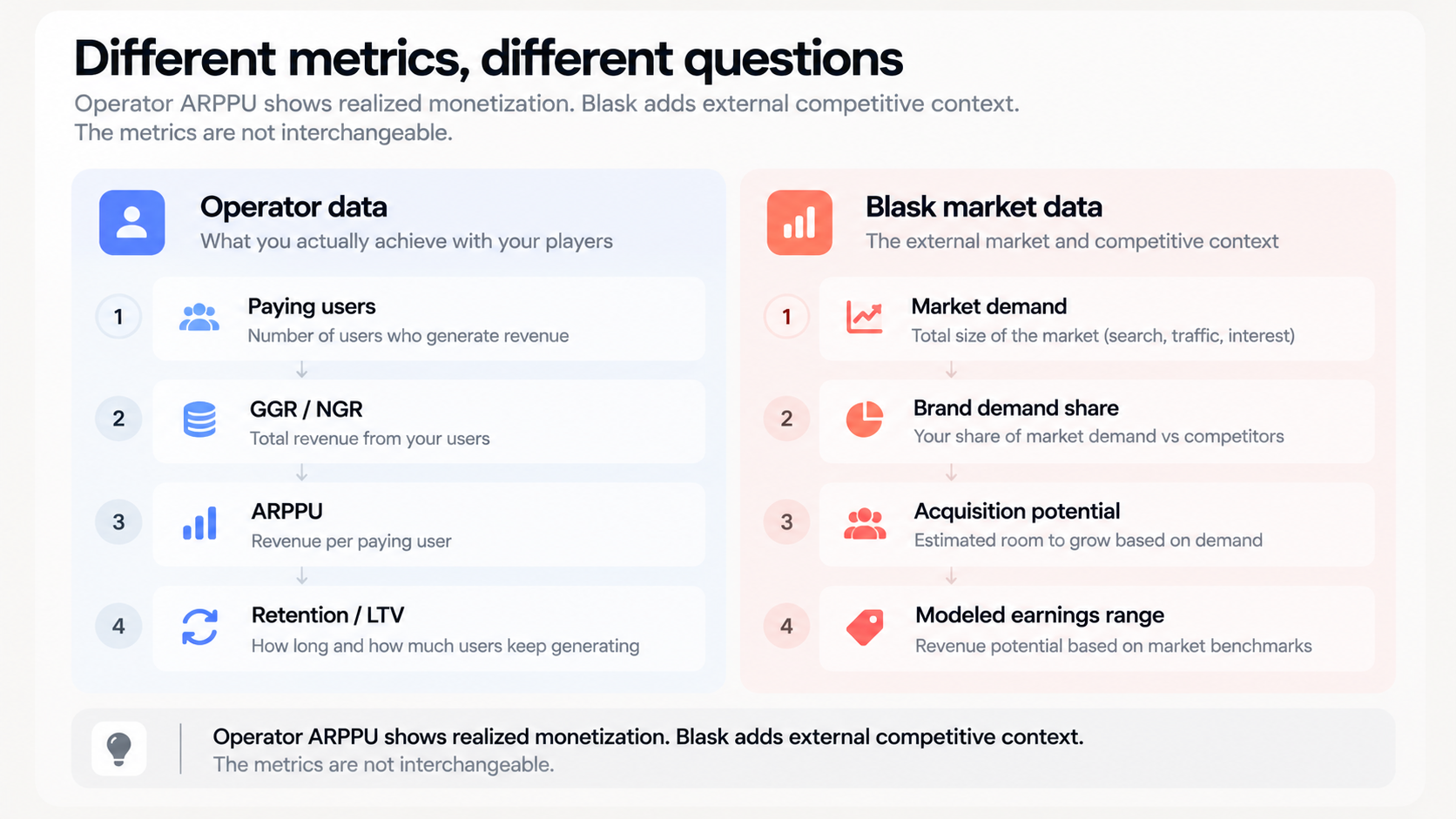
Blask does not publish operator-level ARPPU, which needs payer counts and ledger revenue held by the operator. It supplies an outside view:
- Blask Index: a real-time measure of market demand volume for iGaming brands in a given country, based on normalized search data
- Brand’s Accumulated Power (BAP): a brand’s share of total market demand in a country and period
- Acquisition Power Score (APS): how many new customers a brand’s position should bring, as a min–avg–max range
- Competitive Earning Baseline (CEB): a modeled revenue range, min–avg–max, for what a brand’s position should earn
CEB is a market estimate, not actual NGR, and CEB divided by APS is not ARPPU: CEB covers all of a brand’s revenue, while APS counts new customers only. Max Tesla, CEO and co-founder of Blask, explains why the outside view matters where nobody reports revenue:
“All offshore iGaming is a grey zone with no public financial reporting. No regulatory reports, no investor disclosures, no audited figures. Yet in many countries offshore brands take more than half of all demand. Ignoring this part means seeing only half the picture. Estimating by eye means guessing. Blask closes this gap. […] In regulated jurisdictions, we calibrate brands against confirmed GGR from regulators and operator reporting. In offshore ones, through demand signals and ARPU benchmarks.”
Max Tesla CEO and co-founder Blask
For international brands, Blask extrapolates ARPU from local benchmarks and adjusts for regional spending habits. To see how brands rank by demand in single markets, open the rankings for the UK, Germany, Brazil and the US.
📚 Read more: How to track iGaming competitors with Blask and Blask Index.
Best Practices for Tracking ARPPU
A reliable dashboard makes the calculation reproducible. Fix the revenue definition and the payer rule first, then apply both in every period. Track ARPPU beside:
- Unique paying users and payer conversion
- GGR, NGR and bonus cost
- Retention and churn by cohort
- Acquisition cost and LTV
- Revenue concentration and safer-gambling indicators
Separate changes caused by player mix from changes in revenue per existing player. How to calculate ARPPU is easy. Keeping it comparable for years is the real work.
Frequently Asked Questions About ARPPU
What Does ARPPU Stand For?
ARPPU stands for average revenue per paying user. It measures revenue per unique paying player in a defined reporting period.
What Is a Good ARPPU in iGaming?
No universal good value exists. It depends on product mix, player behavior, revenue methodology and market. Prioritize consistent internal comparisons and long-term customer economics.
Is Higher ARPPU Always Better?
No. A higher figure may reflect stronger monetization, but it can also come from fewer payers, favorable gaming outcomes or revenue concentrated in a few players. Responsible gambling and long-term profit matter as well.
How Often Should ARPPU Be Calculated?
Monthly works for management reporting. Daily or weekly calculations help investigate events and campaigns. Keep definitions identical across periods.
What Is the Difference Between ARPPU and ARPU?
ARPPU vs ARPU comes down to the denominator: ARPPU divides revenue by paying users, ARPU by the whole defined user population, non-payers included.
Does Blask Provide ARPPU Data?
No. Blask does not publish operator-level ARPPU. Its metrics give external context on demand, brand position, acquisition potential and modeled earnings.

“`