
- Updated:
- Published:
What is a bet slip
Every sports bet passes through the same narrow gate. A customer taps a price, the selection lands somewhere on screen, and for a few seconds the product holds its breath. That pause is the bet slip: the place where intent becomes a contract. Product teams treat it as a checkout. Trading teams treat it as a risk checkpoint. Regulators treat it as the last readable surface before money moves. Get the slip wrong and you get mis-bets, abandoned carts, and disputes that support cannot unwind.
What is a bet slip?
| A bet slip is the electronic or printed summary of one or more selections a customer intends to place with a sportsbook. It consolidates markets, odds format, stake or stakes, bet type, and calculated potential returns before the customer commits. In regulated markets it functions as the betting ticket made legible: the gamble spelled out in plain view, not buried in account history after the fact. |
Think of it as a shopping cart for wagers. Selections go in, totals update, the customer reviews, then confirms. Pinnacle’s explainer frames the slip exactly that way: add picks, review details, commit when ready. Once submitted, it becomes the official record of the wager.
Retail still matters. In a betting shop the customer fills a paper slip or uses a kiosk; the printed ticket is proof of purchase. Online, the same job is done in pixels: live odds refresh, calculators run instantly, and the backend receives a structured payload the risk engine can accept or reject. Betmaster’s academy guide notes that both bet slip (paper) and betslip (software UI) appear in the wild. The mechanics are identical; only the medium changes.
How to read a bet slip
A readable slip answers four questions without making the customer hunt.
Selection. Which event, market, and outcome are being backed? “Arsenal to win” pays only if Arsenal wins. Ambiguity here is how disputes start.
Odds. The agreed price, in fractional, decimal, or American format depending on market. The slip should show the format the customer chose and update it if the line moves.
Stake. Money at risk. On multiples and systems, distinguish unit stake (per line) from total stake (what leaves the wallet). betHQ’s walkthrough is explicit about this split because system bets multiply cost by line count.
Potential return. Maximum payout if the bet wins, usually including the original stake in jurisdictions that quote return rather than profit. Profit alone is return minus stake.
UK-facing slips add shorthand regulars expect: EW (each-way), SP (starting price), Acca (accumulator of four or more legs), Void (stake returned). An each-way (EW) bet is two bets in one: win at full odds and place at a fraction, common in horse racing and outright markets, with stake doubled to cover both parts. GotTheOdds’ beginner guide lists these abbreviations because retail literacy still drives search volume even as apps dominate.
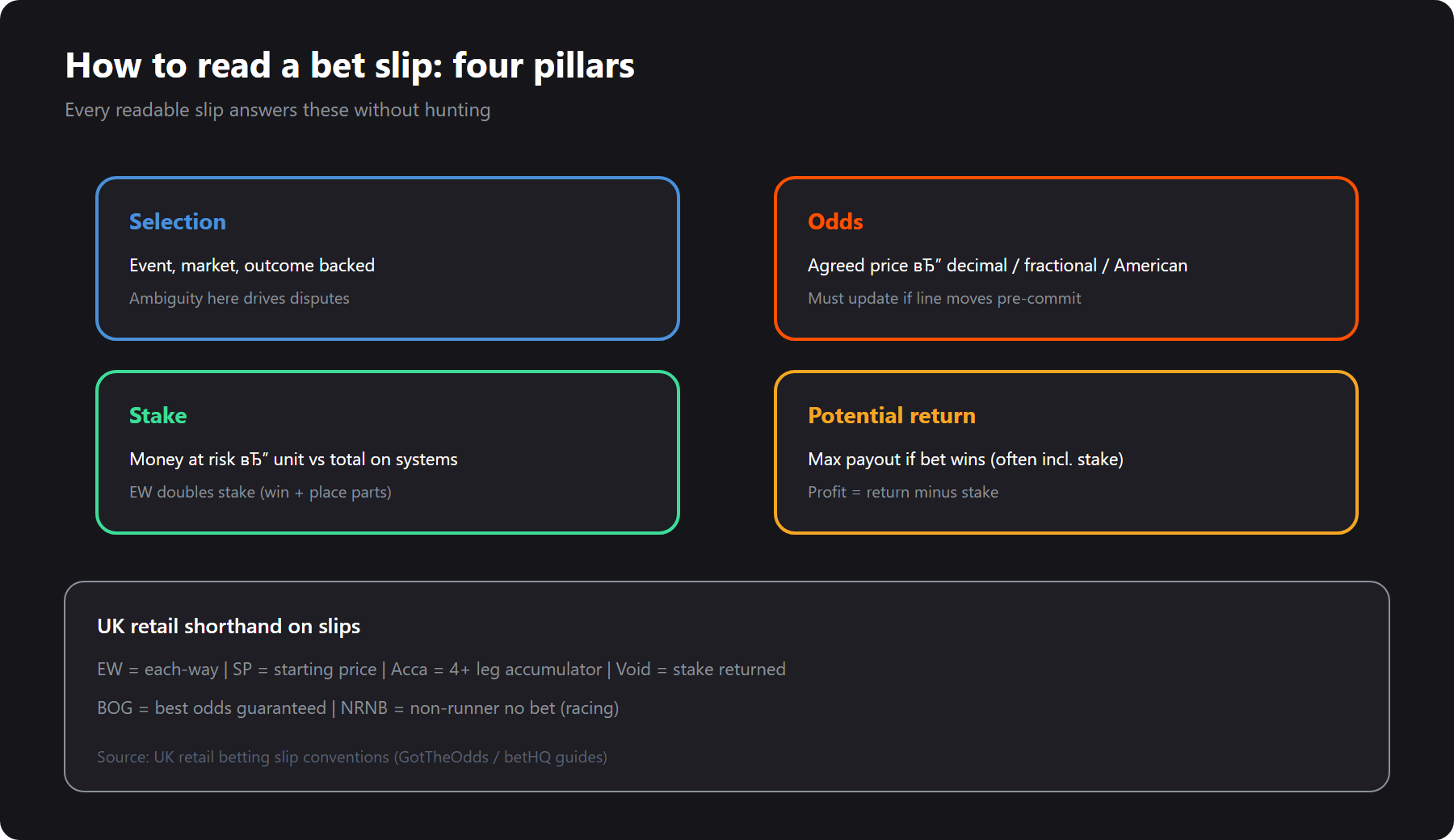
How to read a bet slip — selection, odds, stake, potential return
Paper vs digital bet slips
The story splits at the counter.
On paper, the customer writes selections and stake, hands the slip to a cashier, and keeps the ticket to claim winnings. Odds are fixed at submission unless the shop allows re-pricing. There is no live recalculation; what is printed is what was agreed.
Digital slips invert the friction. Odds can move until acceptance. Potential return recalculates on every tick. Betting.net’s A–Z entry describes how online slips auto-generate multiple bet options once several selections are added, which is powerful for experienced bettors and dangerous for newcomers who accidentally select a Yankee when they meant four singles.
In-play adds another layer. Prices suspend when the ball is in play; the slip must show market status clearly and never alter stake silently when odds change. An accept odds changes toggle is standard UX because refusing stale prices is a top cause of failed placements during peak fixtures. If odds change before the customer places the bet, the slip should prompt to accept the new price or cancel; behaviour is configurable by operator and market, but silent acceptance without consent is a compliance and dispute risk.
Bet types on a bet slip
Not every slip carries one bet. The type determines how selections combine and how failure propagates.
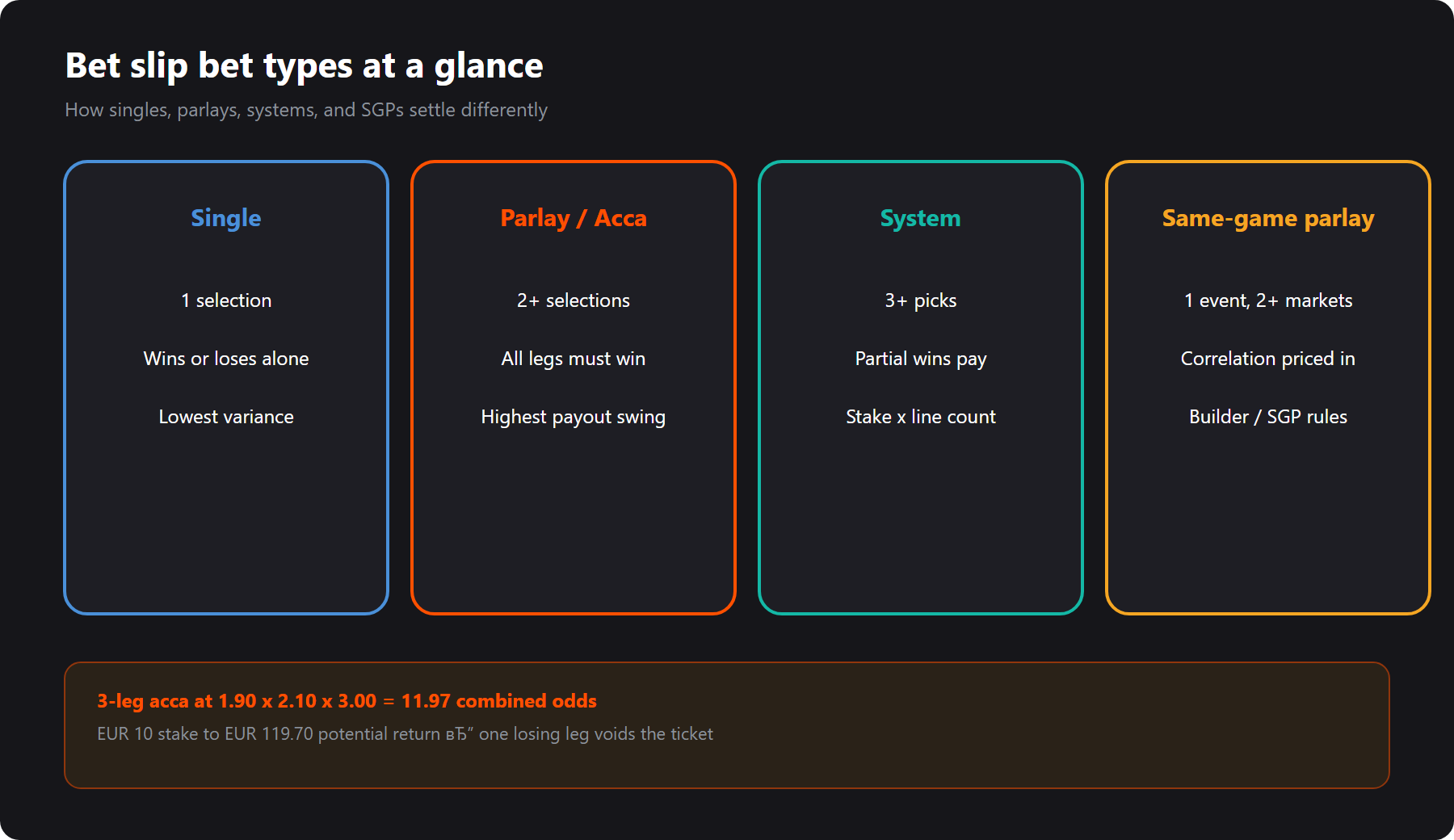
Bet slip bet types — singles, parlays, systems, same-game parlays
Singles. One selection, one outcome. Win or lose on its own. Lowest variance, clearest maths: return equals stake times decimal odds. The difference between a single and an accumulator is scope: a single covers one outcome alone; an accumulator combines several and requires every leg to win for a payout.
Accumulator / parlay. Two or more selections on one ticket. Odds multiply; every leg must win or the entire bet loses. Sporting News’ parlay guide walks through the compounding: a two-leg parlay at -145 and -110 might combine to roughly +205 on a $100 stake. One miss sinks the ticket.
System / round-robin. A system bet on a slip generates multiple smaller combinations from the same picks (doubles, trebles, patents, Yankees), allowing partial wins at the cost of a higher total stake. Each line settles independently, but total outlay equals unit stake times line count. ToolsGambling’s system betting guide contrasts this with parlays: systems survive when something goes wrong; parlays do not.
Same-game parlay (SGP / bet builder). A same-game parlay keeps all legs inside one fixture, with correlation priced into the combined odds. A Super Bowl SGP might combine moneyline and player props from the same game. Legs must still all win, but the book applies restrictions standard cross-game parlays do not need.
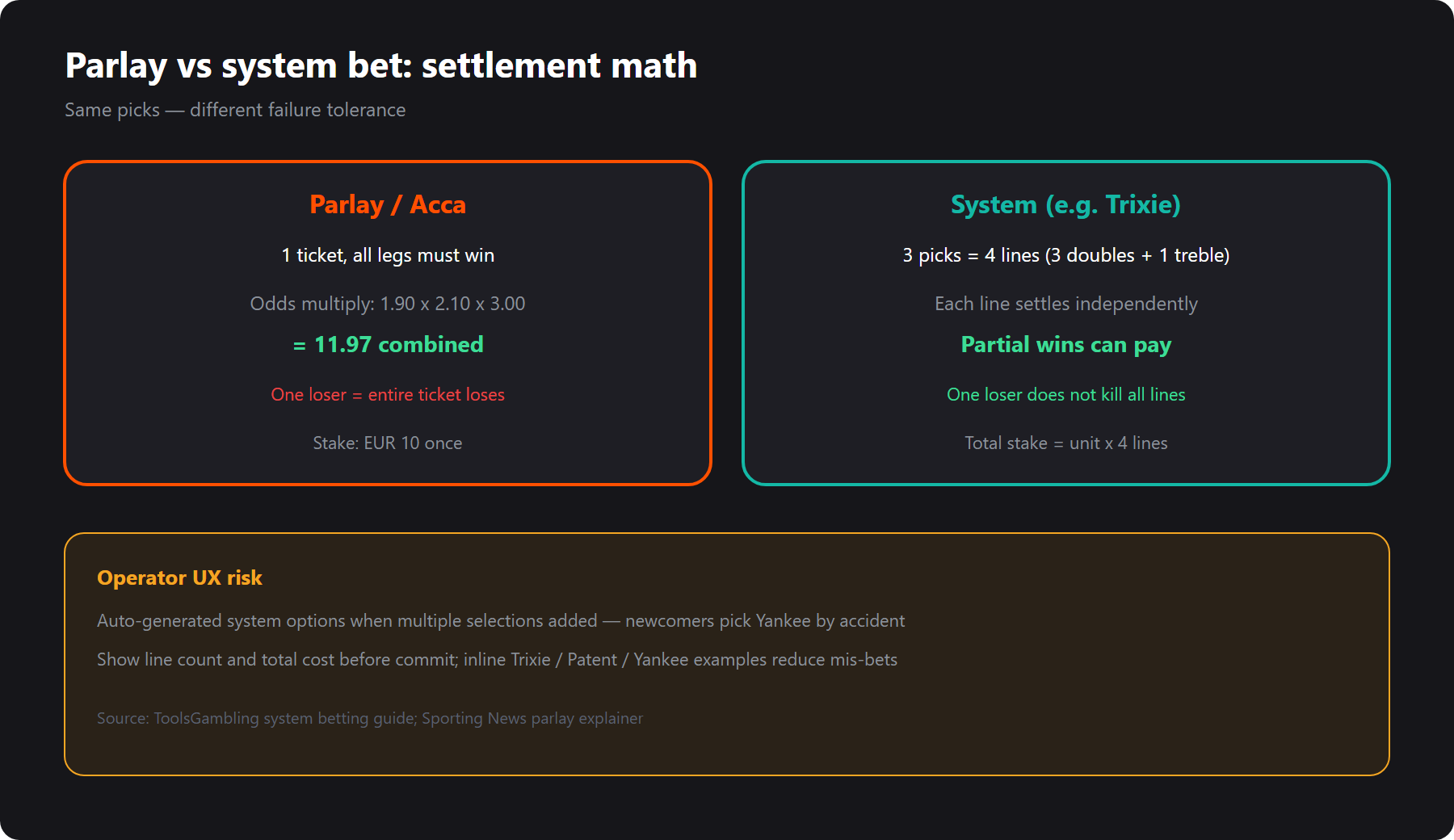
Parlay vs system bet — all legs must win vs partial combinations
How a bet slip works (end-to-end)
The flow product and trading teams align on looks like this:
- Selection and capture. Tap a price; the leg appears on the slip. Live odds refresh until placement or suspension.
- Validation. Combinability rules run: correlated legs blocked unless SGP is offered; geolocation and account status checked; betting limits applied.
- Stake and type. The customer enters stake(s) and chooses single, multiple, or system format. Calculators show total cost and potential return.
- Price change handling. If odds move, prompt to accept a new price or cancel. Some jurisdictions require explicit consent.
- Commit and receipt. Backend risk engine re-prices, accepts or rejects, returns a bet reference. History stores the receipt; partial accepts must be messaged clearly.
Rejected bets should say why: limit breach, suspended market, non-combinable selection. Silent failure during a major final is a retention event you do not get back.
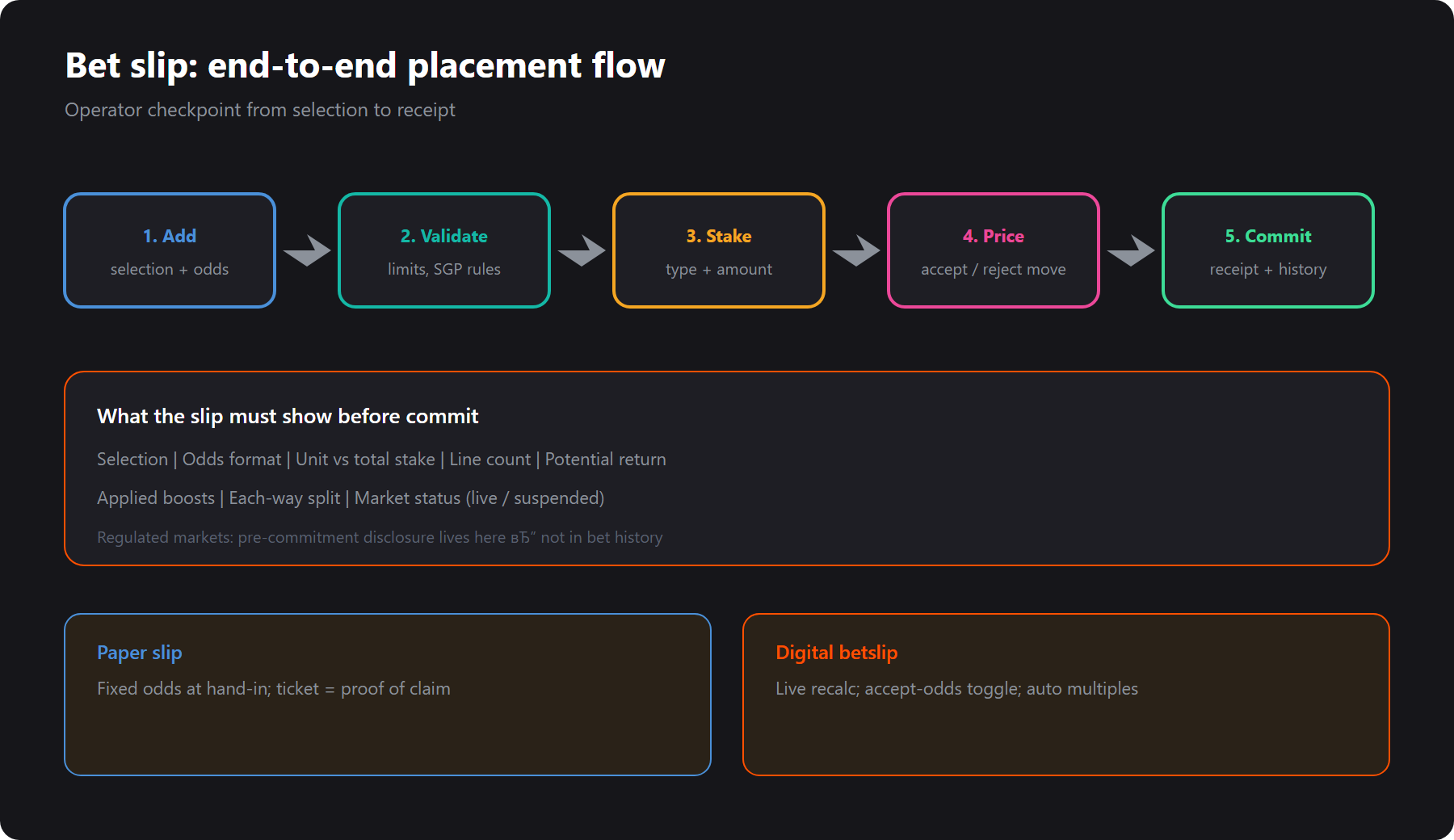
Bet slip end-to-end flow — selection through receipt
Why bet slips matter for operators
Clarity and compliance. Many regulators require sufficient wager detail before commitment. The slip is where that disclosure lives.
Error prevention. One surface to review selections, stakes, line counts, and price updates beats scattered confirmations.
Conversion. Accurate calculators, stake presets, and intelligible combinability rules raise completion rates when traffic spikes.
Operational control. Limits, bonus eligibility, in-play suspensions, and geofencing converge at placement. The slip is the last gate before exposure hits the book.
Bet slip UX as operator priority. Conversion, mis-bet prevention, limit enforcement, and pre-commitment disclosure all depend on how readable the slip is. Product teams who treat it as checkout-only leave trading and compliance to fix problems after money moves.
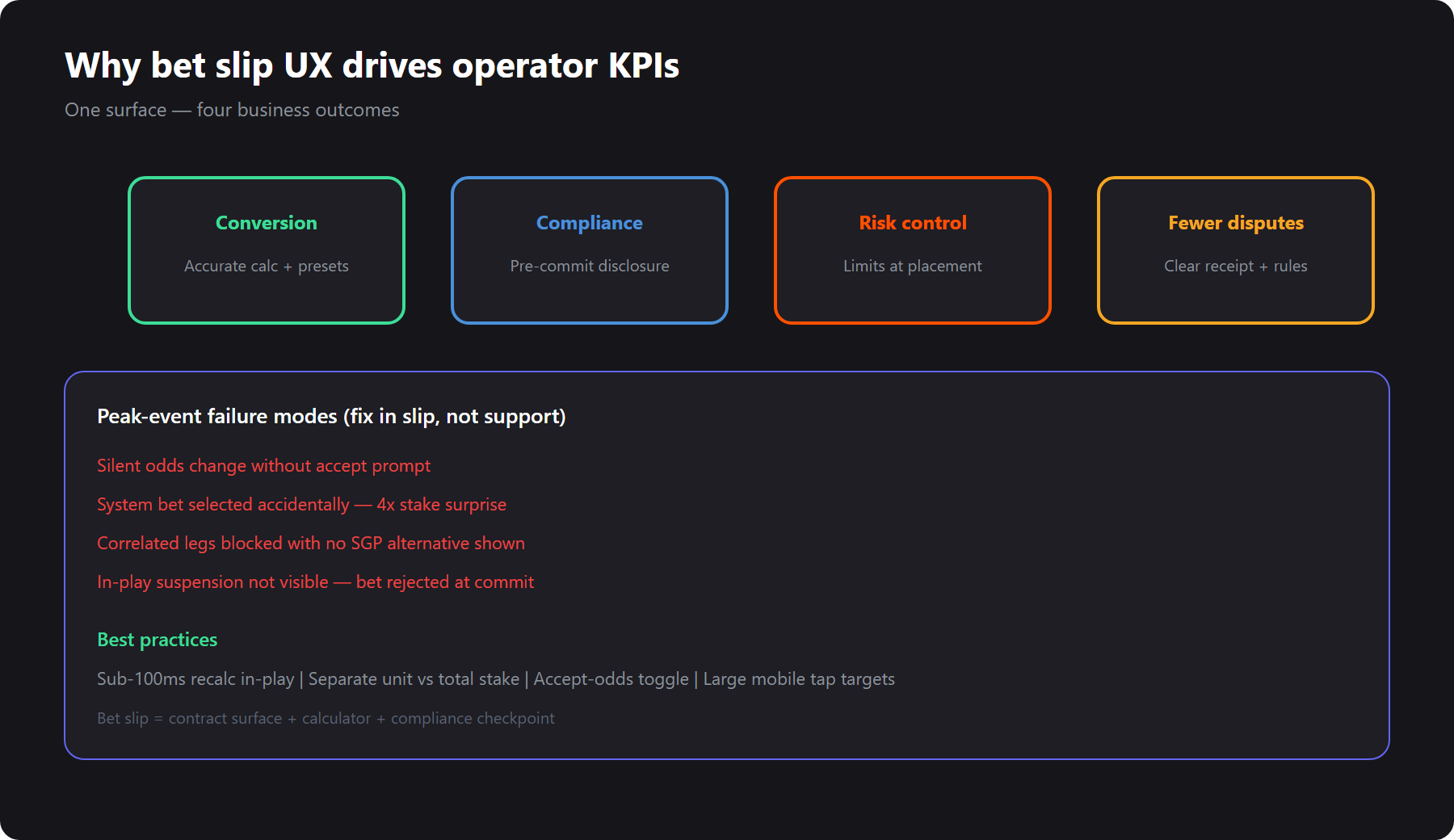
One surface — four business outcomes
Common bet slip features
Modern slips carry more than stake fields:
- Bonus bets and profit boosts applied before commit, with rules visible.
- Cash-out eligibility indicators on open-style previews where product allows.
- Edit bet where regulation permits, re-pricing the whole ticket.
- Quick bet / one-click modes that skip review (high conversion, high dispute risk; use with care).
Each feature changes liability timing. Trading must know when a boost shifts edge; CRM must know when a free bet excludes certain markets.
Tips and best practices
Show critical details up front. Selections, odds with format toggle, stakes, line count, total cost, potential returns, applied promotions.
Handle price movement explicitly. Never change stake when odds update. Message the delta.
Explain combinability. When legs block, say why and offer a compliant alternative (e.g. switch to SGP).
Separate per-line and total stake. Currency and settlement rules visible without scrolling on mobile.
Localise for regulation. Jurisdiction-specific disclosures and responsible gambling labels on the confirmation step.
Performance in-play. Sub-second recalculation during live markets; large tap targets for stake entry.
Educate on systems. Inline examples for Trixie/Yankee/Patent reduce accidental multi-line tickets.
Bottom line
The bet slip is not a decorative UI. It is the contract surface, the calculator, and the compliance checkpoint in one panel. Whether the product label says bet slip or betslip, the job is the same: show selections, odds, stake, and bet type before commitment, then store the result as the official record. Operators who design it as a readable, honest summary convert better and dispute less.