- Updated:
- Published:
What is casino cashback?
Casino cashback returns a percentage of a player’s net losses over a set period, as withdrawable cash or as bonus funds with conditions attached.
Casino cashback is a promotion that refunds part of what a player lost during a defined period. The operator totals the player’s qualifying losses for the day, week, or month, applies a percentage, and credits the result to the account. Some operators call it a loss bonus or losing bonus.
For example, a casino runs a 10% weekly cashback. A player ends the week $200 down on eligible games. The casino credits $20.
How gambling cashback differs from card cashback
Cashback on a bank card pays a percentage of what you spend, whatever happens next. In gambling, however, cashback works differently. It only pays when a player finishes the period with a net loss. A player who breaks even or wins receives nothing.
That condition therefore shapes everything else about the mechanic: who receives it, when it arrives, and what it costs the operator.
How does casino cashback work?
Every cashback program uses the same building blocks. The operator sets the rate, the calculation period, the games that count, the cap, and the form of payout. At the end of each period, the system checks whether the player has a qualifying net loss and pays the percentage if they do.
Cashback formula
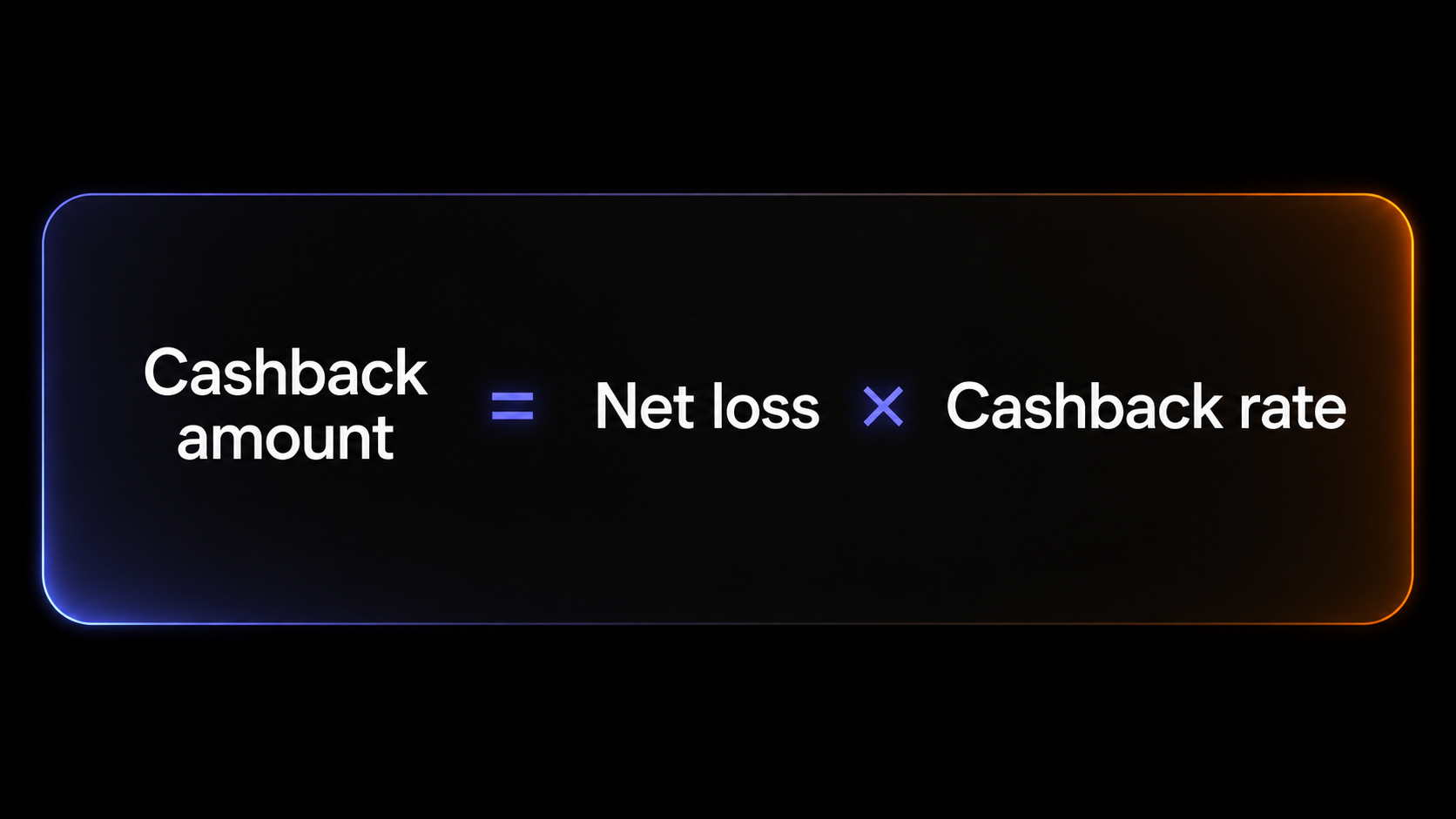
Cashback amount = Net loss × Cashback rate
Net loss is the part operators define in their terms, and the definitions differ:
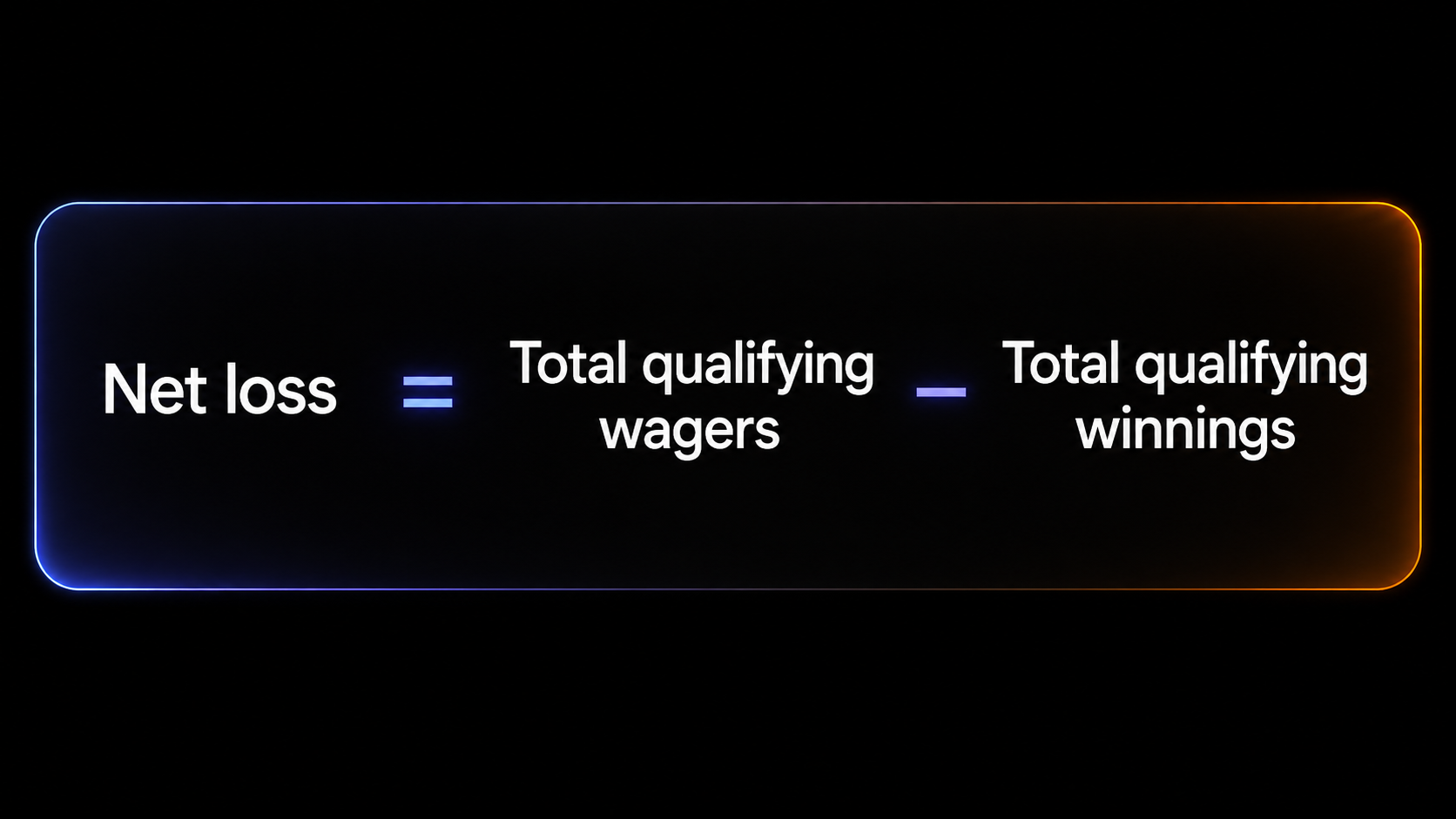
Net loss = Total qualifying wagers − Total qualifying winnings
The word “qualifying” carries most of the restrictions. Operators commonly exclude bets placed with bonus funds, jackpot wins, and some game categories from the calculation.
Others calculate net loss from deposits minus withdrawals and remaining balance instead of from wagers. As a result, the same headline rate can produce different payouts depending on which definition applies.
Step-by-step calculation example
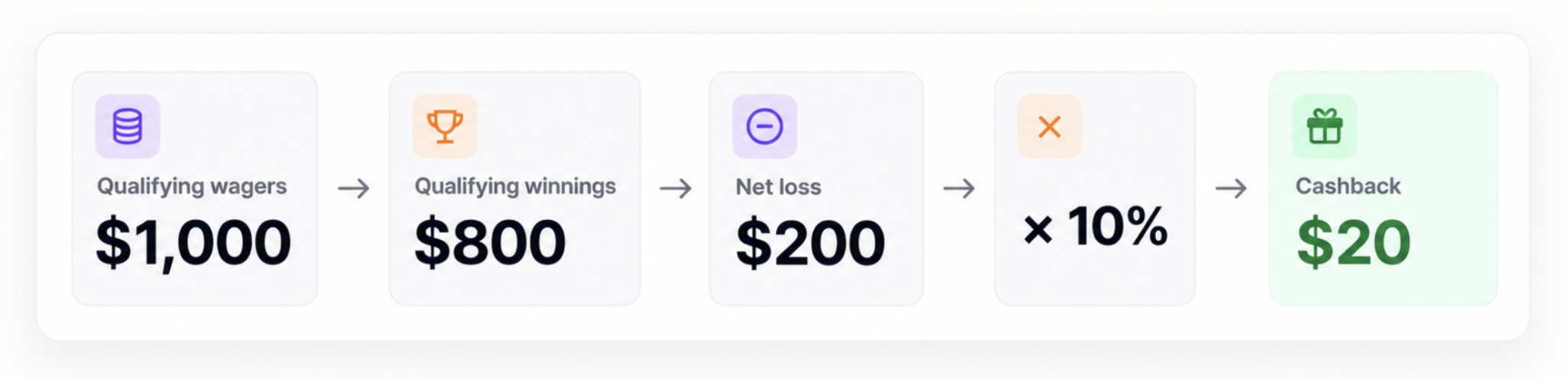
Take a weekly program with a 10% rate, a $500 cap, and slots as the only eligible games.
- During the week, the player wagers $1,000 on slots.
- Those spins return $800 in winnings.
- Net loss is $1,000 − $800 = $200.
- Cashback is $200 × 10% = $20.
- $20 is below the $500 cap, so the full amount is credited.
If the same player had also lost $100 on live roulette, which this program excludes, the cashback would still be $20. If they had instead finished the week $50 up, they would receive nothing.
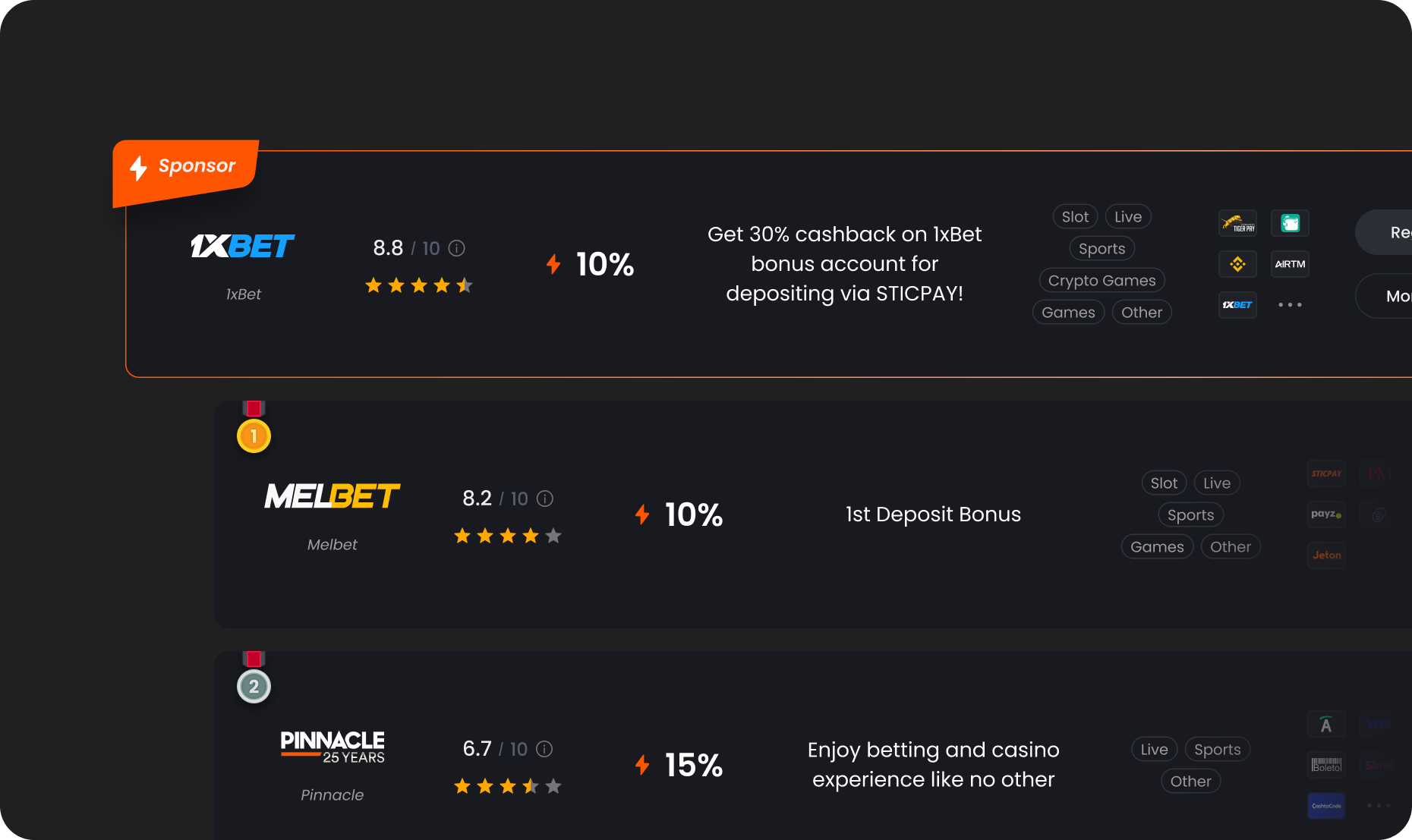
Real offers vary widely in rate, eligible products, and payout conditions, which is why the headline percentage alone says little about value.
Real money vs bonus cashback
The payout form matters more than the rate.
- Real money cashback lands in the cash balance. The player can withdraw it or keep playing. This is what “no wagering cashback” or “wager-free cashback” means.
- Bonus cashback lands as bonus funds. The player has to wager it a set number of times before any winnings become withdrawable, and the credit usually expires.
| Real money cashback | Bonus cashback | |
|---|---|---|
| Where it lands | Cash balance | Bonus balance |
| Wagering requirement | None | Set by the operator (maximum 10x in Great Britain since 19 January 2026) |
| Withdrawable | Immediately | Only after wagering is completed |
| Expiry | Usually none | Usually time-limited |
| Withdrawal limit on winnings | Usually none | Sometimes capped |
“Many players still don’t fully understand the difference between real cashback and bonus cashback, and it causes a lot of frustration. Real cashback is usually withdrawable money, while bonus cashback often comes with wagering rules, limits, and expiry dates. Players often feel misled when they discover their ‘cashback’ can’t actually be cashed out right away.”
Movses Wartan Head of Affiliates at AffPapa
Types of cashback in iGaming
Casino cashback
Casino cashback covers losses on casino products: slots, RNG table games, and live dealer games. Many programs weight these categories differently or exclude some of them (see “Eligible games and contribution rates” below).
Sportsbook cashback
Sportsbook cashback refunds betting losses rather than casino losses. Common formats include:
- a refund of net losses on a specific event or competition
- a weekly refund of net losses across sports markets
- a refund on an accumulator that loses by one leg
Many operators run sportsbook and casino cashback as separate programs, each with its own period and rate. In Great Britain, however, a single incentive can no longer combine betting with casino, bingo, or lottery products (see “Cashback regulations and responsible gambling”).
VIP and tiered cashback
In tiered programs, the cashback rate rises with the player’s loyalty level. The player does not claim a new offer at each level. Instead, the rate changes automatically once they reach the next tier.
Tiered cashback is usually part of a wider loyalty program that can include other rewards and personal account management.
Crypto cashback and rakeback
Crypto casinos often pair cashback with rakeback. The two are easy to confuse:
- Cashback depends on the result. It only pays when the player ends the period with a net loss.
- Rakeback depends on activity. It returns a share of the operator’s margin on every bet, whether the player wins or loses.
For example, a player who finishes a week in profit receives no cashback but still earns rakeback on everything they wagered.
How cashback terms and conditions work
The terms decide what an offer is worth. This section covers the five that matter most.
Cashback rates and maximum caps
The rate is the percentage of net loss returned. The cap, meanwhile, is the maximum the program pays per period. Both only make sense together.
A 10% weekly rate with a $500 cap pays the full percentage on net losses up to $5,000. Above that, the payout stays at $500, so the effective rate falls. A 20% rate with a $50 cap stops growing once net losses reach $250.
Some programs also set a minimum net loss before cashback applies, for example $50 for the period.
Daily, weekly and monthly cashback
The period sets how often the operator calculates and pays net loss.
- Daily cashback resets every 24 hours. Payouts are smaller and more frequent.
- Weekly cashback usually runs Monday to Sunday. Wins and losses across the week offset each other before the calculation.
- Monthly cashback pays once per calendar month and is more common in VIP programs.
The period also changes the result. A player who loses $300 on Monday and wins $300 on Tuesday receives daily cashback for Monday. Under a weekly program, however, the two days cancel out and the player receives nothing.
Wagering requirements
A wagering requirement sets how many times the player must bet the cashback amount before any winnings become withdrawable. On a $20 bonus cashback with a 10x requirement, the player must place $200 in bets first.
Those bets carry the game’s house edge, so the player is likely to lose part of the bonus along the way. How much depends on the games played, their RTP, bet sizes, and variance.
A player may also lose the full bonus before completing the requirement. This is why a wager-free cashback of a given amount is worth more to the player than a bonus cashback of the same amount.
The Gambling Commission has capped wagering requirements on bonus funds in Great Britain at 10x since 19 January 2026. Operators in other jurisdictions can set higher multiples, so the requirement is worth checking in the terms of each offer.
📚 Read more: Wagering requirement
Wartan names the combination that most often undermines an offer:
Movses Wartan Head of Affiliates, AffPapa 
“The biggest red flags in cashback offers are usually a mix of restrictions. High wagering requirements, blocking popular games, and paying cashback as bonus credit instead of real cash. These limits often stop a first-time depositor from becoming a loyal player.”
Eligible games and contribution rates
Operators decide which games count toward net loss and at what weight. A contribution rate of 50% means only half of the loss on that game counts.
For example: a player loses $200 on a live table game with a 50% contribution rate. Only $100 counts as qualifying net loss. At a 10% rate, cashback is $10, not $20.
Common restrictions include:
- some live dealer or table games counting at a reduced rate or excluded
- jackpot wins excluded from the calculation
- a maximum stake per spin or round while the offer is active, with bets above it excluded or the cashback voided
Contribution rates and stake limits differ by operator, so the offer’s own terms are the only reliable source.
Expiry, payout timing and verification
Bonus cashback usually expires if the player does not use or wager it within a set number of days. The terms should also state when the operator credits cashback and whether it arrives automatically or the player has to claim it.
Identity checks can also delay a withdrawal of cashback funds, just like any other withdrawal. However, KYC rules vary between operators.
Movses Wartan Head of Affiliates, AffPapa “Players often forget about KYC rules. Some sites only check your ID if something looks wrong, but others demand it for every withdrawal. Since many people don’t like sharing private documents, this becomes a big hurdle for getting paid.”
Cashback vs other casino bonuses
| Cashback | Deposit bonus | Free spins | Rakeback | |
|---|---|---|---|---|
| What triggers it | Net loss over a period | A deposit | Registration, deposit, or promotion | Every bet placed |
| What it depends on | Losses | Deposit size | Number and value of spins | Wagering volume |
| Paid if the player wins | No | Yes | Yes | Yes |
| When it is paid | After the period ends | At deposit | Upfront, as spins | Continuously or per period |
| Usual payout form | Cash or bonus funds | Bonus funds | Spins, then winnings as cash or bonus funds | Cash or bonus funds |
Cashback vs deposit bonus
A deposit bonus adds funds when the player deposits, before any play. Cashback comes after play and only after a net loss.
Also, a deposit bonus is usually a one-off or tied to each new deposit, while cashback repeats every period for as long as the program runs.
Cashback vs free spins
Free spins give a set number of rounds on specific slots. Their value depends on the spin value and the game, not on the player’s results. Cashback, by contrast, has no fixed value in advance. It depends entirely on how much the player loses on eligible games.
Cashback vs rakeback
Cashback is result-based. Rakeback is volume-based. A player who wins over the period receives no cashback but still earns rakeback. Conversely, a player who loses receives cashback, and rakeback as well if the operator runs both.
How operators use cashback
Cashback costs and NGR
For an operator, cashback is a promotional cost. Its effect shows in the gap between gross and net revenue.
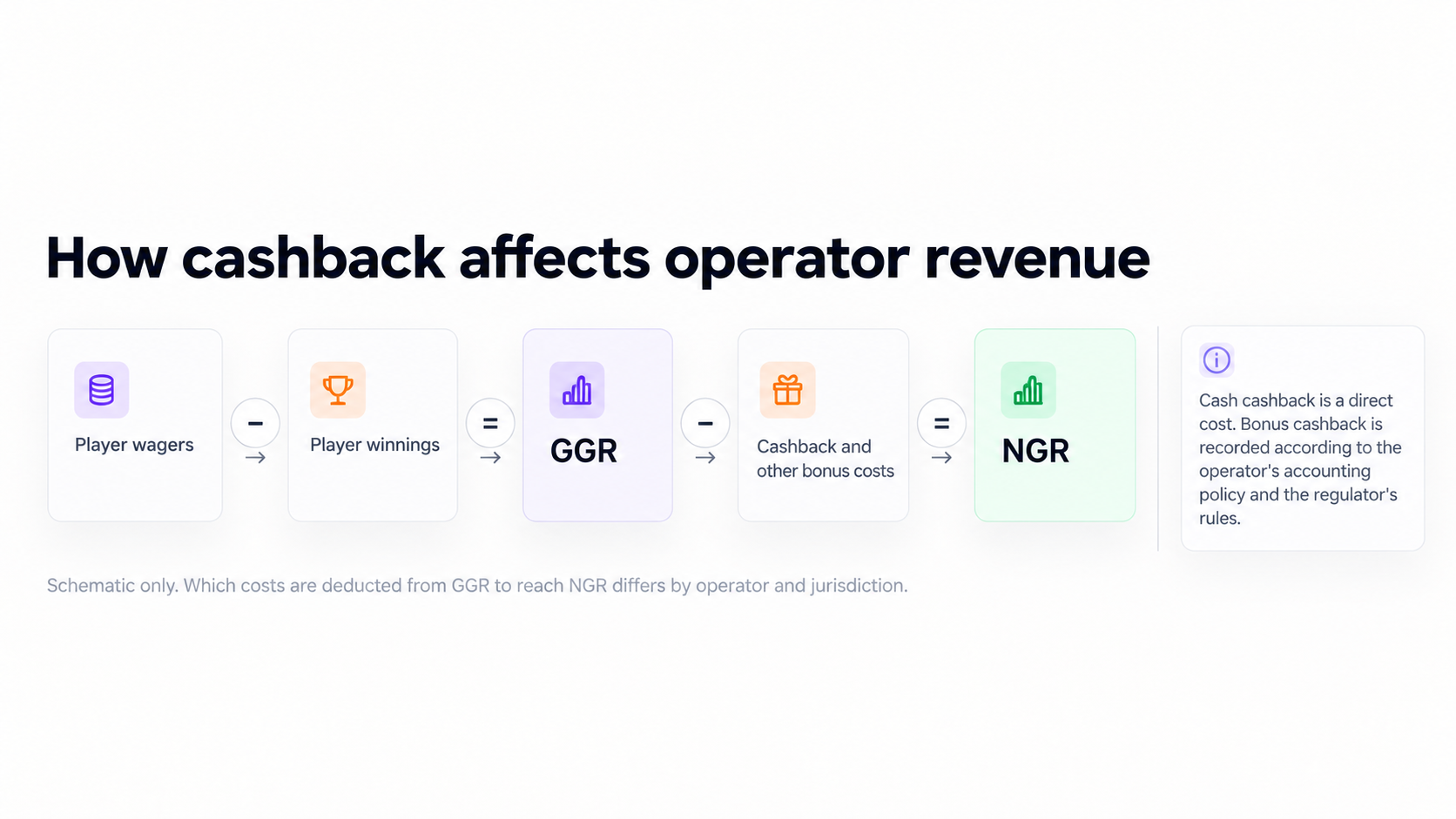
GGR is player stakes minus player winnings. NGR usually deducts bonus and promotional costs from GGR, and in some reporting frameworks also gaming taxes. Cashback reduces NGR in the period the operator pays it.
How much it reduces NGR depends on the program design: the rate, the cap, which games qualify, and whether it pays in cash or bonus funds. Bonus cashback that players never wager through, or that expires, may cost the operator less than its face value. Cash cashback, however, costs its full amount.
Measuring promotional efficiency
Total cashback spend says little on its own. Instead, operators judge a program by what changes after it launches, compared with a group of players who did not receive the offer. Typical measures include:
- cashback cost as a share of GGR for the eligible segment
- changes in retention and reactivation rates against a control group
- changes in deposit frequency and churn rate
- net revenue per player after promotional costs
Market demand moves independently of any promotion. Seasonality, major sports events, and competitor activity can all lift or depress activity in the same weeks a program runs.
Blask Index is a real-time measure of market demand volume for iGaming brands in a given country, based on normalized search data. Comparing a program’s results with brand and market demand trends therefore helps separate the effect of the offer from changes in the market.
For how promotional costs interact with acquisition spend, see the guide to Cost Per Acquisition (CPA).
Cashback and player retention
Operators mainly use cashback for existing players rather than for acquisition: to keep active players engaged, reward loyalty tiers, and bring back inactive accounts. Whether it works depends on the player base, the offer, and the product around it.
Cashback does not fix a weak product or a poor customer experience, and it can cost more than the revenue it protects if the operator sets the terms badly.
Dmitry Belianin Co-founder of Blask 
Cashback works as part of a structured lifecycle marketing approach, but shifting budget from deposit bonuses to cashback programs without addressing the underlying product experience will not produce sustainable retention gains. The mechanic supports retention. It does not substitute for it.

📚 Read more: Retention manager in iGaming: the role
Operators are also changing how cashback is set. Wartan describes the direction:
“Cashback offers are becoming more personal and based on player activity. More casinos are also using simple challenges and loyalty rewards instead of basic cashback deals. Players now prefer clear terms and real cash rewards with fewer restrictions.”
Movses Wartan Head of Affiliates, AffPapa
Belianin draws the line between cashback and other bonus tools:
Dmitry Belianin Co-founder of Blask Cashback and bonus tools are not interchangeable, and shifting budget from one to another without addressing the underlying product experience will not produce sustainable retention gains. Operators who moved beyond generic bonus reliance toward personalized retention programs, with cashback as one component, achieved 14–30% improvements in 90-day retention in documented case studies.
How to evaluate a cashback offer
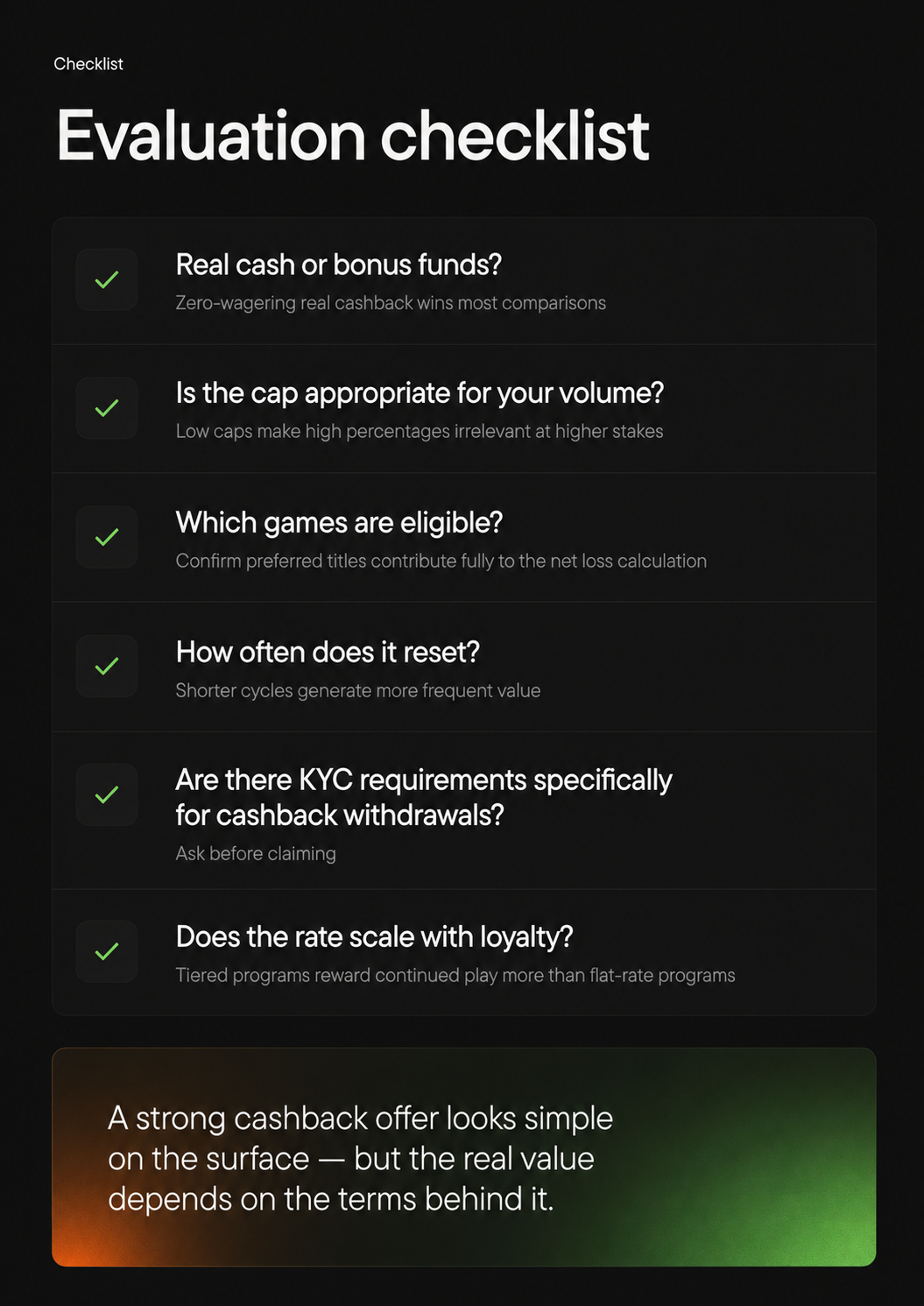
Read the terms before opting in. Five questions cover most of what decides an offer’s value:
- Does it pay out as cash or bonus funds? If bonus funds, what is the wagering requirement and the expiry?
- How does the operator define net loss? Which bets and wins count, and do bonus-funded bets count?
- What is the cap? And is there a minimum loss before cashback applies?
- Which games count, and at what contribution rate? Is there a maximum stake per round?
- When and how does the operator pay it? Automatically or on claim, and on what day?
💡 Key point: A cashback offer is a partial refund of losses, not a way to win back money. It reduces the cost of losses that have already happened. It does not change the odds of any game.
Cashback regulations and responsible gambling
Rules on gambling incentives vary by country. Great Britain introduced two changes that apply directly to cashback offers. From 19 January 2026, the Gambling Commission:
- capped wagering requirements on bonus funds at 10x
- banned incentives that combine more than one type of gambling product (betting, casino, bingo, lottery)
The Commission’s reasoning on the wagering cap was that high requirements can confuse consumers and lead them to gamble for longer and faster than they otherwise would.
Cashback has the same tension built in. On one hand, it reduces the size of certain losses after the fact. It can also give a player a reason to keep playing after losing, because part of the loss will come back.
Still, it does not remove financial risk: a player who loses $200 with 10% cashback has still lost $180.
Responsible design in a cashback program includes:
- clear terms on how net loss, caps, and wagering work
- the option to opt out of promotional offers
- deposit limits, time-outs, and self-exclusion available from the same account
- checks that stop large or escalating losses from triggering larger rebates without review
Players who feel they are chasing losses can set limits in their account or contact support services such as GamCare in the UK.
Common cashback misconceptions
- “Cashback means I can’t lose.” Cashback returns a percentage of net loss, but the player still loses the rest.
- “A higher percentage is always better.” A higher rate with a low cap, heavy wagering, or narrow game eligibility can be worth less than a lower rate paid in cash.
- “Cashback applies to every bet.” Most programs exclude some games, bet types, or stake sizes.
- “Cashback is guaranteed.” It only pays when the player ends the period with a qualifying net loss and meets the program’s conditions.
- “Cashback and rakeback are the same.” Cashback depends on losses, while rakeback depends on wagering volume.
Frequently asked questions
What does cashback mean in gambling?
It is a refund of part of a player’s net losses over a set period, such as a day, week, or month. The operator pays the refund as cash or as bonus funds.
How is cashback calculated?
Cashback amount = Net loss × Cashback rate. Net loss is usually qualifying wagers minus qualifying winnings over the period, subject to the operator’s caps and game rules.
Is casino cashback real money?
It depends on the offer. Real money cashback goes to the cash balance, and the player can withdraw it. Bonus cashback goes to the bonus balance, so the player has to wager it first.
What is 10% cashback?
The operator returns 10% of the player’s net loss for the period. A $200 net loss returns $20, up to the program’s cap.
Can you withdraw cashback?
Players can usually withdraw real money cashback straight away, subject to standard withdrawal and KYC checks. Bonus cashback becomes withdrawable only after the player meets the wagering requirement.
What is the difference between cashback and rakeback?
Cashback pays only when the player has a net loss for the period, whereas rakeback pays a share of the operator’s margin on every bet, whether the player wins or loses.
Does cashback have wagering requirements?
Some offers do and some don’t. No wagering cashback pays out as cash. Bonus cashback, however, carries a wagering requirement, which in Great Britain cannot exceed 10x.
Is cashback available in sports betting?
Yes. Sportsbooks run their own cashback offers, for example refunds on losing bets for a specific event or on accumulators that lose by one leg. These usually run separately from casino cashback.