
- Updated:
- Published:
RevShare model (revenue share)
A 40% revenue share and a $100 CPA cannot be compared as rates. They compare only on one cohort of players, under one revenue formula, over one window.
The percentage is what affiliate programmes advertise, and on its own it settles nothing. What it applies to, for how long, and after which deductions is where two offers at the same headline rate stop being worth the same money.
What RevShare means
RevShare, short for revenue share, is a commission model in which an operator pays a partner a percentage of the revenue produced by referred players. Payment recurs each settlement period while the player stays attributed to that partner.
The calculation itself is simple:
Affiliate commission = commissionable revenue × RevShare percentage
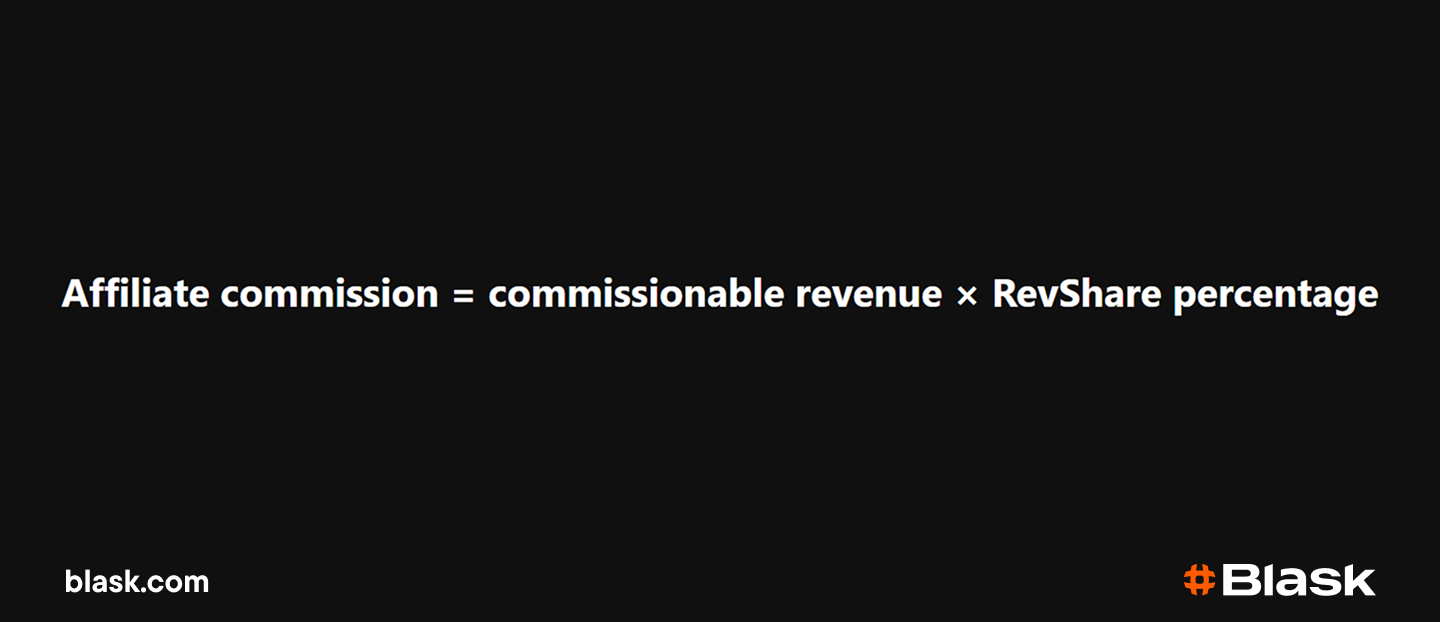
Commissionable revenue is usually net gaming revenue, though some programmes use GGR, a theoretical margin, or a bespoke formula. The model differs from CPA, which pays a fixed amount once a referred player completes a qualifying action, most often a first-time deposit.
The revenue base decides the payout
NGR has no universal definition, so the deduction list carries more weight than the percentage. The Casumo Partners terms define net revenue as monies received from new customers less winnings, bonuses and loyalty bonuses, administration fees, fraud costs, chargebacks, returned stakes, duties and taxes, jackpot contributions, and third-party game or software fees [1]. A programme deducting only winnings, bonuses and chargebacks produces a materially larger base from identical player activity, so a 35% share of the narrow base can pay more than 45% of the wide one.
One cohort, three models
The figures below are illustrative and are not a Blask benchmark or a market average.
Take 100 qualified first-time depositors producing $40 000 of cohort NGR across 90 days. A CPA deal at $80 per qualified FTD pays $8 000, while a RevShare deal at 30% of that NGR pays $12 000. A hybrid at $40 per FTD plus 15% pays $4 000 upfront and $6 000 on revenue — $10 000 in total.
| Model | When it pays | What the affiliate carries | What the operator carries | What the contract has to define |
|---|---|---|---|---|
| CPA | Once per qualified action | No claim on later player value | Risk that cohort revenue never reaches the fee | Qualifying criteria, review period, clawback |
| RevShare | Every settlement period while attribution holds | Player results, deductions, negative balances | Payment while the cohort produces revenue | Revenue base, deductions, carryover, duration |
| Hybrid | Both, at reduced levels | Part of each side | Part of each side | Which revenue the percentage applies to |
Halve the cohort revenue and the ranking inverts. At $20 000 of 90-day NGR the same terms pay $8 000 on CPA, $7 000 on hybrid and $6 000 on RevShare, with no change to any rate in the contract. Cohort value sets which model pays more.
What breaks the comparison
Four contract terms move the result before any player places a bet, and each is written per programme.
Qualification decides how many depositors reach the count. The Marathonbet affiliate terms categorise a referral as a Qualified Acquisition only when campaign-configured criteria are met — first deposit amount, total deposits, turnover, verification, or use of a unique promotional code. A CPA quoted against raw registrations and one quoted against that definition are different prices.
Negative carryover decides what a losing month costs. Virgin Bet resets a negative monthly balance to £0 at the start of each calendar month. Marathonbet applies the opposite rule: a negative balance at month end carries into the following period until the net loss is recovered in full from later net revenue. Casumo zeroes a negative balance arising from customer winnings, administration fees or progressive contributions, and carries forward the part arising from fraud costs.
Attribution decides who is paid at all: commission runs through a tracking code assigned to the partner, and the agreement states which action fixes the relationship and whether another code can overwrite it.
Duration and activity decide how long a percentage survives. Marathonbet reduces a revenue-share rate to 5% after 90 days without traffic, and Casumo may cut a rate to a flat 10% where a partner refers no new customers for three consecutive months.
Tiers move the rate, not the base
An affiliate commission tier raises the percentage as volume rises: Casumo publishes five, from 25% of net revenue at 0–5 new depositing customers a month to 45% at 41 or more [1]. The deduction list and the carryover rule are unchanged across all five, so a tier increase and a wider deduction list can move the payout in opposite directions.
| 👉 Affiliate CPA also differs from an operator’s blended customer acquisition cost, which covers every channel and cost line behind a depositor. |
What Blask measures here
Blask publishes no affiliate payout rates and no programme-level NGR, both of which sit inside private contracts. It measures the market those cohorts come from.
Blask Index demand for H1 2026 against H1 2025 rose 15.8% in Brazil and 5.3% in the United Kingdom, and fell 11.6% in Germany. One set of cohort assumptions does not travel between markets moving in opposite directions, and no contract term governs that part of a projection. The affiliate marketing knowledge base covers the wider set of payout models.
FAQ
Is RevShare better than CPA?
Neither model wins in general. On one cohort, RevShare pays more where per-player revenue and retention are high, and CPA pays more where cohort revenue is thin or the hold period is short. The revenue base, carryover rule and qualification standard move the result as much as either rate.
Can a 40% RevShare be compared with a $100 CPA?
Not as rates. The comparison requires the same qualified depositors, the same window and the same revenue formula, then converts both to a payout on that cohort. Two programmes quoting 40% on different deduction lists are not quoting the same offer.
How long do RevShare payments last?
As long as the agreement specifies. Some programmes pay while referred players stay active, others cap the term, reduce the rate after a period without new referrals, or end commission when the partnership terminates.
Bottom line
RevShare is a contract, not a percentage: a revenue base, a deduction list, an attribution rule, a settlement period, a carryover policy and a duration. Priced on one cohort, CPA and RevShare swap places as cohort value moves, and the terms deciding which side of that line a deal falls on never appear in the headline rate.