

- Updated:
- Published:
President Lula wants to close Brazil’s betting market. The data says it’s already working
Fifteen months into Brazil’s licensed gambling market, Blask data shows the fastest offshore-to-onshore shift in the region — and a presidential candidate threatening to reverse it.
On April 9, 2026, Brazilian President Luiz Inácio Lula da Silva told morning television he would close the country’s bookmakers if it were up to him. “It’s not possible to continue with this unbridled game in this country,” he said on ICL News. He has said versions of this before. Each time, the language gets a little harder.
The irony is well-documented. Lula signed the law that created the regulated market. He is now running for reelection on a platform that includes dismantling it.
From Temer to Lula: how the market was built
Sports betting was legalized in Brazil in 2018 under President Michel Temer, though the market operated almost entirely offshore and unregulated for the years that followed. In December 2023, Lula signed Law No. 14,790/2023 (“Lei das Bets”) — the framework that created a federal licensing structure for online sports betting and fixed-odds gaming.
The licensed market went live on January 1, 2025. Operators had to obtain authorization from the Secretariat of Prizes and Bets (SPA), pay a R$30 million licensing fee, hold a R$5 million capital reserve, and comply with strict requirements: 12% GGR tax, exclusive .bet.br domains, Pix and debit-only payments, and real-time data reporting to the government’s SIGAP system.
By the end of the first licensing round, 81 companies received licenses — 15 definitive, 66 provisional. Superbet and SportyBet secured definitive authorization. Betano, Bet365, and Sportingbet received provisional licenses. Any platform operating without federal authorization became illegal as of January 1, 2025.
Lula used veto powers to block certain tax exemptions during the regulatory process. In January 2026, he approved a gradual tax increase that will take the rate to 15% by 2028. An attempt to push it to 18% failed. The regulated market he created has become his political problem.
The market in numbers
Blask tracks 559 brands in Brazil, of which 526 were active during the January 2025–March 2026 period. For the 15-month period since market opening, total Competitive Earning Baseline (CEB) across all brands reached $6.4B ($4.3B–$12.7B range). Total Acquisition Power Score (APS) came in at 100 million potential new customers ($73M–$179M range).
CEB (Competitive Earning Baseline) projects the revenue a brand should realistically capture given its search demand and competitive position. APS (Acquisition Power Score) estimates new customer acquisition potential. Both are shown as ranges because campaign timing, competition, and seasonal patterns all shift outcomes. These are independent Blask benchmarks — not operator-reported figures.
The annualized CEB run-rate puts the Brazilian market at roughly $5B+ per year, consistent with AP estimates of $4B+ in annual revenues. Government data cited in industry reports showed 25 million unique bettors on licensed platforms during 2025 alone.
Five brands leading the race
Every brand in Brazil’s top five offers both casino and sports betting on web and Android. The competitive gap at the top is wide:
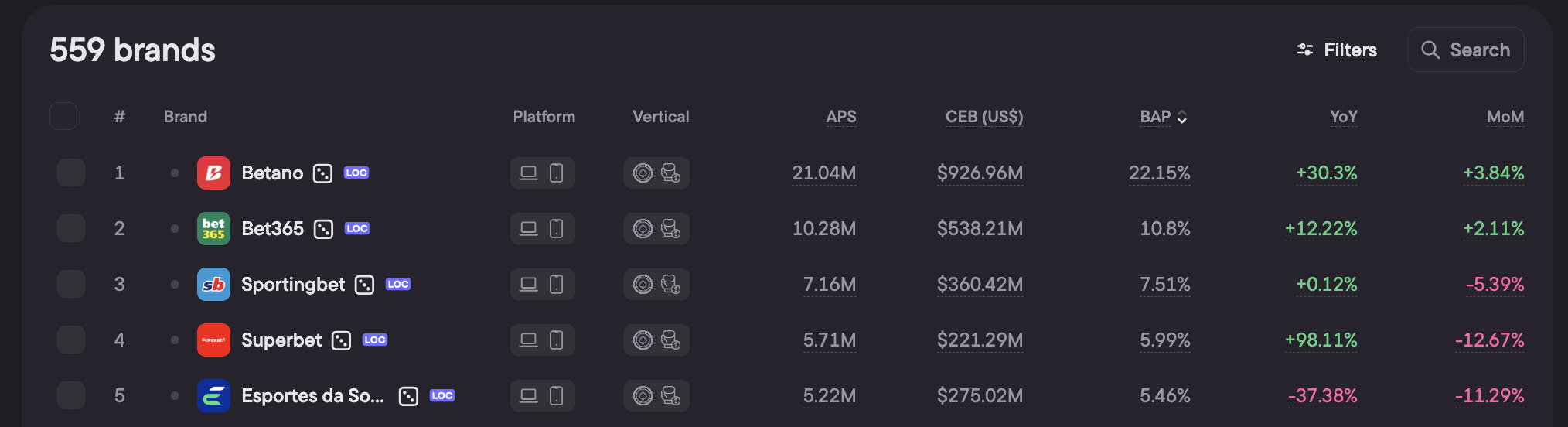
Betano holds the largest demand share at around 22% BAP (Brand’s Accumulated Power — the brand’s share of total market search interest). Bet365 follows at roughly 11%. Sportingbet’s near-flat YoY growth signals it is defending territory rather than expanding.
Superbet stands apart. Its CEB nearly doubled year-over-year — the strongest growth rate in the top 10. The brand holds one of the 15 definitive licenses and has been aggressive in market positioning since day one of the regulated era.
From 100% offshore to 95% licensed: what regulation actually did
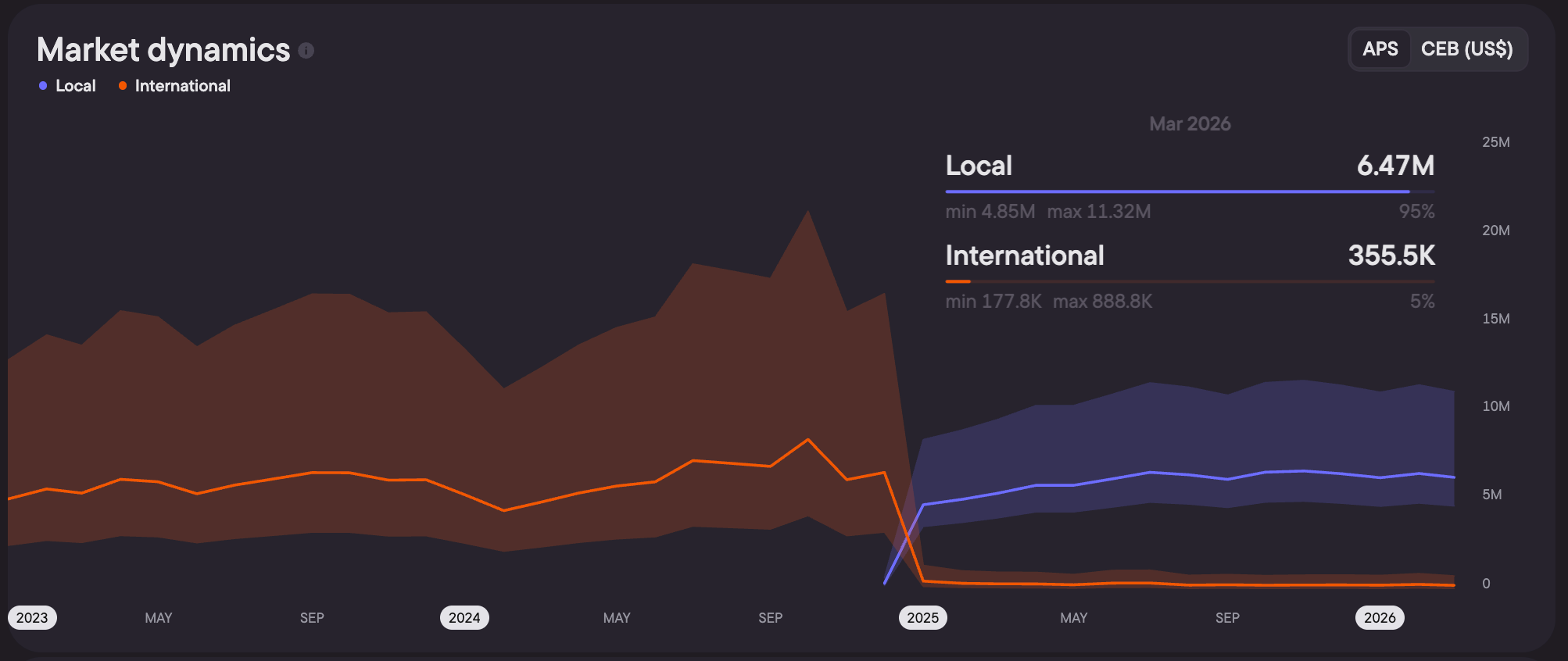
Before January 2025, Brazil was a pure offshore market. Every wager placed online went to brands with no Brazilian license, no local tax obligation, and no player protections under Brazilian law. Blask data is unambiguous: from January 2023 through November 2024, offshore brands held 100% of Brazil’s total Blask Index BAP. The offshore market peaked in July 2024 at a total CEB of $703M in a single month.
Within weeks of the market going live, international operators lost nearly all of their demand. By March 2025, their share of total market CEB had fallen to 5–6% — and it has not recovered since. As of March 2026, local licensed brands account for 95% of Brazil’s CEB, with international operators holding the remaining 5%.
Bottom line
Brazil’s regulated market did what regulation is supposed to do. International operators went from controlling the entire market to holding 5% of acquisition power in under three months. Licensed brands grew their CEB share from zero to 73% in 15 months. Total demand recovered after the initial contraction and is still rising.
Lula signed the law that made this happen. Now he wants to run against it. The industry’s strongest argument is the data itself — and that argument gets weaker every time operators stay quiet.