- Updated:
- Published:
How culture draws the gambling category map

A look at five major gambling markets through Blask’s new category interest metric — where the familiar assumptions hold, and where they don’t.
Every gambling market looks like its stereotypes on the surface — France means lottery, Brazil means football, India means cricket. The Blask Index confirms some of that and breaks the rest.
Blask recently rolled out category-level interest tracking — a new metric that measures direct, non-branded search interest per vertical, showing what players in each market are actually curious about before any brand’s marketing spend enters the picture. This report puts that new data against five very different countries over the twelve months from April 2025 to March 2026.
How Blask measures category interest
Blask’s Category Metrics track direct, non-branded search interest per gambling vertical. A query like “live dealer casino” or “online slots” feeds into the category index; a branded query like “Bet365 roulette” does not.
The metric captures how much organic curiosity exists for each vertical in a given country, independent of any brand’s marketing spend. Higher index values mean more search demand.
France: lottery domination
Lottery owns France — it accounts for 78% of the country’s total gambling search interest. Keno drives the bulk of that number. The state-run FDJ (La Française des Jeux) has operated a near-monopoly on French lottery since 1976, and five decades of cultural habit show up in the search data.
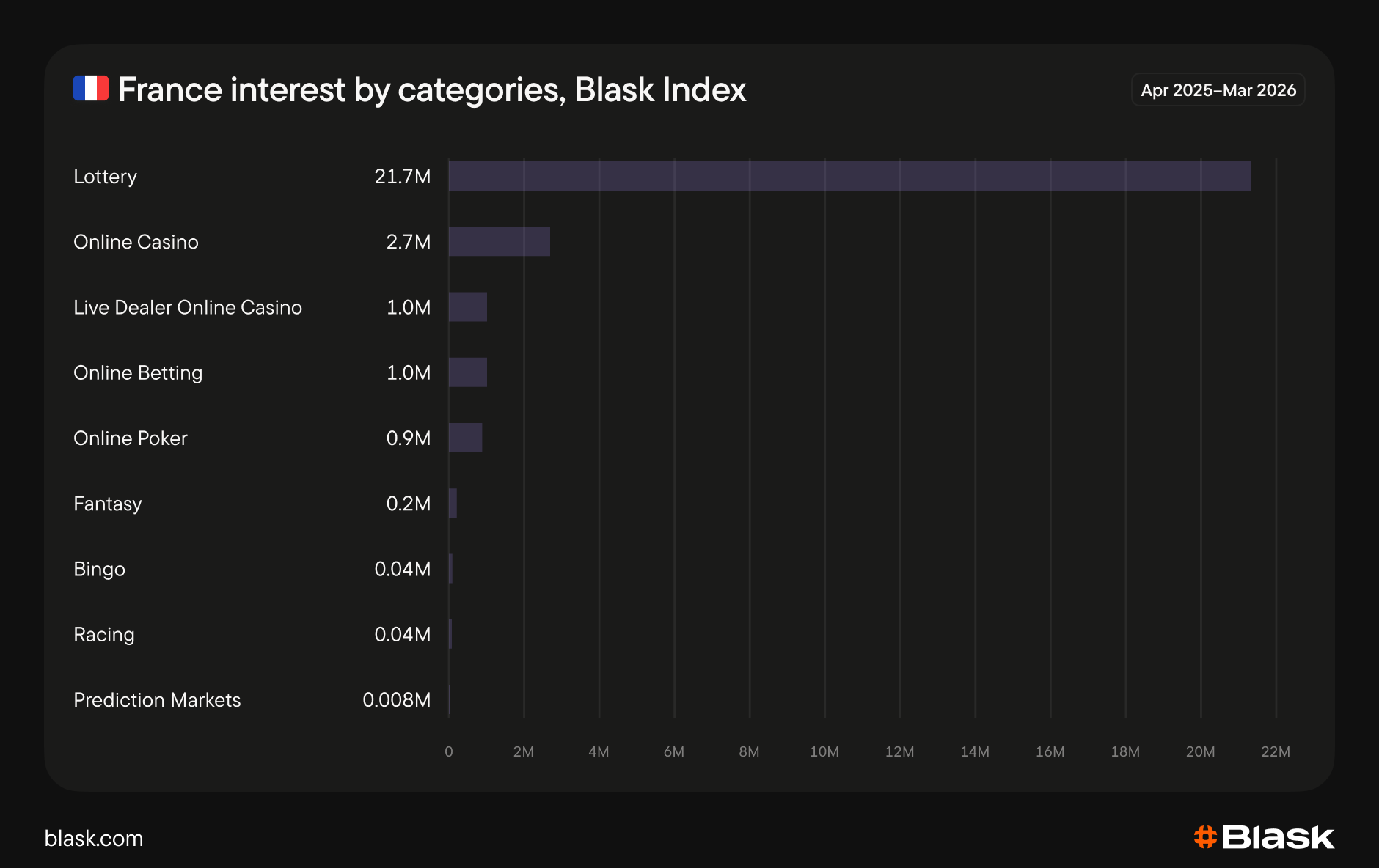
Online casino sits at a distant second with about 10% — a notable figure given that France doesn’t license online casino games at all. Slots, roulette, and blackjack are legal only in land-based venues, so every online casino query in the data reflects curiosity the regulated market doesn’t serve. The demand exists, the legal supply doesn’t.
Live dealer, online betting, and online poker cluster around 4% each. Within live dealer, blackjack and roulette take expected lead positions. Poker reflects more than a decade of regulated play under ARJEL (now ANJ).
Since 2017, France has shared a liquidity pool with Spain, Portugal, and Italy after the four regulators signed an agreement to merge their online poker markets. The shared player pool gave French poker a larger field than its domestic population alone could sustain. That matters in a market where online casino games are prohibited outright.
Switzerland: casino-first
Switzerland runs a tight, casino-first market. Online casino averages about 38% of total demand, the highest casino concentration among all five countries.
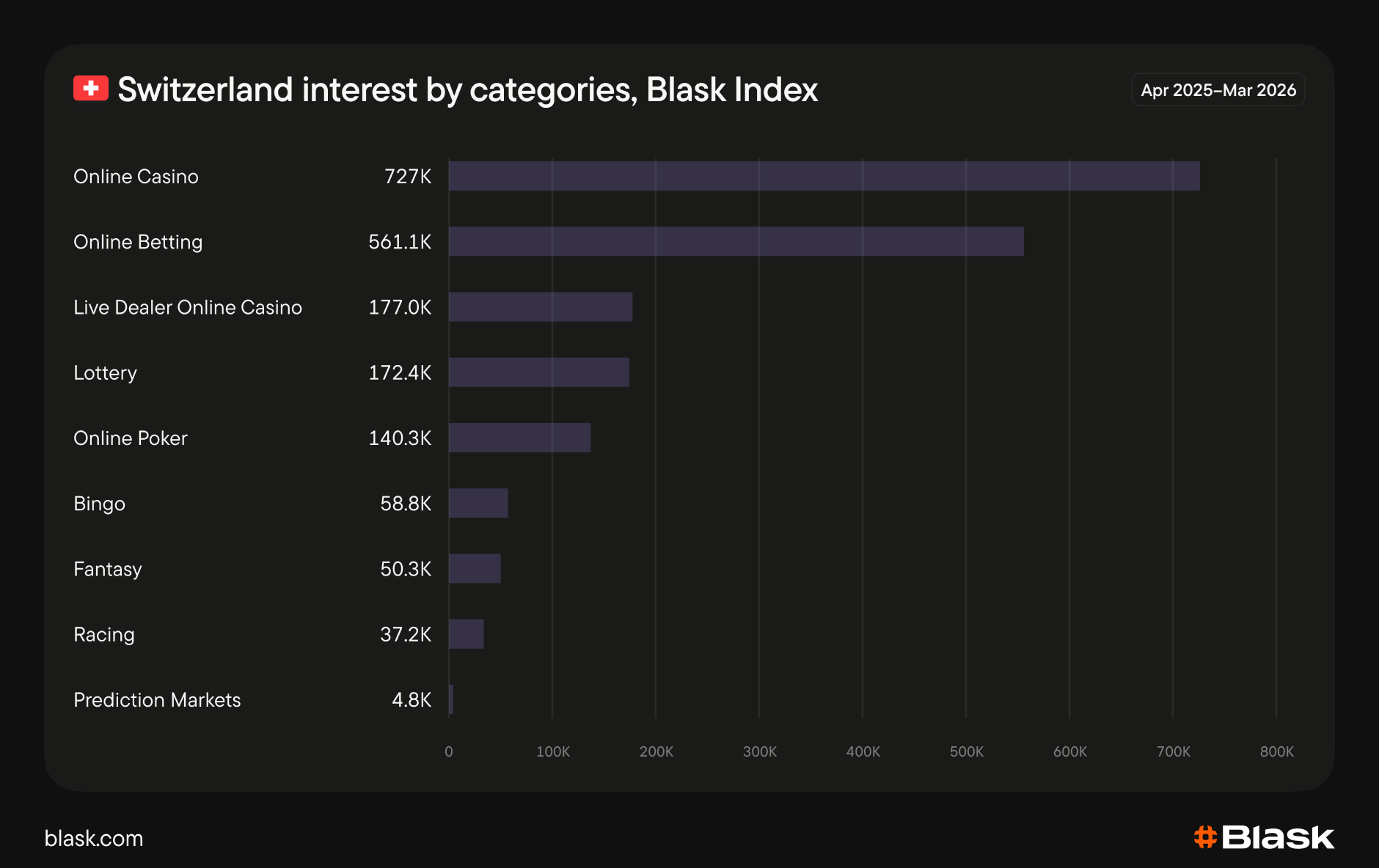
The market is small: total category interest across all verticals is roughly one-eighth of France’s and one-twelfth of Brazil’s. A population of 8.8 million and a licensing regime that limits online casino permits to existing land-based operators constrain the playing field.
Online betting follows at about 29%. Live dealer, lottery, and online poker occupy the next tier at 7-9% each. Blackjack accounts for nearly 90% of live dealer demand, a far more concentrated subcategory mix than India or Italy. Lottery reads as modest for a country with Swisslos and Loterie Romande operating state products, but the small population caps the ceiling.
Brazil: football, MMA, esports
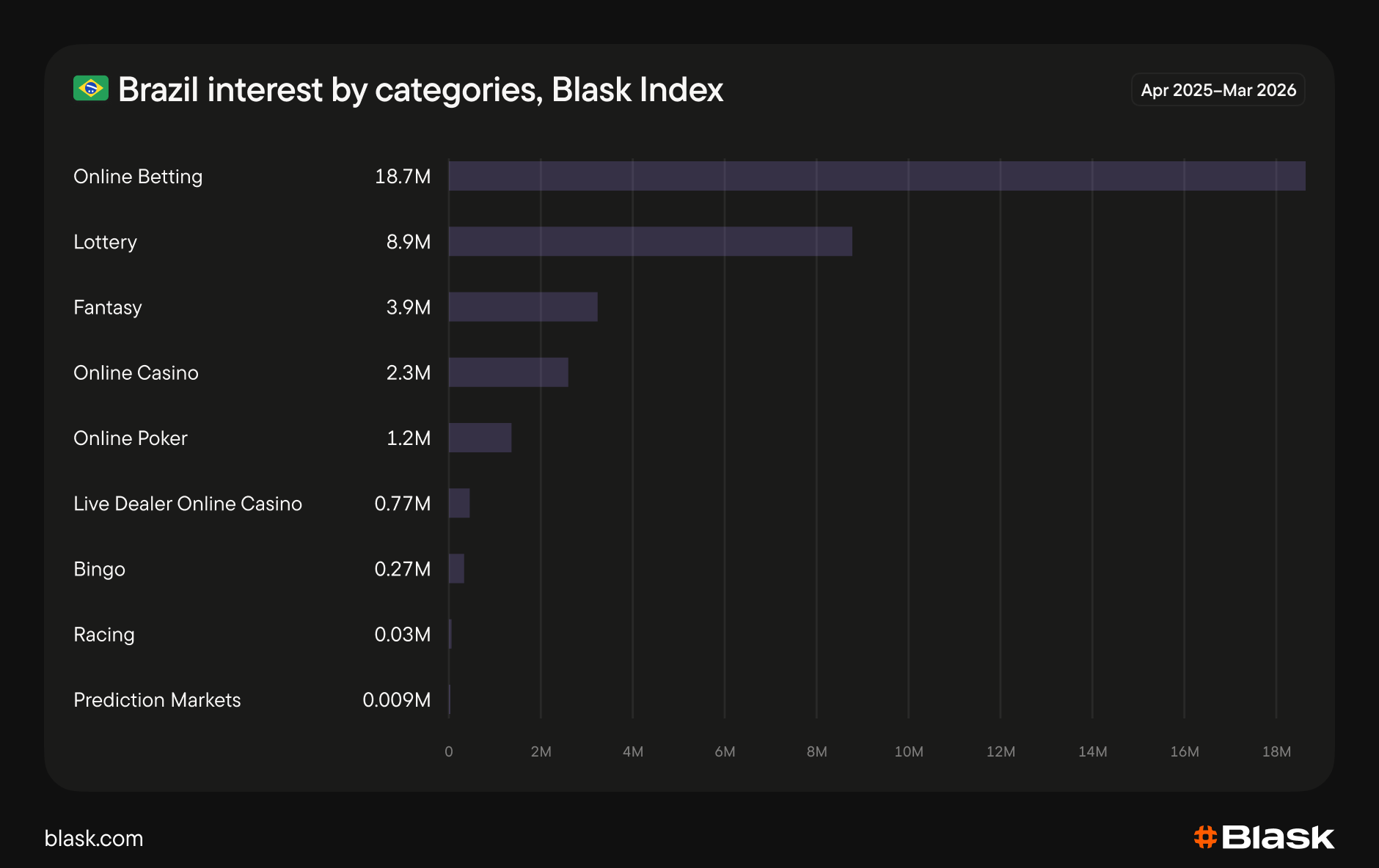
Online betting dominates Brazil at about 52% of total gambling demand. Betting interest runs roughly 8x larger than online casino and more than 20x larger than live dealer.
Football powers the betting category, but two subcategories reveal less obvious demand patterns. MMA-specific search interest runs at roughly double the level of esports, which is itself substantial. Brazil produces more UFC fighters than any country except the United States, and search demand tracks that pipeline. Esports adds a second dimension: Brazil has one of the world’s largest competitive gaming audiences.
Lottery takes second place at about 25%, anchored by the Mega-Sena and Loteria Federal traditions that predate the entire online gambling industry. Fantasy holds around 11%, with a seasonal pattern tied to the Brazilian football calendar.
Online casino (about 6%) and live dealer (about 2%) are small. Brazil’s regulated framework, which took full effect in January 2025, focused on sports betting. Casino verticals haven’t reached the demand mass seen in European markets.
Italy: fantasy leadership
Italy has the most seasonal category mix of the five. Fantasy sports leads by 12-month average at 37%, but that average hides sharp seasonality. Demand concentrates in the Serie A and Champions League months and drops out almost entirely in the off-season.
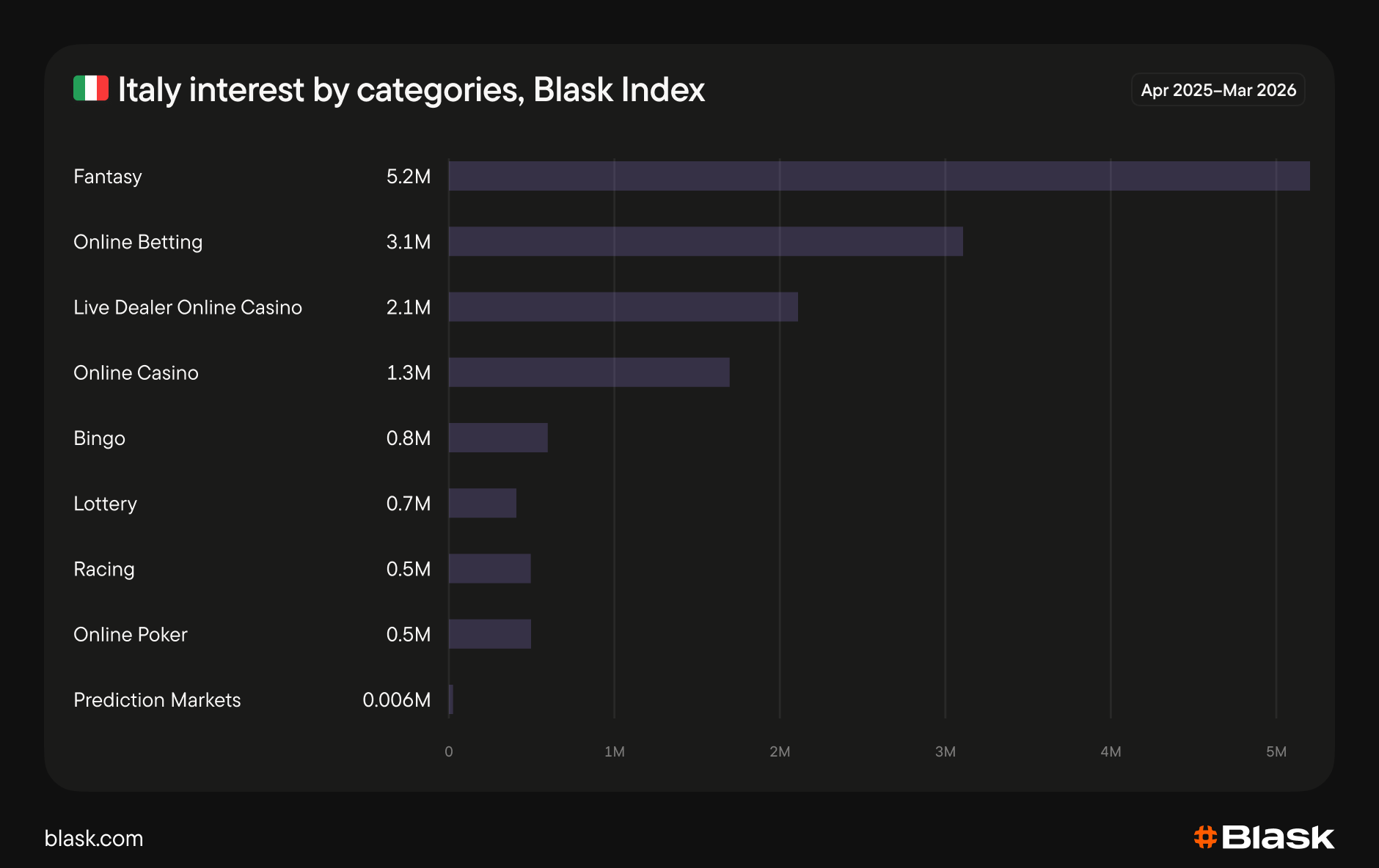
Live dealer and online betting each hold about 15-22% depending on the month. Live dealer demand is distinctive: game shows account for three-quarters of the category. Italian television has decades of quiz and game show culture, from Rischiatutto to Affari Tuoi. Live casino formats like Crazy Time and Dream Catcher tap into that familiarity. Players know the mechanic: a host, a spinning element, a payout.
Online betting carries a visible horse racing component alongside football. Italy operates one of Europe’s oldest toto-based racing betting systems, and players still search for it.
Online casino holds about 9%. Bingo (about 6%) holds a stronger position than in any other country here. Italy’s tombola tradition, played at family gatherings and during holidays, sustains a cultural link to the format.
Lottery reads low at under 5%, which looks odd for the home of the SuperEnalotto. The likely explanation is behavioural: Italian lottery players search for state lottery brands directly, and a non-branded index like this one doesn’t capture that traffic.
India: diverse mix
India spreads demand across five categories more evenly than any European market in this report. Lottery leads at about 35%, followed by live dealer at 29%. Online casino, online betting, and fantasy each hold around 10%.
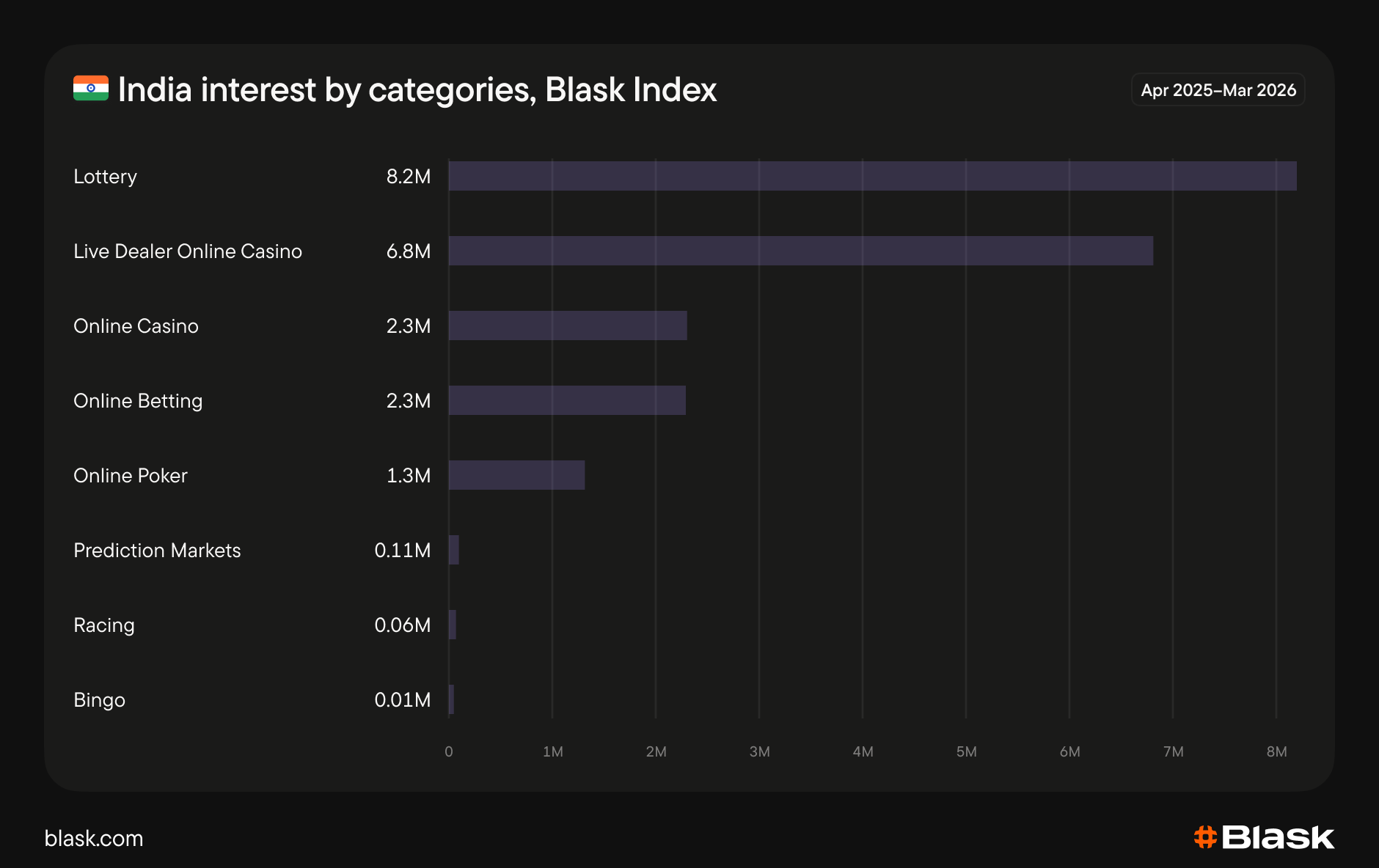
The live dealer composition separates India from every other country in this analysis. Teen Patti, the three-card game played across Indian households for generations, accounts for more than three-quarters of all live dealer interest. Blackjack and roulette fill the remaining seats, but they compete on foreign ground here.
India’s lottery tradition is long and state-specific: some states operate legal draws, others ban them. Search demand runs high regardless. Fantasy owes its scale to Dream11 and the IPL ecosystem, where season-linked play has entered mainstream entertainment. Cricket carries visible weight within betting, with search demand concentrated around major tournament windows. Live dealer interest spikes during Diwali — Hindu festival of lights — when card games are a cultural fixture in Indian homes.
Bottom line
Two patterns cut across all five markets. First, regulation shapes demand more than preference does. Where a vertical is blocked, demand doesn’t disappear. It migrates to adjacent legal categories or flows offshore.
Second, the biggest categories in each country are almost always the oldest ones. Formats rooted in pre-internet habits consistently outweigh imported international verticals. And their demand isn’t flat across the year — it spikes around local calendars: festivals, league seasons, football windows. Twelve-month averages hide most of it.