

- Updated:
- Published:
From FTD to active player: how to improve first deposit conversion in online casino

A first deposit is not an active player. Teams celebrate FTD, then watch the same accounts go quiet. OptiKPI’s casino benchmarks put typical registration-to-FTD in tier-1 markets at 15–35% (top quartile 35%+). This article shows how to improve first deposit conversion in online casino: what keeps a first-time depositor from becoming an active player, how to diagnose the leak with APS/CEB, and which product moves actually close the gap.
What FTD conversion actually measures — and why most operators track it wrong
FTD conversion rate answers one question: of the people who reached you, how many became depositing players? For an FTD conversion rate iGaming benchmark, the useful cut is online casino registration to first deposit — not visits alone.
| FTD rate (%) = (First-time deposits / Unique visits) × 100 |
Example: 10,000 unique visitors and 250 first-time deposits mean 2.5% FTD rate.
Time-to-FTD — hours or days between registration and first deposit — matters as much as the rate itself. Shorter time-to-FTD almost always correlates with higher conversion: the player still remembers why they signed up, the welcome offer is still visible, and the payment method they intended to use is still available. When time-to-FTD stretches into days, every extra hour is another chance to churn to a competitor.
Operators who only review “FTDs this month vs last month” lose the diagnostic. If registrations hold flat while FTDs fall, the leak is rarely “the market cooled”. It is usually a new friction point:
- bonus terms changed;
- a local payment rail disappeared;
- KYC started asking for documents before deposit;
- withdrawal policy copy got worse.
Aggregate monthly conversion hides which of those broke..
Where players actually drop off — the 4 friction points
To reduce FTD drop-off in online casino, product teams must fix the product stretch after sign-up.
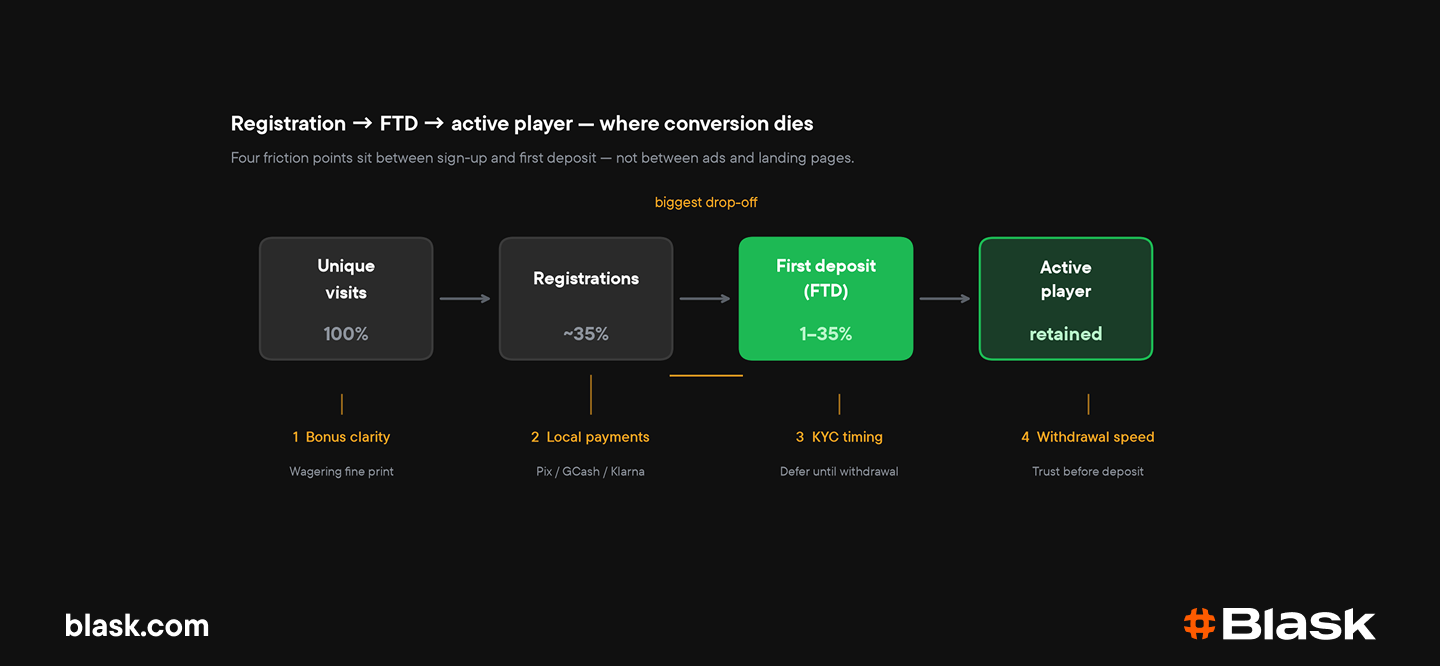
Four friction points between sign-up and FTD
The first deposit funnel casino journey compresses the journey into four stages:
- Unique visits.
- Registrations.
- First deposit.
- Active player.
Industry ranges sit on each stage — visits at 100%, registrations often around ~15–35%. If media CPA looks fine, but FTD rate still sinks, the fix is on this middle stretch.
1. Bonus conditions
A welcome offer with x50 wagering buried in fine print kills conversion. Players who cannot parse the terms in roughly ten seconds do not deposit usually leave. Mr Gamble’s analysis of 600+ casinos and 200,000+ clicks found that low or zero wagering on the first offer is associated with up to +22% higher FTD conversion. Attractive, readable bonus terms overall can lift FTDs per click by up to +45%.
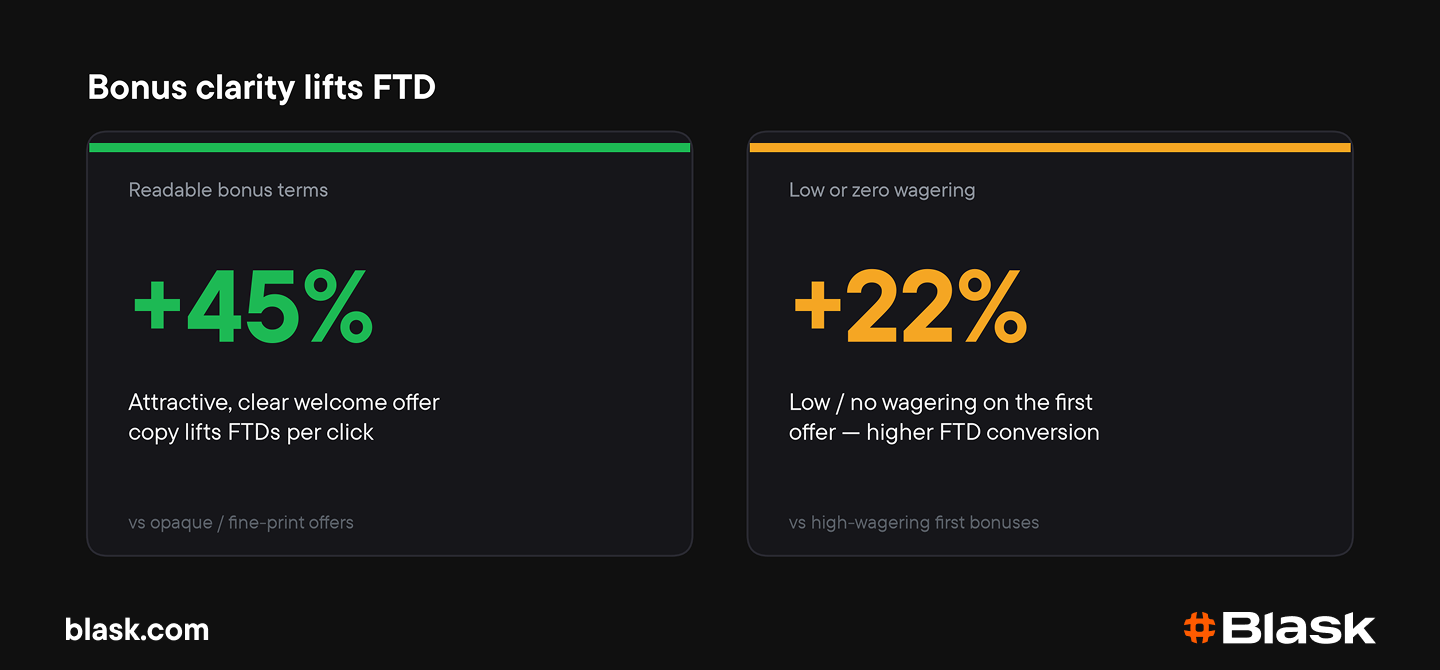
How bonus clarity lifts FTD
2. Payment methods
If the player’s preferred rail is missing, conversion collapses. This is GEO-specific, not generic “add more wallets”:
- Pix in Brazil;
- GCash in the Philippines;
- Klarna (and local open-banking rails) in Scandinavia.
Local rails are a baseline requirement — Mr Gamble ties fast / local banking options to up to +14% FTD. Blask Customer Profile data for Brazil shows a young, money-motivated audience: 71% cite “earn money” / “make money” as a sports-betting motive, 60% for casinos. Offering card rails only in that environment is a self-inflicted FTD tax.
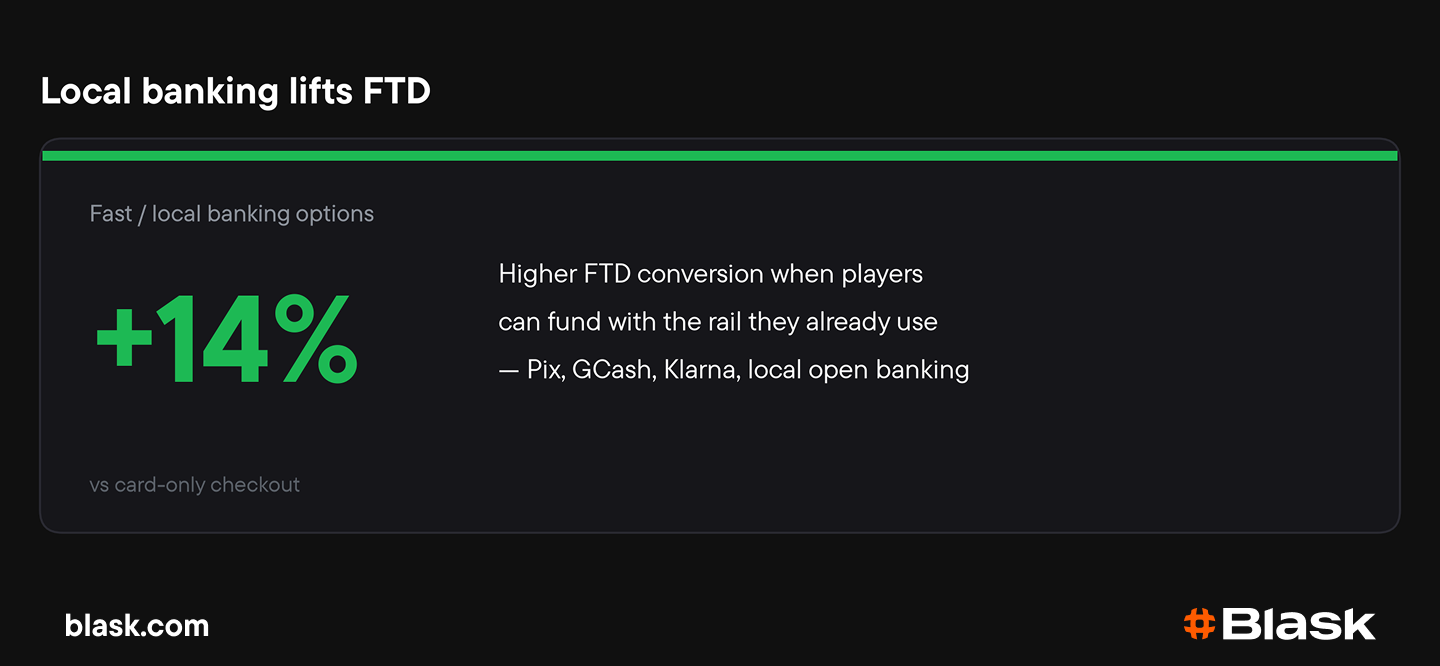
How local banking lifts FTD
3. KYC friction
Asking for document upload before the first deposit is one of the fastest ways to lose a registered player. Best practice in many offshore markets is a deferred KYC — verify before withdrawal, not before deposit.
| ✅ In regulated markets operators cannot skip mandatory checks, but they can still minimise registration fields to what the licence actually requires and push optional identity steps downstream. |
4. Withdrawal speed
Fast withdraw proves that an iGaming brand is reliable. For example, Visa’s Paddy Power Betfair case study reports a 14% rise in weekly-placed deposits after Visa Direct instant payouts (plus 5.5% more weekly bets).
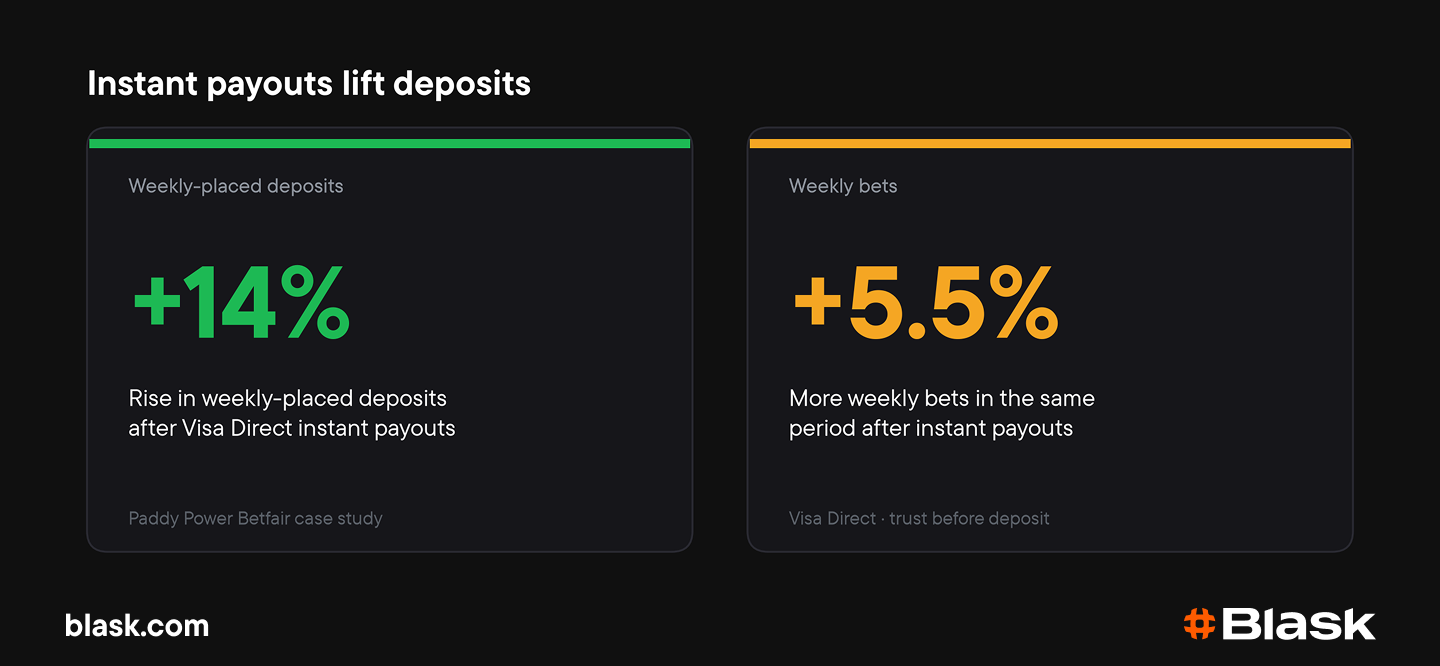
How instant payouts lift deposits
How to use APS to find your FTD gap
Buying more traffic does not tell whether the funnel converts, but APS does.
APS is Blask’s AI metric for how many new customers a brand should be acquiring given its current market presence — visibility, competitive position, and category demand.
The diagnostic is the gap between APS and the reported FTD:
- FTD below the Worse band. It means that awareness and traffic are not the bottleneck. The registration-deposit funnel is leaking (bonus, payments, KYC, or trust).
- FTD inside or above the Better band. It means that acquisition is converting; move the spotlight to monetisation and retention.
Two patterns show up repeatedly in practice:
- Post-deposit leak. APS looks healthy (players are arriving), but the second deposit / GGR sits below the CEB floor. The first deposit happened, but the product failed to keep them. Fix CRM, cross-sell, and bonus abuse — not CPA bids.
- Full-throttle success. APS and reported FTD rise together, visibility converts. Double down on what is working; do not “fix” the funnel into worse.
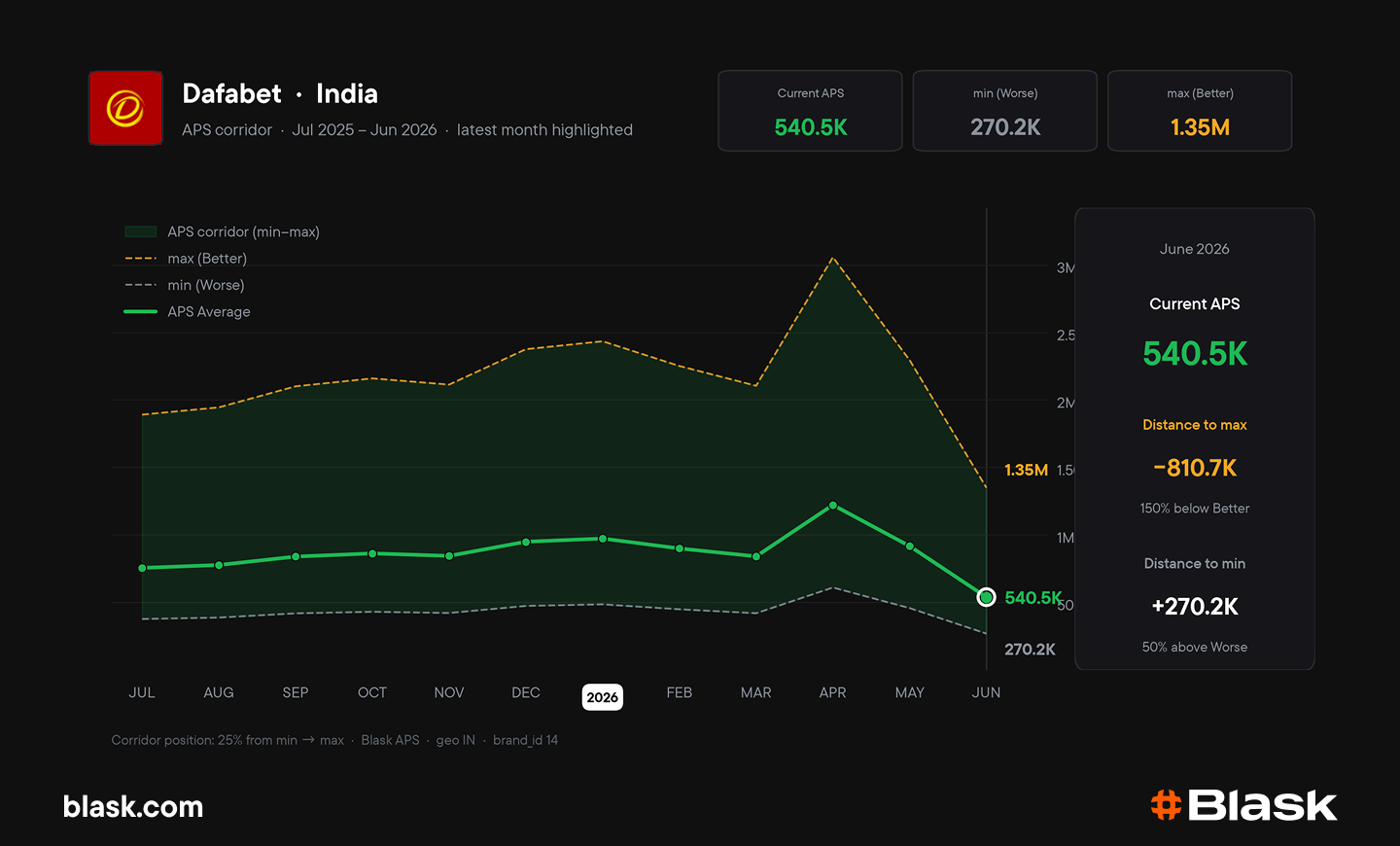
Dafabet’s APS dynamics in India
Example. In June 2026, Dafabet’s APS dropped and was very close to the “min” metric. The brand is not dead on acquisition — it is underperforming its own potential, and that is exactly where first deposits fail to become active players.
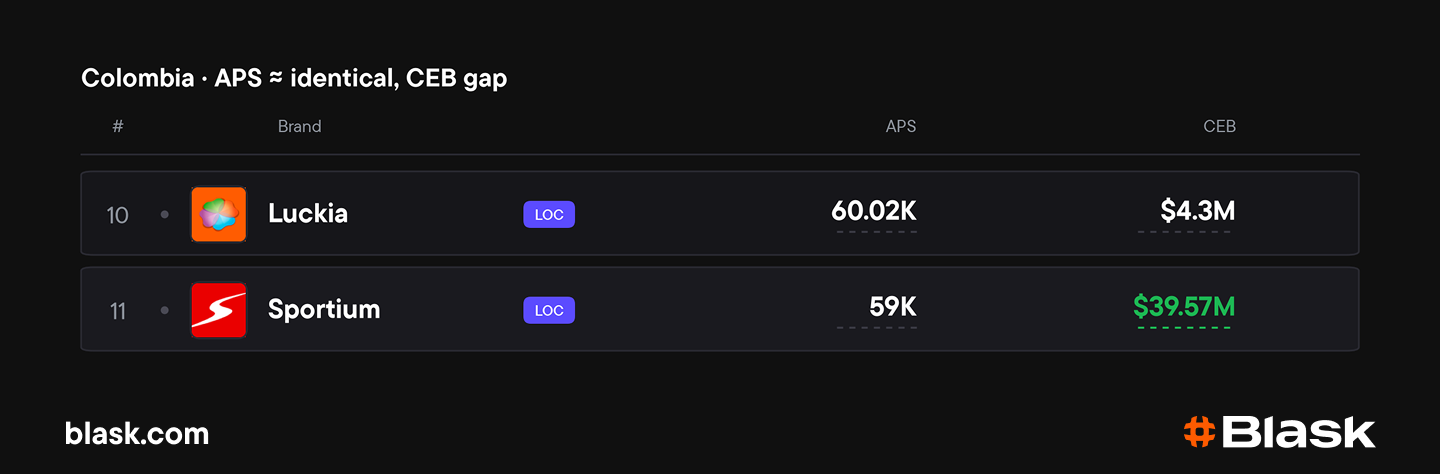
Luckia and Sportium comparison
APS also can be used for comparing rivals. For example, in Colombia, Luckia and Sportium sit on nearly identical APS, so acquisition potential is comparable. But CEB diverges almost 9x. It means that the gap lives after the first deposit, in product, retention, and monetisation. If APS looks healthy while CEB lags, fix your funnel (second deposit, CRM, offer design) before you raise media spend.
4 tactics that move the needle — with numbers
These iGaming FTD optimization tactics move the needle on first deposit and on the path from FTD to active player.
1. Put the bonus in one sentence on the first screen
Attractive, transparent welcome terms are associated with up to +45% FTD. Format: one benefit, one number, one CTA. Kill x50 fine print as the hero message. If low/zero wagering is commercially viable for your margin model, the conversion upside (up to +22%) usually beats the promotional “generosity” that players cannot understand.
2. Add the local payment rail your GEO actually uses
Do not stop at Visa/Mastercard. Match the method the majority of players in that country already use for everyday transfers — Pix (BCB), GCash, Klarna, and peers. Use Blask Customer Profile plus local payment mix research to prioritise which rail to integrate first; then measure FTD rate by payment method, not only by channel.
3. Defer KYC until withdrawal where the licence allows
Top offshore and grey-market operators treat pre-deposit document upload as a conversion anti-pattern. In regulated markets, cut registration to mandatory fields only and sequence identity checks after the player has a reason to complete them (cashout). Every optional field before FTD is a voluntary drop-off.
4. Segment the welcome offer by traffic source
One welcome pack for everyone is the worst pack for each segment:
- Affiliate traffic — matched deposit (they arrived to claim value)
- Organic / brand search — no-wagering free spins or a cleaner product-led offer (they arrived with intent, not a coupon mindset)
Source-aware offers beat generic “100% up to…” copy on FTD rate because the promise matches the motivation that brought the player. Traffic-source FTD ranges also differ sharply — e.g. organic brand search often accounts for 35–55% reg-to-FTD vs much lower paid/social bands.
| 🔥 These tactics also cut wasted media cost: every point of FTD lift lowers effective CAC without needing a cheaper click. For the sports-betting side of the same acquisition cluster, see How to reduce CAC in sports betting. |
Casino vs sportsbook — the FTD funnel is different
Casino and sportsbook share the FTD acronym and almost nothing else in the trigger mechanics.
In casinos, the first deposit is usually pulled by a welcome bonus + immediate game experience — free spins, a clear match offer, a lobby that loads fast on mobile. The emotional clock starts at registration: play now or leave.
In sportsbooks, the trigger is often event-driven: an upcoming match, a boosted market on a favourite team or league, a live bet that only makes sense if the account is funded today. Market coverage and odds presentation matter more than spin-led bonus theatre.
That split means tactics are not interchangeable. A no-wagering free-spin pack that lifts casino FTD can do nothing for a football-first player who needs a same-game parlay market. A match-day odds boost that converts sportsbook registrations will not move a slots player waiting for a clear spin offer. Segment product and CRM by vertical before you declare an “FTD best practice” company-wide.
Start with the gap, then test the tactics
FTD conversion is not a marketing vanity metric. It is a product problem with a marketing budget attached. The operators who win do not start with another creative test — they start with data: where APS says they should be, where reported FTD actually sits, and which of the four frictions explains the distance.
See your brand’s APS and FTD gap — book a Blask demo.