- Updated:
- Published:
Brazil offshore iGaming still has twice the brands and 5% of demand

Unlicensed brands still fill most of the Brazil iGaming headcount. Search demand and the revenue baseline sit with the licensed list.
On 1 January 2025 Brazil opened a regulated market for sports betting and iGaming. Law 14.790/2023 set a 12% levy on GGR, required licensed sites to run on a .bet.br domain, and barred advertising for operators without an authorisation. A 31 December ordinance listed 52 operators on provisional terms beside 14 already on full authorisation.
Eighteen months later the public argument arrives in two versions: legalisation displaced offshore, or offshore is doing as well as ever, just out of sight. August 2026 Blask data on tracked brands tests both. The licensed overview covers scale; this page sizes the leftover.
How Blask splits onshore and offshore
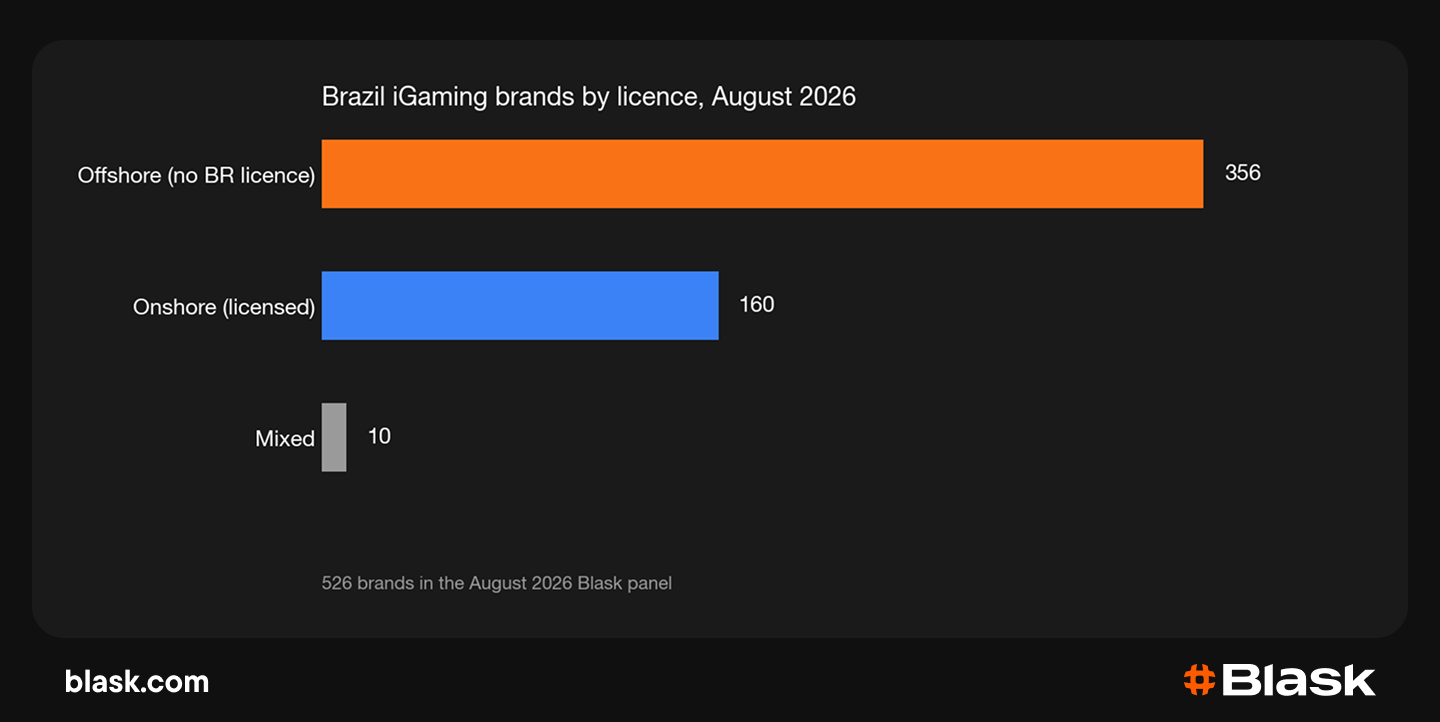
A brand is Onshore when it holds a local licence, Offshore when it does not, and Mixed when the same name sits in both states. Blask tracked 526 casino and/or betting brands in Brazil in August 2026: 160 Onshore, 356 Offshore, 10 Mixed. Headcount still favours the unlicensed pool by about two to one.
Search demand for those names — Blask Index — runs the other way. Licensed operators hold 95.3% of August demand. Brazil offshore iGaming is 4.7%. Mixed names do not change that picture.
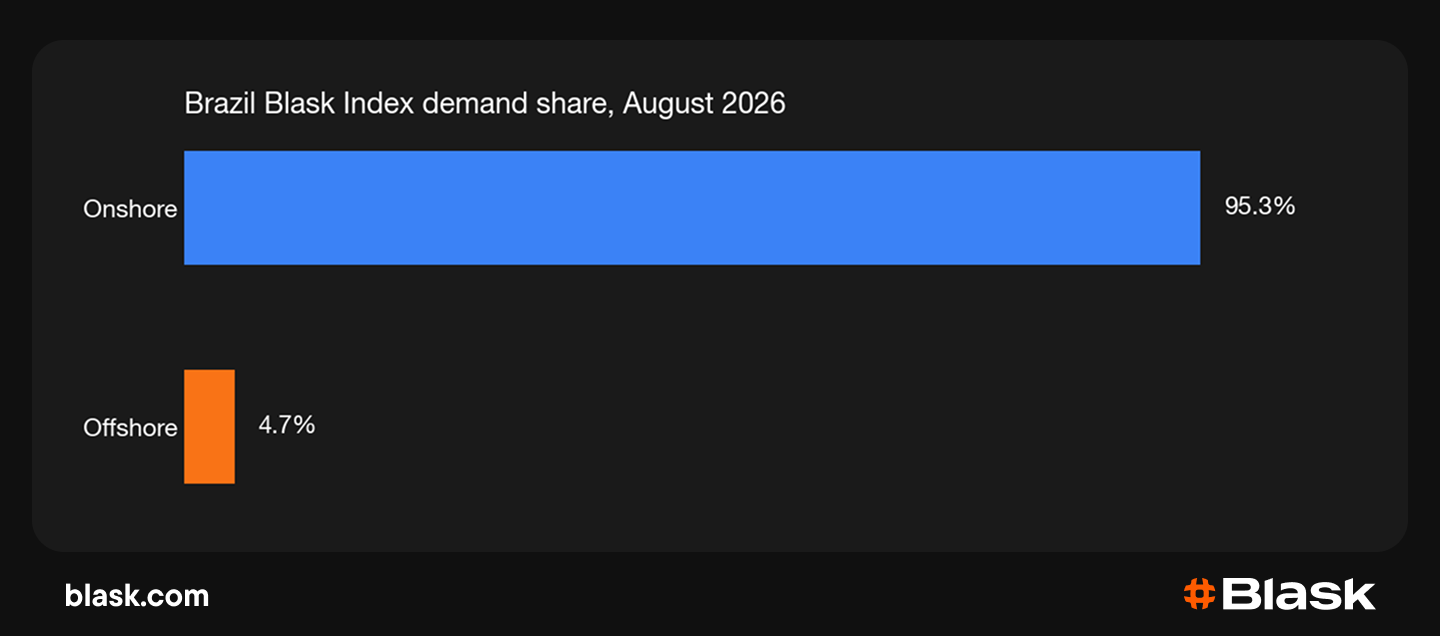
💡 Key point: licensed operators hold 95.3% of August demand. Brazil offshore iGaming is 4.7%.
Competitive Earning Baseline (CEB) is a projected revenue range, not deposits and not regulator GGR. The grey list can look large as a roster and small as money. Both readings are in the same panel; they answer different questions.
📚 Read more: What is Blask Index and How Blask measures
Brazil offshore iGaming share has not moved in a year
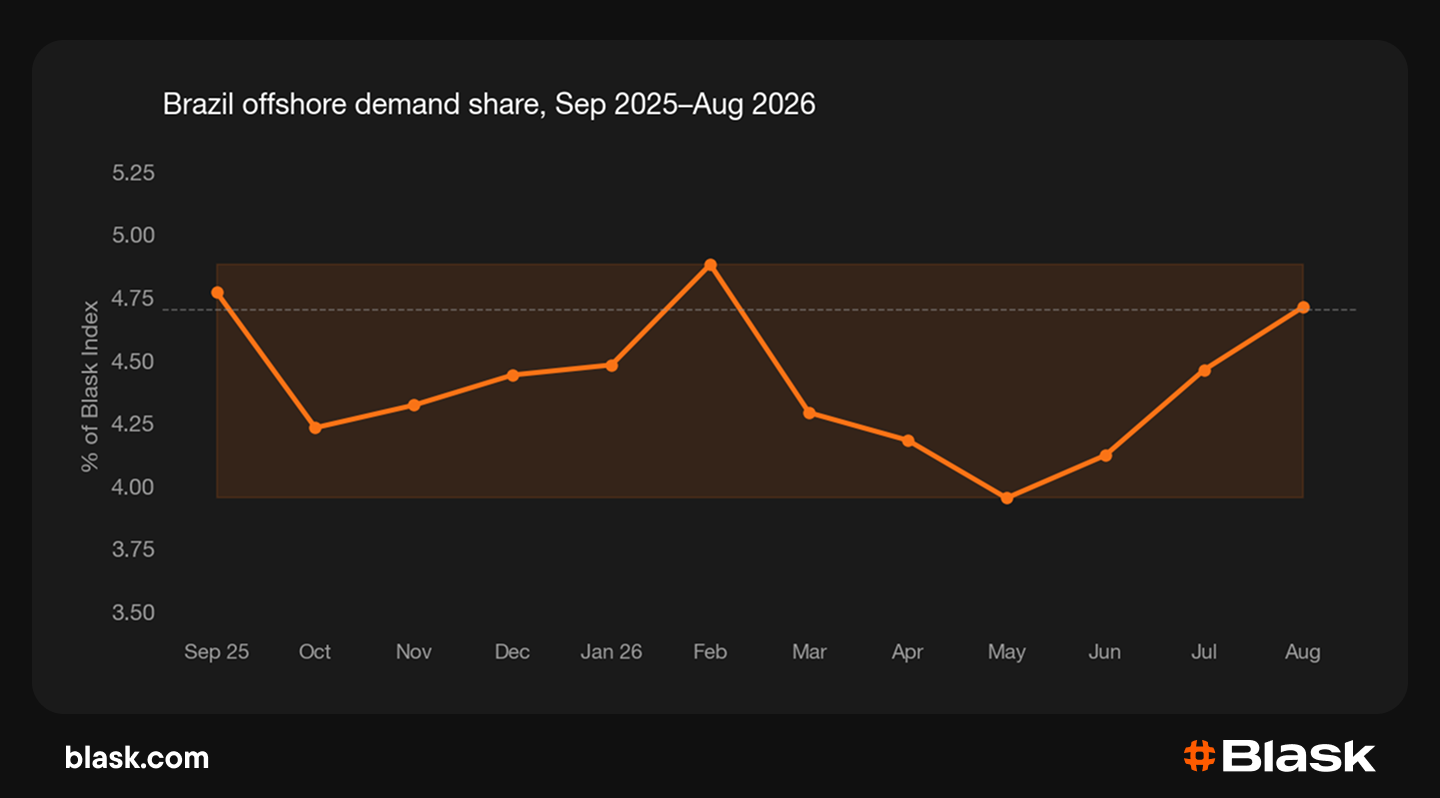
From September 2025 through August 2026 the offshore share of demand stayed inside a 4.0–4.9% band. February printed the high (4.9%). May printed the low (4.0%). August closed at 4.7%, back where the year started.
A 0.9-point corridor around a licensed majority is a leftover that has already found its size. There is no run toward zero and no rebound that would rewrite who holds the market.
Brazil’s Federal Court of Accounts (TCU) puts illegal operators at 41–51% of total betting volume, up to R$40bn a year. A Senate amendment to MP 1303/2025 cites studies that about 50% of bets go through unauthorised platforms.
Those estimates cut the market differently from Blask Index. TCU and the Senate are counting operators and an estimated stake pool, including sites that never enter Blask’s tracked-brand register. The metric records which names players search for.
A long tail of small unlicensed brands can coexist with a 4.7% share of that attention. The 41–51% volume range is not a Blask CEB figure, and it is not a share of the 526-brand panel.
📚 Read more: Brazil illegal betting: operators vs revenue
Which offshore brands still capture demand
The licensed ranking is a closed shop: the August top 10 is Onshore, and Betano alone holds 31.56% of country demand — more than every unlicensed brand combined.
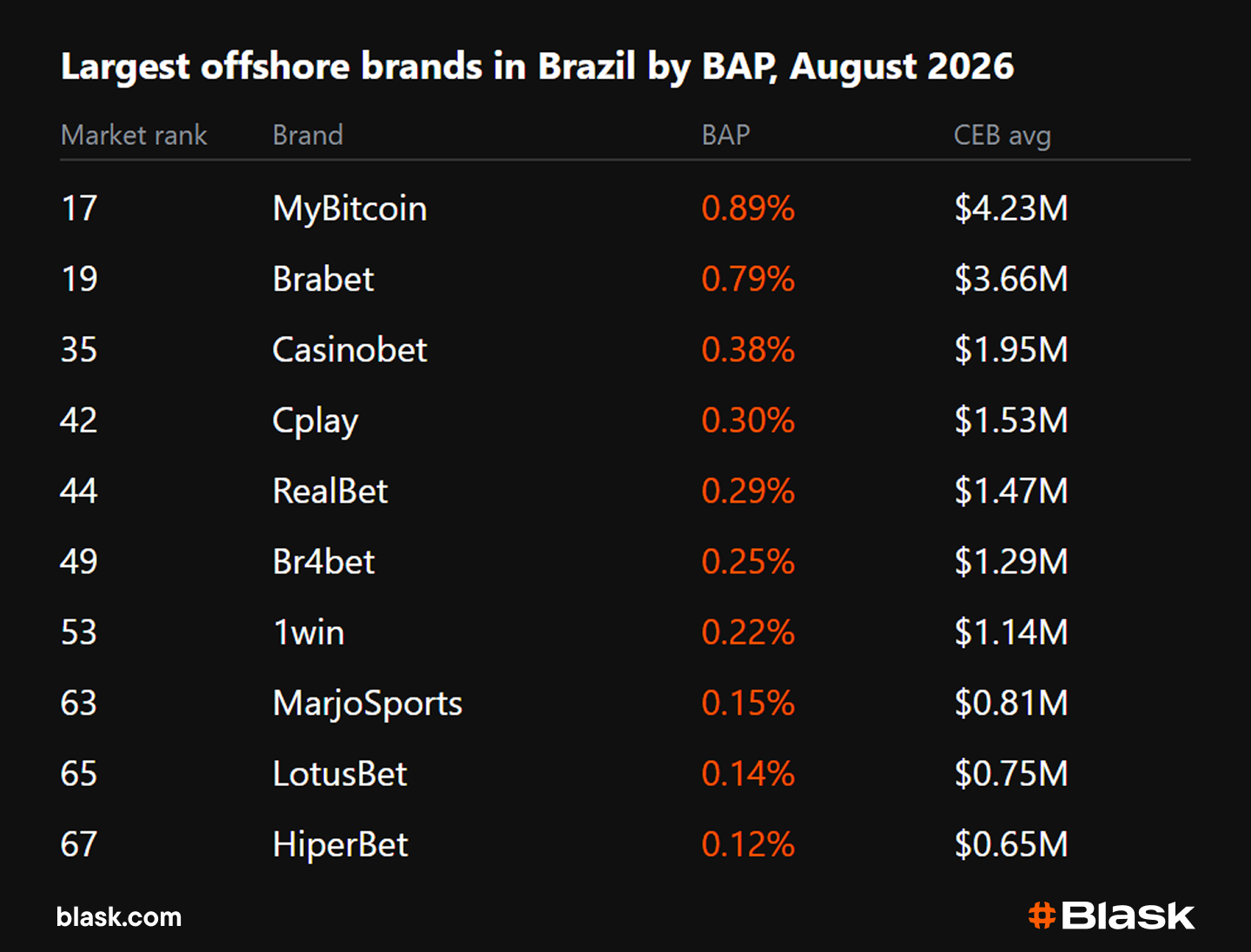
The grey demand that remains is not spread evenly across 356 names. Ten offshore brands hold about 3.6 percentage points of country BAP — most of the 4.7% slice.
- MyBitcoin — 17th in the country (0.89% BAP, CEB $4.23M in a $2.11M–$10.6M range).
- Brabet — 19th, at 0.79% BAP.
- Casinobet, Cplay and RealBet follow.
- 1win sits at 53rd.
The leftover is a short list with a long tail behind it. MyBitcoin’s CEB is about a sixth of the whole offshore baseline. The other 346 unlicensed names share about one remaining point of demand — the roster TCU can still count as operators without showing up in search.
Demand converts into less CEB
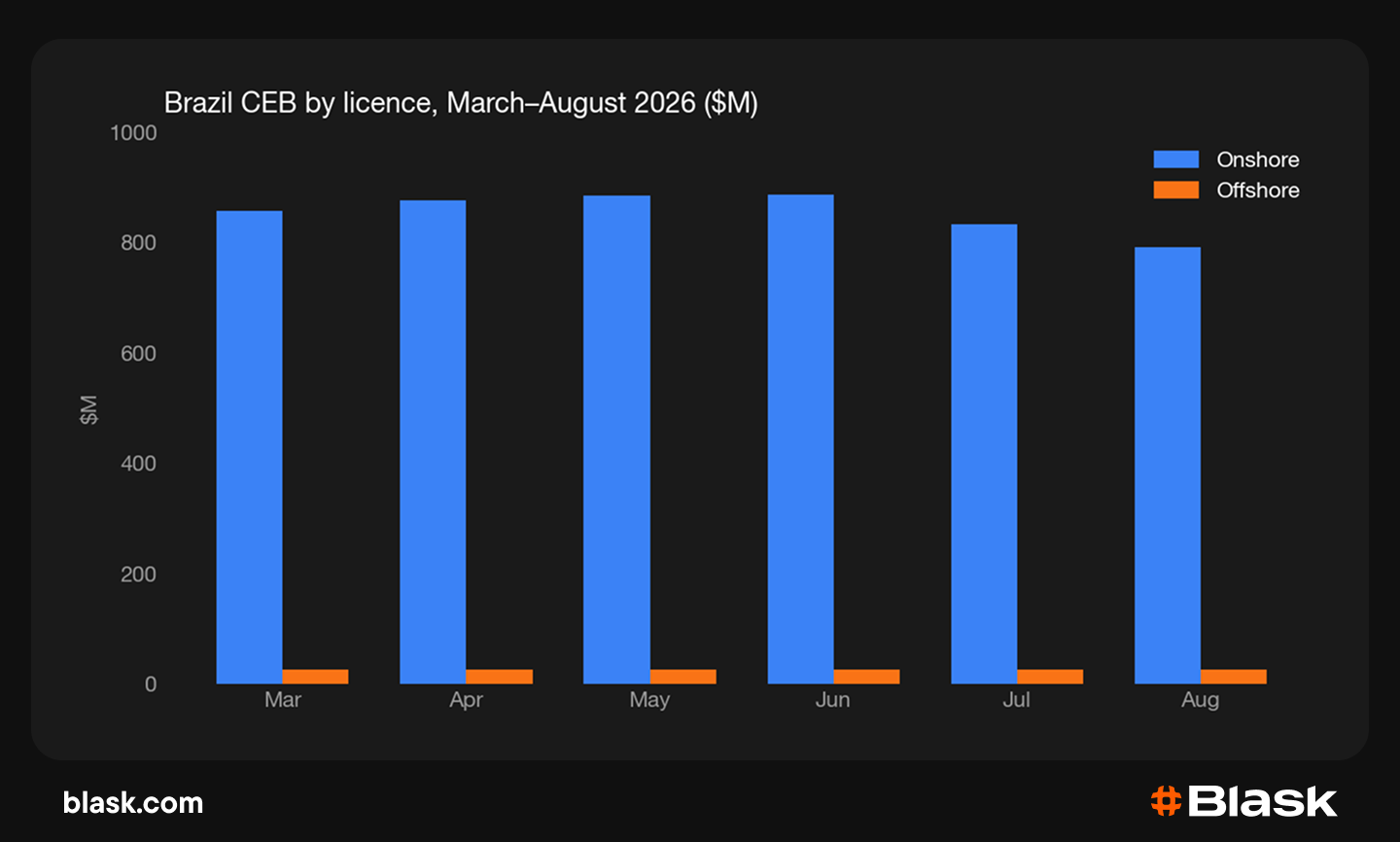
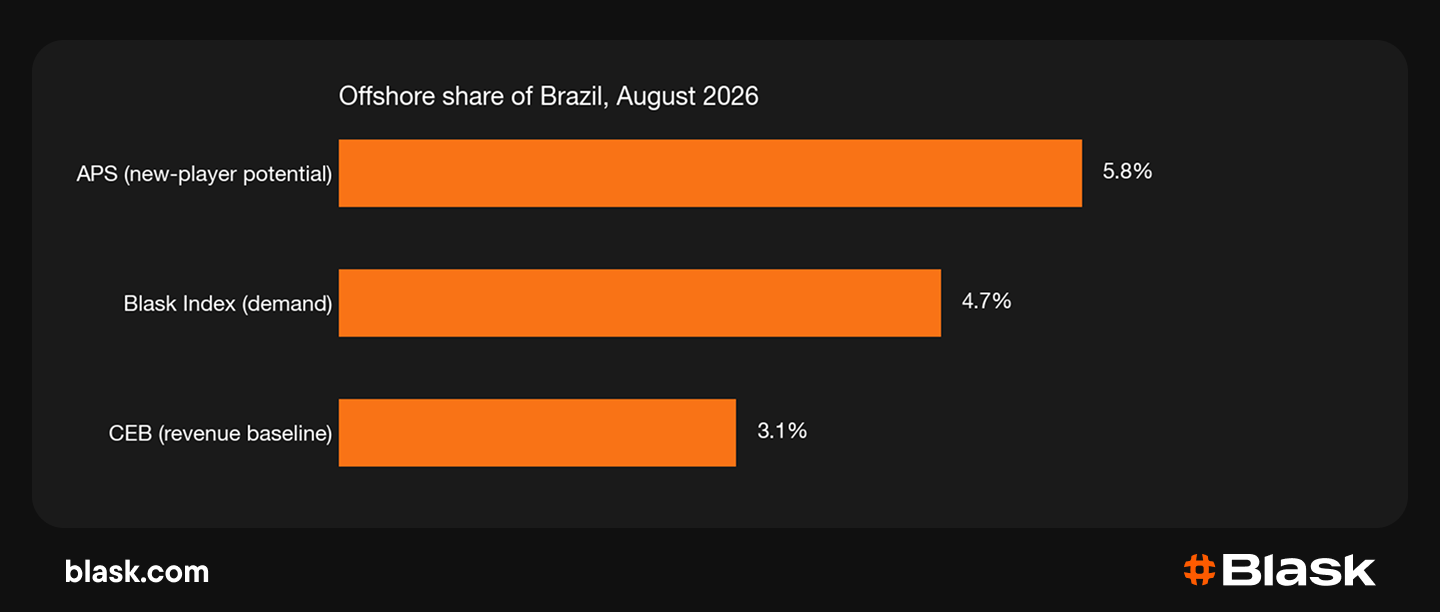
August CEB is $791M ($594M–$1.38B) for licensed operators and $25.5M ($12.7M–$63.7M) for offshore. That is 3.1% of the money against 4.7% of demand: the grey list draws more attention than it converts into a revenue baseline.
💡 Key point: offshore is 4.7% of demand and only 3.1% of CEB — more attention than revenue baseline.
From March to August both pools contracted at almost the same pace. Onshore CEB fell 7.7%. Offshore fell 6.3%. The mix held. January’s level shift in the CEB series is a coverage break, so the comparable window starts in March.
Acquisition Power Score (APS, estimated new-player potential) sits above both of those shares. In August offshore is 5.8% of APS, 4.7% of demand and 3.1% of CEB. The grey list still recruits more than it monetises.
📚 Read more: Competitive Earning Baseline (CEB)
Enforcement has not closed the grey list
Law 14.790 is the federal frame: a 12% GGR levy, a .bet.br domain rule, and an advertising ban on operators without SPA authorisation. Unlicensed brands cannot buy the same awareness the licensed list can. What remains in the Index is residual search.
Provisional licences at launch sat in Portaria SPA/MF nº 2.104; the 52 names in that annex were not a substitute for full authorisation. Payment rails and domain blocks are the state’s other tools. This page does not treat a block count as a share of demand.
Eighteen months after the first full approvals, the tracked leftover is still the same 4–5% of search interest. TCU’s 41–51% volume band lives, if it lives, in brands and stake that the panel does not see. Inside the panel, enforcement has not produced a second drop from the licensed majority that was already in place by late 2025.
📚 Read more: Brazil iGaming market H1 2026
FAQ
How much of Brazil’s iGaming is still offshore in 2026?
On tracked brands in August 2026, 4.7% of demand and 3.1% of CEB. That is the Blask reading. TCU’s 41–51% of betting volume is a different cut of the market.
Does blocking illegal sites kill demand?
In the twelve months to August 2026 the offshore share of Blask Index stayed between 4.0% and 4.9%. Licensed brands already held the rest when the year began. Blocking can remove domains without moving that corridor.
Why do TCU and Blask disagree on illegal betting?
They measure different objects. TCU estimates stakes through unauthorised platforms, including names Blask does not track. Blask Index is search demand for brands in the Brazil panel. A large operator count can sit next to a small demand share.
Is sports betting legal in Brazil?
For operators with SPA authorisation, yes — from 1 January 2025 under Law 14.790. Sites without that authorisation remain illegal. The question this page answers is how much tracked demand still sits with them.
Bottom line
Offshore still wins the headcount. Licensed operators keep the demand and the revenue baseline, and that split has not moved in a year. The open question is whether TCU’s 41–51% volume range lives in brands Blask does not track — because inside the panel, Brazil offshore iGaming is already a thin remainder.
Figures update on the Brazil market page.