
- Updated:
- Published:
Brazil iGaming brand rankings 2026: Betano leads a fully licensed top 10 with 24.15% BAP

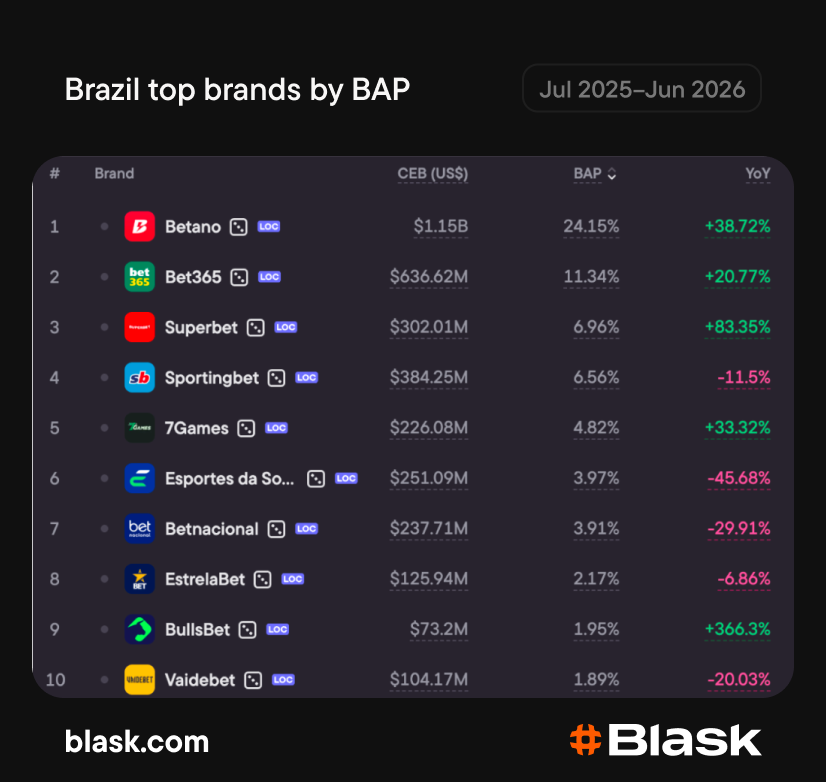
Eighteen months after regulation, Brazil’s top 10 iGaming brands are entirely licensed, controlling 67.72% of BAP and $3.49B in CEB, 53% of the market. Betano leads with 24.15% BAP, more than double Bet365, while market concentration among the top three brands rose from 26.5% to 35.4% since Q1 2025.
Brazil launched its regulated iGaming market in January 2025. Eighteen months later, the number of iGaming operators Brazil licensed has reached 169 brands under the oversight of the Secretariat of Prizes and Bets (SPA/MF). Blask tracks 581 brands’ presence in the country. The market has become noticeably more concentrated: the top 10 by BAP is now made up entirely of licensed operators. In the first month of regulation, nearly 30 spots in the top 100 belonged to offshore brands.
Blask data on Brazil iGaming brands market share 2026 shows which companies benefited from market consolidation and how visible brands outside the top 10 remain.
Brazil iGaming market overview 2026: the regulated landscape
Brazil remains by far the largest iGaming market in Latin America. Over the past 12 months it generated around $6.59B in CEB — roughly 1.5x more than Mexico and Argentina (2nd and 3rd largest LatAm markets) combined.
The regulated segment grew from almost nothing over that period. In December 2024, just before the new rules took effect, only two brands held licenses — Esportes da Sorte and MagicJackpot. Today, 169 licensed brands operate in the country.
The tax burden is also rising gradually: the GGR tax rate increased from 12% to 13% in 2026, and is set to climb to 14% in 2027 and 15% in 2028. Authorities had earlier proposed raising it straight to 18%, but that proposal did not pass.
Brazil sports betting brands remain a visible part of Brazilian football, even as their footprint has shrunk. In 2026, they serve as the main sponsor for 12 of the 20 Série A clubs, down from 18 a year earlier. That’s a third fewer, yet most league clubs still take the field with a bookmaker’s logo in the shirt’s primary sponsorship spot.
Betano leads a top 10 that’s now entirely licensed
Ranking the top online casino brands Brazil 2026 has produced, the top 10 now consists entirely of licensed brands. Together they control 67.72% of BAP and generate about $3.49B CEB — 53% of the market’s total CEB — over the past 12 months.
Who will lead Brazil iGaming market after regulation 2026? Betano remains the clear leader, with Betano Brazil market share at 24.15% BAP. The brand outpaces Bet365 by more than double in share of demand. Yet BAP and CEB rankings don’t always align: Sportingbet ranks fourth by Blask Indexbut third by CEB, ahead of Superbet.
BullsBet shows the sharpest movement in the top 10, up 366.3% YoY. The brand launched in May 2023, but meaningful growth only began in August 2025, and Blask Index data shows most of that growth came from a recent surge rather than gradual expansion since launch.
Regulation created a new generation of local brands
Regulation’s launch in January 2025 didn’t just help the biggest operators. Three local brands made the most notable leap: BullsBet, R7.bet and DonaldBet. All three had already been operating in Brazil before the reform, but started rapidly gaining market share after moving from offshore to onshore status.
Each brand’s growth trajectory, though, looked different.
BullsBet grew most consistently. After regulation launched, the brand steadily built up its presence, and growth accelerated in the second half of 2025. Blask Index data shows that after moving into the regulated segment, nearly all of BullsBet’s demand came to be generated inside Brazil.
R7.bet followed a different path. The brand grew quickly in the second half of 2025, peaked in early 2026, then gave back part of the share it had gained. Group structure adds extra support to its position: R7.bet is run by OIG Gaming Brazil, which is also behind 7Games, Betão and ICE Bet. Shared technical, payment and marketing infrastructure lets the group grow several brands in the same market at once.
DonaldBet shows the most volatile pattern. After growing in the second half of 2025, the brand accelerated sharply in early 2026, then pulled back from its peak. Over the same period, DonaldBet became one of three acquisitions the RNGX group made in under two months, alongside Bet Ponto Bet and Aposta Tudo. Some of that swing may therefore be tied to the change of ownership and the brand’s integration into a wider portfolio.
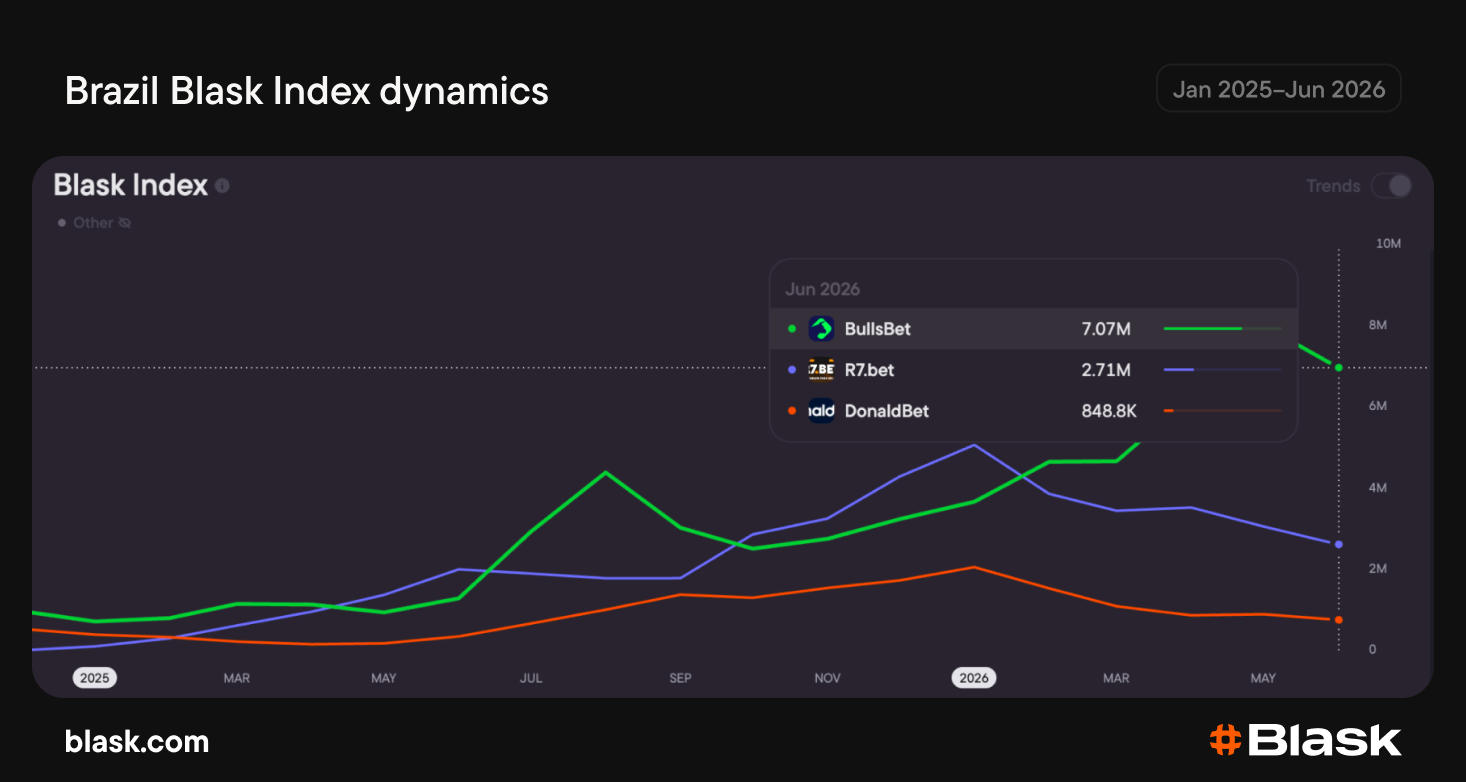
All three brands operate only in Brazil, combine casino and betting products, and grew without any Série A club sponsorship. Their peaks fell in late 2025 and early 2026, not around a major tournament, so the pattern looks more like a regulation effect amplified by marketing.
Offshore brands haven’t disappeared, but their number has halved
In January 2025, 29 offshore brands sat in Brazil’s top 100 by BAP. By June 2026, only 14 of them remained in the ranking.
Of the original 29 brands:
- Six got licensed and kept their spot in the top 100.
- Three got licensed but dropped out of the ranking.
- Six stayed offshore but fell below the top 100.
- Five disappeared entirely from Blask’s Brazil data.
- Nine remain offshore today and still sit in the top 100.
Five new offshore brands also entered the ranking after regulation launched, bringing the total number of offshore names in the top 100 to 14 today: nine have held on since January 2025, five more rose later.
Most of the old offshore brands are losing market share. Of the nine survivors, only Casinobet and ZeroUm are growing noticeably. The new entrants, by contrast, made the top 100 on the back of a sharp surge in demand.
Regulation has not managed to push offshore operators out entirely. SPA and Anatel have blocked tens of thousands of domains, but they can spin up mirror sites quickly. Some brands also rely on crypto payments and hold onto a niche audience, though Blask data alone can’t confirm how much these factors drive demand.
Market concentration: leaders keep taking share
Brazil iGaming market leaders keep consolidating: in the first quarter of 2025, Brazil’s three largest brands accounted for 26.5% of total market CEB. By June 2026, their share had risen to 35.4%. The top 5’s share grew from 37.1% to 44.3% over the same period.
For comparison, in Ontario the top three — bet365, FanDuel and DraftKings — control an estimated 60% of total GGR. The UK remains far more fragmented: Blask data shows that in May 2026, the three largest brands accounted for about 27.5% BAP, despite years of regulation and 349 active brands.
Brazil is still less concentrated than Ontario, but the leaders’ share is growing fast and already sits well above the UK’s level on a comparable concentration measure. The market is moving toward a model where a handful of the biggest brands capture an ever-larger share of demand and value.
The window is narrowing, but not yet closed
Brazil’s top 10 is now fully licensed, concentration is approaching Ontario’s level, and more than two-thirds of the offshore brands that sat in the top 100 in January 2025 have dropped out of it. This is a market consolidating fast — yet BullsBet, R7.bet and DonaldBet built top-30 positions from almost nothing in 12 months, five new offshore brands fought their way back into the top 100 after regulation launched, and 14 offshore names still hold on there despite 50,000 blocked domains.
Explore the Brazil online casino brand rankings Blask tracks in real time → blask.com/market/brazil/
FAQ
Which brand leads Brazil’s iGaming market in 2026?
Betano leads Brazil’s iGaming market with a 24.15% BAP share, more than double second-placed Bet365, according to Blask data covering the 12 months through June 2026. Betano also ranks among the top three brands by CEB.
Are offshore brands still in Brazil’s top 100 iGaming brands?
Yes, but far fewer than before regulation. Offshore brands held 29 of the top 100 spots by BAP in January 2025; by June 2026 that number had fallen to 14, as six brands got licensed and five disappeared from Blask’s Brazil data entirely.
How concentrated is Brazil’s iGaming market in 2026?
Concentration is rising fast. Brazil’s three largest brands controlled 26.5% of total market CEB in Q1 2025; by June 2026, their combined share had grown to 35.4%. The top five brands’ share rose from 37.1% to 44.3% over the same period.
Which new brands grew fastest after Brazil’s iGaming regulation?
BullsBet, R7.bet and DonaldBet posted the sharpest gains after regulation launched in January 2025, moving from offshore to licensed status. BullsBet alone grew 366.3% year over year, building a top-30 position from almost nothing within 12 months.