- Updated:
- Published:
Brazil’s licensed iGaming market is large. The tail stays thin

Brazil is no longer a regulation cliffhanger. It is a licensed market with an $8.87B eight-month CEB, one brand on a quarter of demand, and a grey remainder that Blask already measured elsewhere.
Scale, without the 2025 origin myth
For January–August 2026 Blask’s Competitive Earning Baseline for Brazil is $8.87B ($6.57B–$15.74B range). Only the US prints a larger country-level CEB in that window. The UK is $7.89B, Turkey $7.31B, Mexico $2.39B.
💡 Key point: For January–August 2026 Brazil’s CEB is $8.87B. Only the US prints a larger country-level CEB in that window.
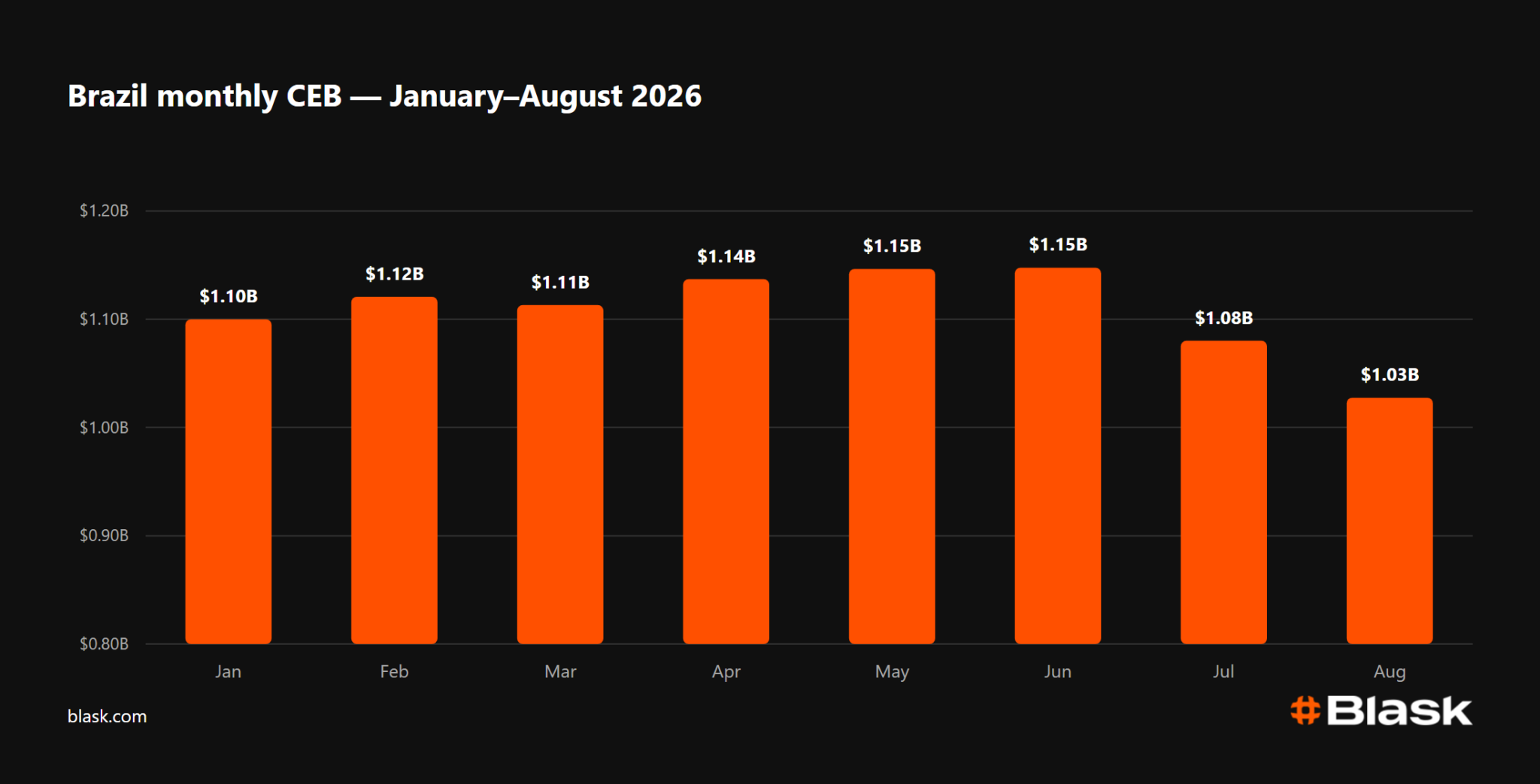
Monthly CEB ran $1.10B in January, peaked near $1.15B in May–June, then eased to $1.08B in July and $1.02B in August. The CEB panel counted 514 brands in January and 523 in August. Headcount did not crash when the World Cup ended. The revenue baseline and demand did.
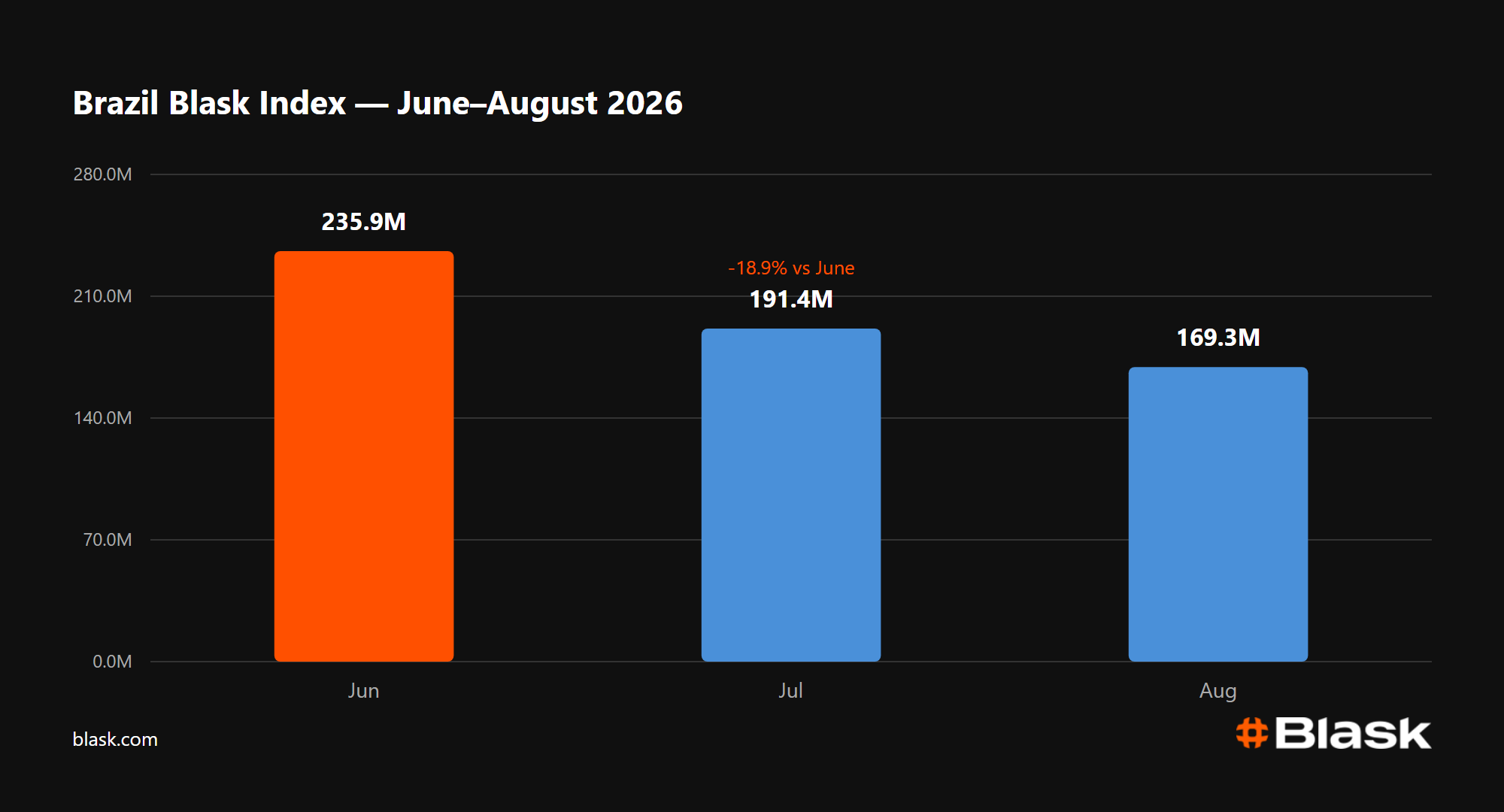
The eight-month sum of monthly Blask Index is 5.9% above January–August 2025. That is the clean year-on-year demand read. Treat it as a high licensed run-rate, not as a second gold rush.
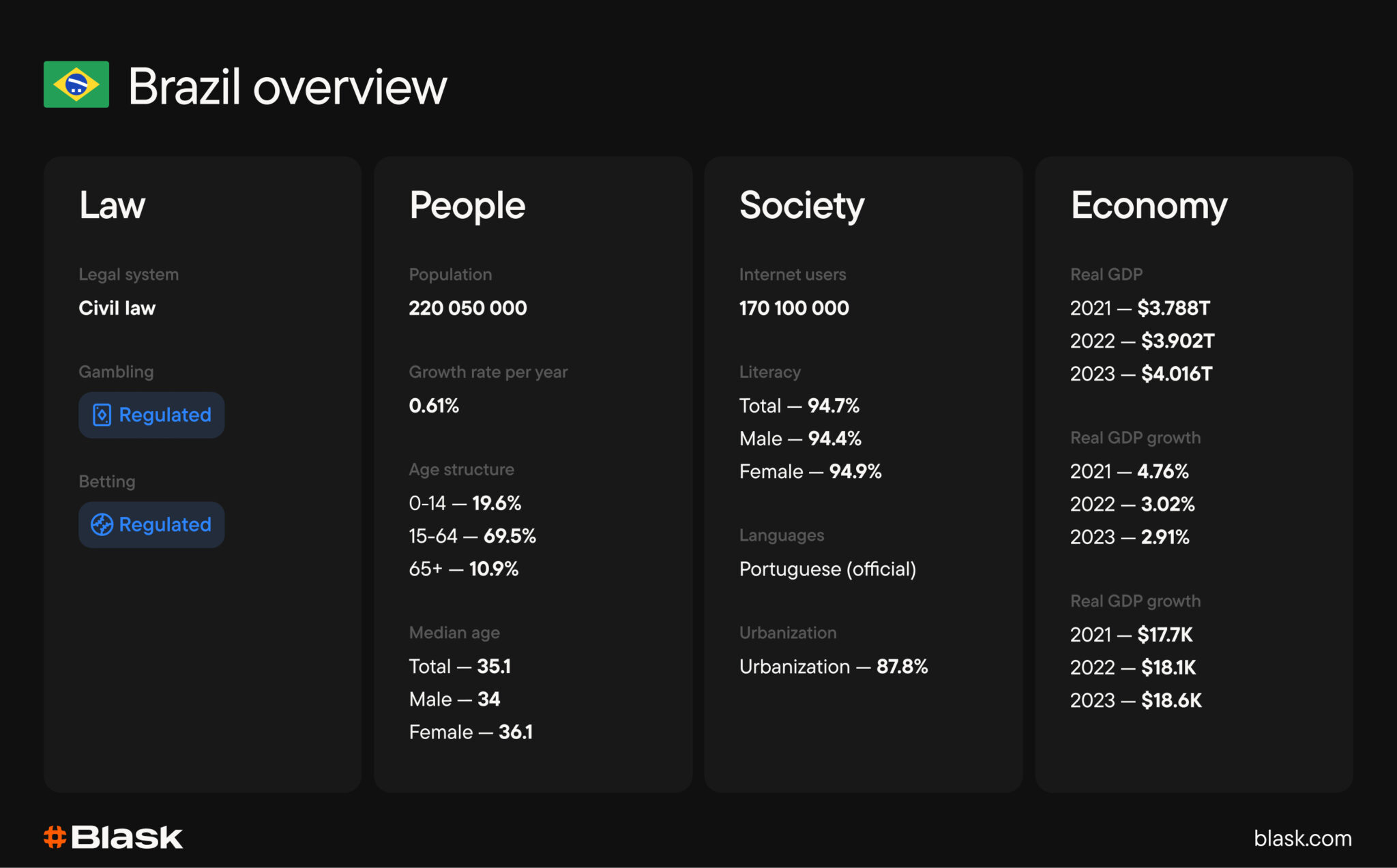
About 220 million people live in Brazil; the geo file counts 170 million internet users. Mobile-first is the default. The constraint in 2026 is brand share and the cashier rule, not whether the country is “ready for iGaming”.
Regulation: Law 14.790 is the market
Fixed-odds betting and the SPA regime sit in Law 14.790/2023. The Secretariat of Prizes and Bets is the federal operator of that law. Full licensing from 1 January 2025 is the date the old overview was written to explain. It no longer needs a 2018–2024 timeline.
💡 Operator GGR tax in the federal frame is 12%; player winnings tax is 15%. Those rates are the cost of the white list, not a forecast of an 18% hike that has not become this page’s news peg.
Payments are part of the licence. Portaria SPA/MF nº 615/2024 put deposits, withdrawals and prizes on Central Bank rails and shut out credit, crypto and cash. PIX is how that rule meets the player. This hub does not retell the CPF-matching spec.
Offshore demand is the other leftover of legalisation. Onshore brands held 95.3% of BAP in August 2026. The remaining 4.7% is not “the market”. It is the offshore slice, already sized in a dedicated piece.
📚 Read more: Brazil offshore iGaming still has twice the brands and 5% of demand
Market dynamics: a World Cup that did not stick
January–April: CEB held above $1.10B a month. Index, in relative terms, was already at a licensed-era plateau.
May–June: CEB’s eight-month high. Football demand into the World Cup.
July–August: Index in July was 19% below June. August ran lower still. The tournament ended on 19 July 2026. Brazil did not keep World Cup demand as a new baseline. The H1 snapshot covers the first half in more detail; this page only needs the hangover.
📚 Read more: Brazil iGaming market H1 2026: brands, demand, and what changed

Competitive landscape: Betano took 2026
For January–August 2026 Betano holds 26.5% BAP. Bet365 has 10.7%, Superbet 7.7%, Sportingbet 6.1%. The top three hold 44.9% of demand. The top ten hold 69.2%. The long tail is the rest of a 500-brand panel fighting over the leftover third.
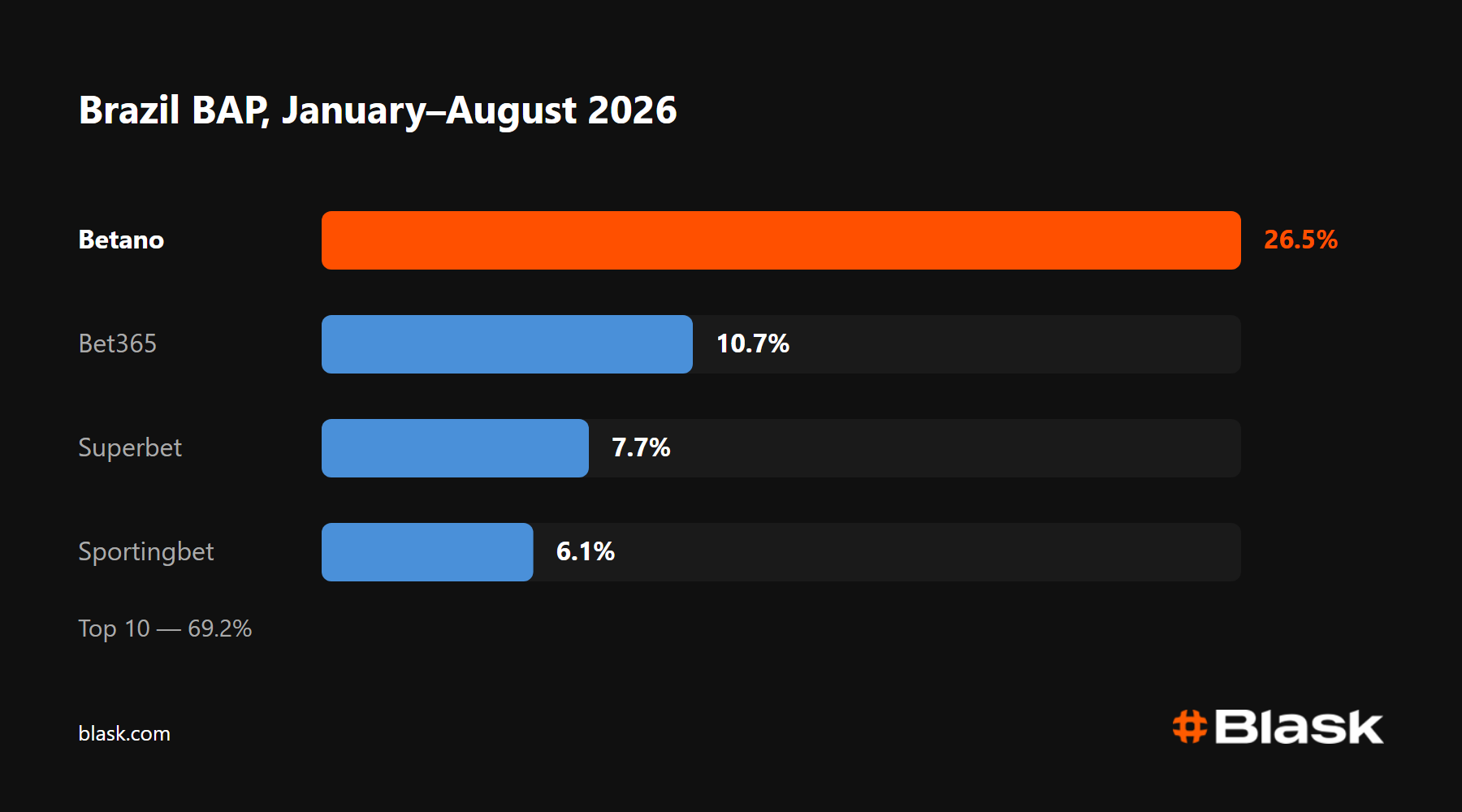
January to August is Betano’s year: 21.6% BAP to 31.6% (+9.9 pp). Almost nobody else in the top ten added a point. 7Games and Betao each lost 1.6 pp. Bet365 lost 0.9 pp.
The brand ranking is the table. The hub fact is simpler: one licensed leader is still widening, and the names that were supposed to “institutionalise” the market are not catching it.
📚 Read more: Brazil iGaming brand rankings 2026: Betano leads with a margin
The casino shelf — Fortune Tiger and the rest — lives on the games URL. Mixing lobby titles into this overview is how the old page became unsearchable.
Where Brazil ranks globally: CEB, APS and Latin America’s leader
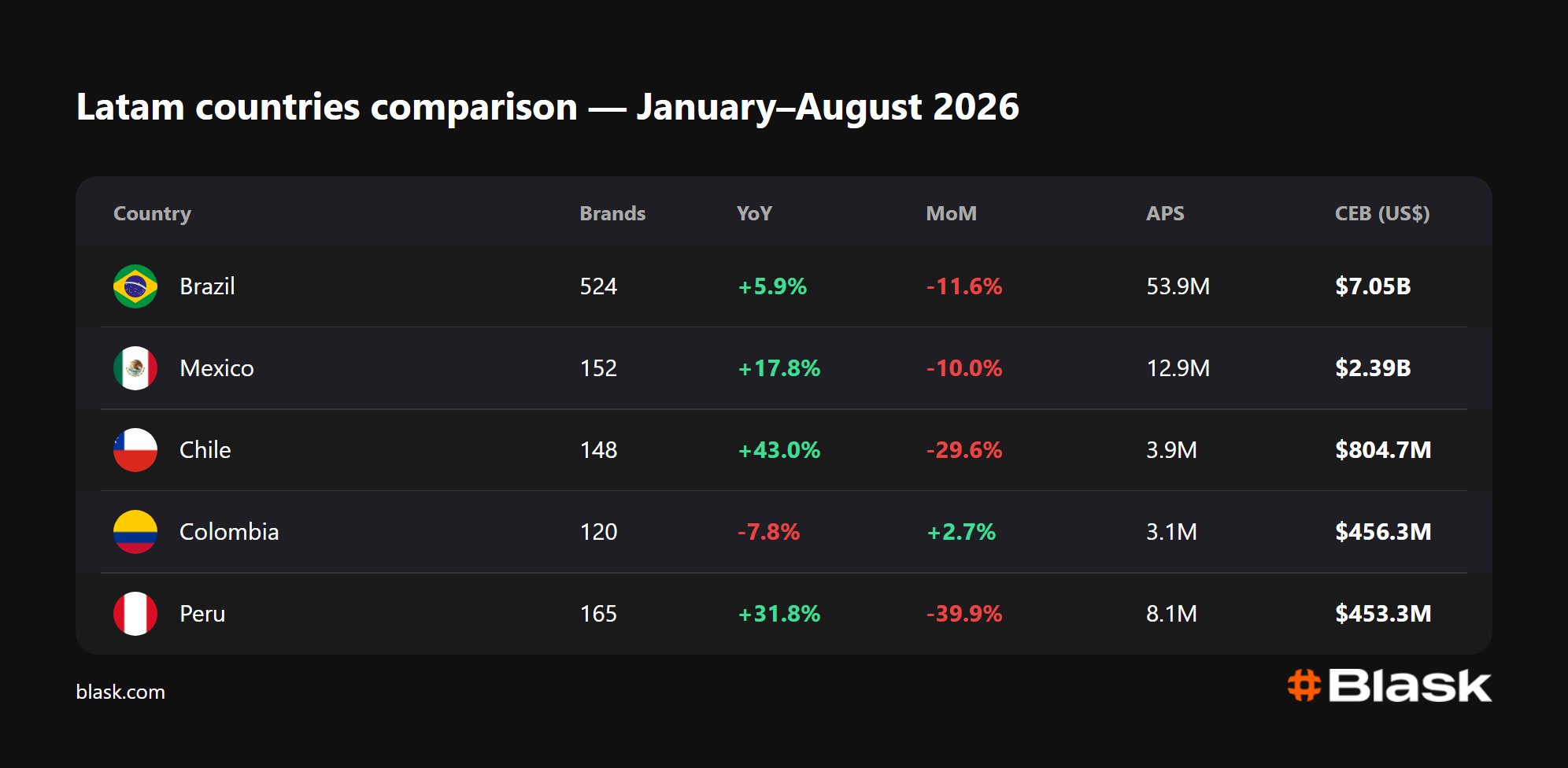
Blask views markets through an off-ledger lens—potential revenue and statistically attainable acquisition at current brand strength.
For January–October 2025:
- CEB (avg) — Brazil ranks No. 3 worldwide at $5.07B, trailing only the United Kingdom and Turkey; Italy and Indonesia follow.
- APS (avg) — Brazil ranks No. 1 globally at 63.66M, ahead of Turkey, Bangladesh, South Africa and Vietnam.
Inside LATAM, Brazil is a consistent No. 1; Mexico, Chile, Peru and Colombia follow.
Notes: Rankings reference 107 countries available in Blask as of Nov. 9.
Context from public sources reinforces the picture: lawmakers accelerated regulation, enforcement tightened, and authorities continued to refine the tax framework, with fiscal leaders signaling higher rates for the sector.
The Brazilian consumer: Youth, income and motivation
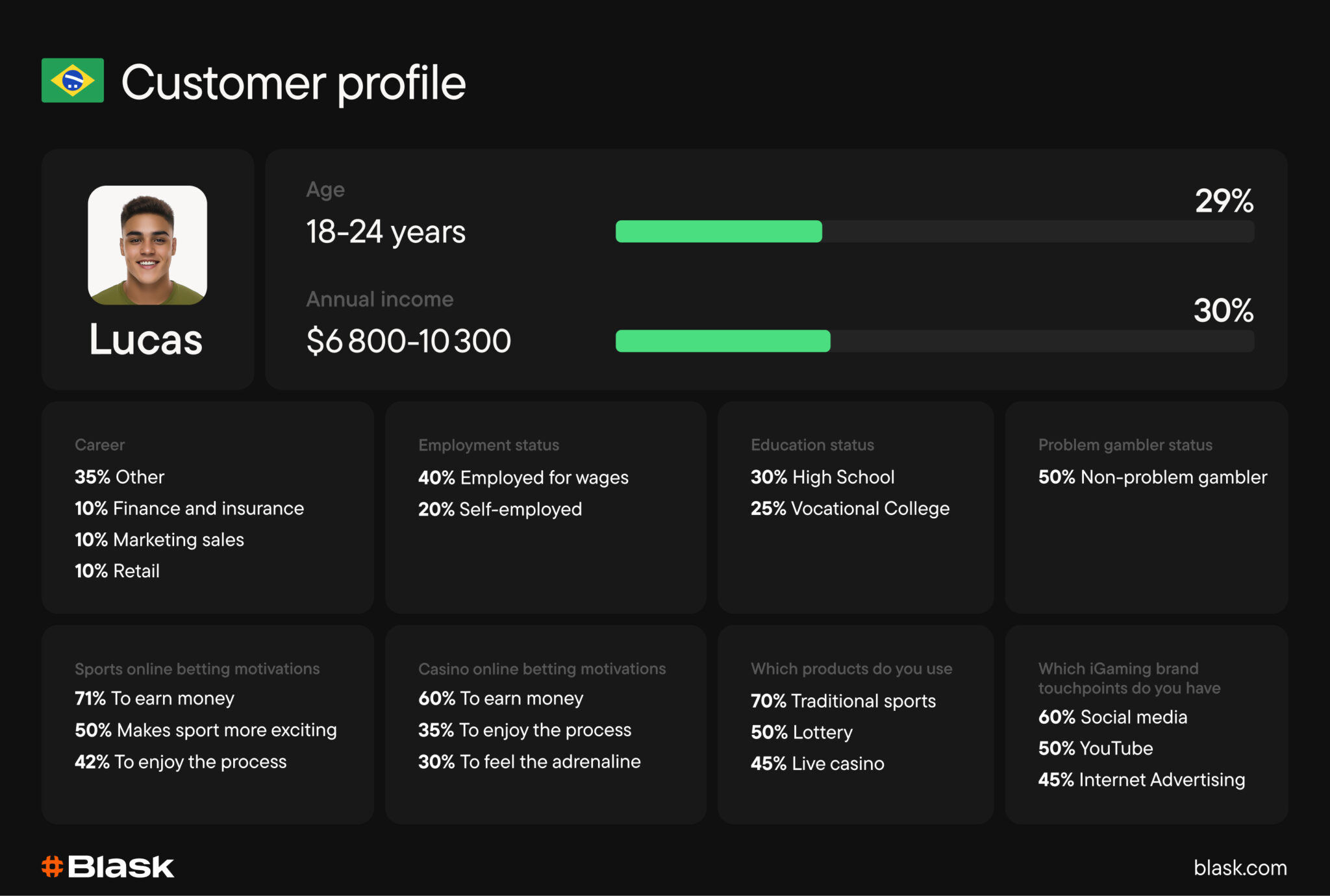
The iGaming customer here is young and pragmatically value-seeking. Blask’s Customer Profile shows:
- Age: Core 18–24 (29%).
- Income: 30% earn $6,800–$10,300 annually.
- Education & employment: 30% high-school, 25% vocational/technical; 40% employed for wages, 20% self-employed.
- Motivation — Sports: “to make money” (71%), “make sports more exciting” (50%), “enjoy the process” (42%).
- Motivation — Casino: “to make money” (60%), “process” (35%), “adrenaline” (30%).
- Products used: traditional sports (70%), lottery (50%), live casino (45%).
- Touchpoints: social media (60%), YouTube (50%), online advertising (45%).
- Responsible gambling: 50% non-problem gamblers, but public-health signals warrant attention—authorities have tied the boom to pressure on household finances and have even considered restricting welfare-funded betting.
What to do with this: design onboarding and funnels for a mobile-first, night-and-weekend audience that pairs “adrenaline” with “a chance to win.” Keep limits visible, embed RG by design, and tune media to social + YouTube.
Bottom line
Brazil in January–August 2026 is an $8.87B CEB market, 95% onshore, with Betano on 26.5% of demand for the period and 31.6% by August. The World Cup lifted June and did not stay.
The licence list is long; the demand list is short. That is the market the generic query should find, before it clicks through to H1, rankings or offshore.