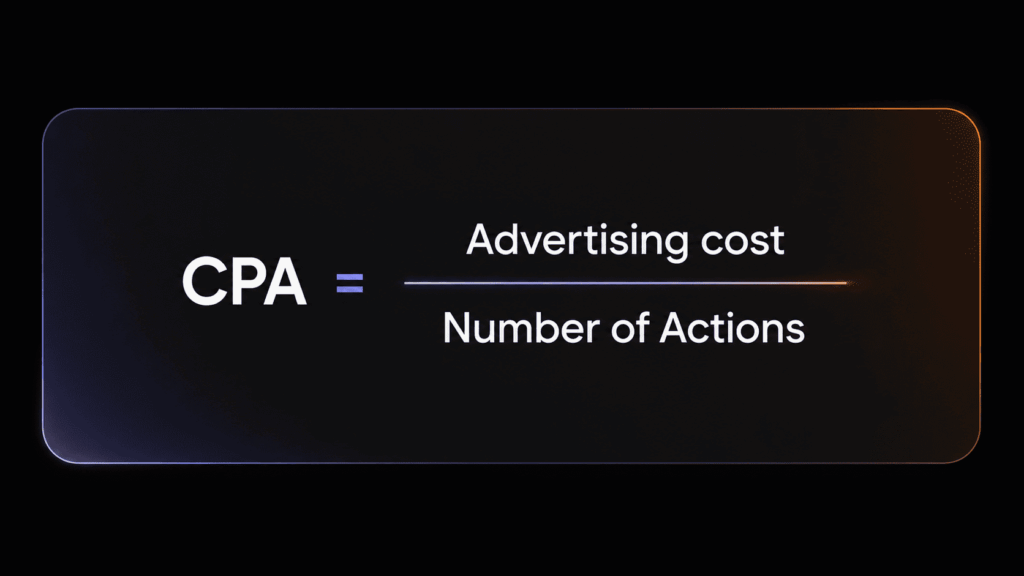
Cost Per Acquisition (CPA) is a performance-based commission model where an affiliate earns a fixed payment for every player who completes a specific action — typically a First Time Deposit (FTD). Understanding what is CPA in iGaming means grasping the most widely used compensation structure in the industry’s affiliate ecosystem: pay for results, not for traffic.
Under the CPA model, the payment is fixed, the qualifying condition is predefined, and the payout happens once, when the player meets that condition.
There is no dependency on how much the player wagers afterward or how long they stay active. Cost per acquisition iGaming programs span more than 100 active GEOs in 2026. Blask tracks 529 active brands in Brazil, 349 in the UK, and 184 in Nigeria — all markets where CPA remains the dominant affiliate compensation model.
CPA sits at the intersection of affiliate marketing and performance media buying. For affiliates, it’s the fastest path from traffic to revenue. For operators, it’s a predictable, auditable acquisition cost per new depositing player.
The role of the FTD
The First Time Deposit is the standard qualifying action across most igaming cpa programs. The player registers, makes their first real-money deposit above a minimum threshold, and the affiliate earns the agreed flat fee. Some programs add a wager requirement on top — the player must complete a minimum bet before the CPA payment triggers. This protects operators from deposit-and-run behavior.
Why operators prefer fixed-cost acquisition
A fixed CPA gives operators budget certainty. They know exactly what each new depositing player costs before that player makes a single wager. This makes CPA programs easy to model, easy to cap, and easy to scale without renegotiating revenue-share structures.
How CPA works in iGaming
The CPA Workflow
The affiliate drives traffic to an operator’s site via a tracked link. The player completes registration and makes a qualifying deposit. The tracking system fires a confirmation event and credits the affiliate’s account with the agreed payout.
Three stages: traffic delivery, qualifying action, payout trigger. Each has failure points — drop-offs in the registration funnel, failed deposits, traffic quality filters — that the affiliate must monitor continuously.
Qualifying actions: FTD, registration, deposit threshold
Not every iGaming CPA offer uses the same qualifying event.
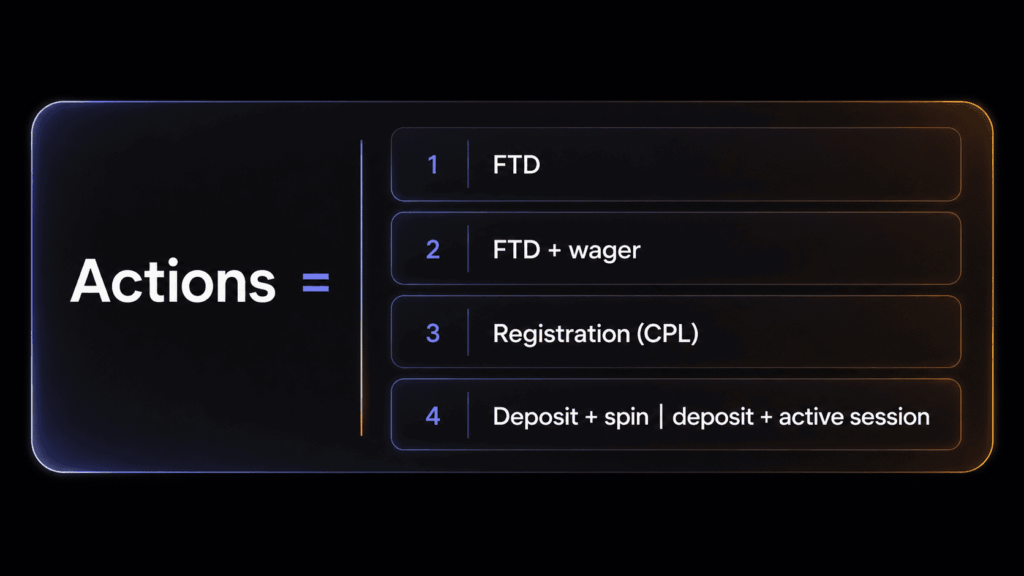
The most common structures:
FTD (First Time Deposit): Player registers and deposits above a minimum threshold. Most common.
FTD + wager: Deposit must be followed by a qualifying bet — e.g., deposit × 1 wagered. Adds friction but improves player quality.
Registration (CPL): Rare. Used where signup volume is the primary barrier and conversion to deposit is the operator’s problem.
Activity-based: Deposit + spin, or deposit + active session. Adds a behavioral requirement beyond the deposit itself.
Edward
COO at CPA BRO
“We mostly work with wager qualification — wager equals the minimum deposit, or player activity equals deposit plus a spin. But these conditions don’t actually protect the operator from fraud. Fraudsters pass all the primary activity requirements easily. Most players complete their wager, don’t use crypto, and show one or two days of activity. Real anti-fraud systems have completely different detection funnels — they track behavioral patterns across player batches. For example: every player without exception made one or two deposits, immediately lost, and left. But that’s also exactly what low-quality social traffic with a motivated creative produces. You need to analyze much deeper.”
How CPA tracking works: Postback / S2S
CPA attribution in iGaming runs on server-to-server (S2S) postback — a direct communication from the operator’s platform to the affiliate tracking system at the moment a qualifying event fires.
When a player completes an FTD, the operator’s backend sends a postback request to the affiliate’s tracker with the conversion data: click ID, offer ID, payout amount, timestamp. No browser cookies, no client-side JavaScript. Tracking is server-level, resistant to browser restrictions and ad blockers.
Affiliates configure their tracking URL parameters before launching traffic. The operator whitelists the postback URL. From that point, every qualifying conversion fires automatically without manual intervention.
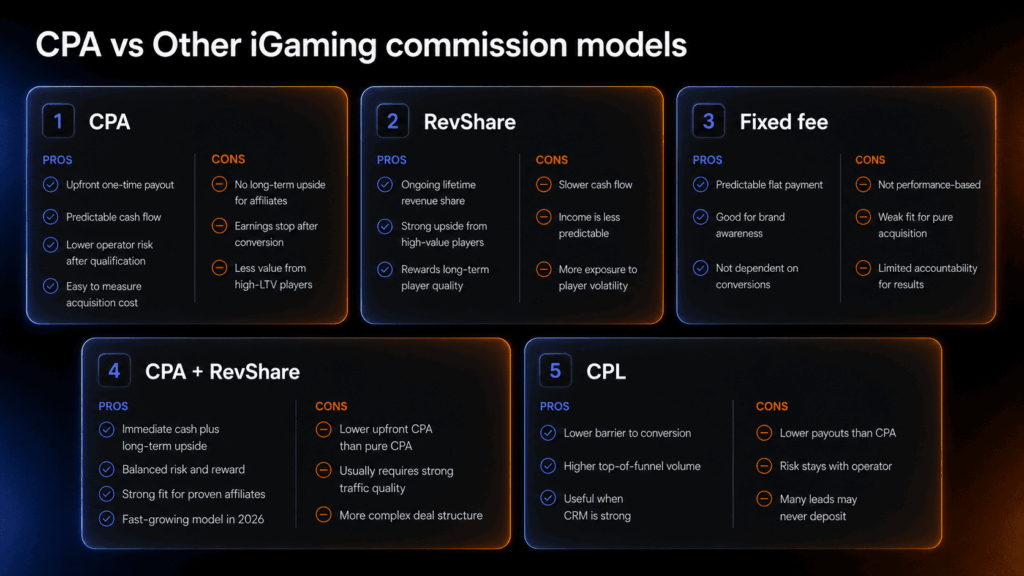
CPA vs Other iGaming commission models
CPA in iGaming is not the only option. Most affiliate programs offer multiple structures, and the right choice depends on traffic quality, volume predictability, and time horizon.
CPA vs Revenue Share
RevShare pays the affiliate a percentage of the player’s net revenue, ongoing for the lifetime of the account. If the player becomes a high-value depositor, the affiliate keeps earning. CPA pays once, upfront, and nothing more.
The trade-off is direct: CPA offers certainty, RevShare offers upside.
Alex Miller
Analyst at 3SNET
“CPA stays the right model when traffic is unstable, when you’re testing new bundles, or when fast cashflow back into media buying matters. For SEO, PPC, and content projects with high-LTV players, pure CPA limits the potential. RevShare or a hybrid model usually wins long-term. The key variable isn’t the model — it’s brand reliability. Payment history, negative carryover policy, analytics transparency. Even a high RevShare percentage loses value if the operator’s calculation terms aren’t transparent, or start changing retroactively.”
CPA vs hybrid: CPA + RevShare
The hybrid model combines a reduced upfront CPA payment with an ongoing RevShare percentage. The affiliate receives immediate cash on conversion and a long-term revenue stream from retained players. Hybrid is typically the structure high-performing affiliates negotiate once they demonstrate consistent traffic quality. In 2026, it’s the fastest-growing model type across direct operator programs.
CPA vs fixed fee
Fixed Fee is a flat payment for a placement or time slot, not tied to player conversions. It’s media buying, not performance marketing. Operators use it for brand awareness campaigns, not acquisition.
CPA vs CPL: Cost per Lead
CPL pays for a registration without a deposit. Rates are lower than CPA — the risk of non-depositing players stays with the operator, who relies on its own CRM to convert signups into depositors.
Advantages of the CPA model
For Affiliates
The core appeal of the cpa model igaming is cash flow certainty. Revenue locks in the moment a player hits the qualifying threshold — regardless of whether they come back tomorrow or disappear after the first session. If a CPA pays $80 and media cost runs $40, the margin is calculable before the campaign scales. There’s no waiting six months for RevShare to accumulate enough to evaluate whether a GEO works.
That predictability also makes testing cheaper. An affiliate can run a new operator or a new GEO for 30 days, count FTDs, check the margin, and make a real decision — without betting on long-term player retention that may or may not materialize.
For Operators
For operators, the appeal is control. A fixed CPA means the acquisition cost for each new depositing player is set before that player wagers a cent. The qualifying criteria — minimum deposit, wager threshold, hold period — let operators define exactly what counts as a real acquisition and filter out the rest. Scaling a CPA program means adding affiliate partners without renegotiating revenue-share terms or opening liability on players who turn out to be high-value. Monthly payout obligations are foreseeable in a way RevShare never is.
Challenges and risks of the CPA model
CPA is not without structural problems. The fixed payout creates an incentive for volume over quality — and for fraud to enter the system.
The biggest operator risks:
Incentivized or low-intent traffic: Players driven by misleading creatives or motivated signup processes
Deposit-and-disappear behavior: Players who qualify the CPA trigger and immediately churn
Pattern fraud: Coordinated player batches with nearly identical behavioral fingerprints
Payment provider abuse: Players using multiple methods to fake clean deposit records
The biggest affiliate risks:
Hold periods: Operators hold CPA payouts 30, 60, or 90 days to check player quality before releasing payment
Retroactive KPI changes: Operators adjusting qualifying criteria after campaigns have run
Operator exit or insolvency: Affiliates who drove traffic to a disappearing operator lose both players and commissions
Dmitry Belianin
Co-founder of Blask
“Market-level data shows things an affiliate dashboard never will. When an operator starts retreating — losing share across multiple markets, showing Index decline while competitors grow — those signals appear in the competitive data weeks before they show up in payout delays or program changes. A suspicious spike pattern can be just as telling: sudden Index growth that doesn’t match real market dynamics is a flag worth investigating. The affiliate who only looks at their own conversion numbers is always the last to know.”
Affiliates watching only their own conversion dashboard miss the operator-level signals that market-competitive data surfaces long before a payout problem becomes visible.
GGR vs NGR: How CPA payouts connect to revenue
For affiliates on RevShare, understanding GGR vs NGR is critical. For CPA iGaming campaigns, it matters less directly, but it explains why operators set CPA rates where they do.
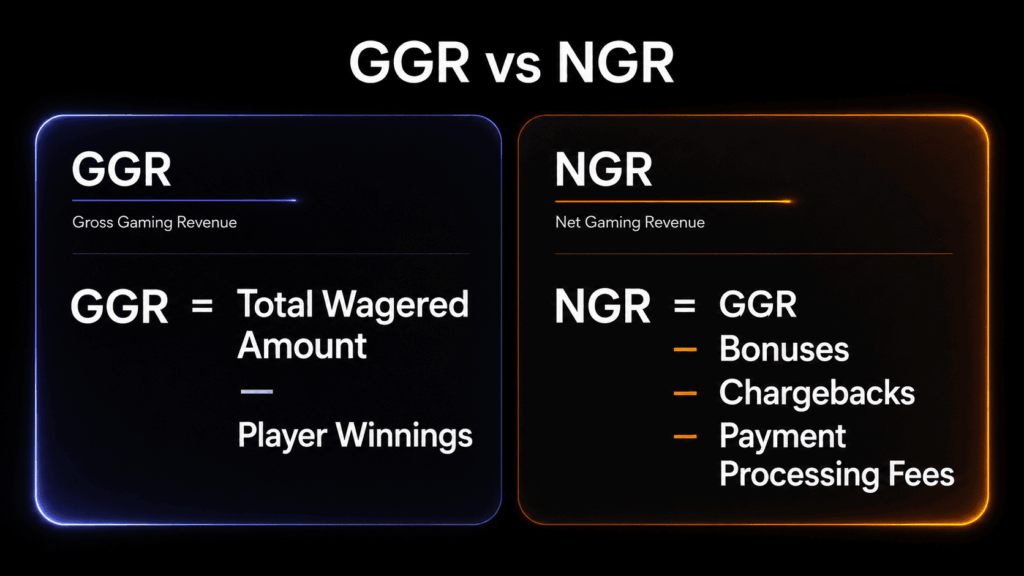
GGR (Gross Gaming Revenue) is the total wagered amount minus player winnings. It’s the top-line revenue number before costs.
NGR (Net Gaming Revenue) is GGR minus bonuses, chargebacks, and payment processing fees. It’s what the operator actually earns.
RevShare programs typically pay a percentage of NGR. This is where disputes arise — aggressive bonus deductions and chargeback policies can significantly reduce NGR, cutting the affiliate’s payout in ways that aren’t visible upfront.
CPA sidesteps this entirely. The payout is fixed and paid regardless of whether the player generates NGR. The operator’s exposure is the cost of the CPA — controlled by the qualifying criteria they set.
Typical CPA rates and GEO benchmarks
Tier-1 / Tier-2 / Tier-3 Markets
CPA rates track player LTV, operator margins, and competitive dynamics by market. They are not universal — and the spread within a single GEO can be several times wider than most affiliates expect.
“In Tier-1, the range is widest: from $90–100 per FTD for Facebook and crash approaches, up to $500–700+ for SEO, PPC, and high-intent traffic. It’s not just competition — it’s player LTV, payment capacity, and regulatory load that drive the premium. Tier-2 is more stable. In LATAM the average CPA often sits below $35, but stronger GEOs like Brazil and Mexico can reach $50–100 with quality organic. In Tier-3, Africa rates run $5–15, some Asian GEOs hit $40–50. But with strong retention and organic traffic, payouts can significantly exceed the market average.”
Alex Miller from 3SNET
Blask market data for 2025 confirms the structural differences across tiers.
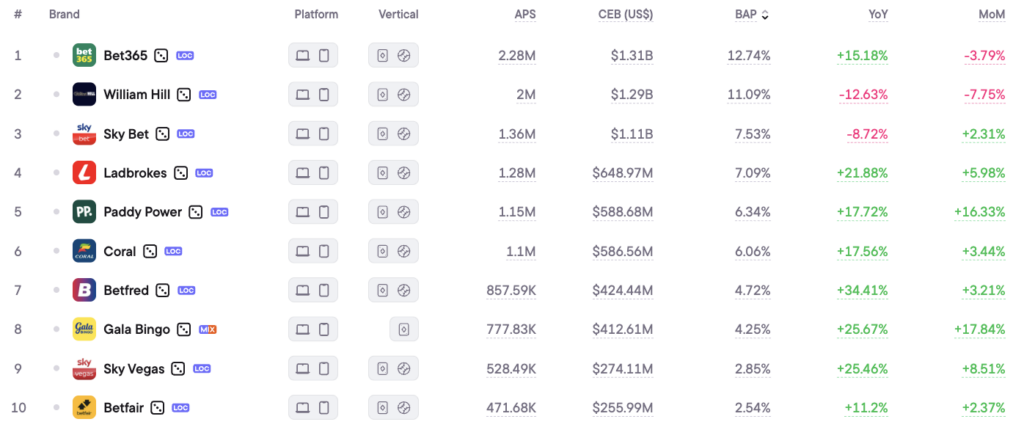
Tier-1 — United Kingdom: The total market Competitive Earning Baseline (CEB — Blask’s market-based revenue benchmark built from brand strength and competitive positioning, not operator-reported financials) reached $11.9B ($8.6B–$21.7B range) in 2025, distributed across 349 active brands.
Bet365 alone generated an estimated $1.3B in CEB ($979M–$2.3B), growing 15.18% year-over-year. In a market this dense, each acquisition carries premium LTV, which is what drives Tier-1 CPA rates to their ceiling.
Germany reached $2.5B in CEB ($1.6B–$5.2B) with 8.3M annual Acquisitions Power Score (APS — Blask’s benchmark for how many new customers a brand’s market position implies), placing it in the regulated mid-range of European Tier-1 markets.
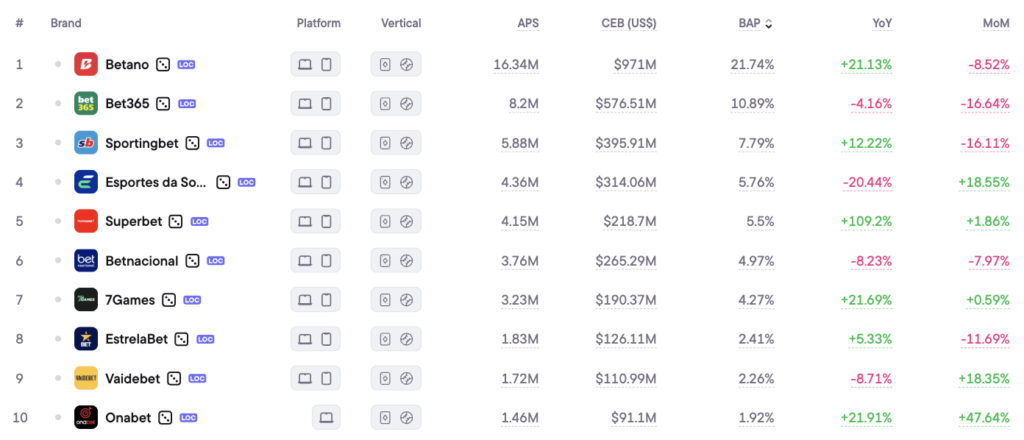
Tier-2 — Brazil: Total market CEB was $6.4B ($4.4B–$12.3B) in 2025, with 529 active brands competing for 79.3M annual acquisitions (58.2M–142.7M range). Volume is massive, but revenue per acquisition is lower than in Tier-1, which moderates per-FTD payouts even for leading operators.
Betano leads the market at an estimated $971M CEB with 16.3M annual APS, growing 21.13% year-over-year. Superbet’s YoY growth of 109% is the clearest indicator that Tier-2 markets are still in their high-investment, high-CPA phase.
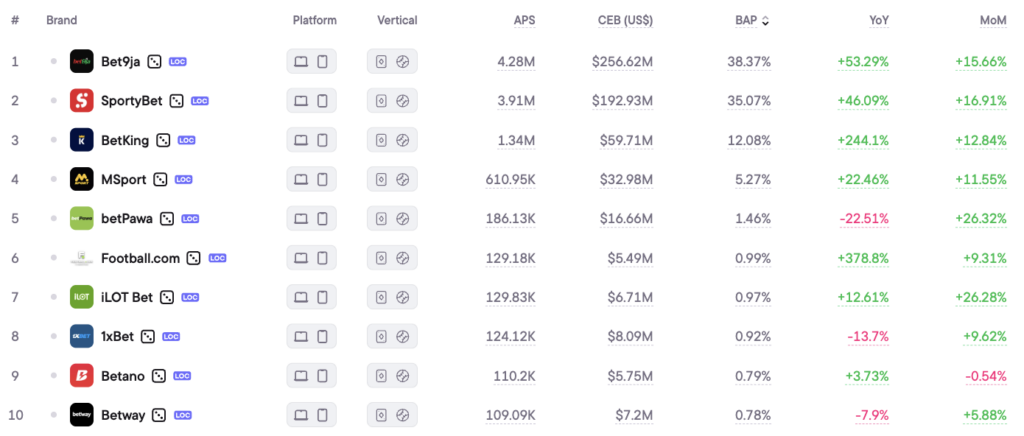
Tier-3 — Nigeria: Total market CEB was $634M ($473M–$1.1B) in 2025 with 184 active brands. Bet9ja and SportyBet dominate, with YoY growth of 53.3% and 46.1% respectively. BetKing grew 244% YoY — a market with that kind of acceleration attracts CPA investment regardless of per-FTD rates.
When platform demand is compounding at that speed, the affiliate who gets in early and locks in reasonable CPA terms captures the best margin window.
“Indonesia shows what an asymmetric market looks like. Low active operator count relative to the Competitive Earning Baseline — that’s where an affiliate with the right traffic source finds margin. Nigeria had nearly 70% year-over-year market growth. That’s not seasonal fluctuation — it’s a structural shift. But seasonality exists inside that growth, and if you’re building CPA campaigns there, you need to plan around it. India showed declining category interest in several high-traffic verticals even as the overall market appeared to grow. Bangladesh had a similar profile. Knowing that before you scale CPA spend into a new GEO can save significant budget.”
Dmitry Belianin, Co-founder of Blask
Indonesia’s 2025 data: APS of 3.5M (1.7M–8.7M) with a CEB of $3.9B ($1.9B–$9.7B). The implied revenue per acquired player is among the highest tracked by Blask — a structural premium that explains why experienced affiliates with mobile-first Indonesian traffic command above-average CPA rates from operators who understand the market’s actual LTV.
How CPA networks operate in iGaming
A CPA network acts as an intermediary between operators (advertisers) and affiliates (publishers). The network aggregates igaming cpa offers from multiple operators onto a single platform, providing affiliates with a unified dashboard, tracking infrastructure, and consolidated payouts.
Networks earn a margin — either built into the CPA rate (operators pay $120, the network pays affiliates $100) or charged as a direct management fee.
For affiliates, the practical advantage is one account, many offers, one payment schedule. The disadvantage: rates are compressed versus direct deals, and terms are standardized rather than negotiated individually.
For operators, networks provide fast access to a broad affiliate base without the overhead of a proprietary program. The trade-off is margin and reduced control over affiliate selection and traffic quality.
Experienced affiliates typically move from network offers to direct operator deals as their volume grows. Direct deals carry better rates, shorter hold periods, and more transparent communication — but require established track records and sufficient FTD volume to justify the operator’s program management overhead.
How operators design CPA programs
Setting CPA rates
CPA rate-setting is not a simple formula. Alex Miller from 3SNET said: “Good operators work from an internal player economics model: payback period, retention, average deposit, lifetime value, GEO specifics, CRM efficiency. Increasingly, the CPA rate is built around expected player value for the business — not just the fact of an FTD. The same GEO can carry a very different CPA depending on the traffic source”
Alex Miller
At 3SNET, we observe more and more operators requesting additional metrics from affiliates upfront: average check, retention rate, repeat deposits, overall audience profile. Rates frequently get revised after test campaigns.”
Defining qualifying criteria
Operators set the minimum deposit threshold, wager requirement (if any), hold period, and player verification requirements before the CPA fires.
A tight criterion — high minimum deposit, mandatory wager — reduces volume but improves player quality. A loose one — any deposit above €5, no wager — drives volume but increases the risk of low-quality conversions. The qualifying criteria is where operator and affiliate interests most visibly diverge.
Anti-fraud measures
Anti-fraud systems in CPA programs operate at the behavioral level, not the transaction level. Edward from CPA BRO said: “The fact that a player made a deposit and completed a wager doesn’t mean the traffic is clean. Fraudsters pass all the primary activity requirements without trouble. Real detection happens at the pattern level, when every player in a batch deposited once, immediately lost, and left.
Edward, CPA BRO
Real anti-fraud has completely different detection funnels from the qualifying criteria the affiliate sees. Low-quality social traffic with a motivated creative produces exactly the same behavioral pattern as a fraud batch. That’s why you have to analyze everything much deeper than the surface metrics.”
How affiliates should choose the right CPA offer
Traffic source match
The first filter is traffic source compatibility. A CPA offer built for SEO traffic — high-intent users who arrive through informational queries — performs differently with Facebook media buying targeting broad audiences. Some igaming cpa offers are explicitly optimized for one traffic type.
Match your dominant traffic source to the offer before evaluating the CPA rate.
Player profile and geography
The player your traffic generates must match the profile the operator’s product is built for. An affiliate running mobile-first Indian traffic to a desktop-focused European operator will see poor conversion regardless of the rate on offer.
Market-level analytics close this information gap.
“With the Blask API, you can query market-level data for any GEO — see who the active operators are, which categories are growing, how stable the market interest is.
India showed declining category interest in several high-traffic verticals even as the overall market appeared to grow. Bangladesh had a similar profile. Those signals are available before you scale CPA spend into a new GEO and knowing them can save significant budget.”
Dmitry Belianin on how Blask data supports affiliate decision-making
Crazy Time is a useful reference point: according to Blask data, it has held dominant Share of Interest since platform data collection began across nearly every market where it’s available. For affiliates assessing operator game catalogs as a proxy for product quality, the presence and prominence of a game like Crazy Time in the lobby is a meaningful signal.
Operator reputation and track record
Evaluate the operator on three dimensions before accepting any igaming cpa offer:
Payment reliability: Documented cases of delayed payouts, changed KPIs, or affiliate disputes are public information in most affiliate communities
Compliance approach: How the operator handles UKGC, MGA, or local license requirements affects campaign restrictions and creative approvals
Market position: Is the brand growing, stable, or retreating? A declining market share is a forward-looking risk for affiliates who drive new players into a weakening product
Alex Miller, 3SNET, on offer evaluation:
“The first thing to look at is brand reputation and transparency of the working relationship. A strong CPA rate doesn’t compensate for payment delays, retroactive KPI changes, or opaque analytics.
The second level is the terms themselves: are the KPIs actually achievable? What’s the hold period? Is there negative carryover? What are the minimum volume requirements? In 2026 it’s also critical to evaluate the brand’s compliance policy — Facebook and PPC traffic requirements, creative restrictions, KYC/AML approach, and their stance on incentivized or aggressive traffic.
Only after all of that does it make sense to evaluate the rate and landing conversion. A strong product with clear cooperation rules almost always delivers more sustainable results than a maximum CPA rate at launch.”
Negotiating better CPA terms
Direct operator programs are almost always negotiable, especially after an affiliate demonstrates traffic quality. What to push for:
Higher base CPA: Back the ask with traffic quality data — retention rate, average deposit, repeat deposit percentage from your existing player base
Reduced hold period: Operators default to 30–90 days. Consistent quality traffic justifies shorter windows — push for 14–30 days as a performance milestone
Performance tiers: A tiered structure where CPA increases at volume thresholds aligns operator and affiliate incentives — standard rate up to 100 FTDs/month, higher above 200
Hybrid conversion: Negotiate a CPA+RevShare structure once your traffic quality is demonstrated. The lower upfront CPA offset by long-term RevShare is often more profitable for affiliates with sticky players
The negotiation leverage is documented player behavior. Affiliates who bring retention metrics, average deposit history, and repeat deposit data from their existing portfolio hold the strongest position. Volume-only arguments don’t move rates in 2026.
Affiliate agreement checklist
Most problems in CPA affiliate iGaming come from terms that were vague at signing. Before committing traffic to any program, get explicit answers on these:
Qualifying criteria in writing. Minimum deposit amount, wager requirement, hold period length. If the program manager describes them verbally but they’re not in the agreement, they don’t exist.
KPI modification clause. Can the operator change qualifying criteria mid-campaign? Some agreements allow it with 48 hours’ notice. That’s enough time to invalidate a month of traffic.
Hold period and release conditions. 30, 60, or 90 days — and what happens if the operator disputes quality during that window? Who decides, and on what basis?
Negative carryover. On hybrid or RevShare components: does a negative monthly balance carry forward to reduce future earnings? Many affiliates discover this only after a bad month.
Approved traffic sources. Not a general statement — a specific list. Facebook, PPC, SEO, in-app, push, native. Anything missing from the list is a potential dispute if the operator decides to review traffic quality retroactively.
Payment schedule and minimum threshold. Currency, payment method, minimum payout amount, what happens to balances below threshold at end of contract.
Volume caps. Some programs cap monthly FTD volume per affiliate. Hitting a cap mid-month with no warning kills campaign economics.
Creative approval timeline. If the operator reviews creatives before launch, how long does approval take? Who approves, and what happens if they don’t respond?
Dispute resolution jurisdiction. Which law governs the agreement and where disputes are heard. Matters significantly if the operator is offshore.
KPIs every CPA affiliate should track
Affiliates who only track payout volume are operating without the metrics that determine long-term profitability.
Primary metrics:
EPC (Earnings per Click): Total CPA revenue ÷ total clicks. The most reliable cross-offer comparison metric
FTD conversion rate: Clicks → registrations → FTDs. Drops anywhere in this funnel signal a traffic-offer mismatch or landing page issue
Media cost per FTD: Total media spend ÷ FTDs generated. This is the number that defines margin
ROI per campaign: (CPA payout × FTD count – media spend) ÷ media spend
Warning signals:
Hold rate rising: An increasing percentage of conversions held for quality review signals the operator is seeing degraded player behavior
Approval rate dropping: Conversions recorded by your tracker that the operator doesn’t validate. Consistent gaps indicate tracking problems or qualification criteria changes
Payment delays beyond schedule: An early indicator of operator financial stress
Regulation shapes cpa marketing igaming programs at every operational level. The jurisdiction an operator holds determines what affiliates can say in creatives, which traffic sources are permitted, and what player verification is required before a CPA qualifies.
UKGC (United Kingdom Gambling Commission): The most demanding Tier-1 framework. Affiliates serving UK traffic must comply with CAP and ASA advertising standards, cannot target under-25s with certain creative content, and face strict bonus advertising rules. Hold periods commonly extend to 60–90 days to accommodate self-exclusion reversal windows.
MGA (Malta Gaming Authority): Standard European framework. MGA-licensed operators serve most EU markets. Affiliates dealing with MGA operators benefit from a stable, well-documented compliance environment with consistent dispute processes.
Curaçao: Most offshore Tier-3 operators operate under Curaçao licenses. Fewer restrictions on creative content and player targeting — but also fewer protections in dispute resolution. The risk-reward profile matches the market tier.
Edward, CPA BRO
“Regulation doesn’t significantly change things in most markets because offshore operators exist almost everywhere. The impact is more visible in the disappearance of specific payment providers from certain GEOs — that affects user lifecycle and average check. UK and Netherlands stand out in the European picture: their markets have large advantages in conversion stability, player quality, and payback speed relative to other European GEOs. From our analytics and trend observations, these are the most stable CPA environments in the region.”
Best practices and common mistakes
What consistently separates profitable cpa igaming campaigns from underperforming ones:
Do:
Match your dominant traffic source to the offer type before evaluating rates
Run test budgets on new GEOs before scaling — operator performance varies significantly within the same tier
Track post-hold approval rates, not just raw conversion numbers
Negotiate hold periods down as your performance record builds
Monitor operator market position data through external analytics — a weakening brand is a forward-looking risk
Don’t:
Optimize only for CPA rate. Terms, hold periods, and operator reliability matter as much as the number
Launch volume campaigns without verifying operator financial stability and market trajectory
Ignore qualifying criteria details — a $200 minimum deposit requirement collapses conversion rates on price-sensitive traffic
Treat all Tier-3 GEOs identically. Nigeria, Indonesia, and Bangladesh have fundamentally different player economics despite sharing a tier classification
“It’s adaptability. The best publishers have enormous variability in everything — approaches, bundles, accounts, GEOs from Tier-1 to Tier-3, even traffic sources: in-app, UAC, Facebook, ASO, SEO. A storm doesn’t worry them because there’s always somewhere to redirect buyers.
The average affiliate optimizes one channel in one GEO. The experienced operator has a portfolio — and diversification is the only real answer to offer volatility.”, — said Edward (CPA BRO)
Future trends in iGaming CPA for 2026
Alex Miller, 3SNET, on what’s shaping the landscape:
“Quality CPA is replacing volume CPA. Operators are evaluating not just the FTD count but the player’s quality after the deposit — retention, average check, repeat deposits, LTV. Post-FTD analytics requests are becoming market standard. Hybrid models are gaining ground: CPA+RevShare gives operators the balance between fast results and long-term traffic value, and affiliates a more stable economics. Facebook traffic still works at scale, but soft KPIs are leaving the market. Crash traffic is under pressure — many operators are pulling back or revising rates downward. AI-based anti-fraud and predictive LTV tools are going mainstream. Compliance is becoming a critical traffic source decision, especially in Tier-1. And Tier-1 keeps getting harder — higher competition, compliance load, rising media costs — gradually pushing less resilient players out.”
Edward from CPA BRO on where the volume opportunity is moving:
“There’s a major push on Tier-3 countries — new products appearing in each GEO, and the active IPL season is creating real acquisition traffic opportunity. On the North American side, we see the Sweepstakes casino and Polymarket trend developing strongly. These platforms are becoming relevant for both operators and affiliate teams, especially where traditional gambling faces regulatory limits.”
Blask data supports both signals. In 2025, BetKing grew 244% year-over-year in Nigeria — a market where Blask tracked 184 active brands. CPA investment in Tier-3 markets with growing operator competition creates arbitrage opportunity for affiliates who understand the local player profile before they scale.
AI tools are reshaping both sides of the CPA equation. Operators are building predictive LTV models that score traffic quality in real time before the hold period ends. Affiliates running in-house tech stacks are increasingly using similar models to pre-qualify traffic before it hits the operator’s funnel. The gap between affiliates who optimize by gut and those who optimize by data is widening in every GEO.
Online casino-style gaming without a real-money deposit sounds too good to be true — but the sweepstakes model has been running legally across most of the US for years, and millions of players use it every month. This guide breaks down exactly how the system works, which states allow it, which platforms are worth your […]
Conversion rate is the percentage of users who complete a defined target action relative to the total number of users who had the opportunity to do so. In iGaming, the term covers multiple distinct measurement points: the share of ad impressions that generate clicks, the share of registrants who make a first deposit, the share […]
The deposit gets the headlines, but the withdrawal decides whether a player comes back. A poorly designed payout process drives churn just as effectively as a bad game lobby or a failed bonus — and at a moment when the player has already decided to trust the platform with their winnings. For operators, the withdrawal […]