
- Updated:
- Published:
CRM (Customer Relationship Management)
What iGaming CRM is, which features matter, how leading platforms compare, and what operators do with it.
What Is iGaming CRM
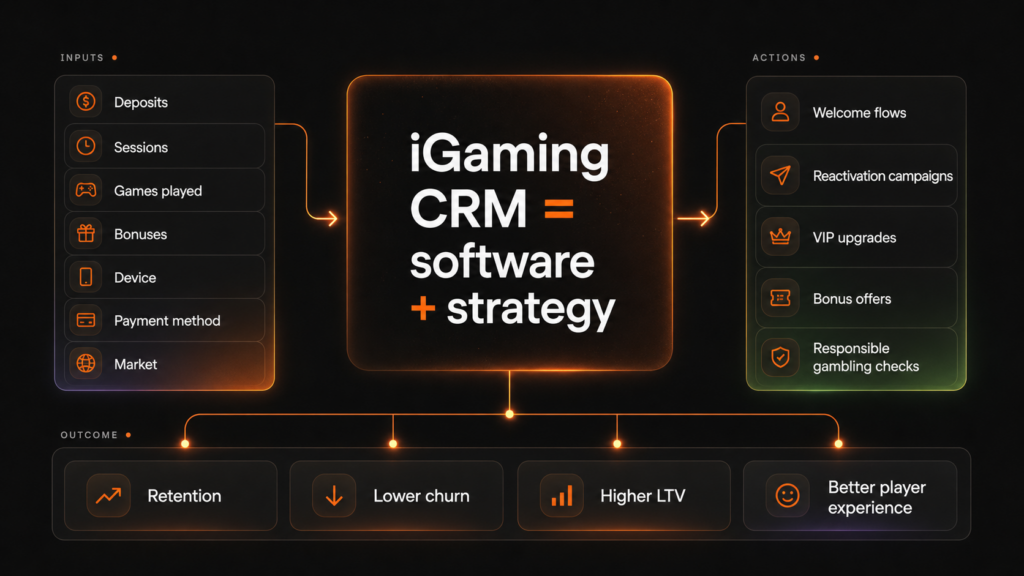
CRM in iGaming is the combination of software and strategy that operators use to track player behavior, automate communication, and run retention programs at scale. The term covers everything from a welcome sequence triggered on registration to an AI-generated re-engagement bonus fired when a specific player hasn’t logged in for 21 days.
Understanding what is CRM in iGaming starts with the data it works with: session depth, deposit frequency, game preferences, withdrawal patterns, bonus history, device usage, payment method, and market. It is a complete behavioral record for every registered player, updated continuously as they interact with the platform.
Most operators think about CRM as a retention tool, and it is. But it also sits at the center of the entire player relationship: from the moment someone registers to when they become a VIP, go dormant, or reactivate after months away.
The goal is to make every touchpoint relevant: the right message, the right offer, the right channel, at the right moment in the player’s journey.
Customer relationship management done well means players feel understood. Done poorly, it means inbox noise and eroding trust.
How does CRM work?
iGaming CRM operates through a continuous cycle of data collection, segmentation, automation, and measurement.
- Data ingestion and unification. The system aggregates player information from multiple touchpoints including registration forms, gameplay activity, deposit and withdrawal transactions, customer support interactions, and marketing campaign responses. This data flows into unified player profiles that update in real time.
- Segmentation and analysis. CRM platforms segment players based on behavioral, demographic, and value-based criteria. Common segments include active versus inactive players, high rollers versus casual players, game preference groups, and risk profiles for responsible gambling monitoring. Advanced systems use RFM (Recency, Frequency, Monetary) analysis and predictive AI models to identify churn risk and lifetime value potential.
- Automated campaign execution. Based on segmentation rules and behavioral triggers, the CRM automatically delivers personalized messages and offers through multi-channel touchpoints including email, SMS, push notifications, in-app messages, and on-site content personalization. These campaigns can be lifecycle-based (welcome sequences, loyalty programs) or event-triggered (deposit failure follow-ups, winning streak bonuses).
The gap between registration and first deposit is where most operators lose players — and where the CRM either earns its keep or fails silently.
“Some operators don’t communicate with players at all in the first minutes on the platform and lose those golden first 10 minutes. Others flood the channel with everything at once — the sensory overload kills any desire to act, and the player leaves.”
Farkhad Gerasimoff CEO & Founder, GNB Agency
- Measurement and optimization. CRM dashboards track key performance indicators including Click-Through Rate (CTR), conversion rates, campaign ROI, and player engagement metrics. This data informs continuous refinement of segmentation logic and messaging strategies.
How iGaming CRM differs from traditional CRM
Standard business platforms (e.g. Salesforce, HubSpot, Microsoft Dynamics) are built for longer sales cycles and moderate interaction volume. A B2B sales team manages hundreds of accounts. An e-commerce customer might touch a brand5 to 10 times a month. An active iGaming player generates hundreds of behavioral signals in a single session and thousands across a month.
CRM for iGaming handles that volume natively. It connects directly to Player Account Management (PAM) systems, game providers, and payment gateways. It tracks gameplay events in real time, not just transaction history — which game was played, how long the session ran, what bet size, when the player stopped. That granularity is what makes meaningful personalization possible.
The product complexity is also different. iGaming platforms combine a casino, a sportsbook, live dealer games, and often poker or virtual sports. Each vertical has its own player behavior patterns, bonus structures, and engagement mechanics. A generic CRM cannot model that. A purpose-built igaming crm platform treats casino and sports players differently by default and lets operators define the rules for each product line separately.
Regulation adds a third layer. An operator running across five regulated markets (say, Germany, the Netherlands, Sweden, the UK, and Brazil) cannot use a single campaign template. Each jurisdiction has its own rules about bonus advertising, communication frequency, self-exclusion databases, and responsible gambling messaging.
The CRM must enforce those rules automatically, per player, per market, and log every decision for potential audit.
Why CRM is critical for iGaming operators
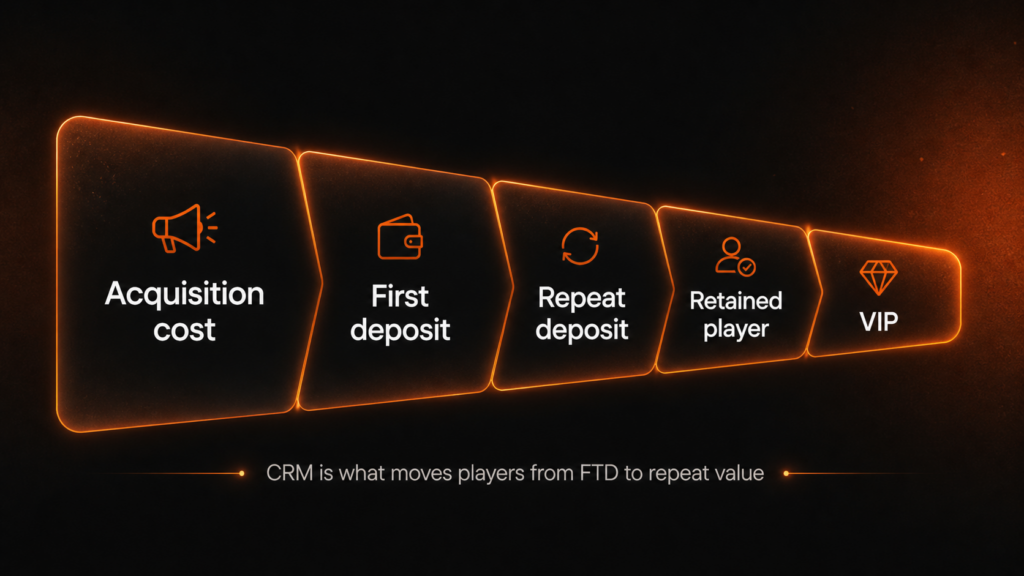
Acquiring a new player costs five to seven times more than retaining an existing one. Every new FTD comes with paid acquisition, affiliate commission, welcome bonus cost, and onboarding overhead. The economics only recover if that player stays long enough and deposits frequently enough to generate positive LTV. CRM is what controls that recovery.
In Brazil and India — where estimated total revenue reached $6.35B and $5.2B respectively in 2025 — dozens of operators compete for the same player base.
Brand-building through advertising attracts players; CRM keeps them. Operators that retain players for an additional 30 to 60 days across their portfolio generate meaningfully more revenue per acquisition dollar without increasing their marketing budget.
Churn rate is the core metric CRM addresses. When players go quiet — shorter sessions, lower deposit frequency, campaign messages going ignored — those are early signals of churn, not just noise. A well-configured CRM catches those patterns before they solidify into inactivity and fires a calibrated intervention: a tailored offer, a game recommendation, a support contact.
The commercial case is straightforward. Operators that invest in CRM infrastructure see lower average cost per acquisition over time, because each player they retain reduces the acquisition spend required to maintain the active player base.
Key features of an effective iGaming CRM
Knowing iGaming CRM features in detail is how operators avoid buying the wrong tool. A platform that looks capable in a demo can fall apart under production volume or break down at the compliance layer. Below is what separates a genuinely capable system from a polished front end.
Player segmentation
Segmentation is where CRM starts and where most platforms reveal their actual capability. The basics — active vs. inactive, high-value vs. low-value — are easy. Any platform can produce them. The question is whether the system can segment dynamically across multiple dimensions simultaneously: deposit value in the last 14 days, game vertical preference, last session date, market, device type, bonus response history, and responsible gambling risk score.
RFM analysis (Recency, Frequency, Monetary) is the standard framework. It tells you who played recently, how often, and how much. But RFM is retrospective. Strong platforms layer predictive models on top — propensity scores that estimate how likely a player is to churn in the next 7 or 14 days, based on behavioral shifts rather than the absence of activity. That distinction matters: reactive churn intervention is more expensive than preventive.
Marketing automation & campaign management
Automation is what turns segmentation into revenue.
The baseline is trigger-based messaging. A player deposits for the first time and receives an onboarding sequence. A player completes a session without claiming their deposit bonus and gets a reminder. A previously active player goes 14 days without logging in and enters a reactivation flow.
Beyond reactive triggers, the CRM should support lifecycle campaign management: structured sequences that guide a player from registration to first deposit, first deposit to active regular, active to VIP candidate. Each stage has different objectives, and the messaging should reflect that. A player on day three of their registration who hasn’t deposited needs different handling than an active player who has been declining in deposit frequency for two weeks.
Campaign management also includes scheduling, send-time optimization, and suppression logic. Good platforms allow operators to set frequency caps per player and per channel, preventing the message volume from crossing into fatigue territory.
Bonus engine & promotion management
Bonuses are the most expensive retention tool in iGaming, and they are also the most abused.
A well-built bonus engine handles eligibility rules (which players qualify for which offer and when), wagering requirements (the multiplier a player must meet before funds become withdrawable), expiry conditions, and sequential offer logic (so a player who claimed a welcome offer cannot receive it again through a reactivation flow). It also flags bonus abuse detection patterns in real time — accounts that consistently claim offers and withdraw without meeting the spirit of the terms.
The strategic question is targeting.
Blanket promotional campaigns that go to all active players are expensive and produce diluted results. A bonus engine that can target by player value segment, game preference, and response history delivers the same promotional budget to a smaller, more responsive audience. The same budget generates better ROI when it reaches players who are genuinely at-risk of churning rather than players who would have returned regardless.
Gamification & Loyalty programs
Gamification adds a structural engagement layer on top of standard CRM messaging. Where a bonus campaign is an external nudge, gamification creates internal motivation — a player is working toward something on the platform itself: a level, a badge, a reward, a leaderboard position.
The most effective loyalty programs in iGaming combine several mechanics. VIP tiers define status: each tier unlocks incremental benefits — higher withdrawal limits, personal account managers, exclusive bonuses, invitations to events.
Missions assign short-term goals: complete 10 sports bets this week, try three new slot titles, reach a wagering milestone. Tournaments create peer competition: players compete for the top position on a leaderboard, with real prizes for the top ranks.
The key requirement is that loyalty mechanics integrate directly into the CRM rather than operating as a separate system. A player who advances to a new VIP tier should automatically receive a congratulatory message and their new benefits without a manual step. A mission completion should trigger a reward within minutes. When the gamification layer and the CRM operate independently, delays and inconsistencies erode the perceived value of the program.
Well-designed loyalty programs increase session frequency and deposit regularity. Players working toward a tier milestone will often deposit more frequently to accelerate their progress. That behavioral shift is measurable through cohort analysis — cohorts enrolled in an active loyalty program consistently show lower churn rates in the 30 to 90-day window compared to cohorts without one.
Omnichannel communication
Players move across channels. They check email on their phone in the morning, receive push notifications during the day, log into the platform on a desktop in the evening. A multi-channel CRM for iGaming treats the player as a single individual across all of those touchpoints, not as separate audiences per channel.
The practical implication is a unified player profile that governs all outbound communication. If a player opens a push notification and clicks through to claim a bonus, the email that was scheduled to deliver the same offer should suppress automatically. If a player unsubscribes from SMS, that preference should cascade to suppress SMS across all active campaign flows, not just the specific campaign where they unsubscribed.
Each channel has different strengths. Email handles detailed content well: bonus terms, game guides, personalized weekly summaries. SMS works for time-sensitive alerts where brevity is an advantage. Push notifications drive immediate action when a player already has the app installed. In-app messaging reaches players who are actively engaged on the platform. On-site personalization — homepage tiles, game lobby positioning, banner content — reaches players who navigate directly to the site without clicking through from a campaign.
A common failure is duplicating the same message across every channel simultaneously. Players who receive the same offer by email, SMS, and push notification within a few hours will suppress notifications from all three rather than engage.
AI & Predictive analytics
AI in iGaming CRM does three things well: it predicts behavior at the individual player level, it automates decisions that would otherwise require manual review, and it personalizes offers at a scale that human campaign managers cannot reach.
Churn prediction is the most widely adopted application. The model monitors behavioral signals such as session frequency, session length, deposit velocity, game switching, bonus response rates and produces a daily risk score per player. Players crossing a defined risk threshold enter a churn prevention flow automatically.
The advantage over rule-based systems is that predictive models catch non-obvious patterns: a player who increases their deposit frequency for two weeks and then stops completely is often a higher churn risk than a player who has been inactive for 30 days.
Game recommendation engines personalize the lobby and post-session messaging. A player who primarily plays high-volatility slots should see different featured games than a player who prefers live roulette. When the recommendation layer is working correctly, players discover relevant content without navigating the full catalog, which increases session depth and reduces the likelihood they switch to a competing platform to find what they want.
Real-time data & player insights
iGaming CRM software that processes data in batches — updating player records once or twice per day — creates significant operational problems. A player who deposits and then immediately encounters a failing game or a delayed withdrawal becomes a churn risk within hours. If the CRM doesn’t know about the session until tomorrow’s data refresh, the intervention window is gone.
Real-time data pipelines pull information directly from PAM, game servers, and payment processors as events happen. The CRM acts on those signals immediately: a deposit failure triggers a support prompt, a win streak triggers a congratulations message with a relevant next offer, a player reaching a session time threshold triggers a responsible gambling check-in. These responses require sub-minute latency to be useful.
External signals provide additional context that internal data alone cannot supply. Blask Index measures how much user interest a brand generates in a given market based on search demand patterns.
When Blask Index for a market drops sharply (often coinciding with regulatory changes, competitor promotions, or seasonal demand shifts) operators can use that signal to calibrate the aggressiveness of retention campaigns. A retention push during a broad market demand drop is fighting ambient conditions; a retention push during a competitor outage is a well-timed opportunity.
Multi-brand management
Enterprise operators — those running three or more brands, often across multiple regulated jurisdictions — have requirements that single-brand operators do not. The CRM must maintain strict data isolation between brands while allowing the operator group to report on performance across all of them simultaneously.
Player data isolation matters for two reasons. First, regulatory compliance: in most regulated markets, sharing player data between brands without explicit consent is a breach of data protection rules. Second, brand experience: a player who chose Brand A over Brand B should not receive marketing from Brand B without a separate opt-in. A CRM that allows cross-brand marketing by default exposes the operator group to significant regulatory and reputational risk.
At the same time, the group needs visibility across all brands to understand which markets are growing, where churn is accelerating, and where bonus costs are disproportionately high. The CRM architecture should provide consolidated reporting at the group level without compromising the per-brand data separation required for compliance.
Effective CRM strategies for iGaming
Features define what the CRM can do. Strategy defines what the operator chooses to do with it. The gap between a well-configured platform and a poorly run one is almost entirely in the strategic decisions layered on top of the technology.
Behavioral segmentation
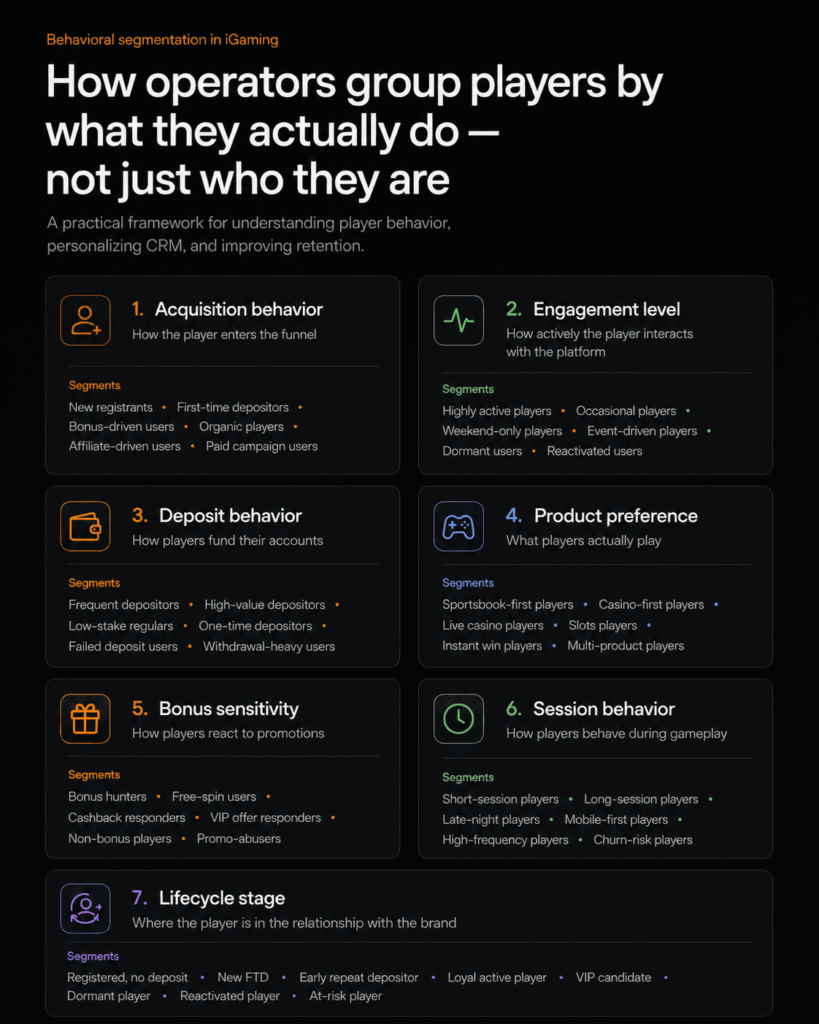
The most effective segmentation in iGaming is behavioral, not demographic. Age and geography help define basic market parameters, but they don’t predict which players will respond to a free spins offer versus an odds boost, or which players are worth a premium retention spend versus a lighter touch.
Behavioral segmentation looks at patterns over time: how often a player logs in, what they play, how long they stay, how they respond to previous campaigns. A player who plays slots for 20-minute sessions five times a week and consistently claims free spin bonuses has a clearly defined profile. The CRM treats them differently from a player who bets on football twice a week for large stakes and never claims promotional offers. The sophistication of behavioral segmentation increases over time as data accumulates. A player in their first week generates limited signal. A player six months in has a rich behavioral history that allows for high-confidence segment assignment and predictive modeling.
Personalized bonus & re-engagement campaigns
Changing the subject line or adding a player’s first name is not personalization. Personalization is offering the specific product, that matches what the player has historically responded to.
Re-engagement campaigns should not begin with the highest-value offer. Start with a soft touch — a personalized reminder of what the player was playing, or a notification about a relevant game launch. If that doesn’t convert, escalate to a targeted bonus. If the player still doesn’t return after two attempts, a final high-value offer with a clear expiry is appropriate before moving them to a dormant segment and reducing communication frequency.
Churn prevention
Churn prevention is more effective than churn recovery. Reactivating a player who has been inactive for 60 days is significantly harder than retaining one who has been showing early warning signs for two weeks. The CRM should be configured to detect and act on those early signals before they compound.
Common behavioral indicators of pre-churn: session length dropping by more than 30% over a two-week period, deposit frequency declining from weekly to bi-weekly, game type switching (a slots player suddenly trying several different categories often indicates boredom rather than exploration), and bonus response rates falling below historical baseline.
When the CRM flags a player as at-risk, the intervention should be calibrated to the player’s profile. A high-value player who has been with the platform for six months warrants a personalized outreach from their account manager. A mid-value player who has been active for three months might respond to a targeted free-spins offer on the game they play most. A low-value player who is eight weeks from their last deposit might receive a generic re-engagement email as the sole intervention before entering a dormant segment.
The goal is matching intervention cost to player value. Treating all churn risk equally is expensive and dilutes the impact of high-touch efforts on the players who genuinely warrant them.
Player lifecycle management
Every player passes through recognizable stages: registration, first deposit, active, high-value or VIP candidate, at-risk, churned, reactivated. Each stage has different CRM objectives and different appropriate actions.
- At registration, the objective is first deposit. The onboarding sequence should be short, clear, and focused on reducing friction — explaining the deposit process, highlighting the welcome offer, and answering the most common first-deposit questions before they become support tickets.
- At first deposit, the objective is second deposit. The player has proven intent; now the platform needs to prove value. A prompt to explore the game lobby, a guided introduction to relevant games based on any preference data collected during registration, and a clear explanation of the loyalty program sets the foundation.
- During the active phase, the objective is increasing session frequency and average deposit value — not through aggressive pushing, but through relevance. The more the CRM understands what a specific player finds valuable, the more likely its messaging is to reach them at the right moment.
- The at-risk phase is where churn prevention programs activate. The reactivated phase is where the CRM must work to restore deposit habits without immediately burning budget on a large offer that the player won’t remember tomorrow.
Cohort analysis is the tool that makes lifecycle management measurable. Tracking each monthly cohort’s 30-, 60-, and 90-day deposit behavior reveals where players fall off at scale and allows operators to target CRM investment at the stages generating the most churn.
A/B testing & optimization
CRM decisions made without testing produce results that are impossible to interpret. If an operator changes the bonus amount, the subject line, and the send time simultaneously and sees an improvement in conversion, they don’t know which change produced the result. The next iteration has no foundation.
Run one variable at a time. A/B testing requires a holdout group that receives no message or the baseline version, and a test group that receives the new version. The split should be statistically valid — typically 50/50 for most campaign sizes, though high-stakes tests on small populations may warrant tighter splits with longer run times.
The metrics that matter are incremental: not total conversions in the test group, but conversions in the test group minus the conversions you would have expected from the control group without any message. Attribution of CRM impact is only meaningful when holdout groups provide a clean baseline.
Build testing into the operational process from the start. Operators who retrofit testing infrastructure after running campaigns for months are working backward. Those who establish control groups as a standard part of campaign setup generate a compounding library of evidence that makes every subsequent campaign decision better informed.
Uladzimir Andryienka CEO, Handbox.io & GGRboost.io 
We start with what brings money fastest and requires the least data. First month — three mandatory scenarios: a welcome series of 3–5 messages after registration (without it the player forgets the brand within 24 hours); a first-deposit trigger for anyone who registered but hasn’t deposited within 24–48 hours; and reactivation for players inactive at 7, 14, and 30 days. VIP programs, complex RFM segmentation, A/B tests, predictive churn models — those come in month two and beyond.”
How to choose the right iGaming CRM
Selection criteria: scalability, integration, compliance, support, pricing
The decision is not primarily about feature lists. Most enterprise-grade CRM solutions for igaming cover similar ground at the feature level. The differences that matter in production are architectural and operational.
- Scalability is the first test. Peak volume in iGaming is highly concentrated — a major sporting event or a regulatory market opening can spike active player counts by three to five times the daily average. The CRM must handle that volume without degrading message delivery latency or campaign execution speed. Vendors should provide benchmark data for peak throughput, not just average performance.
- Integration determines how much the CRM actually knows. A platform that requires weekly data exports from the PAM will always be running on incomplete, delayed information. Native integrations with major PAM providers, game aggregators, and payment gateways are a minimum requirement. Single-sign-on between the CRM and the back office is a quality-of-life requirement for teams using both systems daily.
- Compliance is non-negotiable in regulated markets. The CRM must support dynamic suppression lists that update in real time as players self-exclude, opt out, or enter cooling-off periods across jurisdictions. It must also maintain communication logs in a format suitable for regulatory review and generate reports that auditors can access without requiring developer intervention.
- Support is underweighted in most vendor evaluations. Implementation is rarely straightforward — data migration, integration testing, campaign migration, and team training all create dependencies on the vendor’s professional services team. Understanding what support is included in the contract, what the escalation path is for production issues, and what the SLA looks like for critical failures is due diligence, not negotiation padding.
- Pricing structure shapes long-term costs significantly. A per-message pricing model is cheap at low volumes and expensive at scale. A per-seat model works for small teams but breaks down as operations grow. A per-active-player model aligns the vendor’s incentive with the operator’s growth. Understand which model applies and model it against realistic growth projections over a 24-month horizon.
If you can get a ready-made solution with everything in one place at a reasonable cost and tailored to specific GEOs, most operators choose that option. This enables faster launches, resource savings, reduced risks, and easier maintenance.
Top iGaming CRM Platforms in 2026
The best iGaming CRM platforms operating at enterprise scale today, with the characteristics that distinguish them:
- Optimove uses a data-science foundation built around customer modeling and campaign science. Its strength is predictive segmentation — the platform builds behavioral models per player and uses them to determine both what to offer and when. Compliance tooling is mature, making it the best igaming crm option for operators in heavily regulated European markets who need to satisfy auditors alongside running retention campaigns. It works well for operators with large data teams who can drive strategic value from the analytical outputs.
- Fast Track was built specifically for iGaming from the start, which shows in its PAM integration library and campaign configuration interface. Real-time trigger flows are its operational strength — setting up a campaign that fires within seconds of a qualifying player action is faster in Fast Track than in most alternatives. Onboarding cycles are shorter than typical enterprise CRM implementations, which matters for operators launching in new markets under time pressure.
- Smartico combines standard CRM capabilities with a full gamification engine in a single platform. For operators running loyalty programs with missions, leaderboards, and VIP tiers as a primary retention mechanic, having gamification and CRM under one roof eliminates a significant integration headache. The campaign automation tooling is solid; the gamification layer is where the product differentiates.
- GR8.tech is an all-in-one igaming crm platform that integrates CRM with PAM, sportsbook, casino platform, and payments. Operators launching from scratch who want one vendor relationship instead of five separate integrations will find the unified stack compelling. For established operators already running a separate PAM and game aggregator, the switching cost may outweigh the integration benefit.
- Symplify leads on multi-channel campaign execution. Email, SMS, push notifications, and on-site personalization are all managed from one interface, with mature audience segmentation and A/B testing built in. It is a strong fit for operators whose primary CRM activity is high-volume outbound communication across multiple channels, and whose team needs a campaign management tool rather than a data science platform.
Integration with casino & sportsbook platforms
A CRM operating on incomplete data produces incorrect decisions. The integration architecture determines how much of the player’s actual behavior the CRM can see and act on.
The minimum viable integration connects to four data sources:
- Game engine — game played, session duration, bet size, win/loss outcomes, feature triggers. Without this, the CRM cannot segment by game preference or respond to in-session behavior.
- PAM — account status, KYC verification level, deposit and withdrawal history, responsible gambling flags, active bonus status, communication preferences. This is the core player record the CRM builds on.
- Payment gateway — deposit attempt success or failure, payment method used, withdrawal request status. A player whose deposit attempt failed and who has not returned within 24 hours is a distinct segment requiring specific handling.
- Affiliate system — the acquisition source for each player, so campaigns don’t offer a welcome bonus to a player who arrived through an affiliate already carrying one, and so the CRM understands which acquisition channels deliver the highest-LTV players.
Beyond data ingestion, the integration also governs outbound actions: does the CRM update the PAM when a player enters a VIP tier? Does a bonus claim in the CRM immediately reflect in the player’s account balance without a delay? Integration failures at the action layer create the most visible player-facing problems — a player who claims a bonus and doesn’t see it credited within seconds assumes the system is broken, not that there’s an integration lag.
Operators who accept gaps in their integration architecture send the wrong message to the wrong player regularly. A player who just completed their first deposit should not receive an email asking them to make their first deposit. These errors, small as they seem, signal to players that the platform does not know who they are.
Compliance and responsible gambling
CRM operations in regulated markets are increasingly subject to prescriptive rules about who can receive what type of communication and when. What was acceptable in an unregulated market three years ago is a compliance breach in most of the same markets today.
The regulatory requirements that CRM must enforce include:
- Self-exclusion suppression — players who have self-excluded through the operator or through a national self-exclusion registry must not receive any marketing communication, not even transactional messages with promotional content. The CRM must connect to these registries and update suppression lists in real time.
- Responsible gambling flags — players who have set deposit limits, requested cooling-off periods, or been identified through behavioral monitoring as showing problem gambling indicators must have promotional messaging suspended and, in some jurisdictions, receive mandatory check-in messages instead.
- Opt-out enforcement — unsubscribes and opt-outs must cascade across all communication channels and all active campaign flows immediately. A player who unsubscribes from email on Monday should not receive an email on Tuesday because the suppression hadn’t been applied to a batch campaign that was already queued.
- Communication logs — every message sent to every player must be logged with a timestamp, content snapshot, delivery status, and player consent record. Regulators in the UK, Germany, and the Netherlands have requested these records with limited notice periods.
- Bonus communication rules — several markets restrict the types of bonuses that can be promoted through direct marketing, require specific warning language in promotional messages, or prohibit bonus offers entirely to players who have previously flagged responsible gambling concerns.
Operators who treat compliance as a CRM requirement from the start spend significantly less time and money on remediation when regulations tighten in active markets.
Implementation best practices
The technical implementation of a CRM is the straightforward part. Data integration, campaign configuration, and team training follow documented processes. The harder part is the organizational change — shifting from manual, calendar-based campaign execution to a continuously running, data-driven retention operation.
Most operators who buy a CRM use less than 40% of its capability in the first year. The gap is not usually a training issue; it is a prioritization issue. The team configures what they need immediately and defers everything else. Those deferred features — predictive models, holdout groups, multi-touch attribution — are often the ones that generate the highest incremental value.
A more effective approach:
- Start with lifecycle flows, not one-off campaigns. Welcome sequences, reactivation flows, and churn prevention triggers produce value continuously once configured. A one-off campaign runs once. Lifecycle flows run every day.
- Fix data quality before building campaigns. A CRM trained on incomplete or inconsistent player data produces segmentation errors that take months to diagnose. Audit the data integration layer before running the first live campaign.
- Define success metrics for each campaign type before launch. Incremental deposit rate, churn rate reduction, and reactivation rate per cohort are measurable outcomes. “Increased engagement” is not.
- Assign a dedicated CRM owner. Without a defined owner, CRM becomes the responsibility of whoever has time — which means it becomes no one’s priority. The CRM owner does not need to be a data scientist, but they need authority over campaign decisions and a mandate to improve performance continuously.
- Build holdout groups from day one. The habit of testing against a control group produces a compounding evidence base. Operators who start testing late are always catching up.
Farkhad Gerasimoff CEO & Founder, GNB Agency 
“Email still works — but not in all GEOs. For Europe, email campaigns are a must-have. For Tier-3 markets, the result is near zero. In my agency we match the right channels to the right geographies. When the ESP doesn’t have the functionality we need, we use MessageWhizz.”
Common challenges in iGaming CRM
The problems that appear consistently across operators are not platform-specific. They are structural — gaps in how the CRM is integrated, operated, and measured.
- Data fragmentation is the most common. Casino back office, sportsbook system, payment provider, customer support tool, and affiliate platform each hold a different slice of the player profile. When those systems don’t share data with the CRM in real time, the player record is always incomplete. The CRM segments based on partial information, campaigns go to players who don’t qualify, and suppression logic misfires. The root cause is almost always an integration architecture decision made during the initial setup that seemed acceptable at the time.
- Messaging fatigue emerges when automation is configured too aggressively without frequency management. When every behavioral trigger fires a message, and a player has three active trigger conditions simultaneously, they receive three messages in a short window. Open rates fall, unsubscribes rise, and the deliverability reputation of the sending domain degrades over time. The fix is frequency caps at the player level — a maximum number of messages per channel per week — and priority logic that determines which message fires when multiple triggers qualify.
- Attribution gaps make it difficult to demonstrate CRM ROI and to identify which campaigns are actually working. The standard error is measuring total conversion in the campaign audience without a holdout group. If 10% of the audience deposits after receiving a campaign, that looks like a 10% conversion rate. But if 8% of those players would have deposited anyway, the campaign’s incremental contribution is 2%, not 10%. Without holdout groups, operators routinely overestimate campaign impact and underinvest in optimization.
- Compliance updates create ongoing maintenance requirements. When a market changes its responsible gambling rules — as Germany, the Netherlands, and Brazil have all done in recent years — existing campaign flows may contain content that no longer meets the new standard. Operators without a defined process for auditing active campaigns against regulatory changes discover the problem during an audit rather than before one.
- Segment complexity without execution capacity is an underappreciated failure mode. It is possible to build a segmentation architecture with 50 distinct player types and no team capable of creating differentiated content for each. The result is a sophisticated segmentation model producing the same campaign to every segment with minor variations. Start with six to eight segments with genuinely different messaging, and expand from there as production capacity increases.
Uladzimir Andryienka CEO, Handbox.io & GGRboost.io Add here sending campaigns without segmentation. The operator buys an ESP, loads the database, and sends one promotion to everyone. A new registrant gets the same message as a VIP with two years of deposits. Within weeks: low open rates, high unsubscribes. Within months, the domain is in spam. We see this on 7 out of 10 audits.
Second: no lifecycle automations. No onboarding sequence, no reactivation trigger, no first-deposit reminder. The entire CRM is manual mass sends two or three times a week. The player registers, receives nothing personal, and leaves.”
Future trends in iGaming CRM for 2026
The analogy is precise. Netflix does not show the same homepage to every subscriber — the content grid, the featured titles, and even the thumbnail images are personalized per user based on viewing history. The iGaming equivalent is a lobby where the featured games, the promotional banners, and the bonus offers reflect what that specific player has engaged with and responded to, not what the marketing team decided to promote this week.
Three other developments are reshaping crm solutions for igaming in 2026:
AI-driven churn prediction at the individual level. The shift is from flagging segments — “players inactive for 14 days” — to scoring every player every day on a continuous risk scale. A player might move from low-risk to high-risk over a 72-hour window based on session behavior, and the CRM should respond within that window.
Compliance automation through real-time ML. As regulatory complexity increases — more jurisdictions, more granular rules, more frequent updates — manual compliance review becomes a bottleneck. ML systems that monitor campaign content, player behavior patterns, and communication frequency against a continuously updated ruleset allow compliance to run in parallel with marketing operations rather than ahead of them.
Platform consolidation. The trend is away from best-of-breed point solutions — separate CRM, separate gamification engine, separate communication platform, separate analytics tool — toward unified stacks that cover multiple functions in one product. The operational overhead of managing five vendor relationships, five integration points, and five sets of data schemas is significant. Operators that consolidate onto fewer platforms reduce that overhead and gain a more coherent view of player behavior across the entire stack.
The direction of the market in 2026 is clear to practitioners on the front lines.
“The final move away from the old model of massive communication chains, toward precise, point-in-time trigger interactions. And gamification of everything.”
— Farkhad Gerasimoff, CEO & Founder, GNB Agency
“Predictive analytics instead of rules. Not ‘send reactivation after 14 days of inactivity’ — but a model that predicts churn before the player leaves. AI content personalization that generates different offers, tone, and visuals for a casual slots player versus a poker VIP. And multichannel CRM beyond email — push, Telegram bots, in-app messages, WhatsApp in some GEOs. Email stays the foundation, but operators who stay in one channel lose to those building a coherent experience across 3–4 touchpoints.”
— Uladzimir Andryienka, CEO, Handbox.io & GGRboost.io
Operators who treat CRM as infrastructure — not a campaign tool bolted onto the back office — are building positions that competitors without that foundation cannot close quickly. The gap between a well-run CRM operation and a reactive one compounds over time: better data produces better models, better models produce better campaigns, better campaigns produce higher-value player cohorts that are more expensive to replicate through acquisition alone.