
- Updated:
- Published:
What is casino game management
Casino game management sits at the operational core of every online gambling business. While industry conversation frequently focuses on acquisition, payments, or compliance, the discipline that most directly determines whether a player deposits again — and which games they discover, try, and return to — is casino game management. This guide covers the full scope: definitions, responsibilities, systems, KPIs, onboarding pipelines, lobby strategies, and where the discipline is heading in 2026.
What is casino game management
| Casino game management is the operational practice of selecting, organizing, launching, monitoring, and optimizing the game portfolio of an online casino. It covers every decision between a provider signing a contract and a player clicking “Spin” — and every performance measurement afterward. |
To answer what is game management in casino precisely: it is the intersection of product management, business intelligence, provider relations, and UX design, applied to the games layer of an iGaming platform. A game manager owns the catalog as a product — deciding which titles are live, how they are presented, which are promoted, and when underperformers are rotated out.
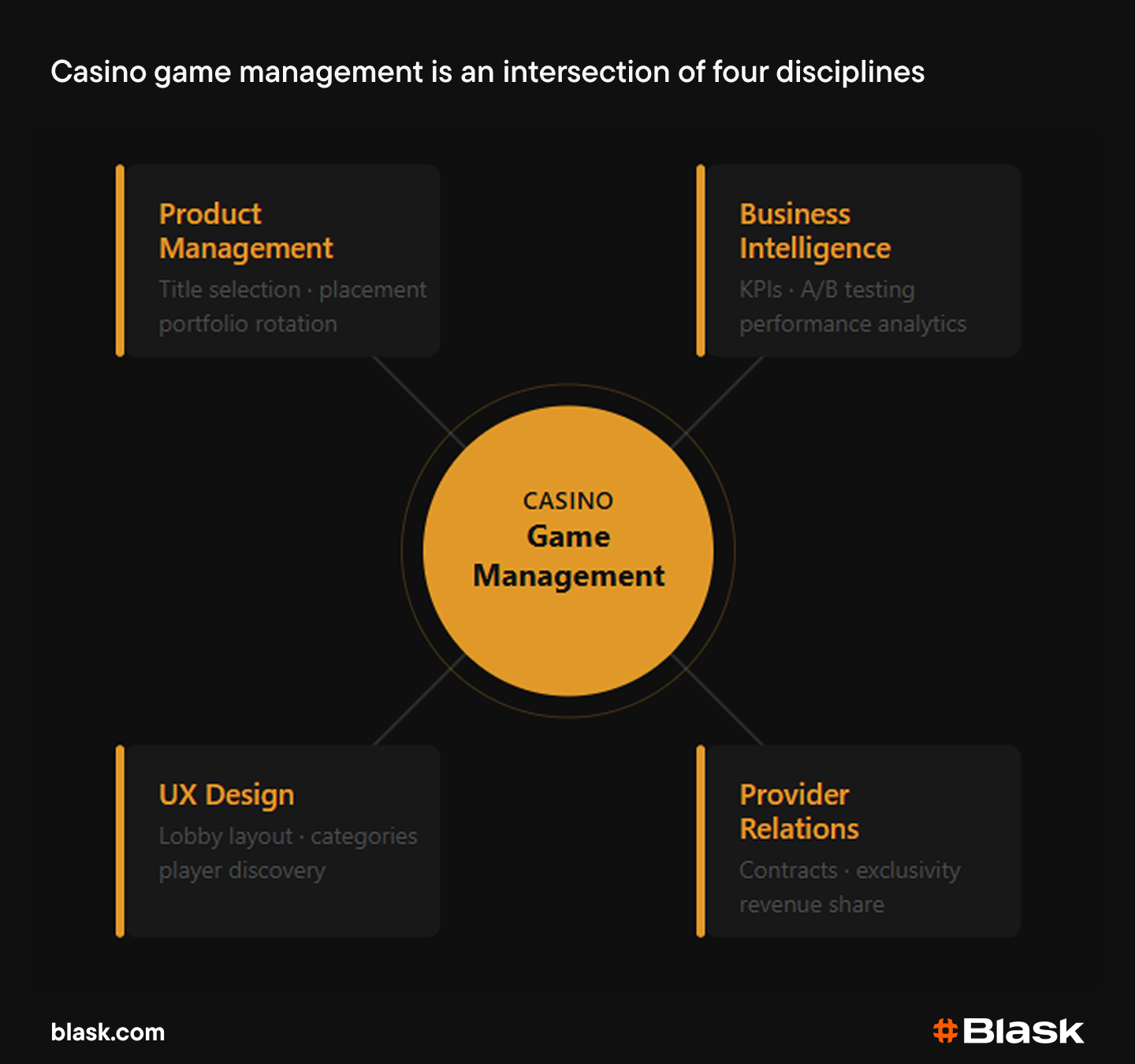
CGM is the intersection of four disciplines, applied to the games layer of an iGaming platform.
Online casino game management is not the same as running a Casino Management System (CMS), which handles player accounts, transactions, bonuses, and compliance. Game management focuses on the supply side:
- what games are in the lobby,
- how they are arranged,
- how they perform against commercial and engagement targets.
The scope has grown substantially. A mid-sized online casino in 2026 typically carries 3,000–10,000 titles from 50–150 providers, according to EveryMatrix’s platform data. Managing that catalog without a structured methodology and a dedicated game management system is operationally impossible.
Why game management matters for operators
Maximizing player LTV from game selection
The link between game portfolio quality and player lifetime value is well-documented. Players who engage with a diverse range of content — slots, live dealer, table games — show longer retention than single-vertical players. According to WA Technology’s operator guide, operators who actively curate their lobbies — aligning content with regional preferences and seasonal themes — outperform those who publish the full provider catalog without editorial structure. The gap appears most clearly in 30-day and 90-day retention metrics.
The choice of high-volatility versus low-volatility games also shapes deposit frequency. High-volatility titles attract players with larger bankrolls who visit less often; low-volatility content drives daily activities with smaller average stakes. A balanced portfolio optimized for both creates more predictable NGR and reduces churn from players who exhaust their bankroll in a single session.
Reducing time-to-market for new releases
New game releases are commercially time-sensitive. Providers invest heavily in launch marketing, and operators who go live early benefit from search traffic, affiliate coverage, and novelty engagement. Being three weeks behind competitors on a major Pragmatic Play or Evolution release is a measurable opportunity cost.
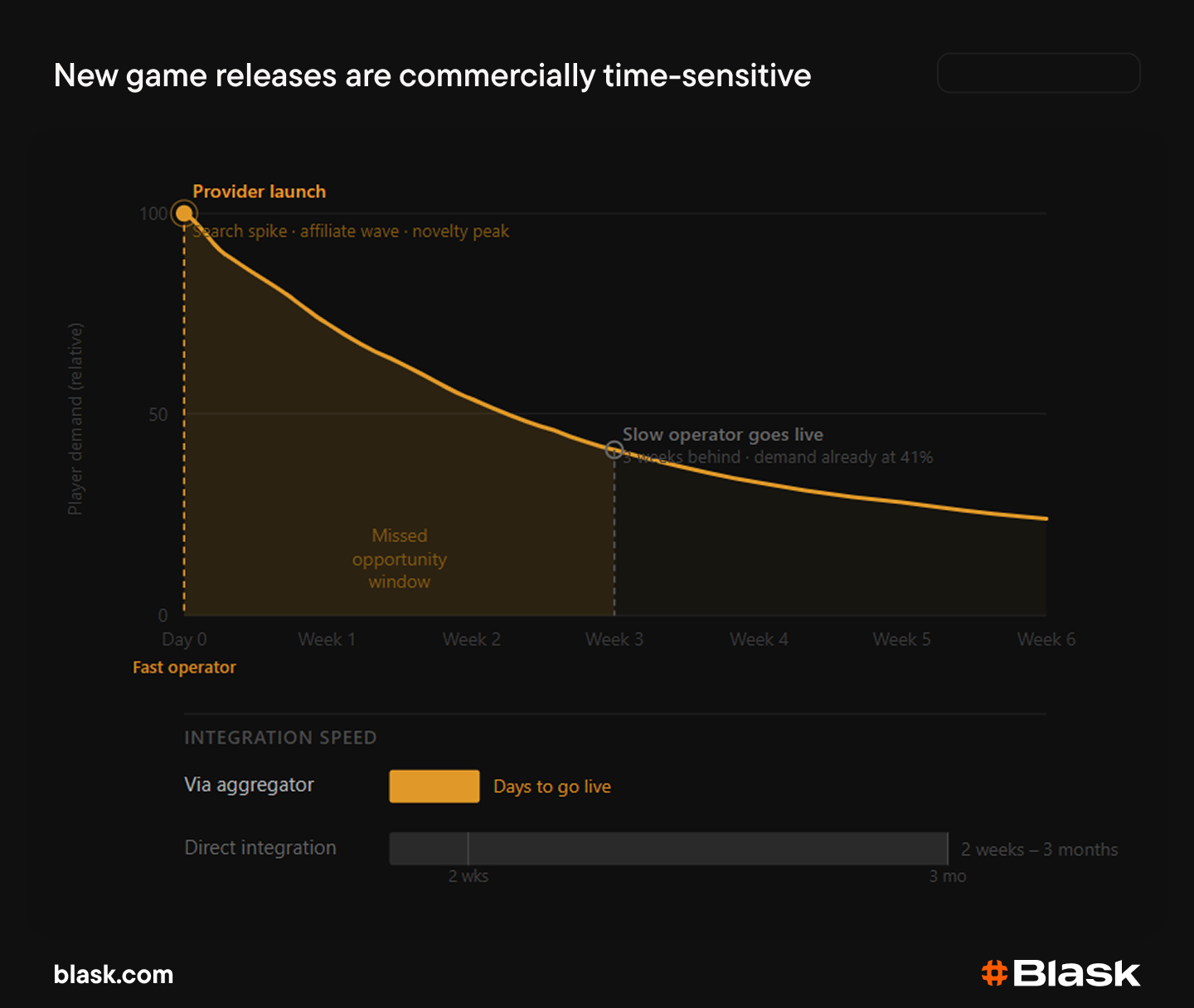
Player demand peaks at launch and decays rapidly — operators who go live weeks late miss the novelty window entirely.
GammaStack’s casino game development guide notes that the integration pipeline — from provider agreement to certified, compliant, live game — takes two weeks to three months depending on technical complexity and jurisdiction approvals. Operators using aggregators with pre-integrated libraries can compress this to days. Casino game management directly governs this pipeline.
Optimizing lobby conversion
The lobby is the primary conversion surface of an online casino. Players land, scan, and decide — usually within 60 to 90 seconds. Constructiondigitalmarketing.com’s analysis of Canadian casino lobby management identifies lobby structure as one of the top three variables affecting first-session conversion, alongside bonus offer and load speed.
Casino game lobby management determines what players see on that first scan. A poorly managed lobby pushes players toward search rather than discovery — and players searching without a destination convert at significantly lower rates.
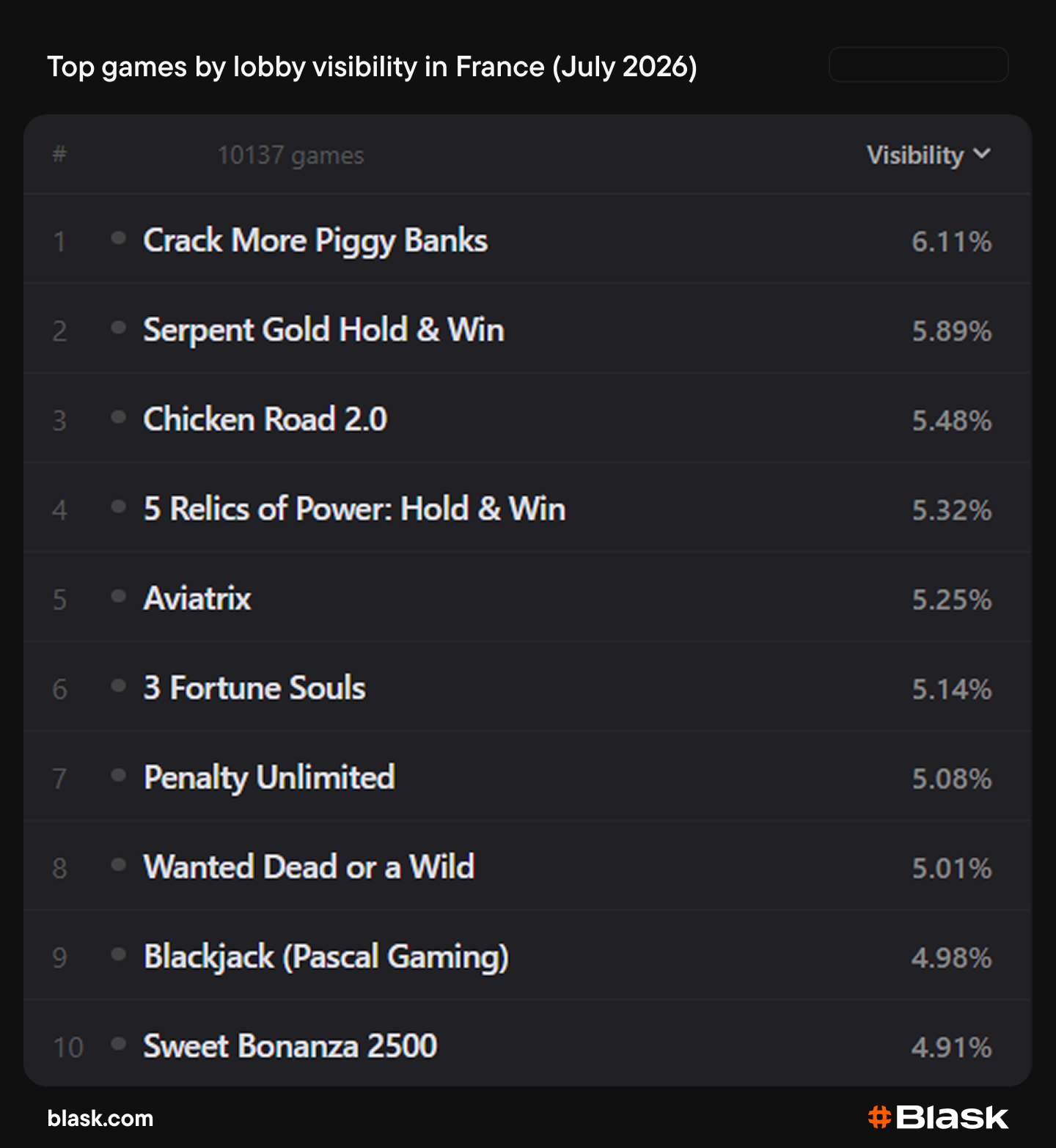
For example, in France, leading lobby titles and leading SOI titles are different.
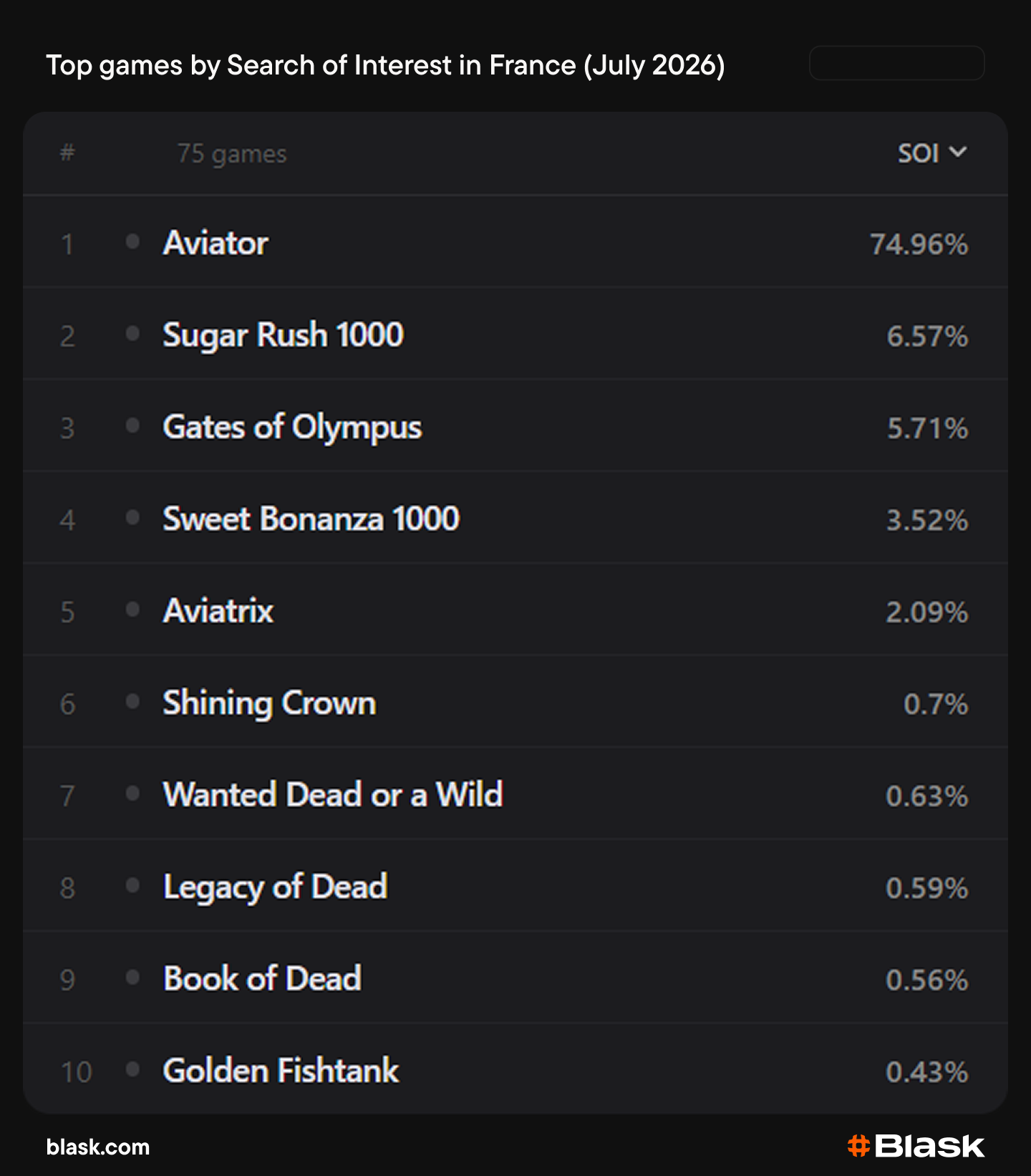
Here are top titles by the Search of Interest metric. It shows which games capture more players’ attention than others. Aviator captures almost 75% of SOI, while casinos don’t include it in the primary lobbies.
Key responsibilities of a casino game manager
Game portfolio curation
Portfolio curation is the editorial function of game management casino. The casino game manager decides which providers to contract, which titles to carry, and how many the lobby should contain. More titles are not always better — an oversaturated catalog increases discovery friction and dilutes promotional resources.
Effective game management casino operations treat the portfolio as a living product: reviewed on a quarterly basis, benchmarked against competitor lobbies, and adjusted in response to player behavior data and new provider releases.
Curation criteria include:
- RTP range,
- volatility profile,
- bet limits,
- visual theme,
- player feedback data,
- provider commercial terms.
A well-curated portfolio balances novelty (recent releases), evergreen performers (proven high-revenue slots), and niche content for advanced segments (high-limit tables, skill-based games).
Provider relationship management
Active provider relationship management involves:
- negotiating revenue share rates,
- securing exclusivity windows for new releases,
- coordinating joint promotions, managing technical dependencies.
Altenar’s operator guide notes that operators perceived as active partners — not passive catalog consumers — consistently receive better terms, earlier beta access, and priority technical support.
New game onboarding
Onboarding a new game involves:
- technical integration (API connection, game client testing, RTP verification),
- compliance sign-off (jurisdiction-specific approvals),
- QA testing (bet limits, bonus compatibility),
- lobby placement.
The casino game manager owns this workflow and sets the internal SLAs that determine how fast new content reaches players.
Lobby and category optimization
Category naming, sort order, search functionality, and visual hierarchy all fall under igaming game management. Standard categories at most operators include: New Games, Popular, Jackpots, Table Games, Live Casino, Slots, Crash Games, and Bonus Buy. Top online casinos who want to stand out add the section “Exclusive” or “Only on Stake”, for example.
A/B testing game placements
Placement is a hypothesis, not a permanent decision. EveryMatrix’s gamification guide cites lobby placement testing as one of the highest-ROI optimization activities available, with tests producing 5–15% improvements in engagement metrics. Effective tests require: a defined duration (14–28 days), a single variable, a statistically sufficient sample, and a clear primary metric (typically featured-game CTR or session revenue).
Tracking game performance metrics
Game manager needs continuous visibility into every title:
- bets placed,
- revenue generated,
- unique players,
- session length,
- retention rate by game,
- anomalies that might indicate technical faults or fraudulent play.
Coordinating bonus campaigns around releases
New game launches are most effective when supported by a coordinated campaign: free spins at launch, featured placement for 30 days, email to eligible player segments, and social content aligned with the provider’s release calendar. EGT Digital’s iGaming software guide confirms that bonus campaigns built around high-profile releases consistently outperform general free spin campaigns in first-time active rate and overall campaign ROI.
Game management system (GMS) features
A casino game management system is the software layer that operationalizes all of the above. It is the primary tool through which a game manager controls the catalog, lobby, and performance monitoring.
Multi-provider game catalog
The foundation of any casino game management system is a unified catalog aggregating titles from multiple providers into a single administrative interface — standardized metadata: provider name, RTP, volatility, bet range, theme tags, jurisdiction approvals, and launch date. GR8 Tech’s iGaming management software guide identifies unified catalog management as the feature that most directly reduces operational overhead for teams managing 50+ providers.
Drag-and-drop lobby builder
A visual lobby builder lets non-technical staff rearrange lobby sections, swap featured games, create seasonal categories, and preview changes without developer involvement. This is operationally critical: promotional windows for new releases are short, and operators who need a development ticket to feature a game miss the window.
Game categorization and tagging
Multi-dimensional tagging powers filtered player-facing navigation, enables precision CRM targeting (“send free spins on high-RTP games to churned players”), and feeds the personalization engine. A single slot might carry tags for: volatility, RTP band, bonus-buy eligibility, provider, theme, and max-win multiplier.
Featured game slots and carousels
The GMS controls which titles occupy high-visibility real estate — top banners, first carousels — at what times, for which player segments, and across which markets. Automated rules can rotate featured slots based on live performance data.
GEO-restricted game visibility
Jurisdiction-aware content filtering hides or disables titles not certified in a player’s market. This is a regulatory requirement. KodeDice’s iGaming risk management guide classifies outdated GEO-restriction settings as a high-probability compliance risk, noting that manual enforcement of per-jurisdiction game rules is unsustainable above 20 jurisdictions.
Personalization engine
Advanced GMS platforms modify the lobby in real time based on play history, preferences, bet size, and lifecycle stage. A player who exclusively plays live blackjack sees live casino content elevated; a jackpot slots regular sees a jackpot-heavy homepage. Personalization consistently improves session length and conversion on recommended content versus static lobby layouts.
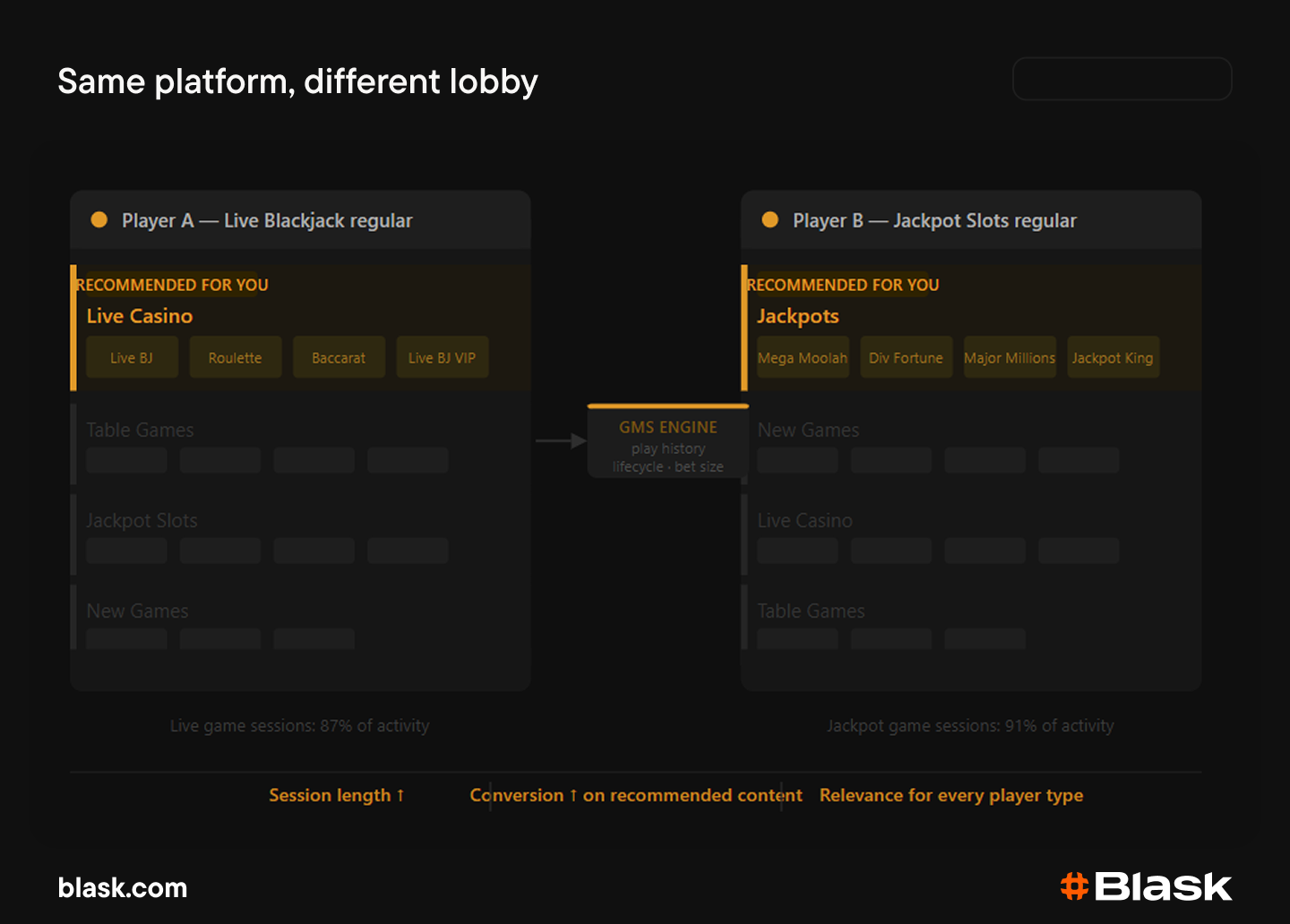
GMS real-time personalization — the lobby adapts to each player’s history, preferences, and lifecycle stage.
Real-time performance reporting
Built-in reporting provides live visibility — active sessions, bets per hour, revenue by title, trending games — alongside historical analysis by day, week, or cohort.
| Alerts flag anomalies: a game suddenly generating 10x normal revenue may indicate a bonus abuse pattern or technical error. |
Key KPIs in casino game management
Total bets and net gaming revenue (NGR)
Total bets is the primary volume metric. NGR is total bets minus winnings minus bonus costs. Game managers use NGR by title and by provider to evaluate catalog ROI and negotiate revenue share.
Unique players per game
Breadth of adoption metric. High NGR from a very small number of players indicates concentration risk and potential dependence on a few VIP accounts rather than healthy organic engagement.
Average session length
Reflects engagement quality. Slots with compelling bonus features generate longer sessions than base-game-only titles. Session length by game distinguishes content that captivates players from content that is clicked once and abandoned.
Game-to-game transition rates
Measures how often players move between titles within a session. A low transition rate from a specific game identifies session terminators. High transition rates signal active exploration. Understanding these paths helps position high-engagement titles as discovery hubs.
Revenue share returns by provider
Tracks what percentage of NGR flows to each provider. Comparing actuals against negotiated rates identifies billing discrepancies and verifies whether tiered volume thresholds are triggering correctly.
Bet per spin and stake distribution
Reveals player behavior within each title. A game where 90% of bets cluster at the minimum stake may serve only recreational low-value players; high max-bet activity may indicate VIP over-representation. This data directly informs bonus calibration — free spins on low-stake games carry different commercial value than on high-stake titles.
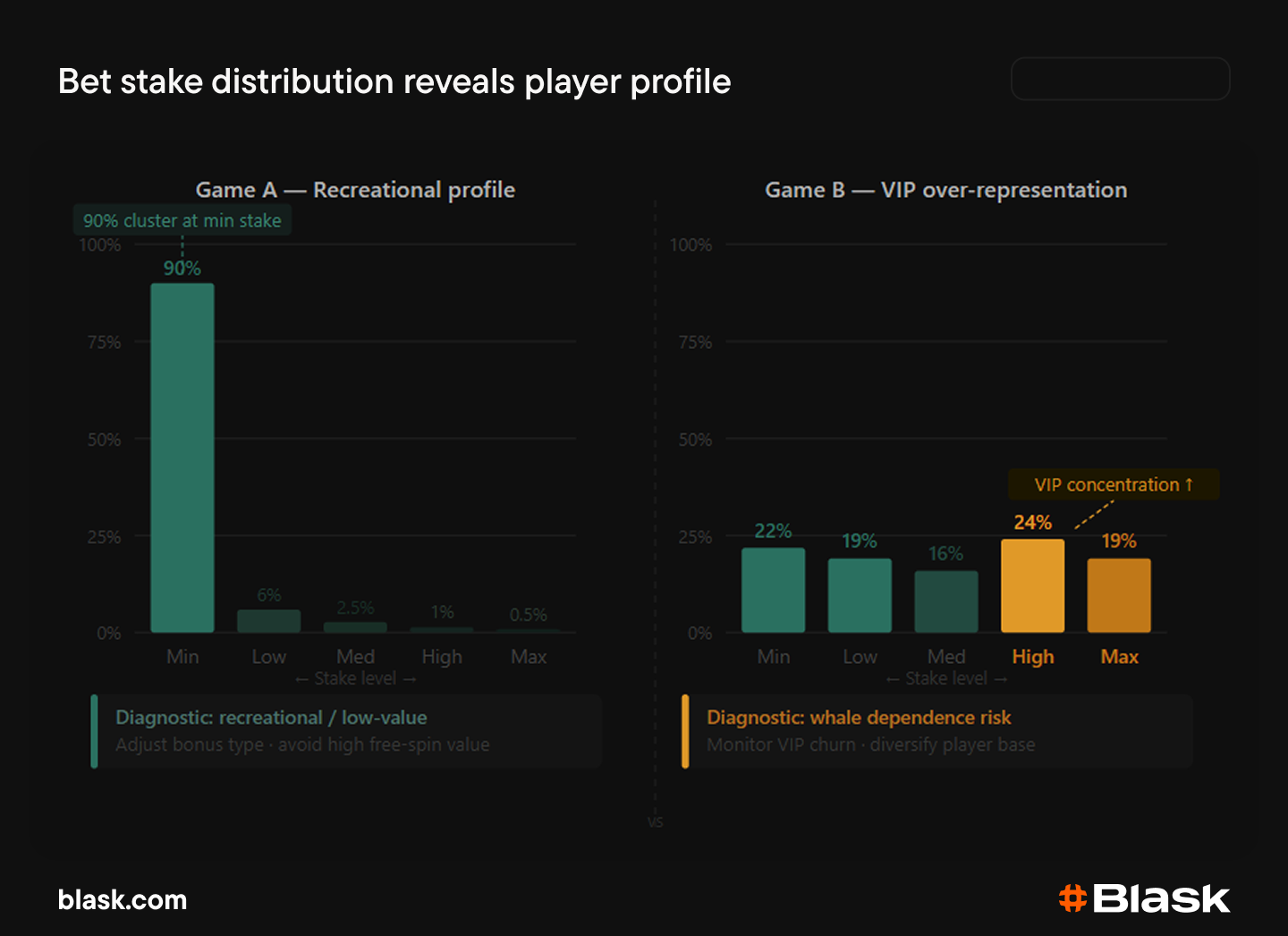
Where bets cluster across stake levels tells operators who is actually playing — and whether a game’s audience is healthy.
How new games are onboarded
Aggregator vs direct integration
| Criteria | Direct Integration | Aggregator |
| Time-to-market | 1-5 days | 2-8 weeks |
| Development cost | High | Low |
| Revenue share | Lower (no middleman) | Higher (aggregator cut) |
| Customization | Full control | Limited by aggregator |
GamingSoft’s 2026 integration analysis notes the aggregator market is consolidating around a few major players — EveryMatrix, SOFTSWISS, GameHub — which means the aggregator route now provides access to virtually all significant providers at competitive commercial terms.
Compliance approval per jurisdiction
Every game must pass compliance review before going live in each jurisdiction: verifying provider certification certificates (MGA, UKGC, AGCO, DGA), confirming RTP and feature compliance with local rules, and updating GEO-restriction settings. Some markets impose additional requirements, for example:
- maximum spin speed (UK);
- mandatory reality-check interruptions (Sweden).
Soft launch and A/B testing
A soft launch runs the game live for 5–15% of the relevant market, monitors for technical faults over 48–72 hours, and advances to full launch only if performance benchmarks pass. IGAcademy’s Online Casino Management curriculum includes soft launch protocol as a core operations competency, noting it significantly reduces the frequency of emergency game pull-downs that damage player trust.
Full rollout with promo support
Full launch removes stake restrictions, activates email campaigns with free spin offers, triggers featured lobby placement, and coordinates affiliate communications and social media support with the provider’s own press release timing.
Lobby optimization strategies
Personalization by player segment
Player segments — defined by RFM analysis, preferred game category, bet size, and device type — receive different lobby configurations. New players see popular, low-complexity titles. VIPs see high-limit live casinos and exclusive releases. Churned players see historical preferences plus a reactivation offer. EveryMatrix’s gamification guide documents that segmented lobby personalization produces measurable lifts in session frequency and average session value when implemented with at least four distinct segments.
Seasonal and themed categories
Time-limited categories aligned with cultural events such as Christmas Slots, Halloween Picks, World Cup Specials. They exploit player tendency to engage with contextually relevant content. The same game can appear in multiple categories simultaneously, allowing existing titles to benefit from seasonal placement without requiring new content.
Promoting high-RTP and bonus buy slots
Dedicated High RTP and Bonus Buy categories serve experienced players who actively compare expected value per spin. WA Technology’s operator guide identifies RTP transparency as an emerging competitive differentiator in regulated markets, where players increasingly compare displayed values before selecting a game.
Live dealer visibility
Live casino contributes a disproportionate share of NGR relative to game count — a small number of tables can generate revenue comparable to thousands of RNG slot titles. Real-time table stats (players at table, current win streaks, recent results) and lobby previews of active tables reduce friction between landing and betting on the most profitable content category.
| Blask published an article about rising live casino content in Europe. For example, this is Evolution’s titles visibility dynamics in Italy. The screenshot clearly demonstrates the growth of live content. This is the Netherlands content share where live casino content skyrocketed from 0.11% to 7.59%. According to Blask data, the tendency is the same across the whole world. |
Top casino game management platforms
| Platform | Game count | Key differentiator | Best for |
| SOFTSWISS Aggregator | 23,000+ | Standalone module flexibility | Operators on third-party PAMs |
| EveryMatrix CasinoEngine | 20,000+ | Personalization + A/B testing | European mid-to-large operators |
| Pragmatic Solutions | Not disclosed | Priority provider access | Content-first operators |
| BetConstruct CasinoConnect | 130+ providers | Integrated sportsbook + casino | Turnkey startup operators |
SOFTSWISS game aggregator
SOFTSWISS Game Aggregator connects operators to 23,000+ games from 250+ providers via a single integration. It includes a built-in lobby management interface, jurisdiction-aware filtering, and a back-office reporting module. The platform handles the full game catalog management workflow — from provider onboarding to real-time dashboards — and is available as a standalone module for operators on third-party platforms.
EveryMatrix CasinoEngine
One of the most widely deployed casino game management system products in Europe and emerging markets. Offers catalog management across 20,000+ titles, visual drag-and-drop lobby builder, built-in A/B testing, and a personalization engine integrated with EveryMatrix’s PAM and bonus tools.
Pragmatic Solutions PAM
Its affiliation with Pragmatic Play — one of the industry’s highest-volume providers — gives operators on the platform priority access to Pragmatic Play releases, including early-access windows and exclusive variants. The lobby management module integrates directly with the bonus engine for campaign-to-launch alignment.
BetConstruct CasinoConnect
Aggregates content from 130+ providers with back-office game management, performance reporting, lobby configuration, and geo-restriction tools. Common among operators who want a single-vendor tech stack combining sportsbook and casino.
Game management vs casino management system (CMS)
A casino management system (CMS / PAM) governs player-facing operations: account creation and KYC, deposits and withdrawals, bonus issuance, responsible gambling tools, and compliance reporting.
A game management system governs the content layer: which games exist, how they are displayed, how they perform, and how they are promoted.
| Criteria | Casino management system | Game management system |
| Primary owner | operations / compliance | game manager / product |
| Core function | player accounts, payments, bonuses | game catalog, lobby, KPIs |
| Regulatory scope | directly licensed | compliance-adjacent (GEO-restriction) |
GR8 Tech’s management software guide notes that the lines blur in integrated platforms where both functions come from the same vendor — but the operational responsibilities remain separate regardless of technical architecture.
Common game management mistakes
Over-cataloging without curation. Publishing every available game from every contracted provider creates lobby clutter. The average player does not scroll past the first 40–60 visible games per session. A 2,000-game catalog with thoughtful structure outperforms a 10,000-game catalog without it.
Static lobbies. Operators who configure the lobby at launch and never revisit it lose the engagement lift from seasonal content, trending releases, and personalized curation. Constructiondigitalmarketing.com’s lobby analysis confirms that operators who update featured content monthly show measurably higher repeat-visit rates.
Ignoring long-tail performance data. Most analytics focus on the top 20–50 games by revenue. The long tail — games ranked 500 to 5,000 — contains high-retention titles that are invisible because they lack promotional exposure. Regular long-tail analysis surfaces these underused assets.
Misaligned bonus campaigns. Running free spin campaigns on low-volatility games for players who exclusively play high-volatility content produces poor conversion. Promotional mechanics must match game type and target segment.
Skipping soft launches. Operators who skip soft launch and push new games to 100% of traffic absorb the full impact of any technical bugs: player complaints, emergency pull-downs, and potential regulatory scrutiny.
Neglecting compliance governance. Geo-restriction configurations set at launch and never updated fail to account for new market entries, regulatory rule changes, and provider certification lapses. KodeDice’s risk management guide classifies outdated GEO-restriction settings as a high-probability compliance risk for rapidly expanding operators.
How to become a casino game manager
The casino game manager role sits at the intersection of product management, commercial negotiation, and data analysis. There is no single formal qualification path, but practitioners consistently develop competency across four areas.
iGaming domain knowledge. Understanding of game mechanics (RNG, RTP, volatility, bonus features), the provider landscape, aggregator architecture, and lobby UX is foundational. IGAcademy’s online casino management course is one of the few structured curricula covering this end-to-end — game portfolio management, provider relations, and performance analytics.
Data analysis skills. Game managers work with large performance datasets daily. SQL for querying back-office databases, comfort with BI tools (Tableau, Looker, or platform-native dashboards), and the statistical literacy to design valid A/B tests are practical requirements at mid-to-senior level.
Commercial and negotiation skills. Revenue share negotiation with providers, evaluation of aggregator pricing models, and understanding of GGR/NGR economics separate operationally competent game managers from those who also drive margin outcomes.
Project management. The onboarding pipeline involves multiple teams — development, legal, compliance, CRM, design — and tight promotional deadlines. Weak coordination creates bottlenecks that delay launches and damage provider relationships.
Career paths typically run from casino analyst or platform coordinator into junior game management, then senior or lead game manager, and eventually VP of Casino Product or Chief Product Officer.
Future trends in game management for 2026
AI-driven personalization at scale
Machine learning models now adapt lobby content at the individual player level in real time, incorporating not only historical game preferences but session-level signals to surface contextually optimal content. EveryMatrix’s CasinoEngine has publicly documented ML-based recommendation deployment, with reported session depth improvements across operator cohorts.
Crash and skill-based content growth
Crash games — driven by Spribe’s Aviator — have reshaped what a “casino game” means. In markets with high mobile penetration and younger demographics (Africa, Latin America, Eastern Europe), crash games are much more popular than in Europe, for example. Their lobby placement logic, performance metrics (much higher bet frequency than slots), and promotional mechanics differ materially from RNG content — requiring game managers to develop format-specific playbooks.
Live casino content growth
As it was previously mentioned in this article, live content grew significantly and will continue to grow in the next few years. Some game providers combined crash games and live titles, for example Fishing Time from Evolution. It’s a live casino title with a crash bonus round. It made this game extremely popular among players in some countries such as Brazil:
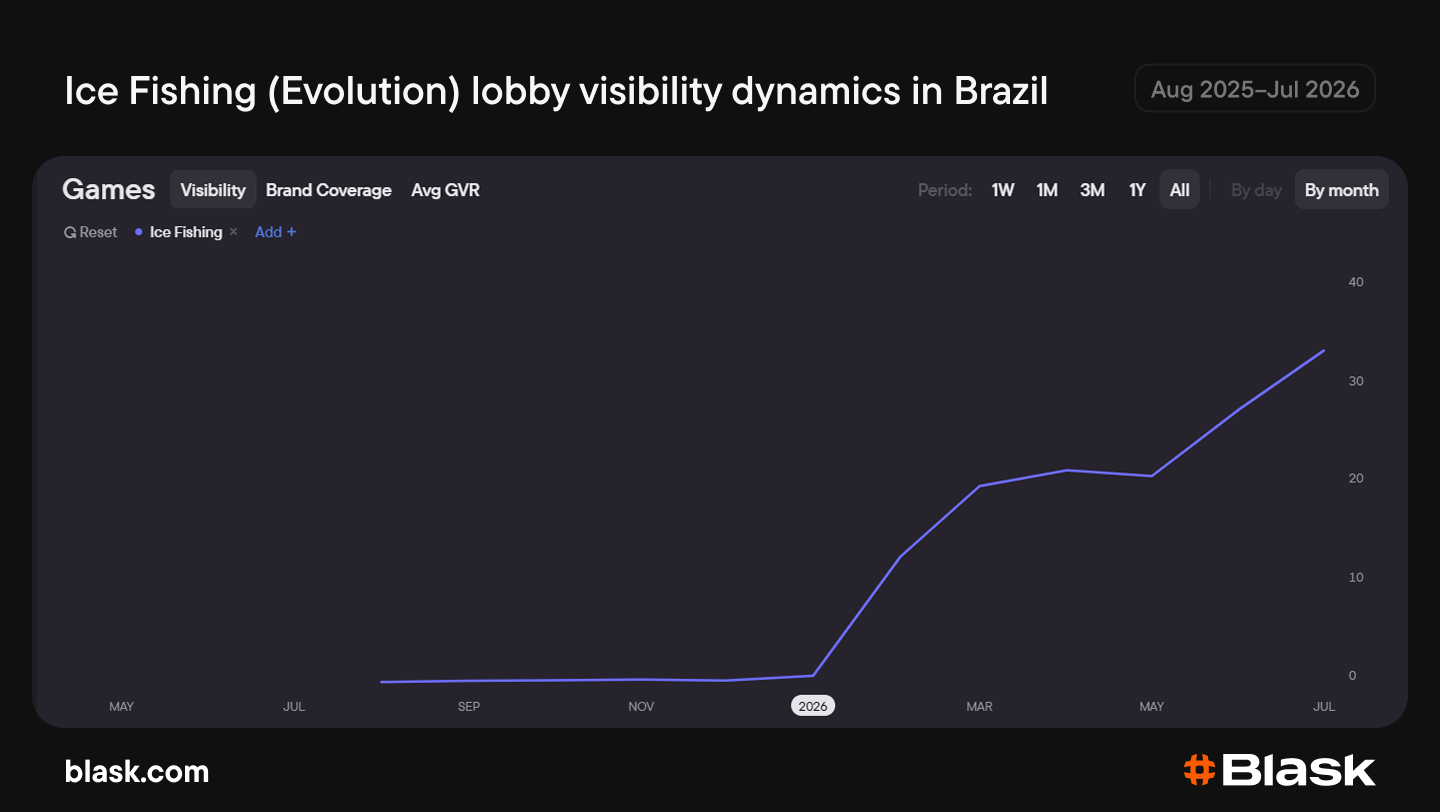
January 2026 and May 2026 are twist points for this title.
Real-time content performance automation
Next-generation GMS platforms are introducing automated placement rules. For example, a game that reaches a defined performance threshold (e.g., trending in top 10 for daily unique players) is automatically elevated to a featured slot. Another example: a game that falls below a retention threshold after 60 days moves to the back of its category. This automation reduces decision latency and removes the dependency on manual review cycles.
Compliance automation
As operator license portfolios expand to 10–20+ jurisdictions, maintaining compliance configurations manually is unsustainable. GMS platforms are integrating with regulatory databases and provider certification APIs to update game availability automatically when certification statuses change. KodeDice’s risk management framework anticipates compliance automation becoming a standard GMS feature by the end of 2026.
Provider consolidation
M&A activity is reducing the number of independent studios; large groups (Pragmatic Play, Evolution, Playtech) are capturing an increasing share of player attention and operator shelf space. For igaming game management, this means fewer but larger provider relationships, greater standardization of integration protocols, and higher strategic value placed on exclusive or first-to-market content as a differentiation tool. The implications for game management casino operations are significant: operators must invest more in exclusivity negotiations and first-look agreements to differentiate their catalogs as the provider landscape consolidates around a handful of dominant studios.