
Rivalry’s entire C-suite and four board members resigned months after the operator paused all player activity. Blask data shows the market side of the collapse: a thin Ontario position, limited share and little room to absorb financial pressure.
By April 2026, Rivalry had no CFO, no COO, and no CTO. Four board members resigned on April 24 — including three of Rivalry’s four co-founders — alongside the three remaining C-suite executives. CEO and co-founder Steven Salz is the only person left in a leadership role at the Toronto-based operator. The board collapse followed an operational pause announced on February 13. The company stopped player activity, cut most of its workforce and opened a formal review of strategic alternatives, including possible asset or corporate transactions. It had already flagged going-concern risk in its Q3 2025 financial statements, published December 1, 2025.
Ontario was the real market
Rivalry launched in 2016 targeting esports betting and went public in 2021 after a $22 million funding raise. From 2024, the company shifted away from esports toward VIP customers and cryptocurrency — under investor pressure to show a path to profitability. The pivot did not stabilize the business.
Rivalry’s measurable demand was concentrated in Ontario, where the company held an internet gaming registration. The Blask Index is a composite demand signal built from search interest, showing how actively users look for a brand in a market. In Ontario, Rivalry remained a small player: its share stayed below 0.03% of the province’s total Blask Index across 2025.
The January spike was not strength
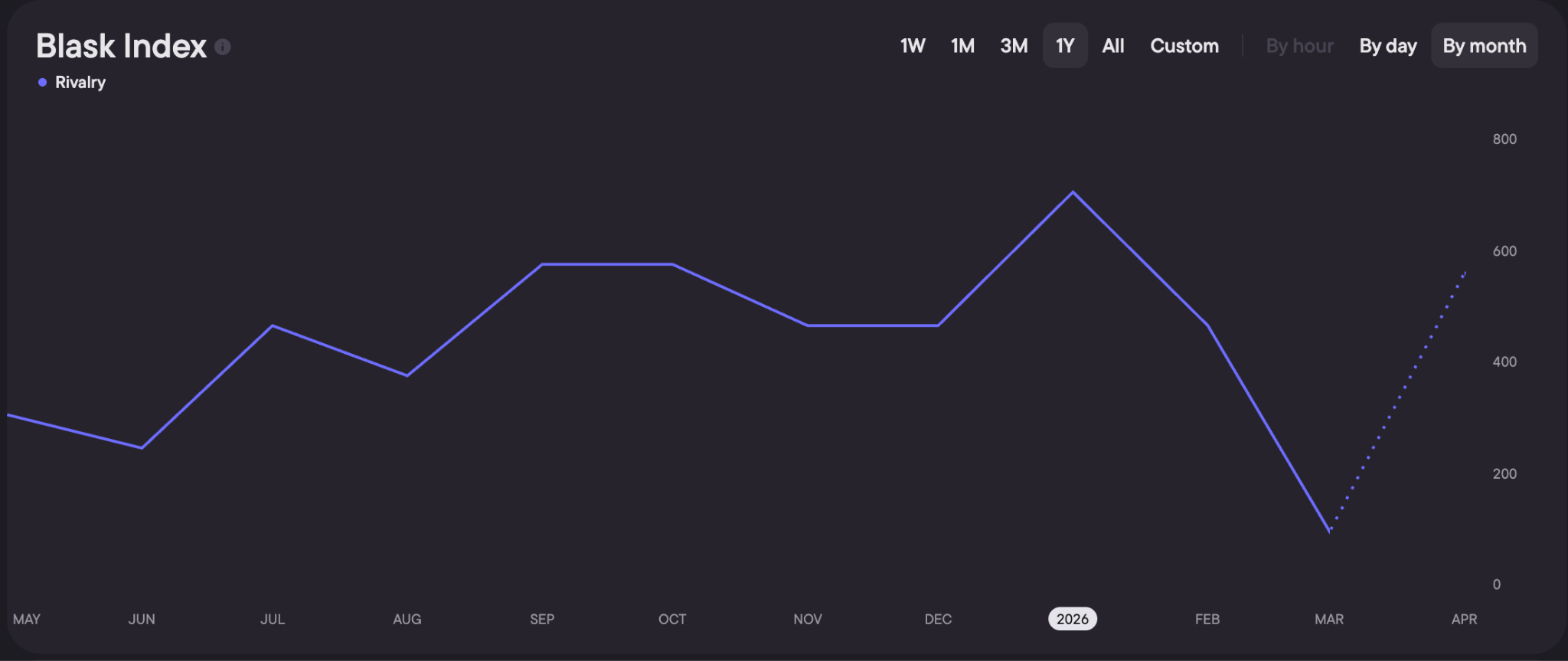
Rivalry’s Ontario Blask Index peaked in January 2026, roughly 35% above the midpoint of its second-half 2025 range. The spike came after Rivalry had already disclosed going-concern risk, so it reads more like crisis-driven attention than clean growth.
After the February pause, Rivalry’s Ontario Blask Index fell more than 6x from its January peak to March. April brought a partial rebound, returning the index to roughly 80% of the January level as the board and C-suite exits pushed Rivalry back into the news cycle. The recovery did not change the brand’s market position: Rivalry still held only 0.03% of Ontario total demand and ranked 149th in the province.
Ontario did not collapse with Rivalry
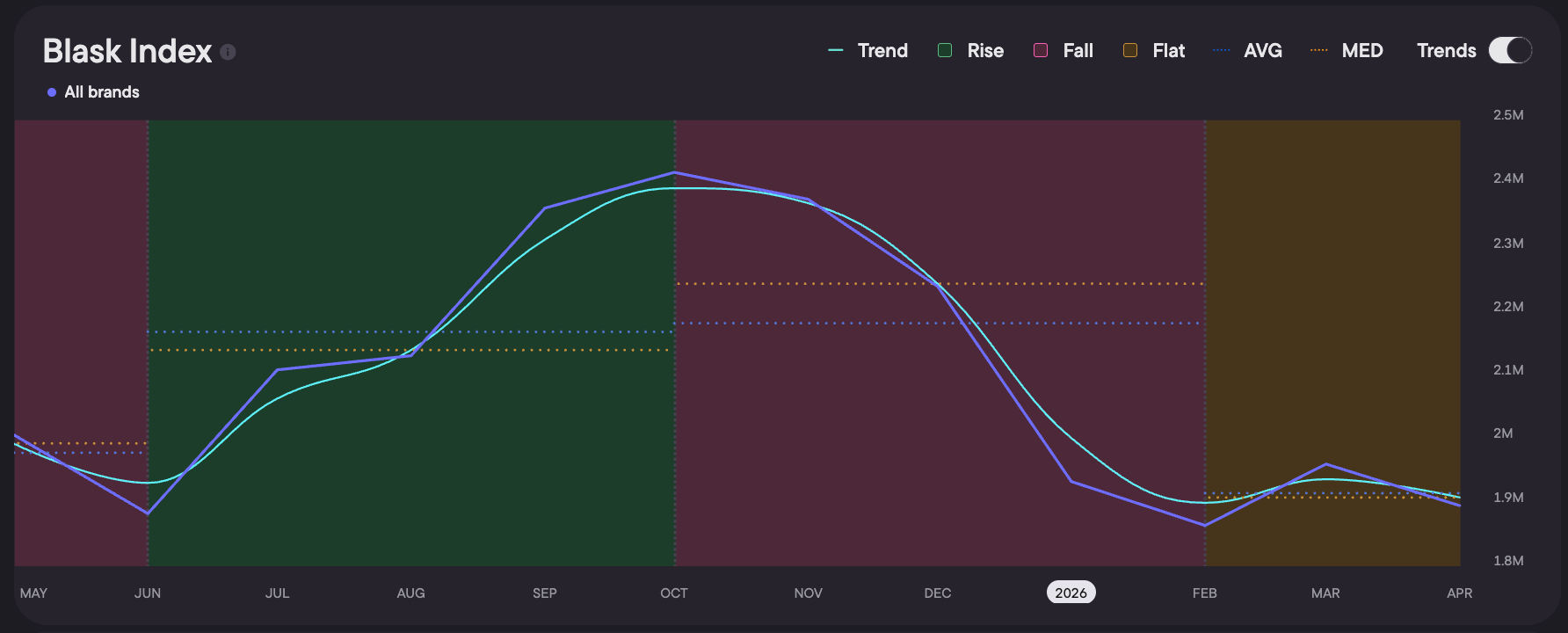
Blask tracks 274 brands in Ontario. The province’s total market held stable through the same period; Rivalry’s signal fell alone. The drop is a brand-specific failure, not a market-wide downturn.
Rivalry held a local licence, a distinct esports positioning, and enough search interest to spike during crisis periods. The esports niche it targeted was too small to support the cost base of a publicly listed operator, and the VIP/crypto pivot did not build a replacement revenue base before financial pressure forced the halt. The company had flagged going-concern risk, paused operations, and started a strategic review — all before the board emptied.
What exits show
Rivalry’s board and C-suite departures confirm the direction the data had already taken. From a Gen Z esports pitch to going-concern disclosure, operational pause, strategic review, and a collapsing brand signal: each step followed from the one before it.
The brand still carries residual recognition — the April Blask Index rebound proves search interest does not disappear overnight. For any potential acquirer, the remaining commercial assets are an Ontario position at 0.03% share and a brand that joins a list of esports betting operators that could not reach scale, including Luckbox, Unikrn, and Vie.gg. Recognisability in search is not the same as a market position. Rivalry’s Ontario footprint was too thin to survive the pressure, and the company ran out of runway before converting its esports identity into durable share.