
- Updated:
- Published:
Brazil’s betting seasons, explained

Brazil’s online wagering market doesn’t move in a straight line. It breathes in rhythms that mirror the country’s sports calendar and cultural life: autumn climbs, Saturday-night spikes, and a brief early-year lull. Using Blask Index — an attention barometer for betting and casino brands — this analysis reads those cycles and turns them into practical timing cues for operators, investors and policymakers.
What is Blask Index
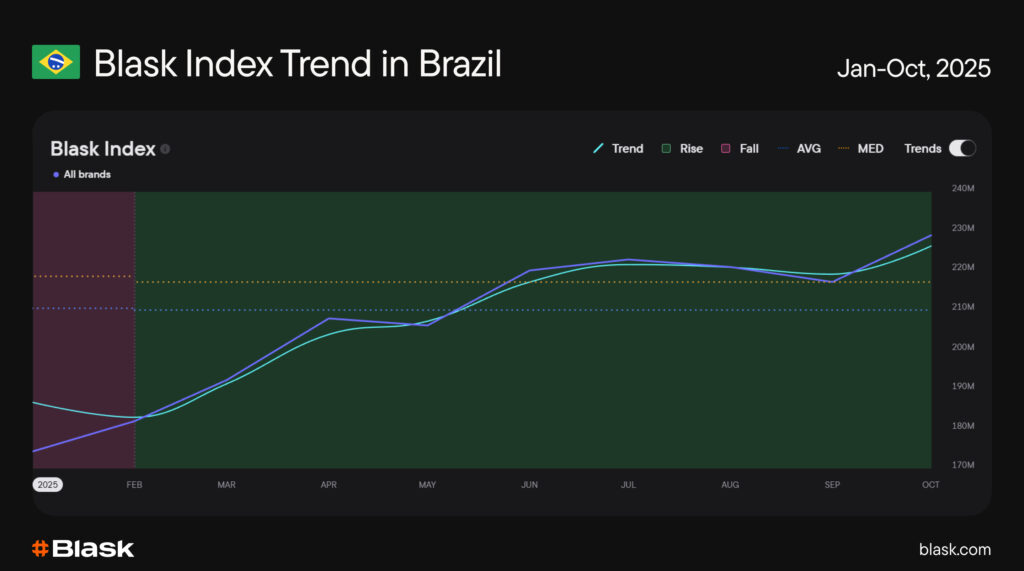
Blask Index aggregates market-level attention to iGaming brands. In the “Trends” view, the series is segmented into rising/falling/flat regimes, with a smoothed Trend line set against mean (AVG) and median (MED) baselines.
For a comprehensive analysis of Brazil’s iGaming market structure, regulation, and player behavior, see our Brazil’s iGaming market overview.
2025: the year interest returned and kept climbing
From January to October 2025, the Trend line of Brazil’s Blask Index rose by roughly 32% (from ~174M to ~230M). In plain sight, the chart looks like a staircase: a winter trough, a steady spring climb, a brief September cooling, and an October re-acceleration.
Read more: Brazil’s online casinos under the microscope: what platforms push, and what players choose
Inside the year, the most active daily peaks are clustered on weekends:
- July 5, 2025 — 10.37M;
- September 20, 2025 — 10.14M;
- October 19, 2025 — 10.27M.
All three fall on Saturdays, aligning with Brazil’s weekend-heavy match cadence in the national league. The 2024 Série A calendar, for example, opened the weekend of April 13–15 and ran through the weekend of December 8, anchoring the competitive schedule to Saturdays/Sundays and concentrating audience attention then.
Peaks and troughs: why autumn runs hot
In Blask’s long-range seasonality (2016–2025), October is historically the most popular month. That’s no accident — it sits at the crossroads of Brazil’s domestic and continental football:
- Copa Libertadores: in 2024, both semifinals were scheduled in October (1–3 and 22–24, home/away legs), nationally televised set pieces that reliably lift attention and betting interest.
- Brasileirão (Série A): the league runs April–December; decisive rounds for the title race and relegation fights land in September–November, a natural attention accelerator.
- FIFA international window: South America typically plays national-team fixtures in October; FIFA’s match calendar shows an international match window in early-to-mid October. Those mid-week matches stack on top of weekend club games.
- Public holiday (Oct. 12): Nossa Senhora Aparecida/Children’s Day is a nationwide holiday created by Law 6.802/1980, extending leisure time and media consumption.
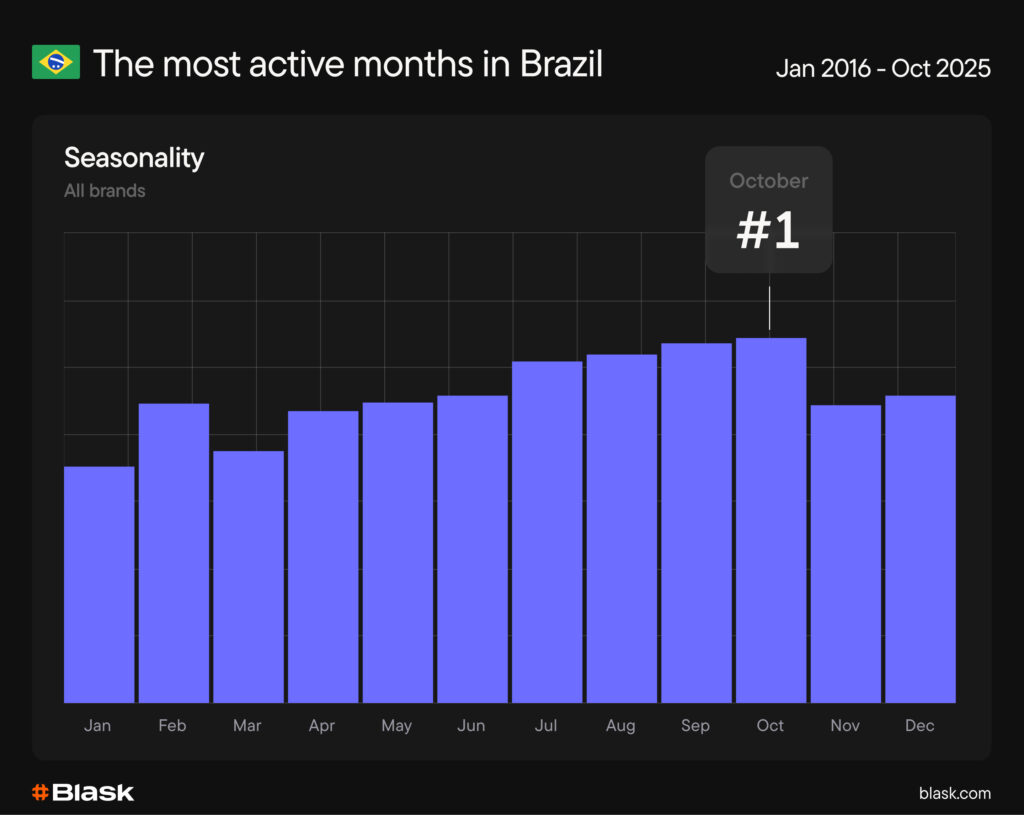
Put together, the country enters an autumn corridor where club, continental and international football overlap, and Blask Index responds.
Two absolute “all-time” peaks underscore how football mega-events ignite Brazil’s market:
- July 14, 2024 — 12.15M (Copa América final, Argentina–Colombia);
- October 5, 2024 — 11.64M (mid-corridor between Libertadores semifinals and critical league rounds).
The February 2024 dip: a repeatable pattern, not a mystery
The composite chart for 2023–2025 shows a pronounced trough around February 2024. Several forces stack in the same direction:
- No national league yet. Série A only begins in April; in February the stage belongs to state championships (Estaduais), which draw smaller national attention and betting volume.
- Calendar mechanics. February is shorter, and in Brazilian statistics the effect of working-day counts is material enough that official time-series use calendar/working-day adjustments (IBGE applies X-13-ARIMA with calendar effects). That same arithmetic lowers any month-sum metric like attention.
- Carnival crowds out attention. In 2024, Carnival ran across Feb. 9–14 (with major parade nights Feb. 9–12). The celebration shifts leisure and screen time toward travel and festival content, pulling attention away from regular-season sports unless a tent-pole event intervenes.
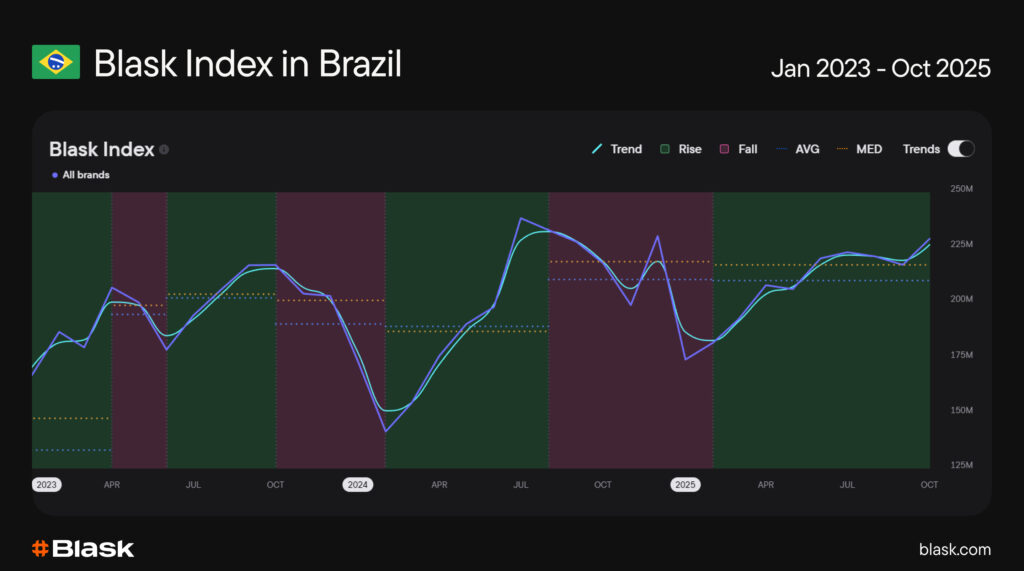
The result is a predictable seasonal hollow: less top-tier football, fewer days, and a country on parade.
Inside the week and the clock: when demand crests
A decade-long heatmap (2016–2025) shows a durable micro-rhythm:
- Day of week: the index crests late in the week, peaking on Saturday — a mirror of match scheduling.
- Hour of day: the “hot window” is Saturday night into early Sunday (UTC), which translates to roughly 01:00–03:00 BRT for most of Brazil. That is exactly when live matches, in-play betting and longer sessions stack up.
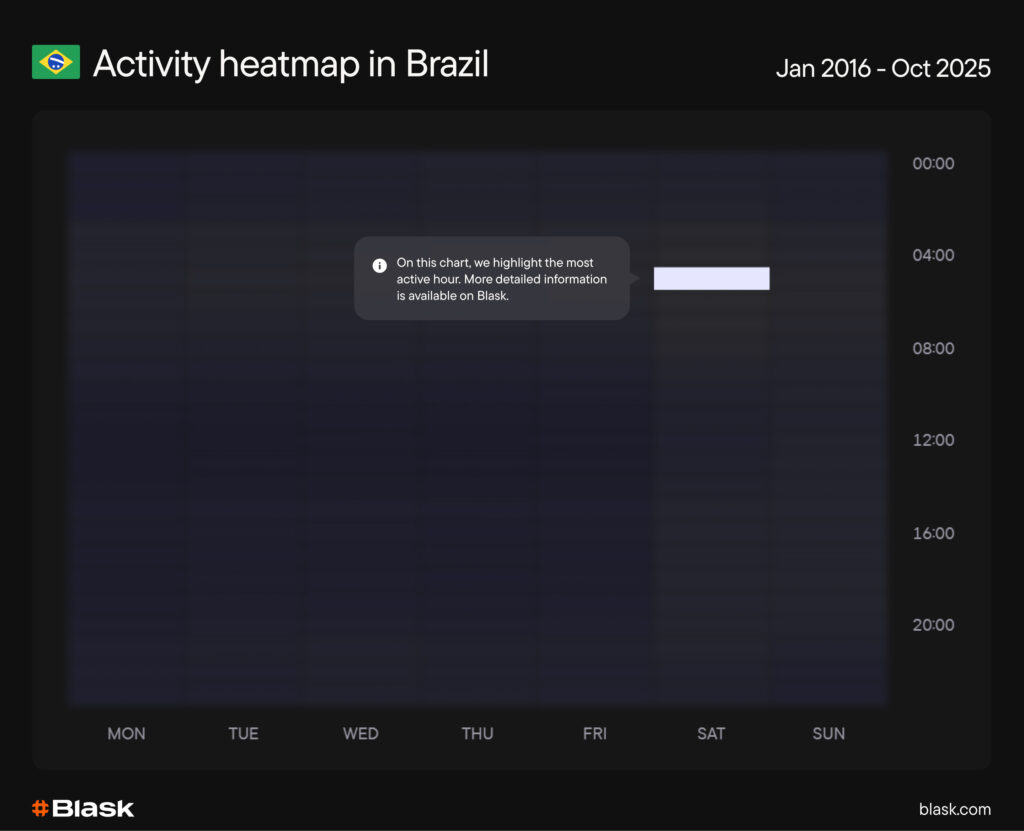
The practical read: prime your live ops, payments capacity and VIP outreach for weekend nights; that’s where the index consistently pays out.
What to do with seasonality (if you run money, media or policy)
- Plan for the autumn sprint. October is your best month statistically. Build brand pressure through September, peak budgets in October, and carry momentum into early November, when title races and international windows overlap.
- Use mid-season waypoints. June–July offer strong entry points — international tournaments in even-numbered years and a fully rolling domestic calendar. Note how July 5, 2025 printed one of the year’s top daily peaks; mid-season isn’t sleepy — it’s when casuals re-enter and cohorts can be “re-trained” for higher LTV.
- Own the weekend nights. If your deposit pushes, live-bet product and customer care aren’t calibrated to Saturday night, you’re leaving money and experience on the table.
- Expect (and budget for) the February hollow. It’s structural. Treat it as time to rebuild funnels, test product and accumulate brand reach while CPC/CPM soften, then scale as the calendar turns to April.
Policy and risk: why this matters beyond operations
For regulators and public-health planners, seasonality is an early-warning system. October’s confluence of fixtures and holidays can stress Responsible Gaming and payments oversight; targeted messaging and tooling should move ahead of the curve. Conversely, February provides a natural breather to evaluate interventions and audit systems before volume returns.
Bottom line
Brazil’s iGaming demand is cyclical for reasons you can mark on a calendar. Autumn runs hottest thanks to Libertadores semifinals, decisive league rounds, and an October FIFA window. February cools as Carnival and a short month sap regular sports attention.
In 2025, the Trend climbed by 32% from January to October, a staircase recovery that confirms interest has normalized after regulatory turbulence. Treat these rhythms not as trivia but as a playbook: time your brand pushes, rotate acquisition budgets, staff weekends, and plan RG capacity where the curve says it will matter most.