- Updated:
- Published:
Thailand’s iGaming market: $2.71 billion in demand, one dominant brand, and one 100% growth story
Thailand sits in an interesting position: no onshore licensing framework yet, a $2.71 B Competitive Earning Baseline, and one challenger brand that doubled its market presence in twelve months.
That combination — deep organic demand, limited infrastructure friction from formal competition, and a clear window for differentiation — makes Thailand one of the more compelling pre-regulation markets in Southeast Asia right now.
An unregulated market with very regulated-looking dynamics
Thailand currently operates without a formal iGaming licensing regime, which means the field is shaped by offshore brands and cross-border platforms rather than onshore operators.
In practice, this creates a specific operating pattern. Without a centralised regulatory framework, the market landscape shifts more quickly — domain availability, payment routing, and app distribution can change, and operators who build redundant infrastructure navigate this more smoothly than those who don’t.
For operators, this is not a reason to avoid Thailand. It is a reason to understand exactly how it works.
Track how Thai market demand shifts in real time on blask.com/market/thailand.
One brand owns a third of the market. Another just doubled in a year.
The Thai market is not a free-for-all. It is a concentrated field with two dominant players — and then the rest.
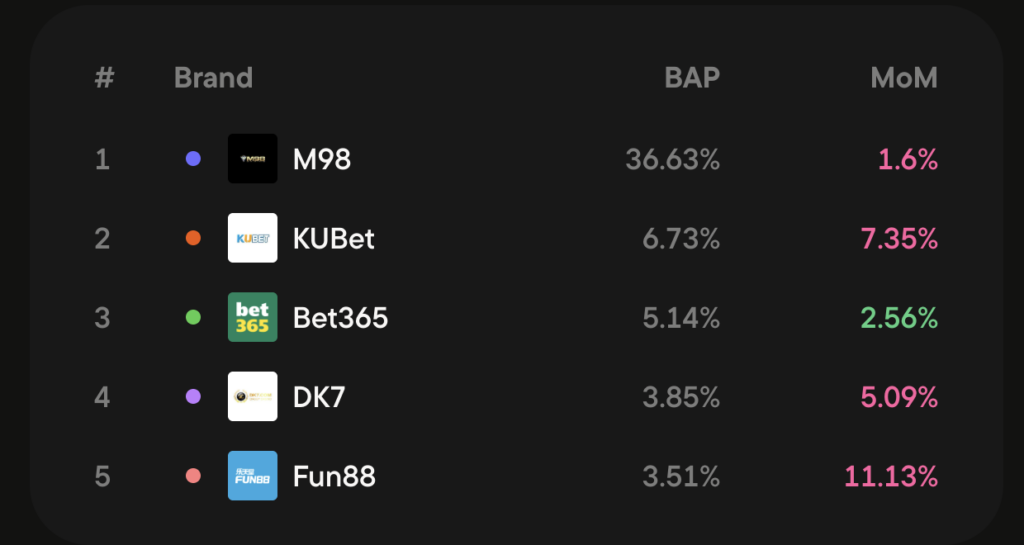
- M98 holds a 36.6% BAP (Brand’s Accumulated Power), roughly a third of all consumer attention in the market. Its APS sits around 1.25 M and CEB around $680 M. No other brand comes close in cumulative visibility.
- UFABET is the clear second at 22.4% BAP (~$476 M CEB), and growing faster than M98: +36.6% YoY versus +12.8%.
- Then there’s KUBet: 4.47% BAP and $98.7 M CEB — numbers that look modest until you notice it grew +99.7% year-over-year. That is not a rounding error. KUBet effectively doubled its market presence in twelve months while the incumbents were managing their existing positions.
The pattern is familiar in concentrated markets: the top two control the funnel economics, while a challenger scales fast in the pockets they ignore — esports, crash games, crypto rails, faster KYC, better local UX. The brands showing YoY declines (W69, Dafabet among them) tell you which pockets are being vacated.
💡 If you’re entering Thailand: don’t try to outspend M98. Find what M98 is not doing, and do that extremely well.
Football makes the market tick. Winter makes it sleep.
Thai iGaming has a distinct seasonal shape, and it tracks the sports calendar closely.
The Blask Index hits its annual low in January–February. From March onward, intent rises steadily as the European football season moves toward its climax. It accelerates into July–August — the sweet spot of pre-season announcements, betting anticipation, and returning player activity. Late summer finishes above the long-run average.
December–January is soft. Casino-led CRM is the mechanism to smooth that trough: keep VIPs engaged, run retention programmes, rotate casino content. Don’t try to fight the seasonality; plan around it.
The paid acquisition window opens in spring. When Blask Index and APS rise together — a reliable signal that both demand and conversion power are improving — that’s the moment to scale bids, open affiliate inventory, and push harder. When Index rises but APS plateaus, stop. Something is broken downstream: landing page speed, KYC friction, wallet coverage. Fix those before spending more.
$2.71 billion — what does that actually mean?
CEB (Competitive Earning Baseline) represents the market’s collective revenue potential across all brands. $2.87 B cumulative. In a given month, the range runs from around $175 M in a quiet winter month to north of $400 M during a football-season peak.

The CEB–APS relationship is your health check. If CEB consistently runs ahead of APS for six or more weeks, you’re harvesting retention while under-investing in acquisition — a profitable short-term position that erodes market share. If APS consistently outruns CEB, your bonus costs and VIP economics need review.
Tourism, payments, and what drives demand spikes
Thailand’s inbound tourism — especially Chinese visitors — creates consistent demand spikes in entertainment spending. That spending flows to mobile-first platforms and digital products, creating short-term amplification on top of the organic base.
For operators: tourism peaks amplify demand; they don’t create it. The organic base is already there. Tourism is the multiplier.
On payments: Thai bank rails and TrueMoney Wallet are the baseline. Crypto adds margin where risk tolerance and policy permit. Alternative payment infrastructure is well-developed across the market, which means players expect broad wallet coverage — and brands that deliver it convert better.
What operators actually need to do (the short version)
Localise everything. Thai-language UX, near-instant in-app KYC, one-tap wallet integrations. The brand that removes friction wins the depositor. Speed of the first session matters more than almost any other variable.
Own a vertical. M98 and UFABET win on breadth. You win on depth: VIP management, esports, crash/instant games, crypto-native products, or any content vertical the leaders treat as secondary.
Run compliance as infrastructure, not checkbox. No licence doesn’t mean no standards. Age-gates, affordability checks, and KYC/AML hygiene de-risk partnerships, improve affiliate terms, and position you better when (not if) regulation eventually arrives.
Watch the domain and payments stack. Maintain redundant channels — mirrors, alternative app distribution, backup payment processors. Enforcement is episodic, not predictable.
What happens next
Three scenarios worth monitoring:
- Regulation shifts. Any move toward a formal licensing framework — even a limited pilot — would reshape the acquisition economics significantly. APS would spike, CACs would temporarily fall, and brands with established Thai player bases would have a structural head start. Operators who build presence now are better positioned for any future framework than those who wait.
- Tourism pulses. Regional calendar events and Chinese inbound volumes will continue to create short-term demand amplification. Track the Blask Index around national holidays and major sporting events; the correlation is consistent.
- Payment friction. App-store actions and PSP disruptions are the most likely near-term operating hazard. Operators with distribution depth and multiple payment rails navigate these; those running single-channel stacks get hurt.
Thailand is not the simplest market to enter. It is also not one to overlook — not with $2.87 B in annual demand, not with KUBet proving that even a concentrated field has room for a 100% growth story, and not with the structural dynamics shifting as the market matures.
For the broader regional picture — including how Thailand fits into Asia’s evolving iGaming landscape — the Online iGaming Market Trends in Asia report covers the data side by side across the region’s most significant markets.
The demand is there. The question is which brands are positioned to capture it.