
- Updated:
- Published:
What is betting tax
In the United States, sports-betting winnings are taxable as ordinary income, including amounts that never produce a W-2G. That rule applies to the player. It is separate from the tax an operator pays on handle or gross gaming revenue.
Commercial sportsbooks paid $3.71 billion in state sportsbook taxes in 2025. With that scale came tighter 2026 reporting and loss-deduction rules — this article walks through both the player side and the operator side.
What is betting tax?
| The term covers the federal and state rules that tax sports wagering winnings as ordinary income, plus the separate levies operators pay on handle or gross gaming revenue. |
The scale of the market explains why the rules tightened in 2026. According to the American Gaming Association, commercial sportsbooks handled $166.94 billion in 2025 and generated $16.96 billion in sports betting revenue, producing $3.71 billion in state sportsbook tax collections. That volume sits inside a broader commercial gaming industry that paid $18.09 billion in gaming taxes the same year.
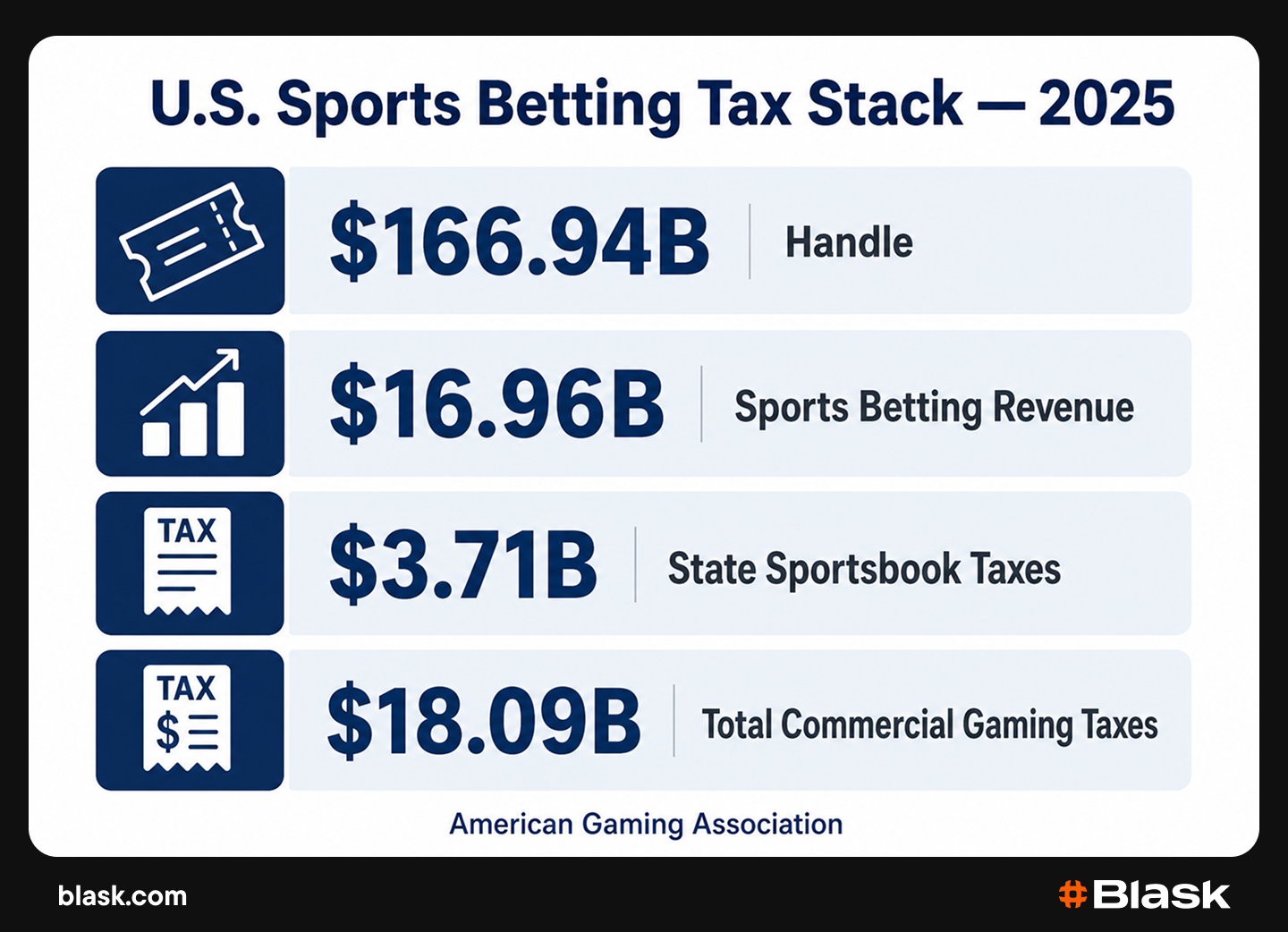
US sports betting tax stack. Data for 2025
Are all gambling winnings taxable?
Under IRS Topic No. 419, gambling winnings are fully taxable for casual gamblers. The category includes lotteries, raffles, sports betting, horse races, casinos, cash prizes, and the fair market value of non-cash prizes such as cars or trips.
| Income type | Federal treatment | Typical form |
| Cash sportsbook payout | Ordinary income | W-2G if thresholds met |
| Non-cash prize / comps (FMV) | Ordinary income | W-2G / other reporting |
| Sub-threshold wins | Still taxable | No W-2G required |
Nonresident aliens face separate rules on Form 1040-NR; many cannot deduct gambling losses (Topic 419).
Federal tax on sports betting winnings
Federal rules treat net reportable gambling income as ordinary income stacked on wages, interest, and other taxable sources. There is no special federal sports-wager rate. Marginal rates for tax year 2026 run from 10% to 37%.
The 24% federal withholding rule
Regular gambling withholding is 24% of proceeds (winnings minus the wager) when proceeds exceed $5,000 and — for sports wagering — the payout is at least 300 times the amount wagered (Instructions for Forms W-2G and 5754 (01/2026)). Backup withholding is also 24% when a TIN is missing on reportable wins that are not already subject to regular withholding.
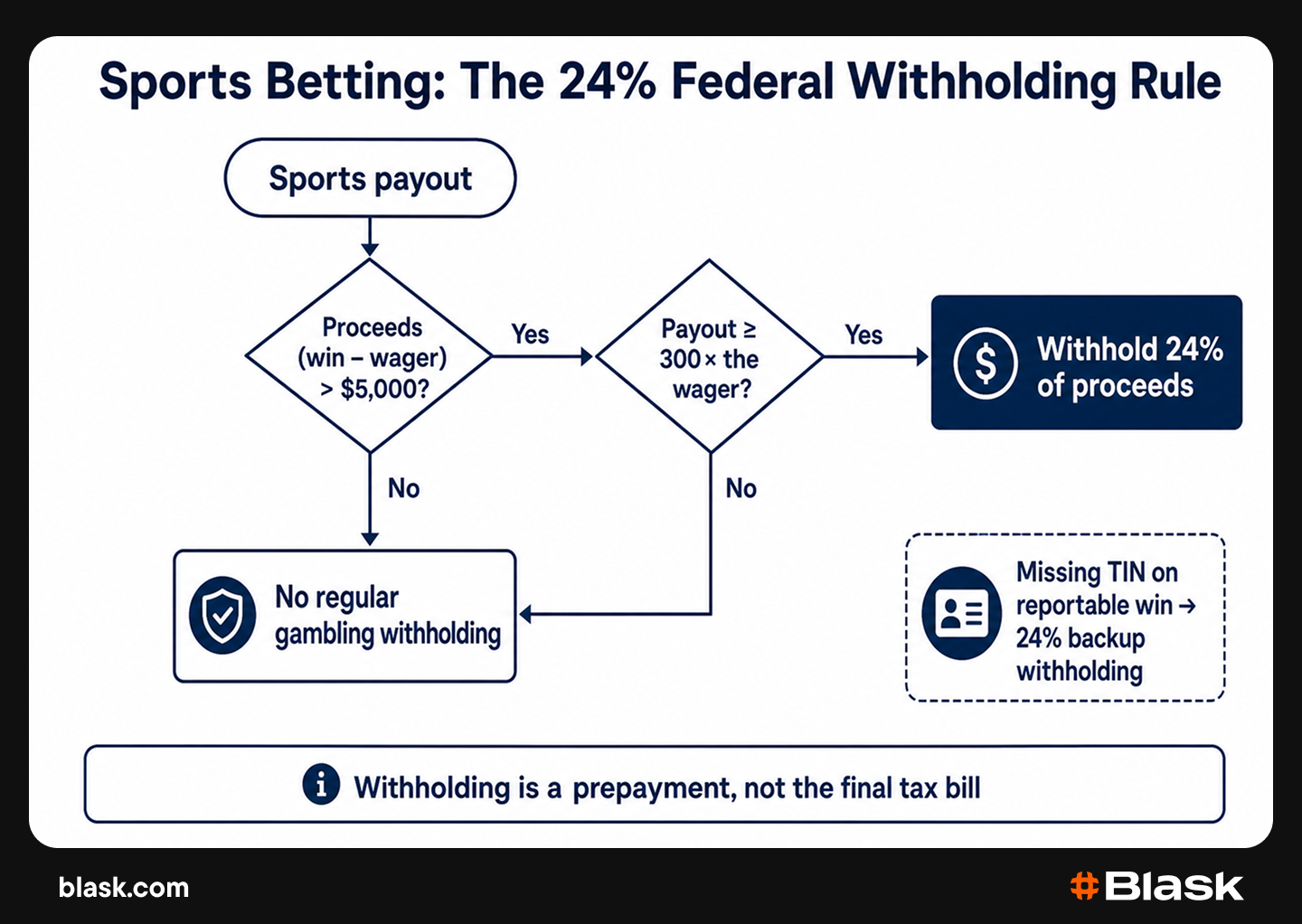
The 24% federal withholding rule: scheme explanation
Withholding is a prepayment, not a final bill. A filer whose marginal rate is below 24% may recover the excess through the annual return; a filer in a higher bracket may still owe more.
| Trigger | Rate | Applies when |
| Regular gambling withholding | 24% of proceeds | Proceeds > $5,000 and ≥300x wager (sports) |
| Backup withholding | 24% | Reportable win, no TIN, not already withheld |
| Noncash certain payments | 31.58% (gross-up method) | Specified noncash gambling payments |
Income bracket rates (10–37%)
For tax year 2026, single filers face these ordinary-income brackets:
| Rate | Single taxable income | Married filing jointly |
| 10% | $0–$12,400 | $0–$24,800 |
| 12% | $12,401–$50,400 | $24,801–$100,800 |
| 22% | $50,401–$105,700 | $100,801–$211,400 |
| 24% | $105,701–$201,775 | $211,401–$403,550 |
| 32% | $201,776–$256,225 | $403,551–$512,450 |
| 35% | $256,226–$640,600 | $512,451–$768,700 |
| 37% | Over $640,600 | Over $768,700 |
A filer’s marginal ordinary rate on gambling income after allowable offsets — not the 24% withholding rate alone — determines the federal bill.
Non-cash prizes and comps
Fair market value of merchandise, trips, and similar prizes is taxable gambling income (Topic 419). Comps that are promotional credits or free play are treated according to their cash-equivalent character.
When FMV is reportable, operators may issue information returns. Noncash payments subject to special withholding use the 31.58% gross-up method in the W-2G instructions.
State taxes on sports betting
State income tax — where it exists — generally follows residence, not the location of the sportsbook app. Residents of high-tax states can owe state tax on out-of-state casino or sportsbook wins even when the wager was placed elsewhere.
States with no income tax
Nine states impose no broad individual income tax, so gambling winnings face federal tax only in those jurisdictions:
| State | State income tax on winnings | Note |
| Alaska, Florida, Nevada | None | No broad income tax |
| South Dakota, Texas, Washington, Wyoming | None | No broad income tax |
| New Hampshire, Tennessee | None on wages/gambling | NH interest/dividend tax phasing out |
Federal withholding and W-2G rules still apply in these states.
States with the highest rates
Top marginal individual rates drive the upper bound of state gambling tax exposure on large wins:
| State | Approx. top marginal rate | Context |
| California | 13.3% | Highest top rate (incl. mental-health surcharge band) |
| Hawaii | 11.0% | High bracket burden |
| New York | 10.9% (+ NYC local) | State plus city for NYC residents |
| New Jersey | 10.75% | High top bracket |
| Oregon | 9.9% | High rate, no sales tax offset |
Some states (e.g. Indiana, Illinois, Ohio, Pennsylvania in common summaries) disallow or limit gambling-loss deductions on the state return even when federal itemizing is available.
Multi-state and out-of-state betting
Residence controls state income tax for most individual gamblers. A New York resident who cashes a ticket in Nevada still reports the win on a New York return. Nonresidents who win in a state with source-based gambling rules may face filing duties in that state and a credit mechanism at home — details vary by statute. Multi-state activity is a frequent audit friction point because W-2G payer addresses do not map cleanly to residency.
What is form W-2G?
| Form W-2G, Certain Gambling Winnings, reports gambling payouts and any federal income tax withheld to the IRS and to the winner (IRS Form W-2G instructions). Copy B goes to the recipient; the payer files with the Service. |
Reporting thresholds in 2026
For calendar years after 2025, the minimum threshold for certain information returns — including Form W-2G — is inflation-adjusted. For payments in the calendar year 2026, that minimum threshold amount is $2,000.
According to sources IRS W-2G instructions; IRB 2026-19.
Sports wagering reporting still requires the win to meet or exceed the applicable reporting threshold and to be at least 300 times the wager
According to the source W-2G instructions §5 Sports Wagering.
Bingo, keno, and slots use the applicable threshold without the 300x multiplier for regular reporting.
| Game type | 2026 reporting gate | 300x wager test |
| Sports wagering | ≥ applicable threshold ($2,000 base) | Required |
| Slots / bingo | ≥ applicable threshold | Not for regular W-2G |
| Keno | ≥ threshold after wager netted | Not for regular W-2G |
| Poker tournament | ≥ threshold net of buy-in | Per tournament rules |
The new $2,000 W-2G rule
The One Big Beautiful Bill Act (Public Law 119-21) raised the statutory section 6041 reporting base to $2,000 for payments after December 31, 2025, with inflation indexing thereafter (IRB 2026-19). Slot reporting that previously keyed off $1,200 (and keno off $1,500) now aligns to the new floor.
This threshold change is sports betting tax news with operational impact: fewer mid-size slot jackpots interrupt play for paperwork, while taxpayers remain obligated to report all gambling income regardless of form issuance.
When you won’t receive a W-2G
No W-2G is issued when a payout:
- sits below the applicable reporting threshold;
- fails the 300x sports test;
- or is structured so the payer’s reporting duty is not triggered.
Parlay tickets at short prices almost never hit 300x. Daily fantasy and certain contest products may use different information returns. The tax obligation does not disappear with the form. A standalone sports betting tax still applies to reportable income even when no information return is mailed.
How to report betting income on your tax return
Form 1040 and Schedule 1
Gambling winnings enter Form 1040 through Schedule 1 (Form 1040) as other income (Topic 419). All winnings — including amounts not on a W-2G — belong on the return. Withheld amounts from box 4 of Form W-2G credit against total tax like wage withholding.
Itemizing on Schedule A
Gambling losses for casual gamblers are claimed only by itemizing on Schedule A, as other itemized deductions, and only with substantiating records (Topic 419; Publication 529). Taking the standard deduction bars the loss claim.
Can you deduct betting losses?
The 90% loss deduction limit (One Big Beautiful Bill Act)
For taxable years beginning after December 31, 2025, 26 U.S.C. § 165(d) limits the deduction for losses from wagering transactions to 90% of such losses, and only to the extent of gains from wagering transactions during the same year. The statute also folds otherwise allowable wagering-related deductions into that loss definition.
| Scenario | Pre-2026 deduction | From 2026 (90% rule) |
| Win $100k / lose $100k | $100k → $0 taxable | $90k → $10k taxable |
| Win $50k / lose $40k | $40k → $10k taxable | $36k → $14k taxable |
| Win $20k / lose $25k | $20k cap → $0 taxable | $18k → $2k taxable |
Illustrative figures follow the worked examples in Womble Bond Dickinson’s OBBBA client alert. Break-even recreational years can still produce taxable “phantom” income.
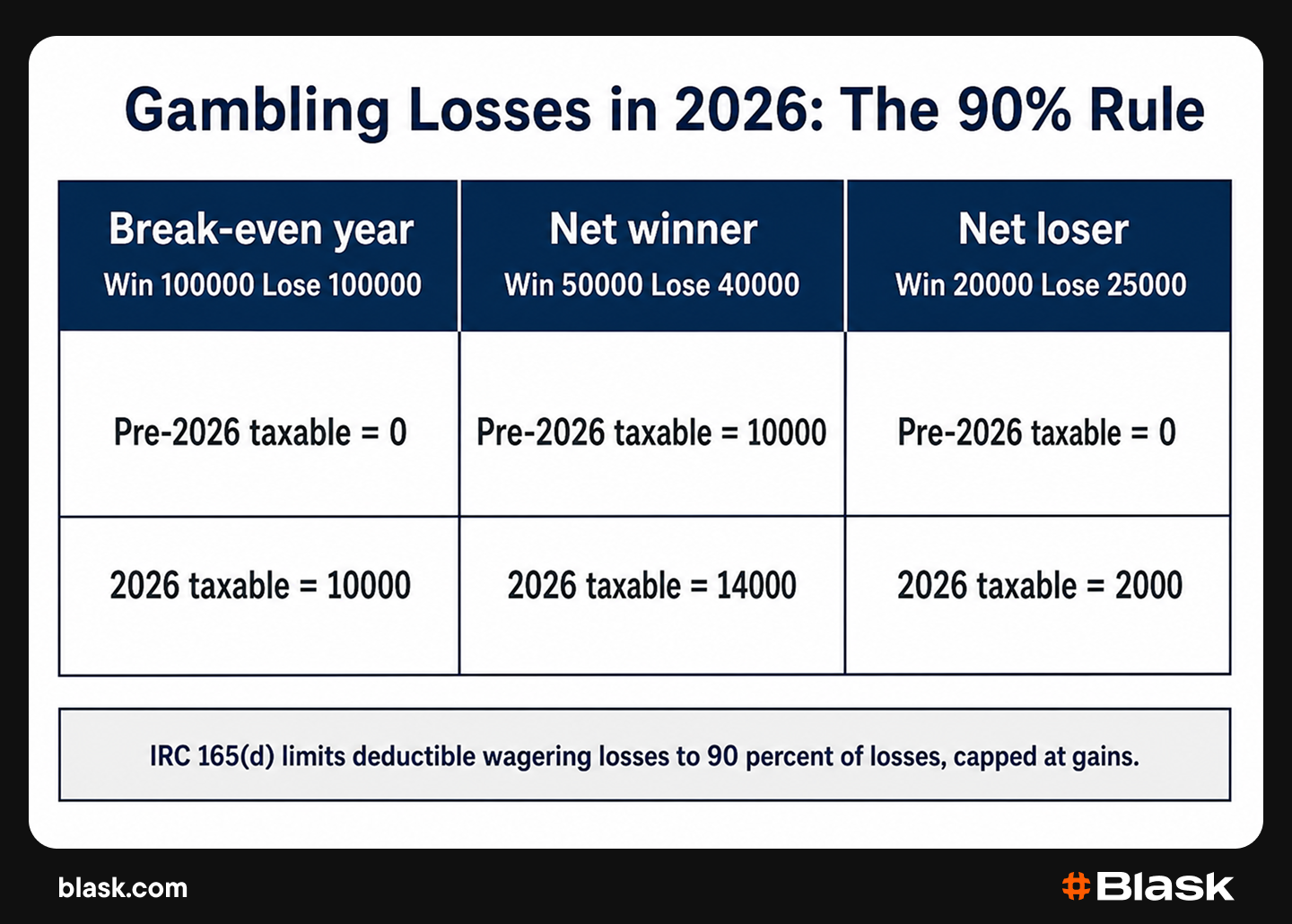
The 90% loss deduction limit: scheme explanation
Standard deduction vs Itemized deduction
For tax year 2026, the standard deduction is $16,100 (single), $32,200 (married filing jointly), and $24,150 (head of household)
According to the IRS TY 2026 adjustments.
Gambling-loss claims require itemizing; if other itemized deductions plus allowable gambling losses do not exceed the standard amount, the economic loss may never appear on the return.
Loss records the IRS expects
Topic 419 and Publication 529 expect an accurate diary or similar record plus receipts, tickets, statements, or other evidence of both wins and losses. Sportsbook annual activity summaries help but rarely replace bet-level logs when examining large claimed losses.
Tracking bets and record-keeping
A defensible log captures:
- date;
- event or game;
- stake;
- odds;
- payout;
- net result;
- account or ticket identifier.
Monthly reconciliation against bank deposits, withdrawal screenshots, and year-end sportsbook tax statements closes gaps before April. A sports betting tax calculator can estimate bracket impact; it does not replace the primary records the IRS cites in Topic 419.
Separate ledgers for each operator reduce confusion when one account issues a W-2G and another does not. Preserve records at least as long as the assessment period for the return — commonly three years, longer when substantial understatement risk exists.
Professional gamblers and Schedule C
Taxpayers in the trade or business of gambling report on Schedule C, with different expense and self-employment considerations than casual Schedule A itemizers. Facts-and-circumstances tests look at regularity, sophistication, time devoted, and profit motive. Professionals still face the § 165(d) wagering-loss framework as amended by OBBBA. Business-expense treatment is not a free pass around the 90% limit where the statute sweeps related deductions into “losses from wagering transactions” (Cornell § 165(d)).
Misclassification — filing Schedule C without a genuine trade — is a documented audit risk. Classification questions belong with a qualified tax professional.
Online sportsbook taxes vs retail sportsbook taxes
For the player, federal income tax treatment of a legal win does not change because the ticket was mobile rather than retail. Withholding and W-2G duties follow the same dollar and odds tests in the 2026 W-2G instructions.
Differences appear on the operator side and in state product taxes: many states tax online sports GGR at higher rates than retail. For example, New Jersey’s online vs retail split in industry rate tables.
According to the sources RG.org state tax table; Bipartisan Policy Center.
Mobile books also concentrate annual statements and downloadable histories, which improves — or exposes — player record-keeping.
Online gambling tax for the individual remains ordinary income tax plus any state income tax. The channel changes paperwork more than the tax character of the win.
How operators pay betting tax (B2B Angle)
Gross Gaming Revenue tax by state
Most states tax sportsbook GGR (handle minus payouts, with promotion add-backs varying by statute). Industry compilations place online GGR rates from about 6.75% (Iowa, Nevada) to 51% (New York online, New Hampshire, Rhode Island)
According to the sources RG.org 2026 rates; BPC issue brief.
| State (online focus) | Approx. GGR / equivalent rate | Model note |
| Nevada, Iowa | 6.75% | Low GGR tax |
| New Jersey | ~19.75% online / 8.5% retail | Channel split |
| Pennsylvania | ~36% (+ local share) | High GGR |
| New York / NH / RI | 51% | Highest online GGR |
| Tennessee | ~1.85% of handle | Handle tax, not GGR |
State-regulated sportsbooks generated $3.71 billion in sportsbook tax revenue in 2025.
Federal excise tax on wagers
Legal sports wagers face a federal excise tax of 0.25% of the amount wagered, plus a $50 annual occupational tax per principal or agent accepting wagers. Unauthorized wagers face 2% of handle and a $500 occupational tax. Operators file Form 730 monthly and Form 11-C for the occupational tax. The AGA notes this federal layer sits outside state gaming-tax totals in State of the States reporting.
Licensing and regulatory fees
Beyond GGR and excise tax, operators pay state licensing fees, renewal charges, responsible-gaming assessments, and sometimes local shares. High combined tax stacks — New York’s 51% online GGR plus federal excise — compress promotional budgets and have driven market exits documented in trade reporting.
International comparison: UK, Canada, Australia
| Country | Recreational player winnings | Where the tax lands |
| United States | Taxable ordinary income | Player + operator (GGR/excise) |
| United Kingdom | Generally not taxed | Operator duties (e.g. Remote Gaming Duty) |
| Canada | Generally not taxed if recreational | Provincial operator / lottery frameworks |
| Australia | Generally not taxed if recreational | Operator and product taxes; ATO may tax a business |
HMRC’s business-income manuals treat ordinary betting and gambling winnings as not chargeable to income tax for most players. Remote Gaming Duty rose from 21% to 40% from 1 April 2026, with a new 25% remote betting rate inside General Betting Duty from 1 April 2027.
Canada and Australia likewise leave casual wins untaxed while reserving power to tax gambling conducted as a business.
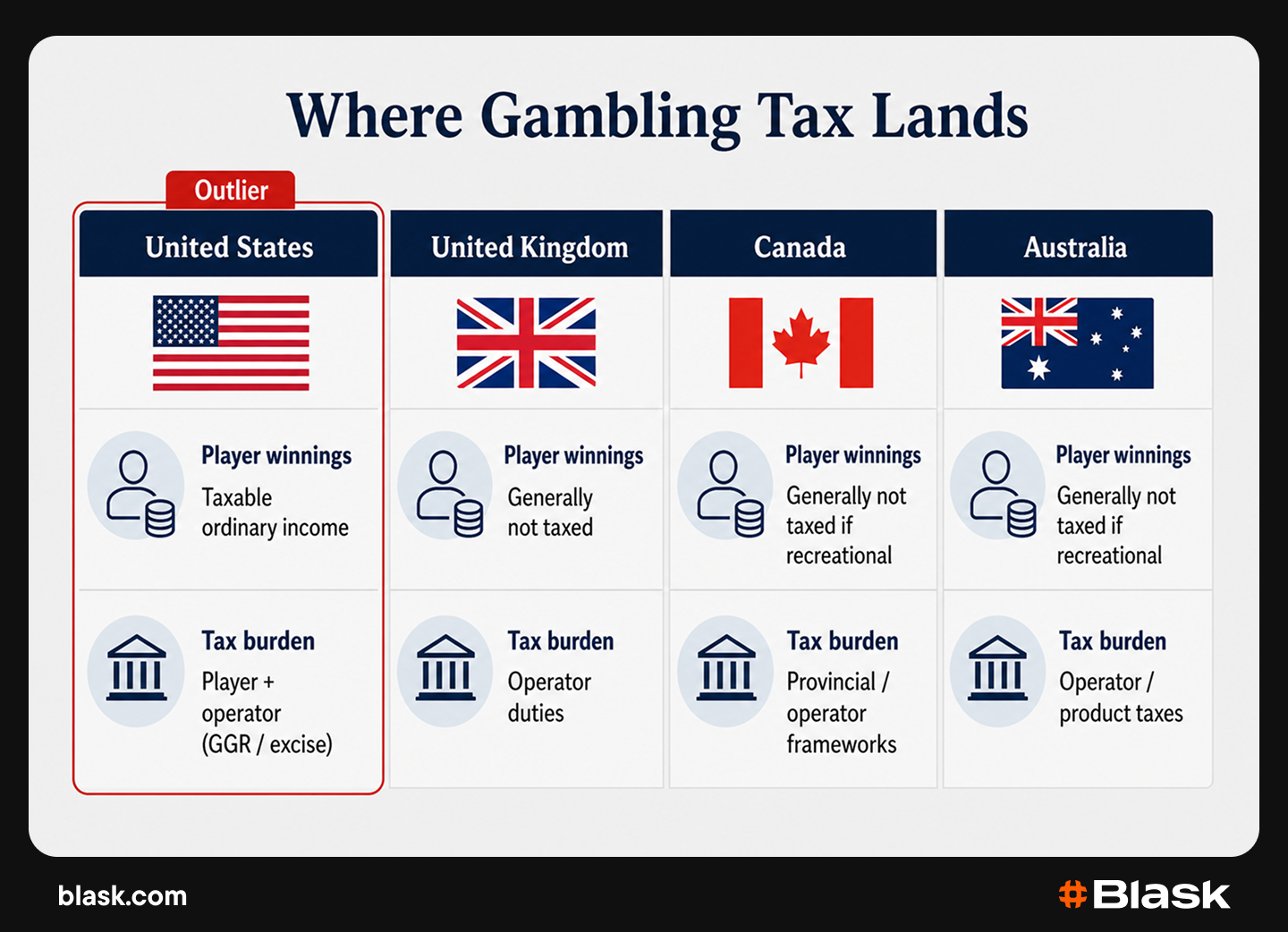
International comparison of taxes. The U.S. model — player income tax plus operator gambling tax and GGR levies — is the outlier among these peer markets.
Common tax filing mistakes to avoid
- Assuming no W-2G means no tax. Topic 419 requires reporting all gambling winnings.
- Ignoring the 90% loss haircut. Break-even years can still create taxable income under § 165(d).
- Claiming losses without itemizing. Standard deduction filers cannot take Schedule A gambling losses.
- Netting on the wrong form. Casual gamblers report wins on Schedule 1 and losses on Schedule A — not a single net figure on one line.
- Discarding losing tickets and app histories. Deductions require contemporaneous records (Pub. 529).
- Treating withholding as the final tax. The 24% withhold is only a deposit against the true bracket rate.
- Omitting non-cash FMV. Prizes and certain comps are income at fair market value.
- State residency errors. High-tax residents owe state tax on wins booked in no-income-tax states.
When to work with a tax professional
Professional help is warranted when annual gambling income is material relative to other income, when multiple states are involved, when Schedule C status is in question, when large W-2G withholding created a refund or balance-due puzzle, or when OBBBA’s 90% limit interacts with thin itemized deductions. Enrolled agents and CPAs who track federal and state wagering rules can map operator statements to Schedule 1, Schedule A, and state returns without relying on informal netting.
The 2026 stack — $2,000 W-2G floor, 24% withholding on large long-odds sports payouts, 10–37% ordinary brackets, and the 90% loss rule — rewards precise books more than any prior post-PASPA season. A compliance process built around daily logs and year-end reconciliations remains the cheapest insurance against underreporting. State brackets compound quickly once they sit on top of federal ordinary income.