
- Updated:
- Published:
Cost per mille (CPM)
Cost per mille (CPM) is the price an advertiser pays for one thousand ad impressions. Mille is Latin for thousand, so the metric is also written as cost per thousand.
The definition is settled. What counts as an impression is not, and that is where two CPM figures for the same placement stop agreeing.
How CPM is calculated
The formula divides spend by delivery and rescales it to a thousand:
CPM = (campaign cost ÷ impressions) × 1 000
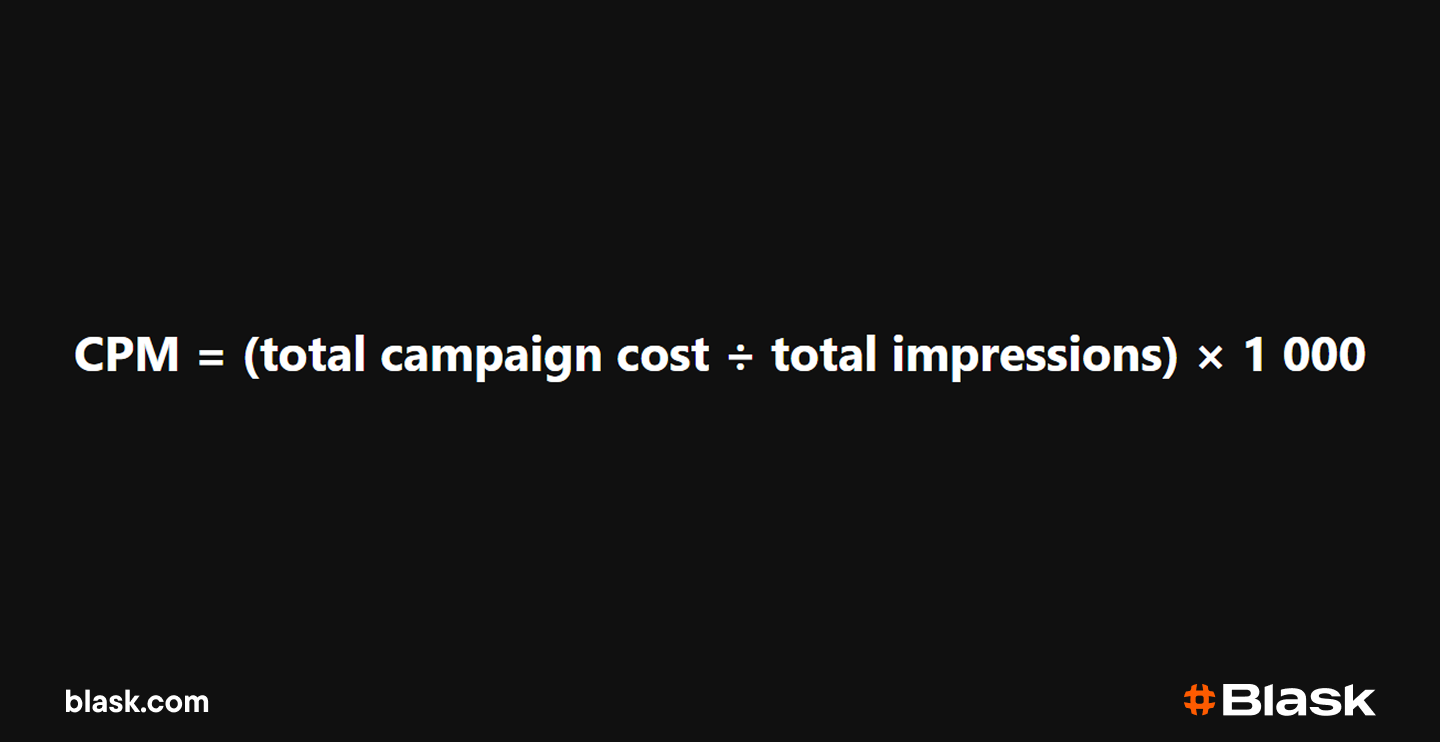
A campaign costing $2 400 that records 800 000 impressions carries a CPM of $3. Read the other way, inventory quoted at $6 CPM delivers 1 million impressions for $6 000.
CPM is a price rather than a performance measure. It records what was paid for exposure and says nothing about whether the ad was seen or acted on.
What counts as an impression
The counting rule sits in the IAB and MRC ad impression measurement guidelines. A served display impression may be counted only after the creative has loaded on the user’s device and has at minimum begun to render — the point at which the file is painted or added to the document object model. Non-essential elements such as separate tracking assets do not count towards that test.
Begin-to-render replaced the older count-on-decision and count-on-download methods — MRC-accredited services had to comply by 31 January 2019 — and moved the count later in the delivery chain, past ad blocking, pre-rendering and latency.
Rendering is a lower bar than being seen. An ad renders whether it sits at the top of the page, four screens below the fold, or in a tab that lost focus while it loaded.
Impressions against viewable impressions
The MRC viewable ad impression guidelines set the threshold that separates the two. A display ad counts as viewable when at least 50% of its pixels are in the viewable space of an in-focus browser tab for a minimum of one continuous second. Large creatives of 242 500 pixels or more are measured at 30% of pixels over the same second. Video requires 50% of pixels in view across two continuous seconds of play, which need not be the opening two seconds.
Viewable CPM prices only the impressions that clear that bar. A vCPM bid in Google Ads is a maximum price for 1 000 viewable impressions measured through Active View, and impressions failing the threshold are not charged.
The distance between the two prices is the viewability rate — viewable impressions divided by measurable impressions. Inventory bought at $2 CPM that runs 40% viewable costs $5 per thousand viewable impressions. Inventory at $4 CPM running 90% viewable costs $4.44. The cheaper line on the invoice is the more expensive one in delivery.
CPM against eCPM, CPC and CPA
Effective CPM inverts the calculation for the sell side: estimated earnings divided by impressions, multiplied by 1 000. Buyers use it to restate a campaign bought on another basis, so a click or acquisition deal can be compared against a CPM line.
Cost per click prices a click, cost per lead prices a qualified enquiry, and cost per acquisition prices a completed action such as a registration or a first deposit. Moving along that sequence shifts delivery risk from the buyer to the seller: on CPM the advertiser carries the risk that exposure produces nothing, on CPA the publisher carries the risk that the traffic fails to convert. Click-through rate bridges the first two, since a CPM restated per click is that CPM divided by the clicks it generated.
Gambling affiliate agreements sit mostly at the far end of that sequence, in CPA, revenue share or hybrid structures, which is why CPM appears in the media-buying budget rather than the affiliate one.
Why a low CPM can still be poor inventory
Programmatic prices span more than an order of magnitude, and the cheapest inventory is cheap for reasons that survive the purchase.
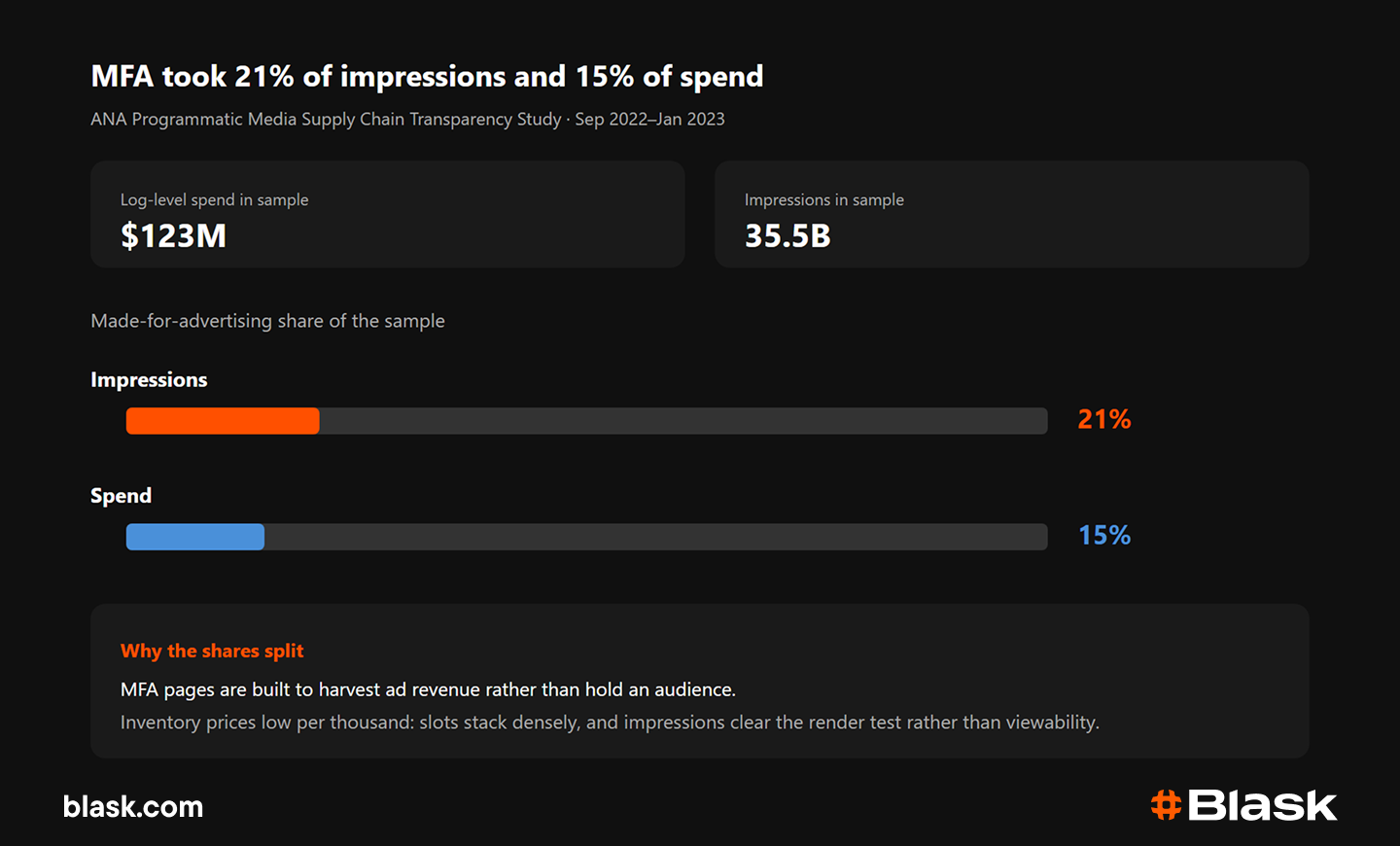
The ANA Programmatic Media Supply Chain Transparency Study analysed log-level data covering $123M of spend and 35.5 billion impressions between September 2022 and January 2023. Made-for-advertising sites — pages built to harvest ad revenue rather than hold an audience — took 21% of impressions in the sample and 15% of spend. The asymmetry is the point: MFA inventory prices low per thousand because the pages stack slots densely and the impressions clear the render test rather than the viewability one.
Invalid traffic and what it does to the number
MRC defines invalid traffic as activity that does not meet quality criteria or does not represent legitimate traffic, and splits it in two. General invalid traffic is caught by routine list-based filtration: known data-centre traffic, declared bots and crawlers, non-browser user agents, pre-fetch and pre-rendered activity. Sophisticated invalid traffic needs advanced analytics and multi-point corroboration — hijacked devices and ad tags, hidden or stacked ad serving, falsified viewability decisions, falsely represented sites, adware and malware. Every accredited measurer must filter GIVT; SIVT detection is accredited separately.
The split matters to a CPM because filtration runs on a different clock from billing. Google Ad Manager treats reported earnings as estimates until month end, when invalid activity adjustments are applied and finalised. A CPM read mid-flight sits on an impression count that has not settled.
CPM in a gambling context
Two conditions change how the metric reads in iGaming.
Advertising rules differ by jurisdiction, so the inventory a licensed operator can legally buy is a different subset of the open market in each country. Narrower supply lifts clearing prices, which weakens CPM as a cross-market comparison: the same figure in two markets can reflect different competitive pressure against different inventory.
Exposure also sits a long way from what gambling operators report. CPM ends at the impression, and the chain from there to a first-time deposit runs through click-through, landing page conversion and verification. Blask Index measures demand at market and brand level from search behaviour, which makes it a separate read from anything priced in a media plan.
FAQ
What does CPM stand for?
CPM stands for cost per mille, or cost per thousand impressions, calculated as total campaign cost divided by total impressions, multiplied by 1 000.
What is the difference between CPM and vCPM?
CPM prices served impressions, counted once the creative loads and begins to render. Viewable CPM prices only impressions that met the MRC viewability threshold — 50% of pixels in view for one continuous second for display, or two continuous seconds of play for video. The ratio between them is the viewability rate.
Is a lower CPM better?
A lower CPM buys cheaper exposure, not cheaper attention. Two placements become comparable on price only once the viewability rate and the invalid-traffic rate are known for both, because a low CPM on inventory that renders but is rarely in view costs more per viewable impression than a higher price on inventory that is.
Bottom line
CPM is arithmetic over an impression count, and the count is the part that moves. Begin-to-render decides what enters the denominator, the viewability threshold decides how much of it was seeable, and invalid-traffic filtration decides how much survives to settlement. A CPM quoted without those three is a price without a unit.