

- Updated:
- Published:
Brazil iGaming offshore market 2026: still $118M a month, 18 months after regulation

In a year and a half since the law took effect, Brazil cut offshore brands’ share of iGaming revenue from 35% to 21%.
But even after licensing 167 brands and blocking more than 25,000 illegal domains, offshore still pulls in $118.3M a month. Factor in prediction markets, and the Brazil online gambling regulation offshore share picture gets considerably more complicated.
What regulation promised: the channelization target
Law 14.790/2023, which took effect on January 1, 2025, aimed to move players from offshore brands to licensed ones. Regulators have treated the Brazil iGaming channelization rate 2026 as the key benchmark for the law’s success. To hit it, authorities are licensing the market, blocking illegal sites through Anatel, restricting their payment infrastructure, and gradually raising the GGR tax from 12% to 15% by 2028.
They dropped plans to raise the rate straight to 18%, worried that too heavy a tax burden would weaken licensed operators and push players back toward offshore brands.
Brazil iGaming licensed vs offshore: the decline comes in three uneven phases
But across all 18 months since Law 14.790/2023 took effect, from January 2025 through June 2026, the decline didn’t move in a straight line — Blask’s monthly data shows three distinct phases:
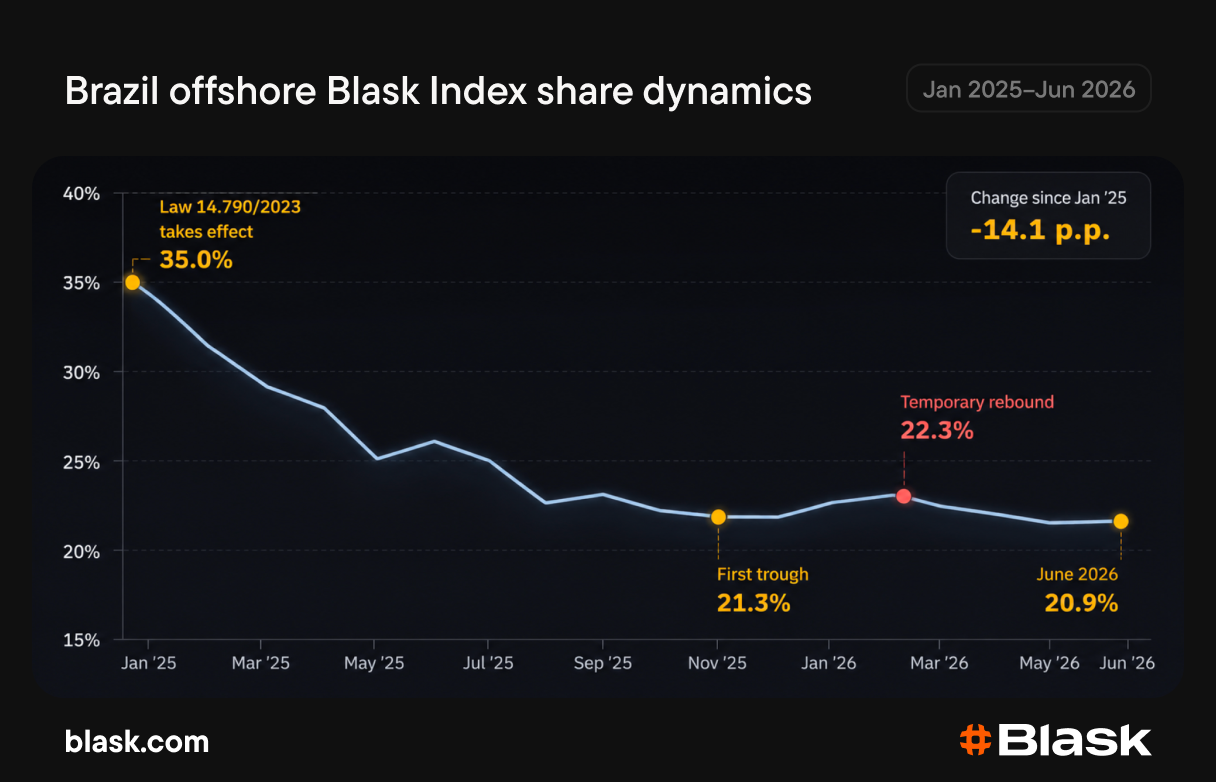
Offshore’s share fell fastest right after launch, dropping to 24.4% of CEB by May 2025 from 35% in January. The decline then slowed, bottoming out in the low 20s before a brief rebound in early 2026 and a further dip by June — three distinct phases visible on the chart below.
Comparing first halves confirms the overall trend. In H1 2025, offshore brands controlled 28.7% of Brazil’s CEB; in H1 2026, their share dropped to 21.5% — down 7.2 percentage points. Over the same period, onshore CEB grew 16% year over year, while offshore CEB fell 21%.
The shift shows up in demand too — offshore brands’ share of Blask Index fell from 6.1% in H1 2025 to 4.3% in H1 2026. Yet in CEB, offshore still held 21.5% of the market. The gap between offshore and onshore CEB is wide, though the numbers alone don’t explain why.
That gap is a more direct measure of channelization than the domain-blocking count. The spread between onshore and offshore CEB share widened by 14 percentage points since regulation started, and Brazil’s three largest brands by BAP — Betano, Bet365, and Superbet — operate under license. Blask covers how the competitive landscape shifted after regulation launched in a separate piece: the top 10 by BAP is now entirely licensed brands, and the number of offshore brands in the top 100 nearly halved, from 29 to 14.
Still, offshore hasn’t disappeared: 18 months after regulation launched, it still holds around 21% of market CEB.
Why offshore still matters in Brazil: three structural reasons
The slowdown in offshore’s decline isn’t random — several structural constraints continue to shape the market.
Tax pressure: even a gradual GGR tax hike from 12% to 15% raises costs for licensed operators and narrows the margin gap with offshore brands. But the available data can’t confirm this measure’s direct effect on odds, bonuses, or players switching to offshore.
Blocks can’t keep up with mirror sites. Brazil Anatel gambling blocks have expanded fast: the regulator increased the number of blocked illegal domains from 15,463 by mid-June 2025 to more than 25K by December and issued orders to 17K telecom providers. Even so, operators launch new mirror sites quickly, so the regulator is pursuing blocks at the DNS, CDN, and broader infrastructure level rather than targeting individual domains alone — a sign that illegal betting Brazil 2026 enforcement still has ground to cover.
Prediction markets stayed a blind spot. On April 24, 2026, Brazilian authorities blocked 27 platforms, including Polymarket and Kalshi, classifying them as bet-like products. In the first quarter, they drew 2.18M visits from Brazil, of which 1.46M went to Polymarket.
These platforms weren’t part of Blask’s Brazil brand base, so their demand wasn’t counted when assessing channelization. The block landed six weeks before the World Cup, when betting interest spiked: on June 13, Blask Index jumped more than 50% day over day, and the share of Brazilians sending money to bookmakers rose from 11% to 34.8%. Prediction markets missed that surge entirely.
Bottom line
Channelization in Brazil is working, but the process is far from finished. Licensed brands captured nearly all the market’s growth, offshore lost share in both Blask Index and CEB, and the country’s biggest brands now operate under license.
But the block count doesn’t tell the whole story. Offshore operators launch mirror domains fast, and new categories like prediction markets can sit outside monitoring until the regulator steps in.
So how much of Brazil iGaming is still offshore 2026? Roughly one in five CEB dollars, eighteen months after regulation launched. That leaves the harder question open: does Brazil regulation reduce illegal gambling, or does it just push it into new corners? Brazil is moving toward a licensed market, but the gap isn’t closed yet.
The Brazil regulated gambling market offshore share Blask numbers are tracked in real time at blask.com/market/brazil
FAQ
What is Brazil’s offshore iGaming channelization rate in 2026?
By June 2026, offshore brands held about 21% of Brazil’s iGaming CEB, down from 35% in January 2025. Onshore CEB grew 16% year over year during that period, while offshore CEB fell 21%, narrowing but not closing the gap.
How much money does offshore gambling generate in Brazil each month?
Offshore operators generated approximately $118.3M in CEB per month as of mid-2026, even after Brazil licensed 167 brands and blocked more than 25,000 illegal domains since Law 14.790/2023 took effect in January 2025.
Why does offshore iGaming still operate in Brazil despite regulation?
Offshore brands persist because of rising GGR taxes on licensed operators, mirror sites that outpace domain blocking, and new categories like prediction markets that sit outside current monitoring, according to Blask’s market data.
Are prediction markets like Polymarket included in Brazil’s offshore iGaming numbers?
No. Polymarket and Kalshi were blocked in Brazil on April 24, 2026, and were never part of Blask’s tracked brand base, so the roughly 2.18M visits they drew in Q1 2026 are not counted in the channelization figures.