
- Updated:
- Published:
What is bonus abuse
Bonus abuse is the use of casino or sportsbook promotions in ways the bonus terms prohibit. This guide covers how it works, the most common types, how it differs from bonus hunting, and how operators detect and prevent it.
Every welcome offer is a calculated loss. The operator gives away value up front and expects a share of new players to stay, deposit again and become profitable customers. Bonus abuse breaks that calculation. Some accounts claim the offer, extract its value and leave, often through methods the terms forbid, such as opening several accounts or coordinating play with other people.
For players, the topic matters because operators can void bonuses and winnings when they find a breach. For operators, it decides whether promotions bring in customers or pay for people who never intended to stay.
What Is Bonus Abuse?
Bonus abuse is a breach of the terms attached to a promotion in order to extract more value than the offer allows. The most common example is one person opening several accounts to claim a welcome bonus that is limited to one per player. Experian defines it more broadly as “the exploitation of bonuses and promotions offered by online gambling operators,” and notes that the term overlaps with promo abuse and bonus hunting.
The useful distinction is between breaking the terms and using them well. A player who reads the rules, picks eligible games and meets the wagering requirement within the published limits is using the offer as designed. That is true even if the operator would prefer the player to lose more along the way. Abuse starts when the player does something the terms prohibit: duplicate accounts, false identity details, coordinated play or bets that the rules exclude.
Bonus abuse is also called bonus fraud or promo abuse. In practice, “bonus fraud” is usually reserved for cases that involve false identities, stolen payment details or organised groups.
How Does Bonus Abuse Work?
Take a simple welcome offer: a 100% match on a first deposit of up to $100, with a wagering requirement of 10x the bonus. A genuine new player deposits $100, receives $100 in bonus funds and must place $1,000 in eligible bets before the bonus converts into withdrawable cash. The operator pays for that bonus with the expectation that some of these players will stay.
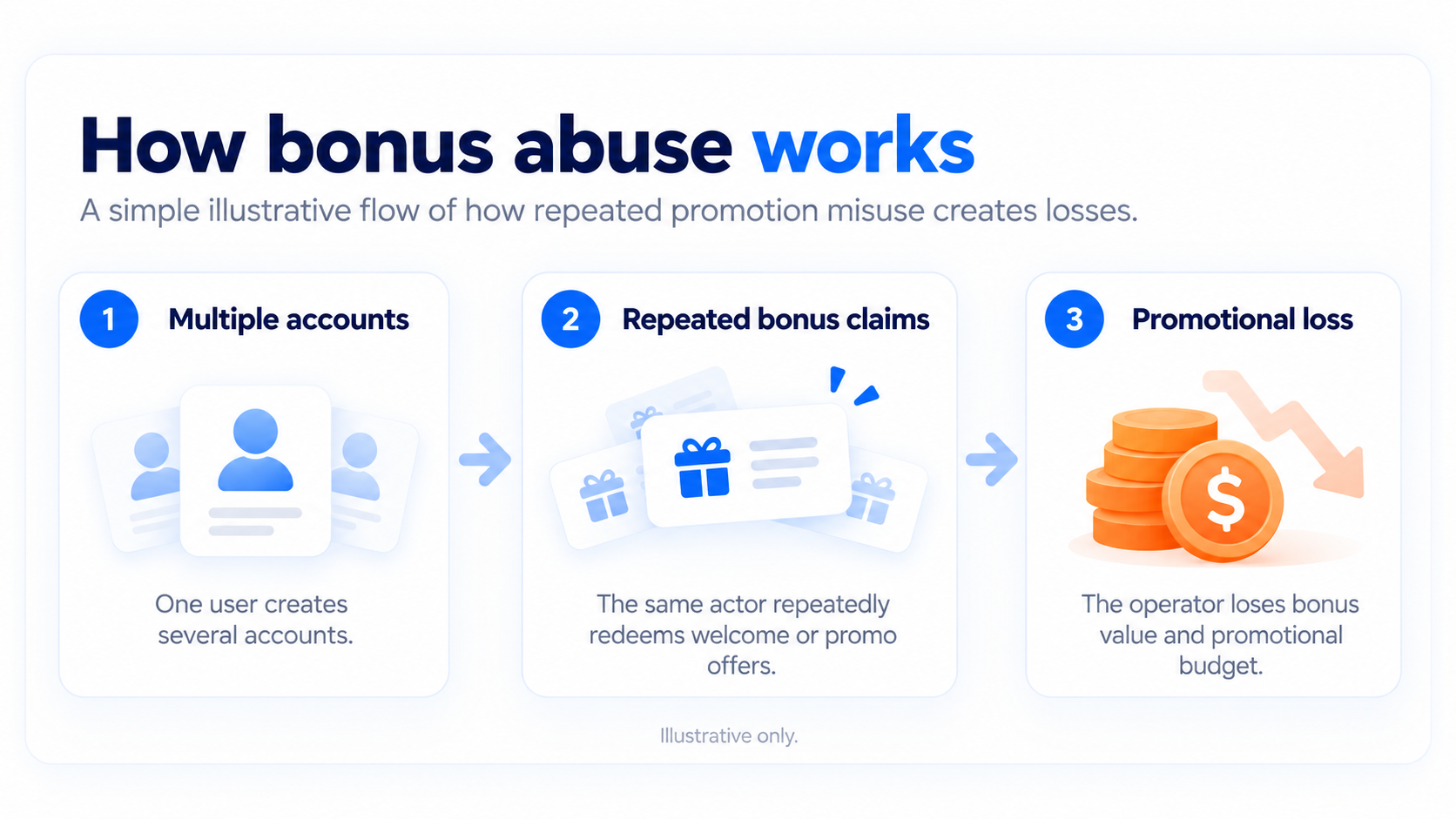
The abuse version follows the same steps across many accounts. One person, or one group, registers several accounts with different names, emails or payment methods. Each account claims the welcome bonus, meets the wagering requirement as cheaply as possible, withdraws and stops playing. The operator records several new customers and several bonus costs, but no lasting revenue.
The loss is not limited to the bonus. The operator may also have paid an affiliate commission or a cost per acquisition (CPA) for each of those accounts, and spent money on verification and payments.
Common Types of Bonus Abuse
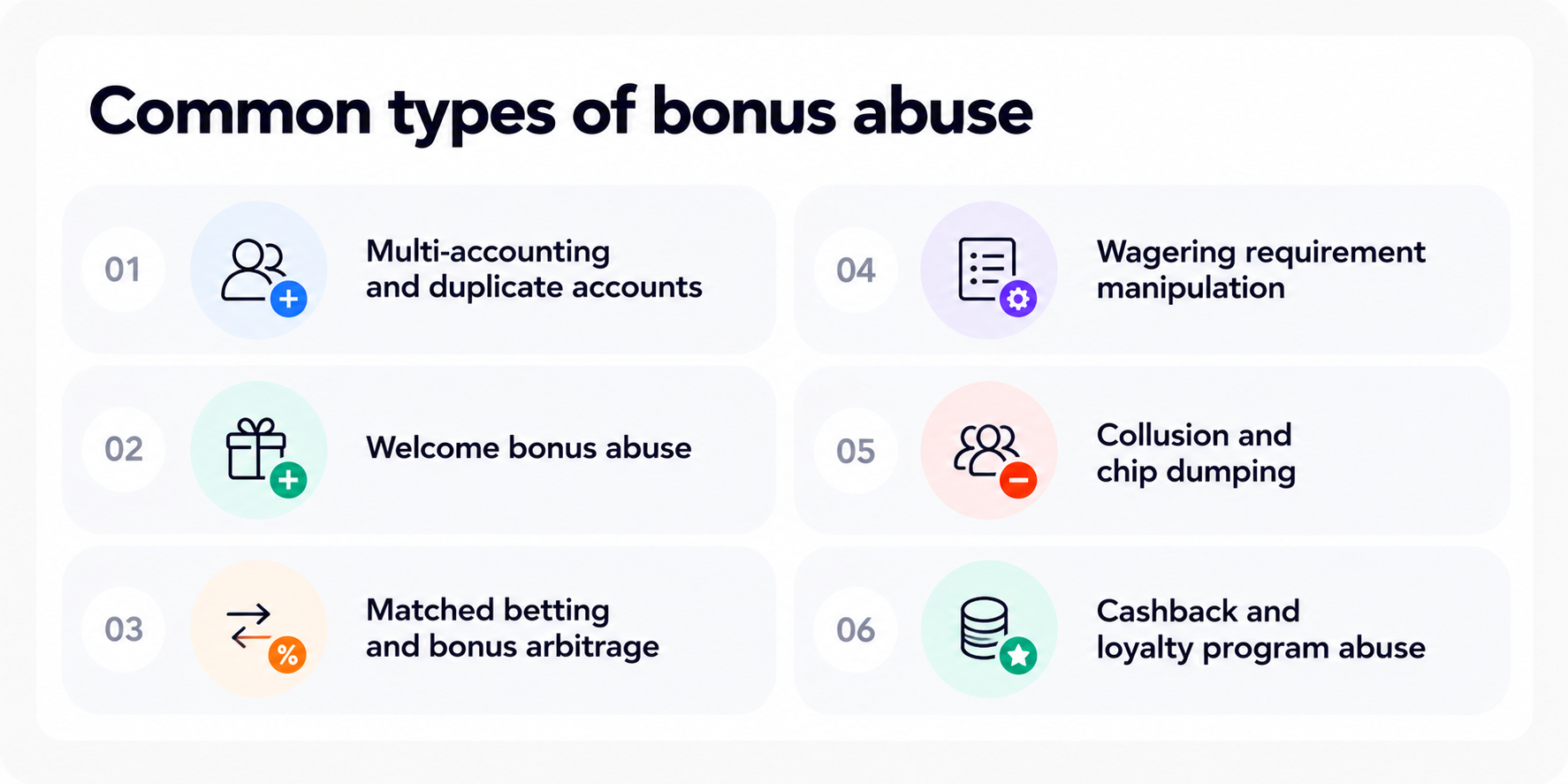
Bonus abuse takes several forms. Some involve one player, others involve organised groups running dozens or hundreds of accounts.
Multi-Accounting and Duplicate Accounts
Multi-accounting means one person controls more than one account at the same operator. Almost all bonus terms limit offers to one per person, household, device or payment method, so a second account exists only to claim the same promotion again. Experian lists it first among bonus abuse types and notes that it breaks most platforms’ terms of service.
Organised versions use different identities for each account. When those identities are stolen or invented, the case moves from a terms breach to identity fraud.
Welcome Bonus Abuse
Welcome offers are the most generous promotions an operator runs, so they attract the most abuse. Typical patterns are signing up only to clear the bonus and leave, or registering again after closing an account to qualify as “new.” The deposit bonus, free spins and the sportsbook free bet are the usual targets.
Matched Betting and Bonus Arbitrage
Matched betting uses a free bet or risk-free bet at one bookmaker and an opposite bet elsewhere, often on a betting exchange, to lock in most of the promotion’s value whatever the result. Arbitrage betting does the same with ordinary price differences between bookmakers.
Neither is illegal in most markets, and neither breaks the terms by default. Operators can still restrict these customers, cut their stake limits or exclude them from future offers, because most terms give the operator discretion over who receives promotions.
Wagering Requirement Manipulation
Wagering requirement manipulation means meeting the playthrough without the risk the operator priced in. Examples include betting above the maximum stake allowed while a bonus is active, playing games the terms exclude, or placing offsetting bets that cancel each other out. Game contribution tables, maximum bet rules and excluded game lists exist to close these routes.
📚 Read more: Wagering requirement
Collusion and Chip Dumping
Collusion is coordinated play between accounts that are supposed to compete. In poker, chip dumping means one player deliberately loses to another to move chips, including bonus-funded chips, into an account that can withdraw them. Experian notes that chip dumping can also be used for money laundering, which brings it under AML monitoring as well as bonus rules.
Cashback and Loyalty Program Abuse
Cashback and loyalty programs reward volume, so abuse here focuses on producing volume cheaply. Examples include deposit and withdrawal loops that trigger a reload bonus with little real play, low-risk betting that collects loyalty points, and linked accounts that pool rewards. These patterns build up over months rather than in one registration, which makes them harder to see than welcome bonus abuse.
Bonus Abuse vs Bonus Hunting: What’s the Difference?
Bonus hunting means signing up with several operators to take advantage of their offers. A bonus hunter may hold one account at each of ten casinos, claim each welcome bonus, meet the wagering requirements with low-risk play and withdraw. Each step can be within the terms.
Bonus abuse breaks the terms. The same person holding two accounts at one casino to claim the welcome bonus twice is abusing it. So is a bonus hunter who breaks the maximum stake rule while wagering.
💡 Key point: The practical test is the terms, not the player’s motive.
An operator can dislike low-value bonus hunters, limit them or stop offering them promotions. Confiscating winnings, however, needs a clear breach of a published term. In the UK, the Competition and Markets Authority said in 2018 that operators “cannot rely on vague terms to confiscate players’ money” and must make gameplay restrictions clear.
| Allowed optimization | Violation of bonus terms |
|---|---|
| One account per operator | Several accounts at the same operator |
| Choosing eligible games with good odds | Playing games the terms exclude |
| Meeting wagering within stake limits | Exceeding the maximum bet while a bonus is active |
| Claiming offers at several brands | Using false or borrowed identity details |
| Withdrawing after wagering is complete | Coordinating play with other accounts |
Bonus hunting uses offers within the rules. Bonus abuse starts where the bonus terms are broken.
How Bonus Abuse Affects iGaming Operators
Bonus Costs and Promotional ROI
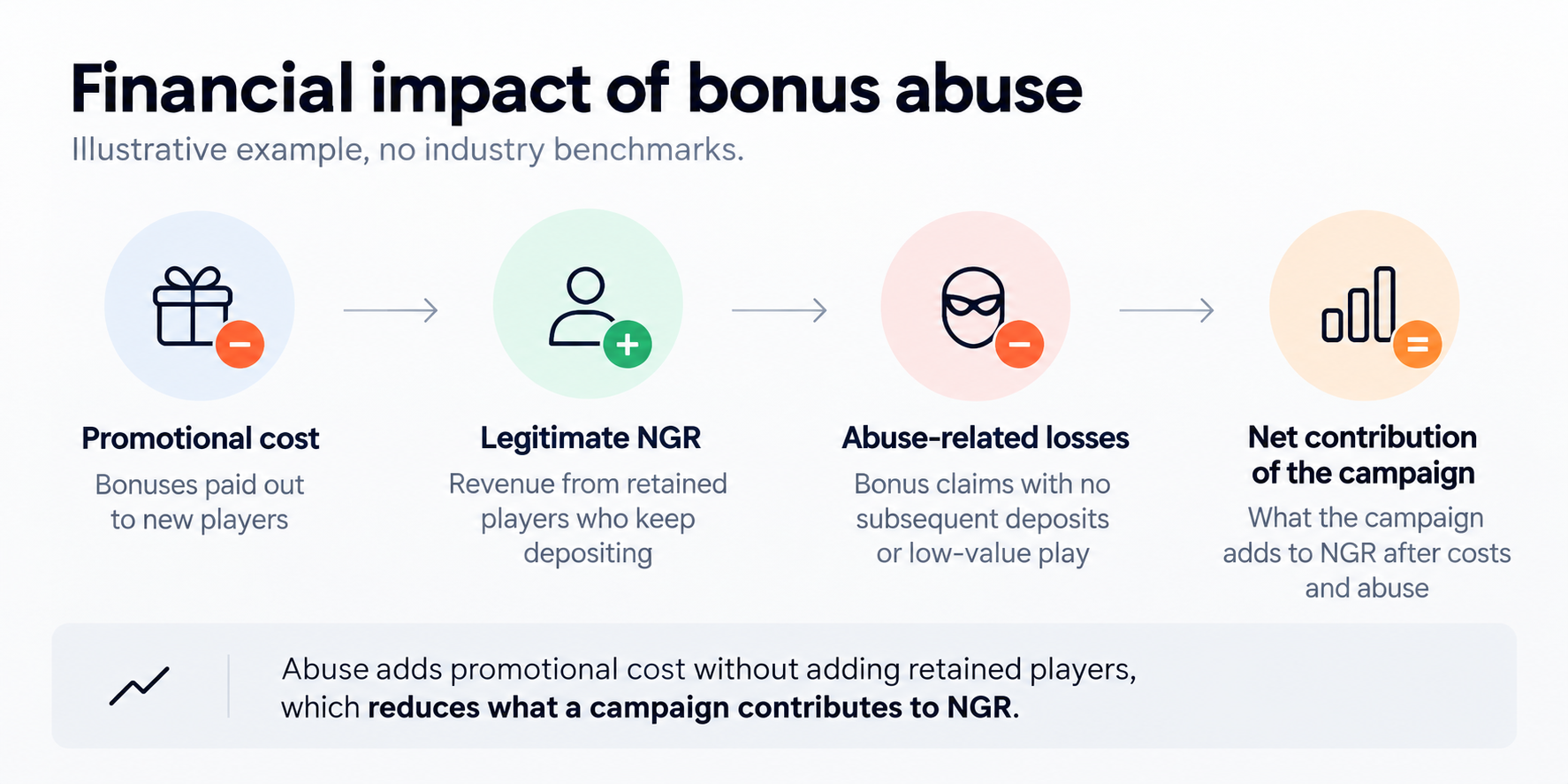
A bonus is marketing spend. Its return depends on how many players who claim it keep depositing after the offer ends. Abuse adds claims with no later deposits, so the cost per retained player goes up even if the number of sign-ups looks healthy.
Impact on GGR and NGR
Bonus funds sit between two revenue lines. Gross gaming revenue (GGR) is stakes minus winnings. Net gaming revenue (NGR) is GGR minus bonuses and other deductions such as taxes. Abuse raises bonus costs without adding the play that would lift GGR, so the gap between GGR and NGR widens.
Acquisition Quality and Player LTV
Abuse inflates first-time deposit counts. A campaign can look like it acquired 1,000 new players when a share of them were the same few people. Measured lifetime value (LTV) for that cohort drops, and the marketing team may keep paying for a channel or affiliate that sends low-value traffic.
Fraud, Compliance and Reputation Risks
Bonus abuse often overlaps with other risks. Stolen identities, shared payment cards and fast deposit-withdrawal loops are also signals of payment fraud, chargebacks and money laundering. Heavy-handed enforcement creates a second risk: legitimate players who get blocked or lose winnings complain publicly and to regulators.
📚 Read more: Antifraud in iGaming: threats, controls, and data
How to Detect Bonus Abuse
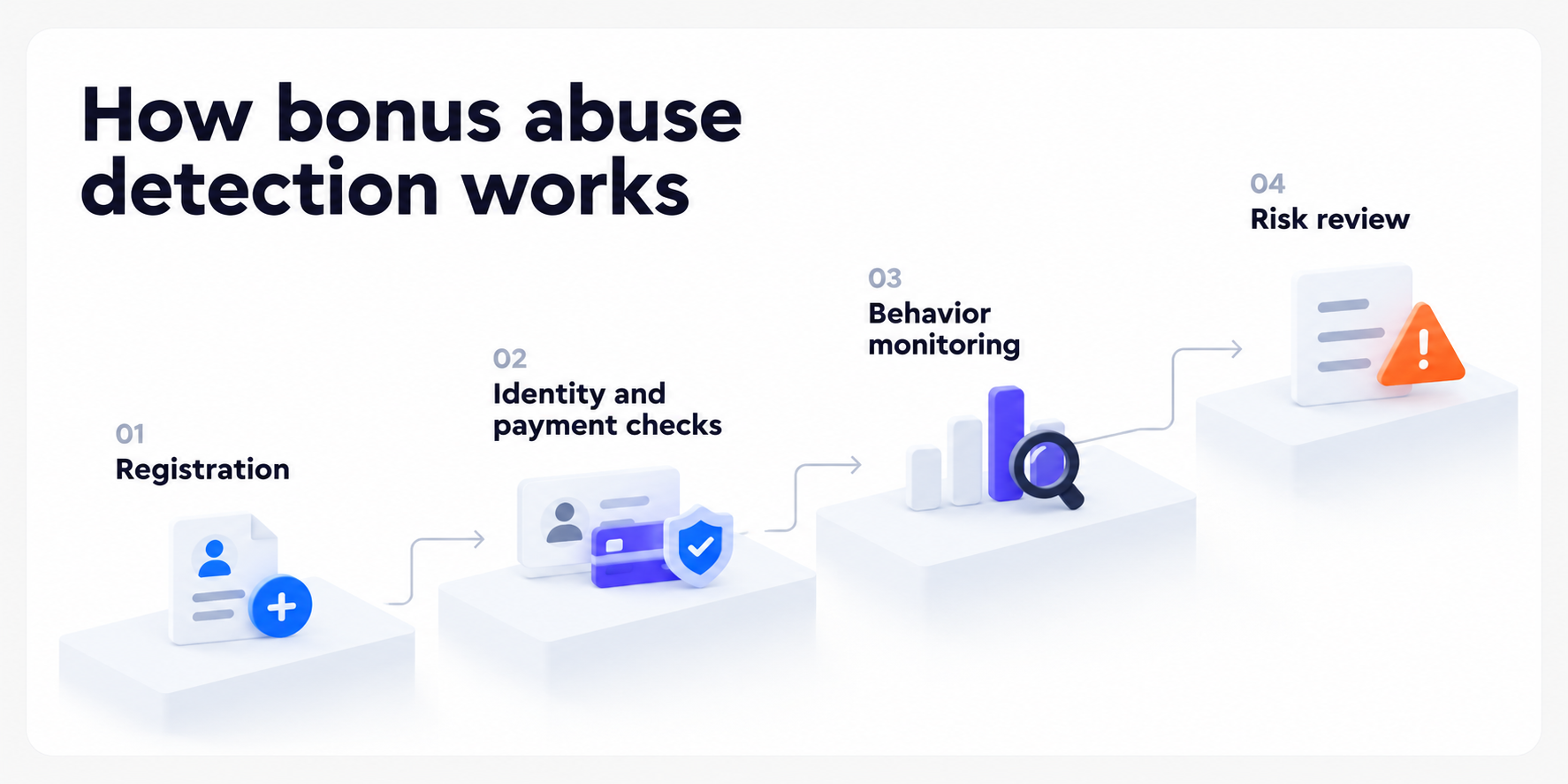
Detection looks for patterns that connect accounts or show play designed only to clear a bonus. No single signal proves abuse. Shared Wi-Fi, a family payment card or a VPN can all have innocent explanations, so mature programmes combine signals and send uncertain cases to a person.
Behavioral and Transactional Signals
Common red flags include accounts that deposit, meet the wagering requirement with minimum risk and withdraw straight away, very similar betting patterns across accounts, and play that stops as soon as the bonus is cleared. Experian also lists rapid sign-ups and cash-outs and unusual play patterns among the signals operators watch.
Device Fingerprinting and Multi-Account Detection
Device fingerprinting builds an identifier from browser and hardware attributes, so the operator can link accounts that use the same device even after cookies are cleared. Experian cites multiple accounts from one IP address, rapid IP changes and multiple devices used in a short period as typical warning signs.
Payment and Identity Verification
Payment data is often the clearest link between accounts. Several accounts depositing from or withdrawing to the same card, e-wallet or bank account rarely happens by chance. KYC checks compare identity documents and personal details with existing customers.
AI and Fraud Detection Software
Rule-based systems flag single triggers and treat every player the same. Newer tools build risk scores from behaviour over time and compare each player with their own history. An iGaming Business feature on the topic describes this shift from static rules to behavioural profiling, which lets low-risk players move through without extra checks.
Bonus abuse detection tools fall into a few groups. Identity verification providers check documents and personal data. Device intelligence tools fingerprint devices and flag VPNs, proxies and emulators. Payment risk tools link accounts through cards and wallets. Many casino platforms and player account management systems now include bonus risk scoring as a built-in module.
When comparing detection software, operators usually look at three things: how well the tool links accounts across signals, how many genuine players it flags by mistake, and whether its decisions can be explained to a regulator or to the player who complains.
How to Prevent Bonus Abuse
💡 Key point: Detection catches abuse after it starts. Prevention makes it less profitable to try.
Clear Bonus Terms and Wagering Requirements
Clear terms prevent abuse and protect the operator when it enforces them. Every restriction that will be enforced should be visible before the player opts in: wagering multiple, eligible games, maximum stake, time limit and maximum withdrawal. The UK Gambling Commission’s guidance on fair and transparent terms expects operators to be able to show that their terms are fair and transparent.
KYC and Account Verification
Verifying identity before a bonus can be withdrawn stops most duplicate accounts. The trade-off is friction: long verification at sign-up loses genuine customers. Many operators therefore run light checks at registration and full checks before the first withdrawal or when risk signals appear.
Bonus Eligibility and Risk Controls
Operators can limit who receives an offer instead of limiting the offer for everyone. Common controls include one bonus per person, household, device and payment method, excluding certain payment methods from bonus eligibility, and holding back offers from accounts that show risk signals.
Fraud Monitoring and Manual Reviews
Automated scoring decides which cases need attention. People decide the outcome. A graduated response works best: request more verification at medium risk, and remove the bonus or close accounts only when the evidence is strong and the breach is clear.
Common Mistakes in Bonus Fraud Prevention
- Blocking on one signal. A shared IP or a VPN alone is weak evidence. Acting on it blocks genuine players.
- Vague terms. A clause like “we may void any bonus we consider abusive” is hard to enforce and may be found unfair.
- Launching offers without a risk review. Marketing and fraud teams should review bonus mechanics together before launch.
- Checking only at sign-up. Loyalty and cashback abuse builds up over months.
- Measuring sign-ups instead of retained players. A campaign that doubles registrations can still lose money.
- Ignoring affiliate patterns. Clusters of linked accounts from one traffic source point to a source problem, not just a player problem.
Bonus Abuse in Online Casinos vs Sportsbooks
Casino abuse centres on wagering requirements. Players look for games with high RTP and full contribution to wagering, or exceed stake limits to clear the bonus faster. Operators respond with contribution tables and lists of excluded games.
Sportsbook abuse centres on free bets and odds. Matched betting and arbitrage can extract most of a free bet’s value at low risk, and multi-accounting is used to claim the same free bet several times. Sportsbooks respond with minimum odds requirements, stake limits and restrictions on customers who consistently take value from promotions.
Poker and peer-to-peer products carry a third risk: collusion and chip dumping between accounts.
Legal and Regulatory Considerations
Is bonus abuse illegal? Usually not in itself. Multi-accounting or matched betting typically breaches the operator’s terms, not criminal law. It becomes a legal matter when it involves fraud, such as false or stolen identities, payment fraud or money laundering.
What can operators do? Within their terms, operators can remove bonuses, void bonus winnings, restrict or close accounts and exclude players from promotions. Regulators limit how far they can go. In the UK, the Competition and Markets Authority secured undertakings from several operators in 2018 under which they agreed not to rely on vague terms to confiscate players’ money. The Gambling Commission later required the rest of the sector to follow the same standards.
Bonus rules themselves are also tightening. The UK Gambling Commission capped wagering requirements at 10x and banned promotions that require players to use more than one type of gambling product, with the changes taking effect in 2026. Lower wagering requirements change the abuse calculation: a bonus becomes easier to clear, so eligibility controls matter more than playthrough rules.
Rules differ by market. Operators should check how their licensing authority treats bonus terms, confiscation and complaints.
How to Measure Bonus Abuse and Promotional Efficiency
Operators track bonus performance with a small set of metrics:
- Bonus cost as a share of GGR: how much of gross revenue goes back to players as promotions.
- Post-bonus retention: the share of bonus claimers who deposit again after the offer ends.
- Bonus-to-withdrawal rate: how many accounts withdraw immediately after clearing the wagering requirement.
- Linked-account rate: the share of new accounts connected to existing ones by device, payment or identity.
- False positive rate: how many flagged accounts turn out to be genuine after review.
- Cohort LTV by campaign and affiliate: whether a source brings players who stay.
Internal data shows what happens after sign-up. Market data shows what happens before it. Blask Index is a real-time measure of market demand volume for iGaming brands in a given country, based on normalized search data. Comparing a brand’s demand with its first-time deposit numbers helps a team see whether a spike in sign-ups follows real interest in the brand or follows the promotion alone. Blask’s Acquisition Power Score (APS) adds a market-level view of how brands attract new players.
Frequently Asked Questions About Bonus Abuse
What is bonus abuse in gambling?
Bonus abuse is the use of casino or sportsbook promotions in ways the bonus terms prohibit, such as claiming a welcome bonus with several accounts or coordinating play between accounts to extract bonus value.
Is bonus abuse illegal?
In most cases it breaches the operator’s terms, not the law. It becomes illegal when it involves fraud, such as using stolen identities or payment details, or money laundering.
Is bonus hunting the same as bonus abuse?
No. Bonus hunting means claiming offers at different operators within their terms. Bonus abuse means breaking the terms, for example by opening several accounts at one operator.
How do casinos detect bonus abuse?
Casinos combine device fingerprinting, payment and identity checks, and behavioural monitoring. Linked devices, shared payment methods and play that stops once the bonus is cleared are common signals. Uncertain cases go to manual review.
Can a casino confiscate winnings for bonus abuse?
A casino can void bonus funds and bonus winnings if a player clearly breaks a published term. In the UK, regulators have said operators cannot rely on vague terms to confiscate players’ money. A player’s own deposit is treated differently from bonus funds.
What is multi-accounting in iGaming?
Multi-accounting is one person controlling more than one account at the same operator, usually to claim a one-per-player bonus more than once. Almost all operators prohibit it in their terms.
How can operators prevent bonus abuse?
By writing clear terms, verifying identity before withdrawals, limiting offers to one per person, device and payment method, monitoring behaviour throughout the player lifecycle, and reviewing borderline cases manually before acting.

“`