- Updated:
- Published:
Bet365 still leads Spain. August already looks different

Spain is a licensed, football-timed market that no longer grows by adding brands. The 2026 fight is inside the top ten: Bet365 still owns the eight-month BAP print, and it no longer owns the summer months.
A European mid-tier that barely moved
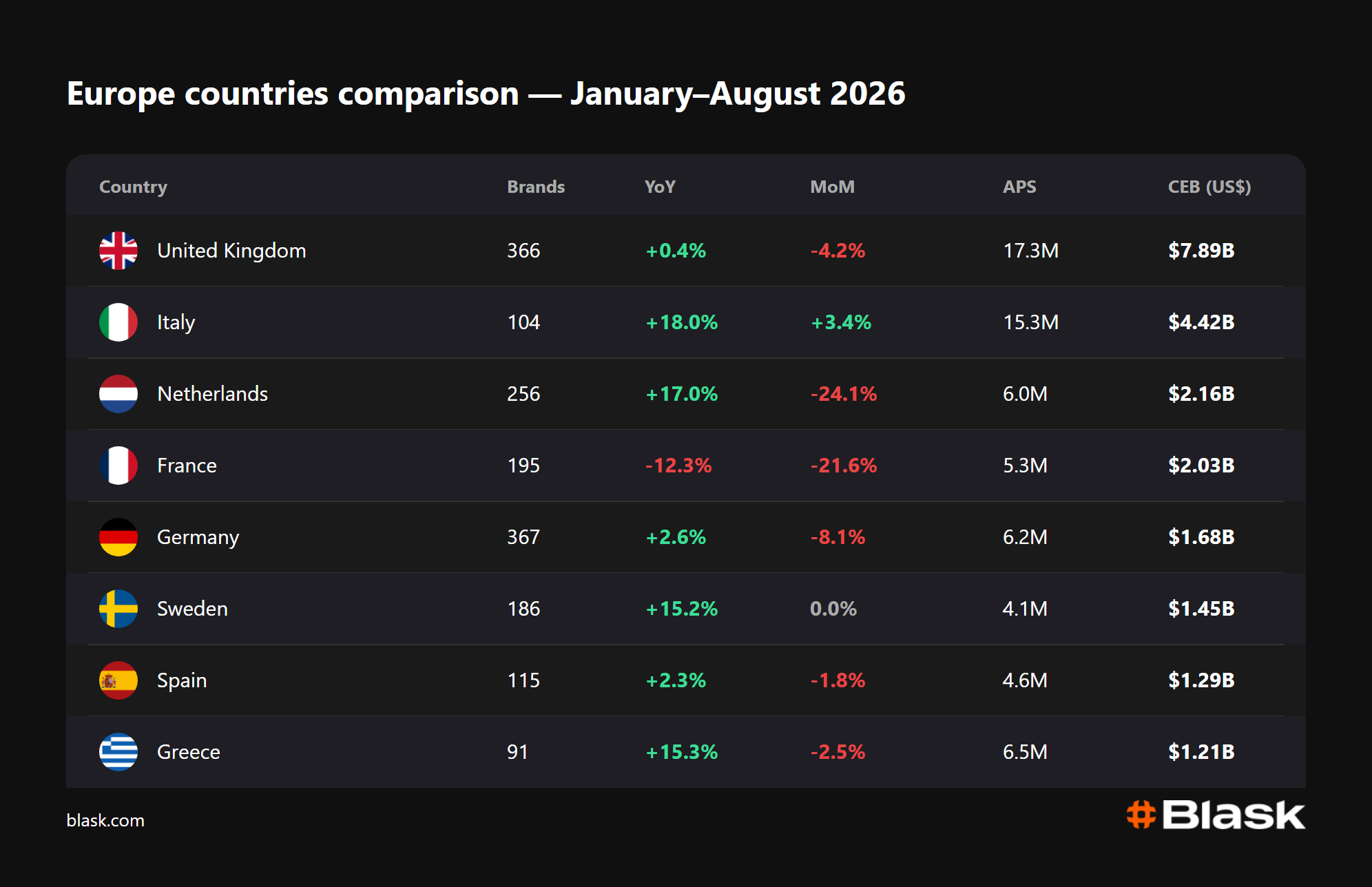
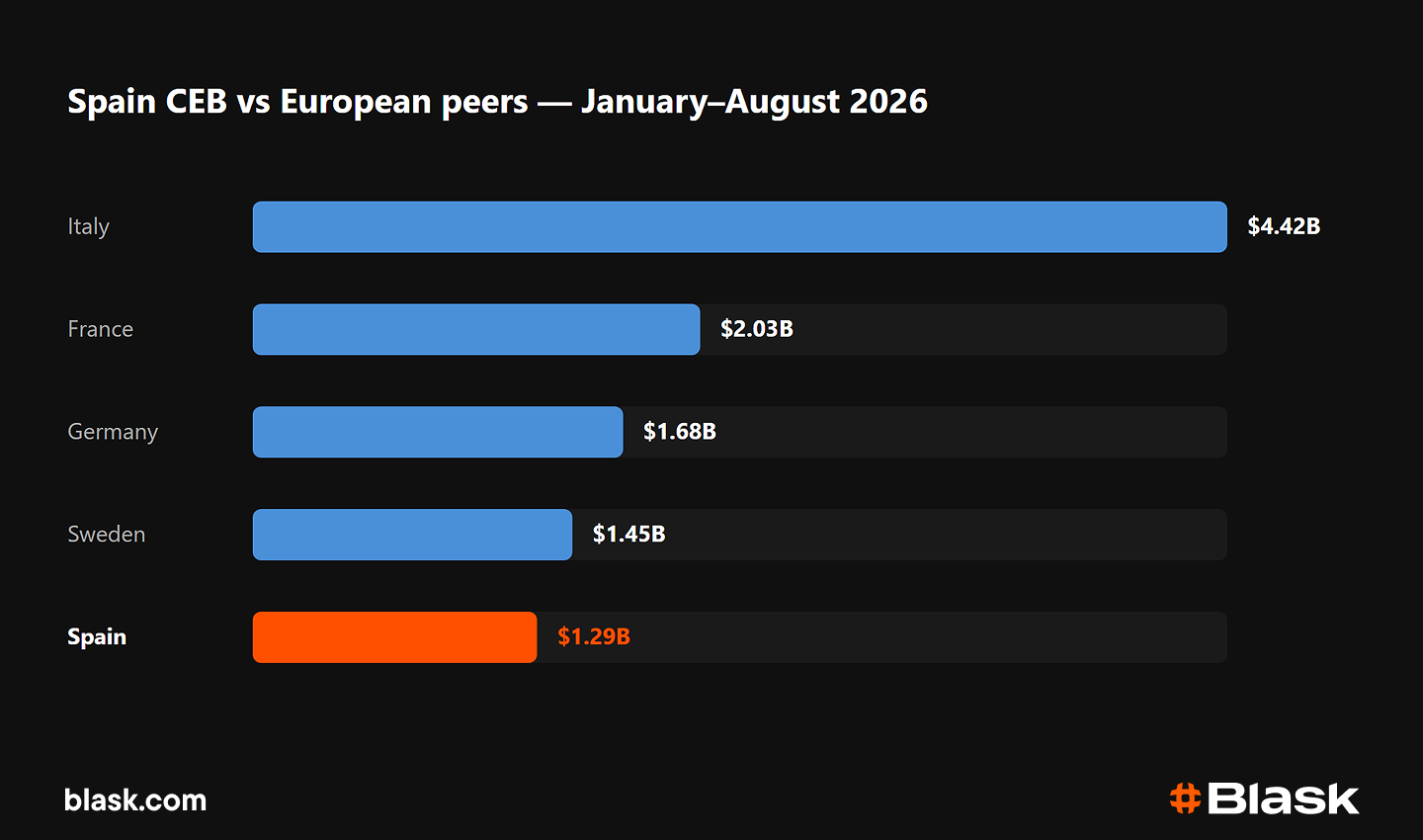
For January–August 2026 Blask’s CEB for the Spain iGaming market is $1.29B ($964M–$2.28B range), 6.7% above the same months of 2025.
Italy is $4.42B in that window, Germany $1.68B, France $2.03B. Spain sits with Sweden ($1.45B) on the European mid-tier, not with the UK or Italy.
💡 Key point: Spain’s Jan–Aug 2026 CEB is $1.29B — up 6.7% YoY, still Western European mid-tier next to Sweden, not the UK or Italy.
The CEB panel counted 111 brands in January and 115 in August. Onshore brands held 98.5% of BAP in August.
This is not a market waiting for a first licence wave. It is a market where the DGOJ list is the list.
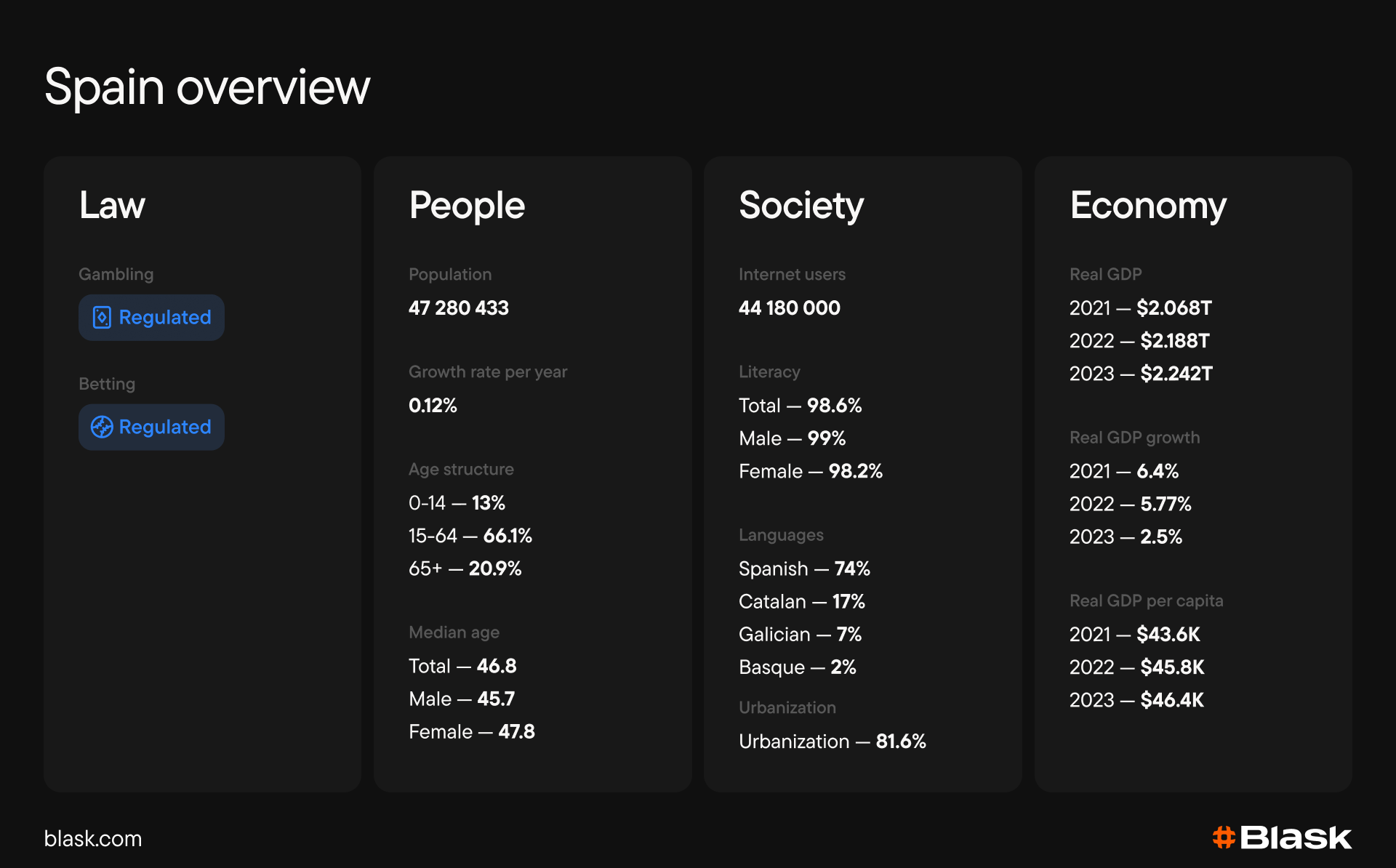
Spain’s population in the Blask GEO file is 47.3 million, with 44.2 million internet users. Discovery and play are already digital.
📚 Read more: What APS and CEB mean in iGaming
Regulation: Law 13/2011, still the frame
Online gambling in Spain sits under Law 13/2011 and the Dirección General de Ordenación del Juego. General licences run for ten years; singular licences cover specific products on shorter terms.
Operator GGR tax is 20%, with a reduced 10% rate for operators tax-resident in Ceuta or Melilla — a split the old page already used and that still belongs in the tax stack.
Royal Decree 958/2020 tightened advertising, including welcome offers. Supreme Court ruling 527/2024 struck key articles of that decree and put welcome bonuses back in play.
Safer-gambling duties from Royal Decree 176/2023 remain on the books. The 2026 overlay is operational (joint deposit limits, standardised risk flags), not a new Gambling Act.
Enforcement against unlicensed sites is a DGOJ constant. It does not show up as a meaningful offshore BAP line: 1.5% in August 2026.
Market dynamics: football season without a demand boom
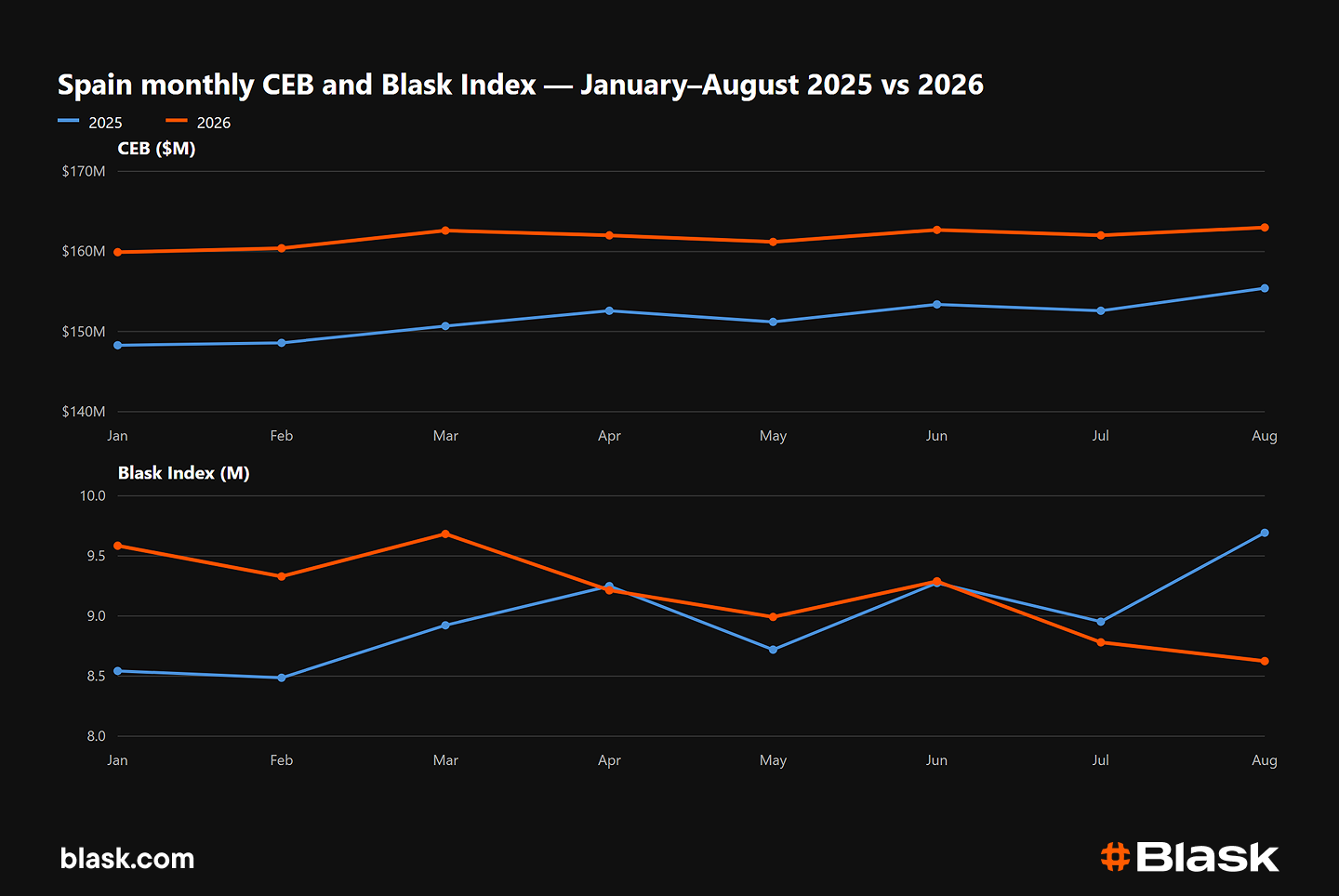
- January–March: monthly CEB around $160M–$163M. La Liga is in session; the baseline is already high.
- April–June: CEB stays in the same band. Blask Index, in relative terms, does not reprint the 2025 climb. Year-on-year the eight-month Index sum is only +2.3%.
- July–August: the calendar hollow that the La Liga seasonality article mapped. Index eases further. CEB does not.
Spain’s 2026 story is share rotation on a flat revenue baseline, not another +13% demand year.
📚 Read more: Spain iGaming seasonality: From La Liga to Lotería de Navidad
The casino shelf is a separate URL: Spain’s games ranking already records Blackjack beating branded slots. This overview does not retell that table.
📚 Read more: Top casino games in Spain 2026
Competitive landscape: the period ranking lies about the summer
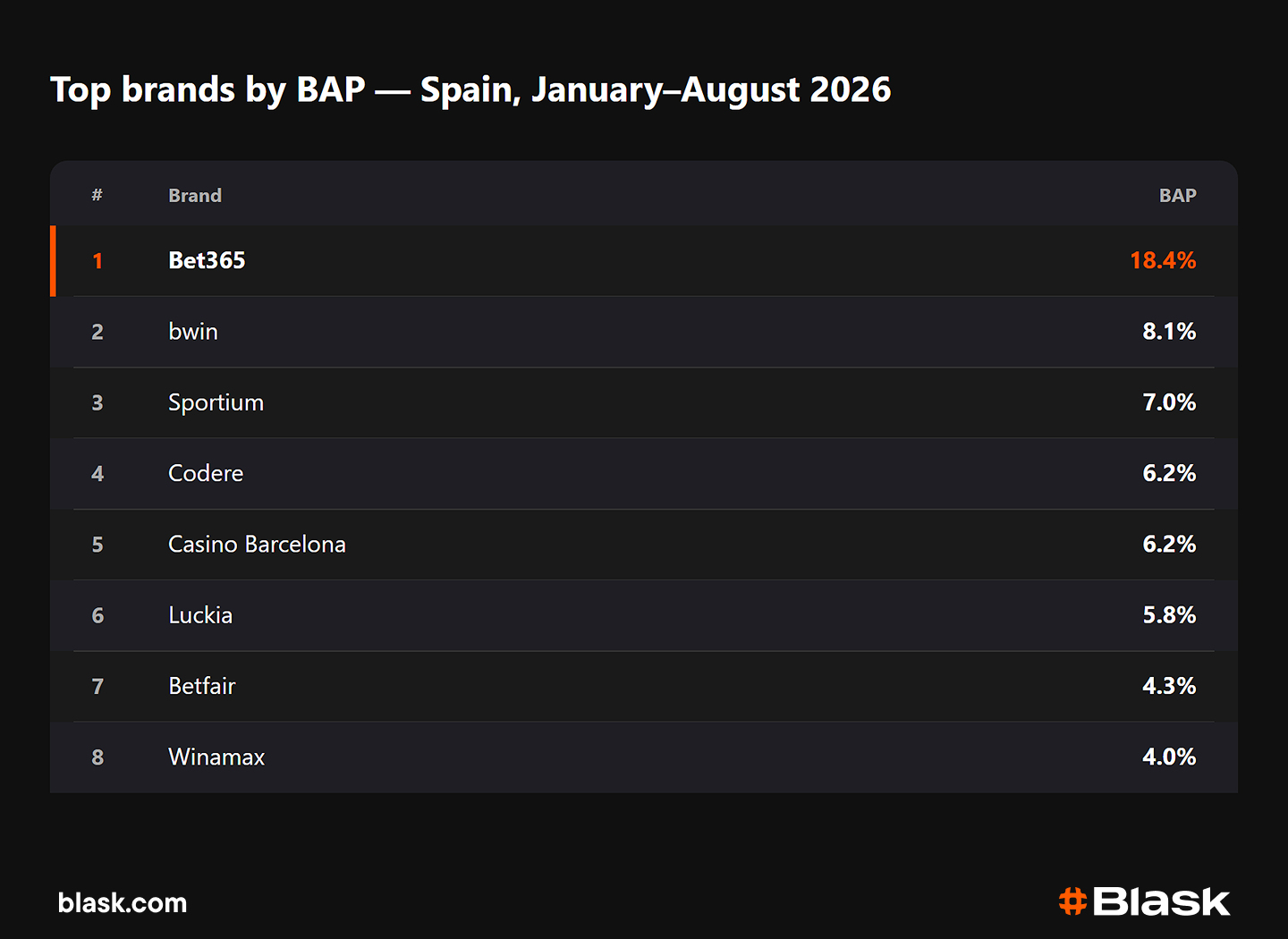
For January–August 2026 Bet365 still leads on 18.4% BAP. bwin is second on 8.1%, then Sportium 7.0%, Codere and Casino Barcelona 6.2% each, Luckia 5.8%.
The top three hold 33.5%. The top ten hold 67.0%. Luckia and Casino Barcelona — the 2025 domestic breakout names — are still in that ten. They are not the 2026 movers.
January to August is a different picture. Bet365 fell from 20.6% BAP to 12.9% (−7.8 pp). bwin rose from 6.9% to 13.8% (+6.9 pp). Betfair rose from 3.3% to 9.3% (+6.1 pp).
In August, bwin’s monthly share sits above Bet365. Codere, Sportium and William Hill all lost more than a point.
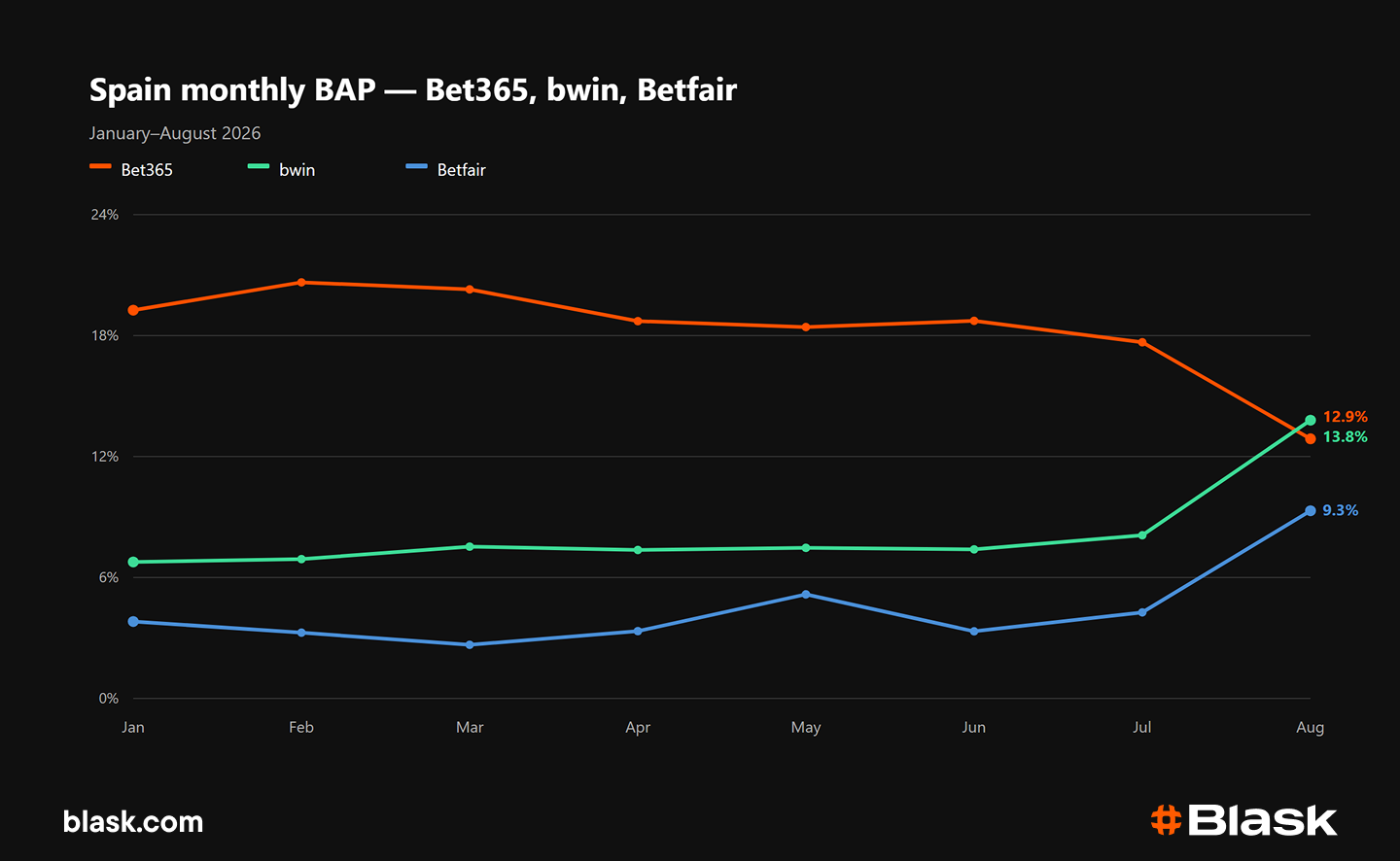
💡 Key point: A period leader with a collapsing monthly line is the definition of a mature market in motion — Bet365 still leads Jan–Aug; bwin leads August.
Entain (bwin) and Flutter (Betfair) took summer demand from the long-term leader. The local names held their seats. They did not take the eight-month crown.
The Spanish consumer: Young, educated, football-obsessed
The typical Spanish iGaming customer is a university-educated male under 35, earning a modest €10,000–€30,000 annually — reflecting the broader Spanish economic context. The motivation split is telling: sports bettors play primarily to enhance the viewing experience and support their team, with money a secondary driver; casino players lean more toward adrenaline and process enjoyment.
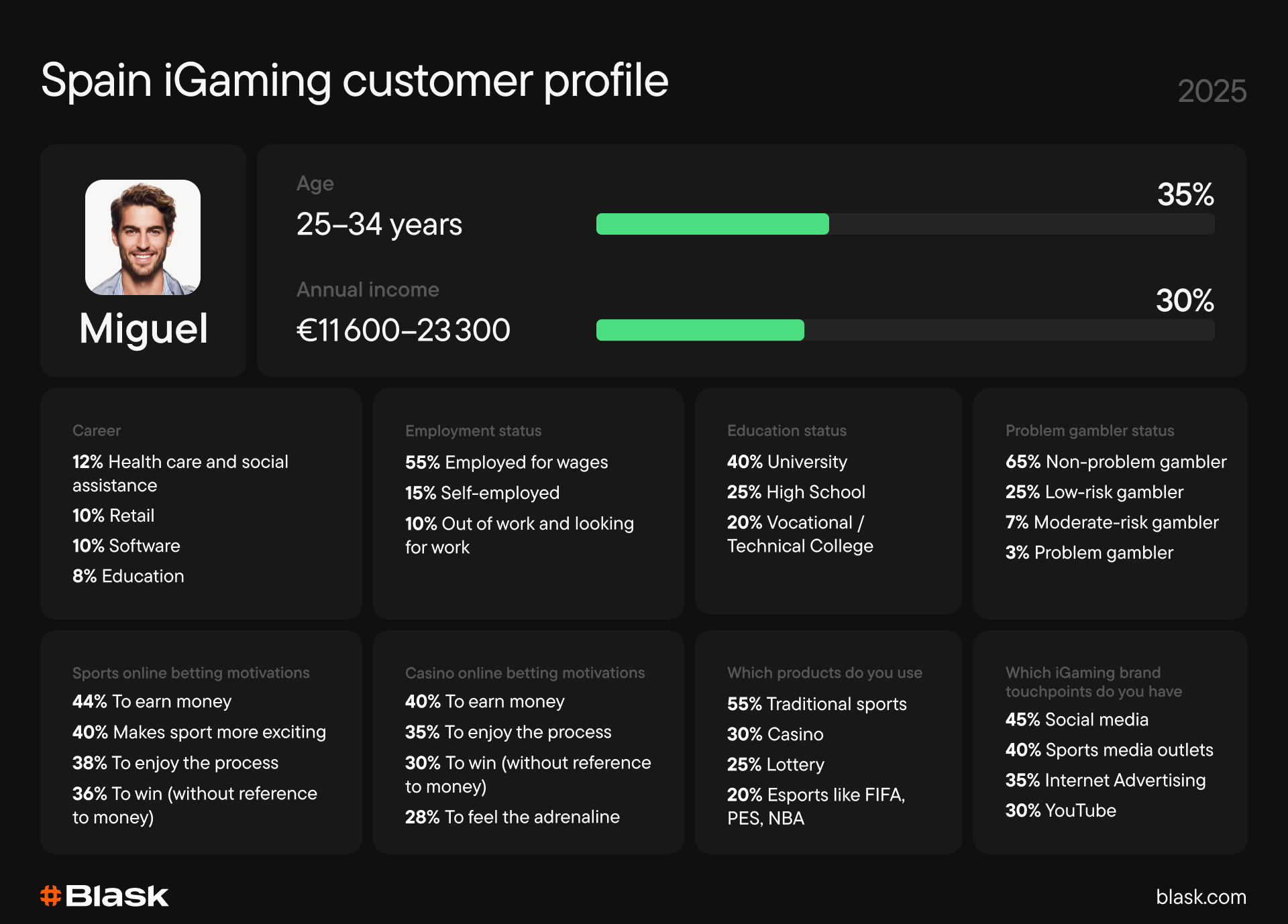
Discovery happens digitally: social media and sports media outlets dominate the acquisition funnel, with YouTube and internet advertising rounding out the top channels. Traditional sports betting leads product engagement, followed by casino/live dealer and lottery.
On responsible gambling, the combined 10% moderate-risk and problem-gambler rate aligns with European averages. It will, however, face increased scrutiny under the DGOJ’s forthcoming mandatory risk-detection algorithm, expected to roll out in 2026.
Bottom line
Spain in January–August 2026 is a $1.29B CEB market, 6.7% up on 2025, 98.5% onshore, with 115 brands on the panel.
Bet365 still leads the period on 18.4% BAP. It does not lead August. Whether the rest of the year gives the eight-month ranking back to Bet365, or confirms bwin’s summer as a handover, is the only open competitive question that matters.
The licence list will not decide it.