

- Updated:
- Published:
How to cross-sell between sports betting and casino: player value, timing and what the data shows

A sports-only player is often worth $400–$600 a year, but a cross-sold sports+casino player delivers $1,800–$2,500 — a 3–4x gap that defines cross-sell sports betting casino iGaming. When operators convert 20–25% of the sports base, that uplift is the highest-ROI revenue lever available without raising CAC. Most operators still leave the money on the table because they run it at the wrong time and in the wrong way.
Why cross-sell matters more than acquiring new players
Blended US first-time depositor CAC commonly lands in the $300–$500 range, and higher when affiliates and paid search dominate. Move that player into the casino and you can add another $1,400–$1,900 in GGR a year — on the same acquisition cost. Read as casino player LTV vs sports bettor, the multi-product cohort is not a slight uplift — it is a different unit-economics animal.
Compare the three cohorts:
| Cohort | Typical value signal | Why |
| Sports-only | ~$300–$700 LTV (source) | Event-driven sessions, 1–3 bets/week |
| Casino-active | ~36% higher future value than sports-only (Optimove) | Higher session frequency |
| Multi-product | ~50%+ higher than sports-only (Optimove); up to 4–5x in some datasets (Optimove) | Two triggers to open the app |
Unit economics favour casino engagement even when per-bet hold looks lower. US sportsbooks held about 10.15% of handle in 2025, online slots typically run a 2–4% house edge per spin. Per dollar wagered, sports take more.
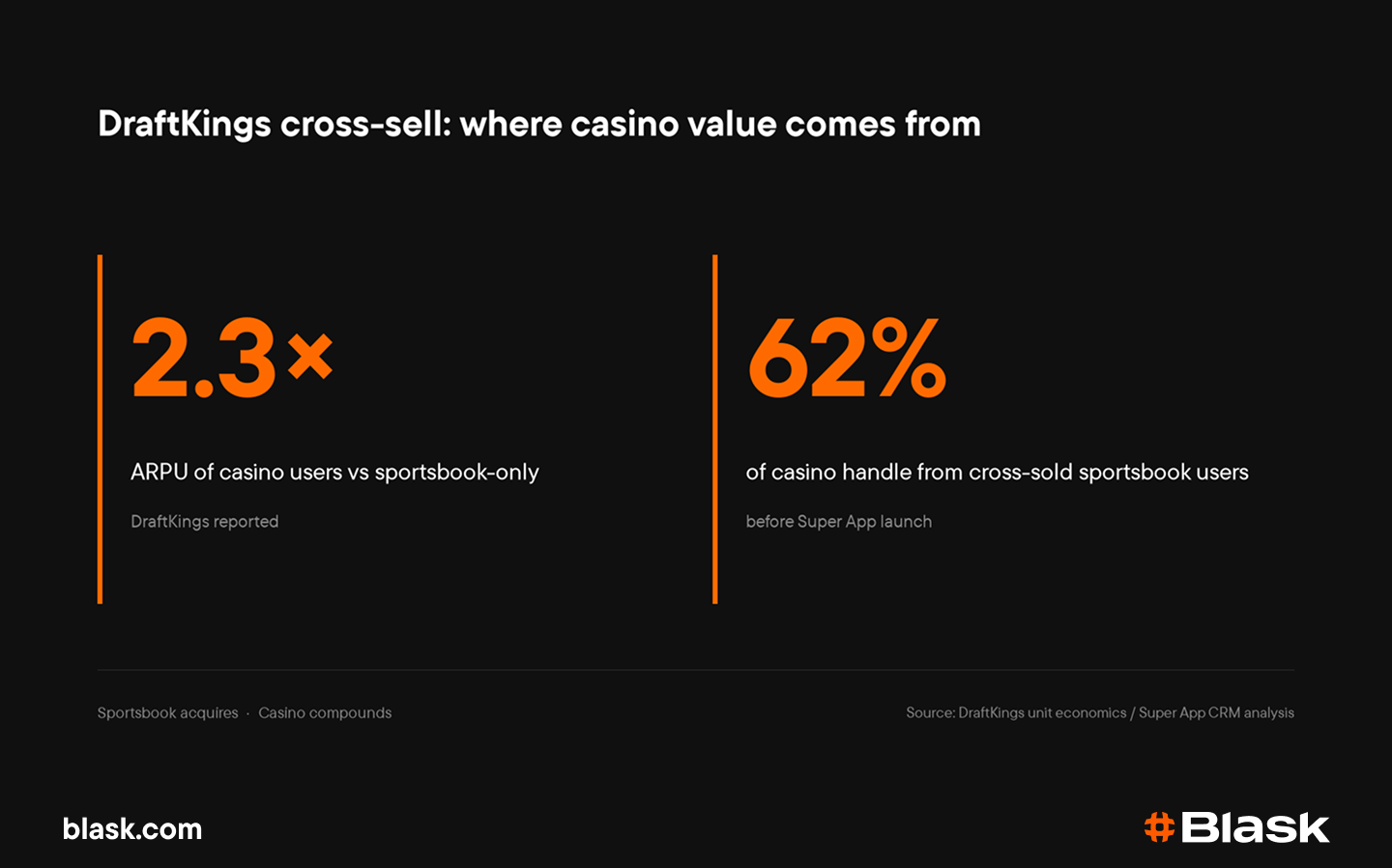
Per player-hour, casino volume usually wins — which is why DraftKings has reported casino users at roughly 2.3x ARPU versus sportsbook-only customers, and why 62% of DraftKings’ casino handle already came from cross-sold sportsbook users before the Super App formalised the stack.
The strategic point: iGaming multi-product player value is a product architecture decision. Operators with one wallet, one identity and one loyalty ledger convert because the second product is a tap away. Operators where casino and sports still feel like separate apps convert because the player has to decide twice.
| For the acquisition side of the same equation, see and how to reduce CAC in sports betting. |
Sports to casino — when and how it works
This is the industry’s default direction of travel — and the practical answer to how to convert sports bettors to casino players. Sportsbooks are usually the wider acquisition funnel, while casino is the higher-frequency monetisation engine.
👉 In the US, that flywheel is already visible in the numbers: DraftKings’ iGaming revenue grew 22.6% YoY to $429.7M in Q2 2025, outpacing sportsbook growth in the same period, with the majority of casino handle sourced from sportsbook migrants.
Timing beats creative. The best sports-to-casino windows are downtime between fixtures and the sports off-season — Tuesday 2 a.m. after a settled slip, or the summer gap when NFL/NBA handle softens.
Sports betting handles can drop 40–50% in summer months between major leagues, while gambling has no equivalent off-season. Operators such as FanDuel lean on shared-wallet architecture and contextual triggers — free spins after a settled bet, casino credits as near-miss consolation, push offers when sports activity dips — rather than a permanent casino banner on the sportsbook home.
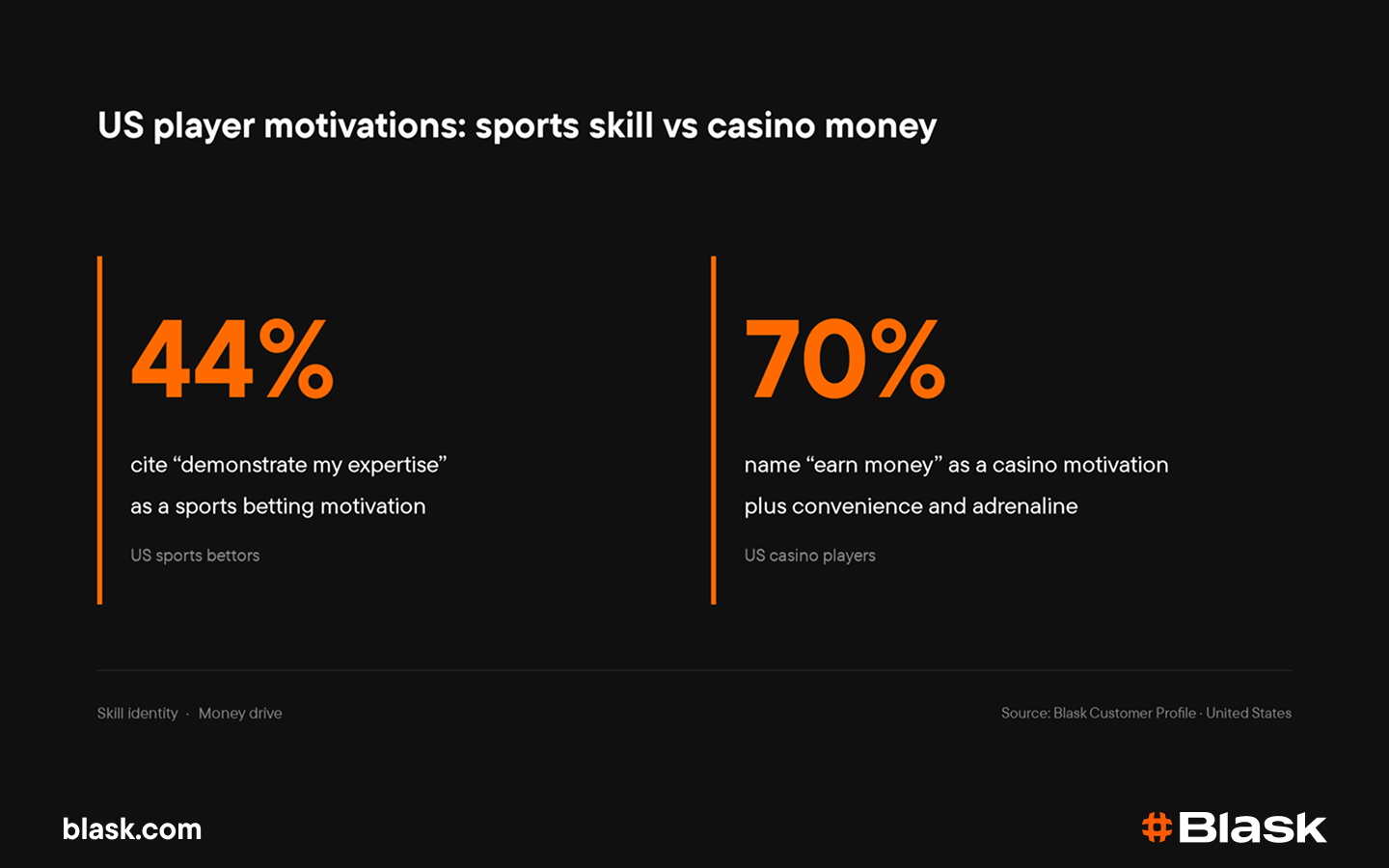
The psychological barrier is skill identity. Sports bettors often frame themselves as analysts. Casino reads as pure luck. Blask Customer Profile data for the US shows that gap in motivations: 44% of US sports bettors cite “demonstrate my expertise” as a sports motivation, while casino motivations skew toward earn-money (70%), convenience and adrenaline. The conversion path that respects that identity is skill-perception product — blackjack, live dealer, game shows — not an “Egypt treasure” slot dropped into a football CRM stream.
Mechanics that consistently work:
- Event-tied casino bonus — “Bet the match, get 20 free spins” attaches the second product to a habit the player already has.
- Halftime / in-play bridge — live casino during the break keeps the session open without asking for a new deposit.
- Low-stakes tables as the on-ramp — lower ticket size, social cues, readable rules; slots come later once the wallet is already warm.
Optimove’s campaign work also warns against waiting forever: a seven-day sports-only depositor still has about a 5% organic chance of placing a casino bet in the next 30 days. After three months with no casino activity, that falls to roughly 1%.
That is the real sports betting to casino conversion rate iGaming operators should manage — a window, not a permanent open door.
Casino to sports — a harder sell, but a more valuable player
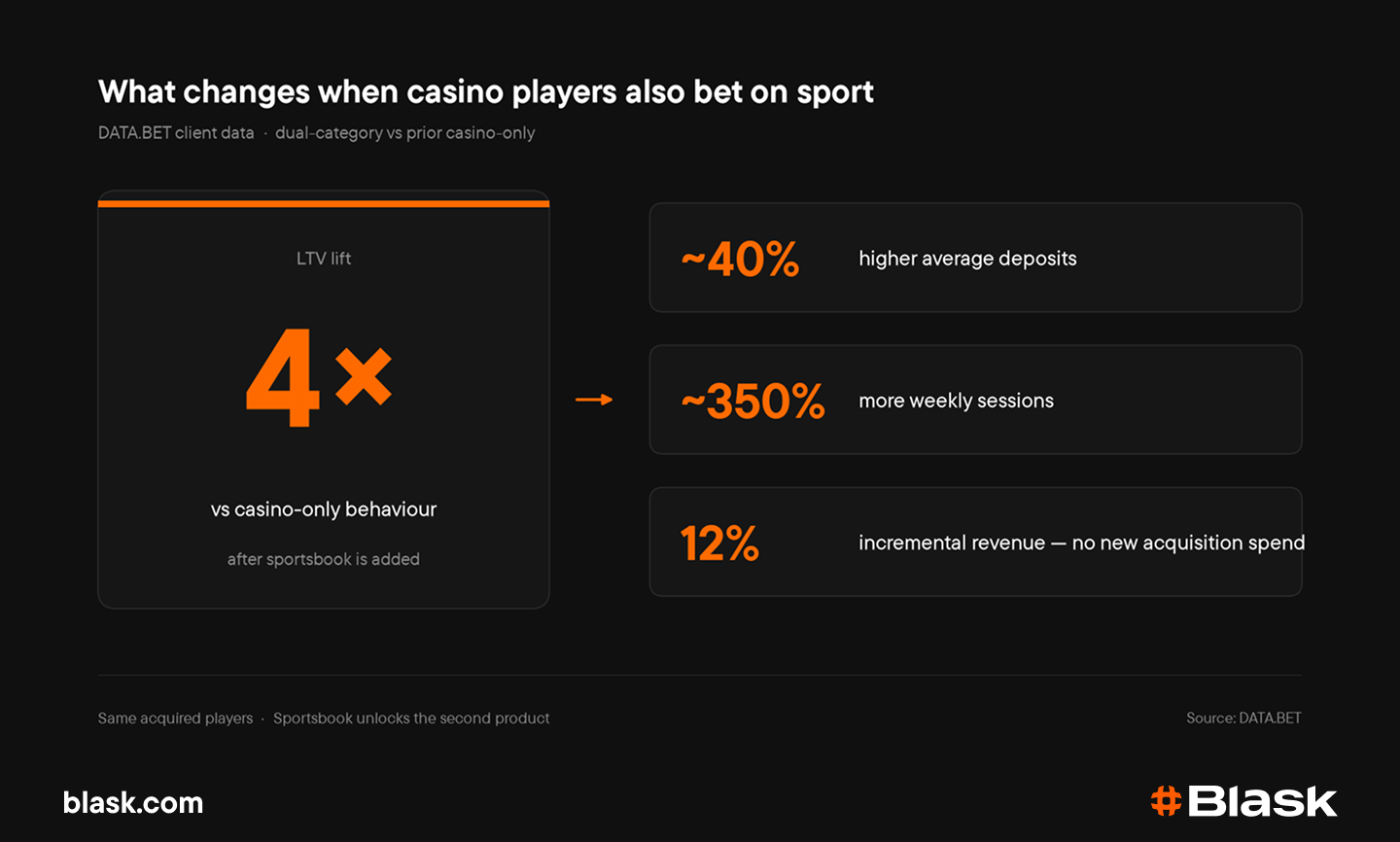
The reverse path is less automated in most CRM stacks, but the payoff can be larger for casino-first operators. DATA.BET’s client data shows that once a sportsbook is added, dual-category players can deliver:
- up to 4x LTV versus their prior casino-only behaviour;
- with ~40% higher average deposits;
- nearly 350% more weekly sessions;
- about 12% incremental revenue without new acquisition spend.
Roughly every second casino player placed at least one sports bet after sportsbook launch in that dataset.
Why it is harder: a slots regular does not automatically care about Asian handicaps. The barrier is literacy, not wallet balance. The cleanest entries are simple markets — match winner, total goals — attached to cultural events (Champions League final, World Cup, Super Bowl) when non-sports audiences are already inside the conversation.
What works in the reverse direction:
- Reverse promo — “Stake $10 on the match, get $10 casino bonus” uses the familiar product as the reward.
- In-play as the gateway — live betting feels closer to a casino session (fast feedback, continuous action) than pre-match handicaps.
- Same-wallet settlement — winnings from either vertical should fund the other without a second KYC or cashout loop.
A casino high-LTV player who also bets sport becomes an anchor account: match day and Tuesday night both justify opening the app.
What Blask data shows — which markets cross-sell best
Blask shows the multi-vertical picture on two sides: which brands actually own attention in a market, and what players say they play. Brand rankings below are for June 2026. Audience figures come from the latest Blask Customer Profile snapshot. Three markets, three different cross-sell geometries.
United Kingdom — multi-vertical is the default culture
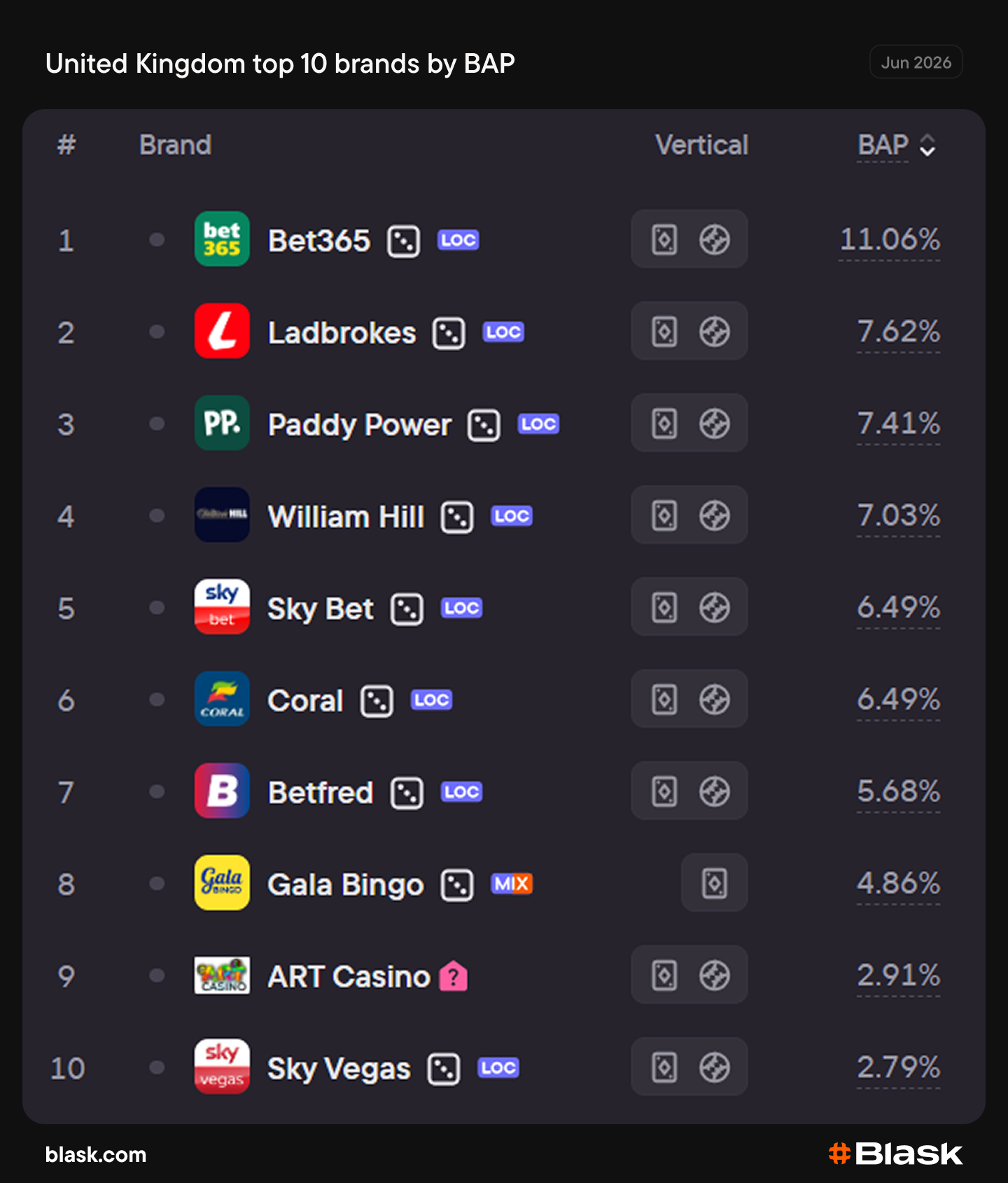
In Great Britain, June BAP is concentrated in dual-product brands. Of the top 15 non-prediction-market brands, 9 run both casino and sports. The casino-only exception is Gala Bingo.
Customer Profile matches that supply picture. UK players report using:
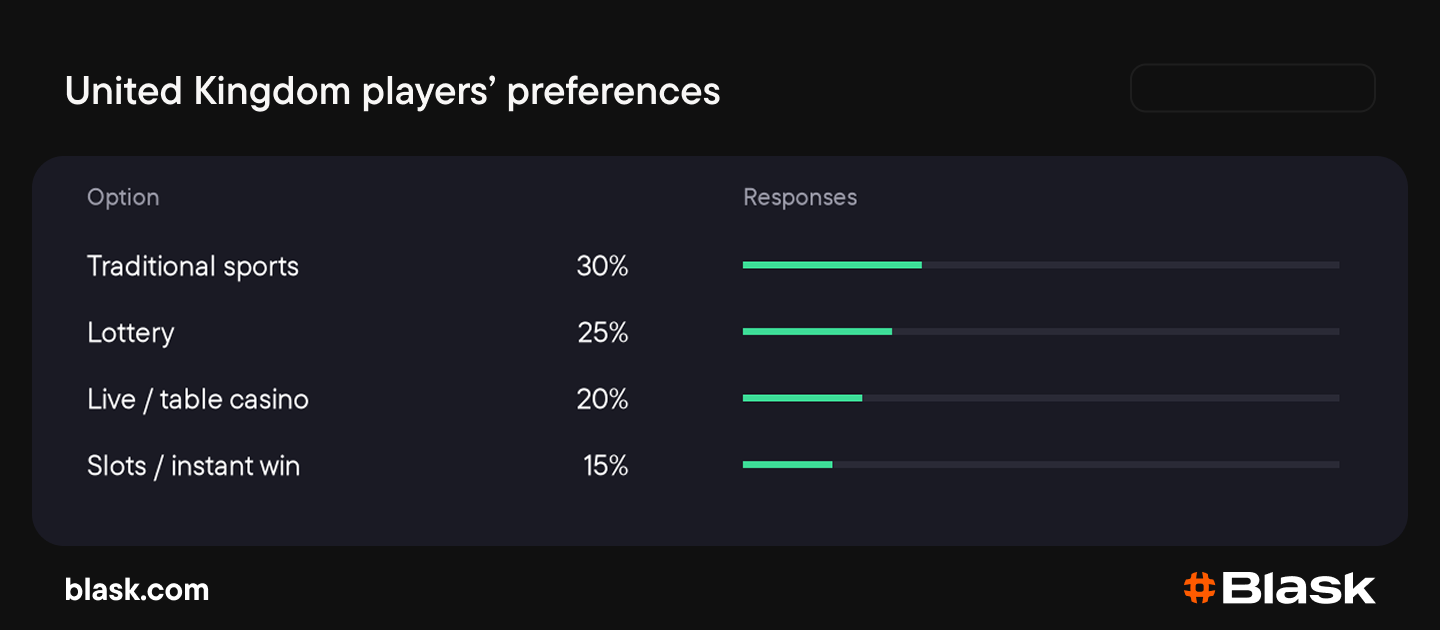
Motivation overlap is convenience-led on both sides: “comfortable / no need to leave home” leads sports (25%) and casino (28%); “pass the time when bored” is 18% for sports and 22% for casino. This is a market where cross-sell friction is cultural as much as technical — players already expect both tabs.
UK sports and casino motivation overlap — convenience and boredom relief.
Brazil — every rung of the ranking is dual-product
Brazil’s June top 10 is 10/10 multi-vertical. Betano sits alone at the front, then Bet365, Superbet, Sportingbet, 7Games, Esportes da Sorte, Betnacional, BullsBet, EstrelaBet, Vaidebet, Onabet, VeraBet, R7.bet, Blaze and KTO — every name flags casino and sport. Brazil is the market where it is a dual-product shelf at every rung of the ranking.
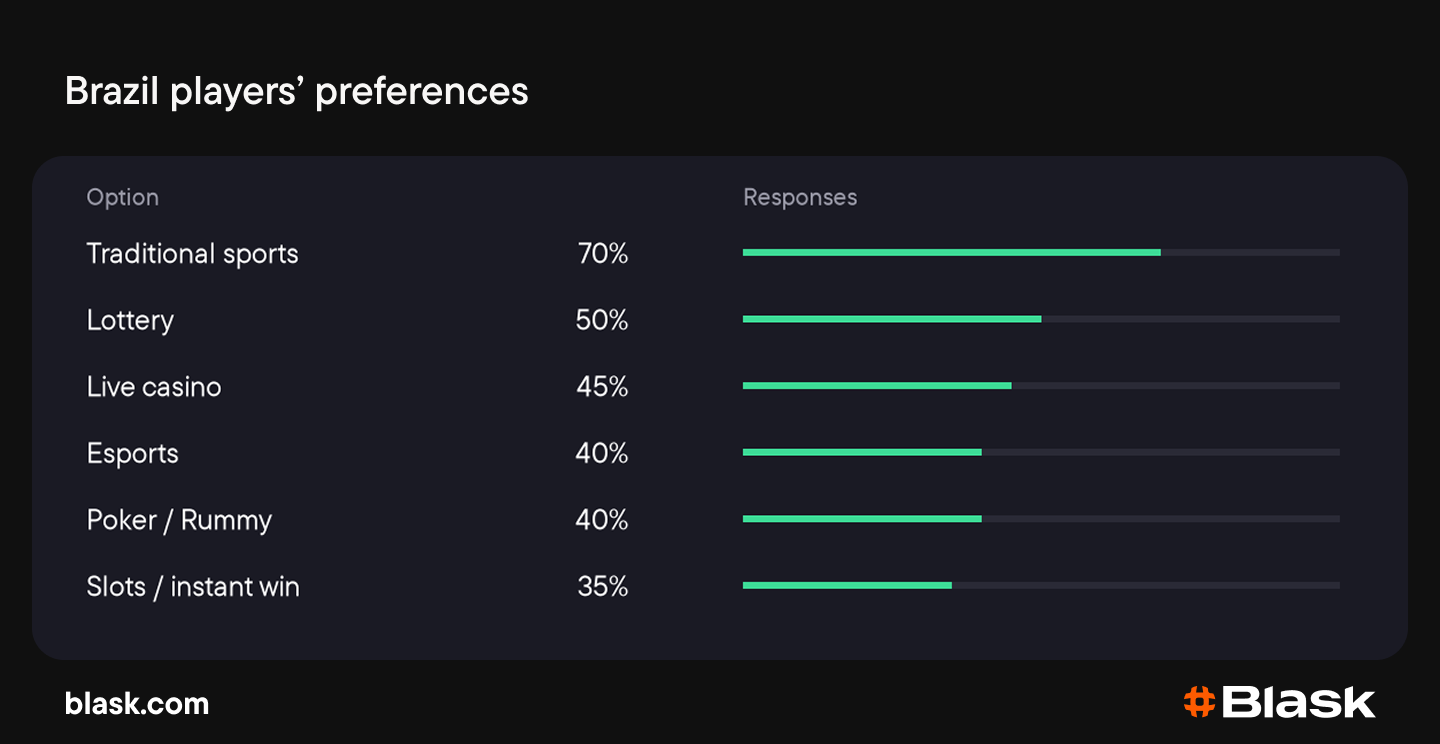
Demand agrees. Customer Profile for Brazil shows:
Motivation is money-forward on both verticals — 71% “earn money” for sports, 60% for casino — with a young skew (29% aged 18–24). Post-2024 regulation, sports operators are not inventing a casino audience from scratch; they are competing for an audience that already plays both.
United States — sports→casino is the operating system
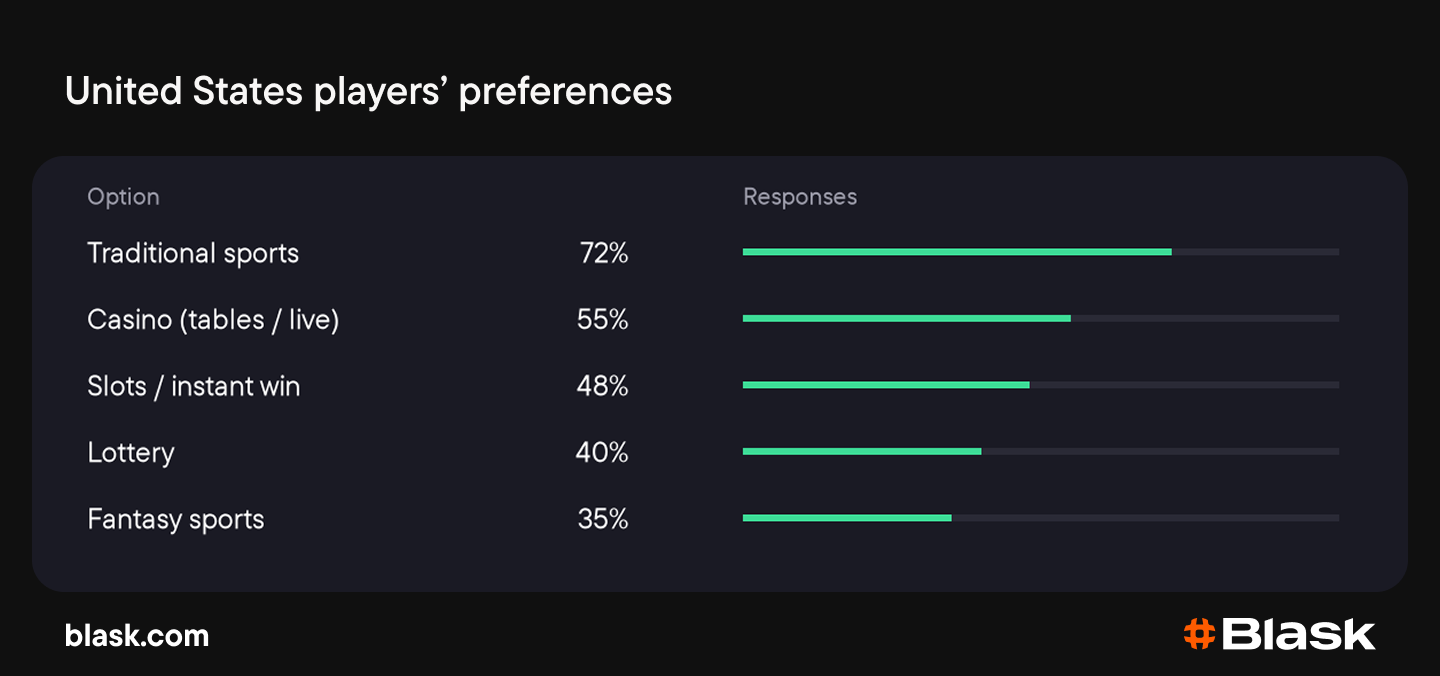
US Customer Profile shows a sports-first base that already touches casino heavily:
In New Jersey — a mature dual-product US state — 9 out of 10 brands are multi-vertical, while the single brand is betting-only.
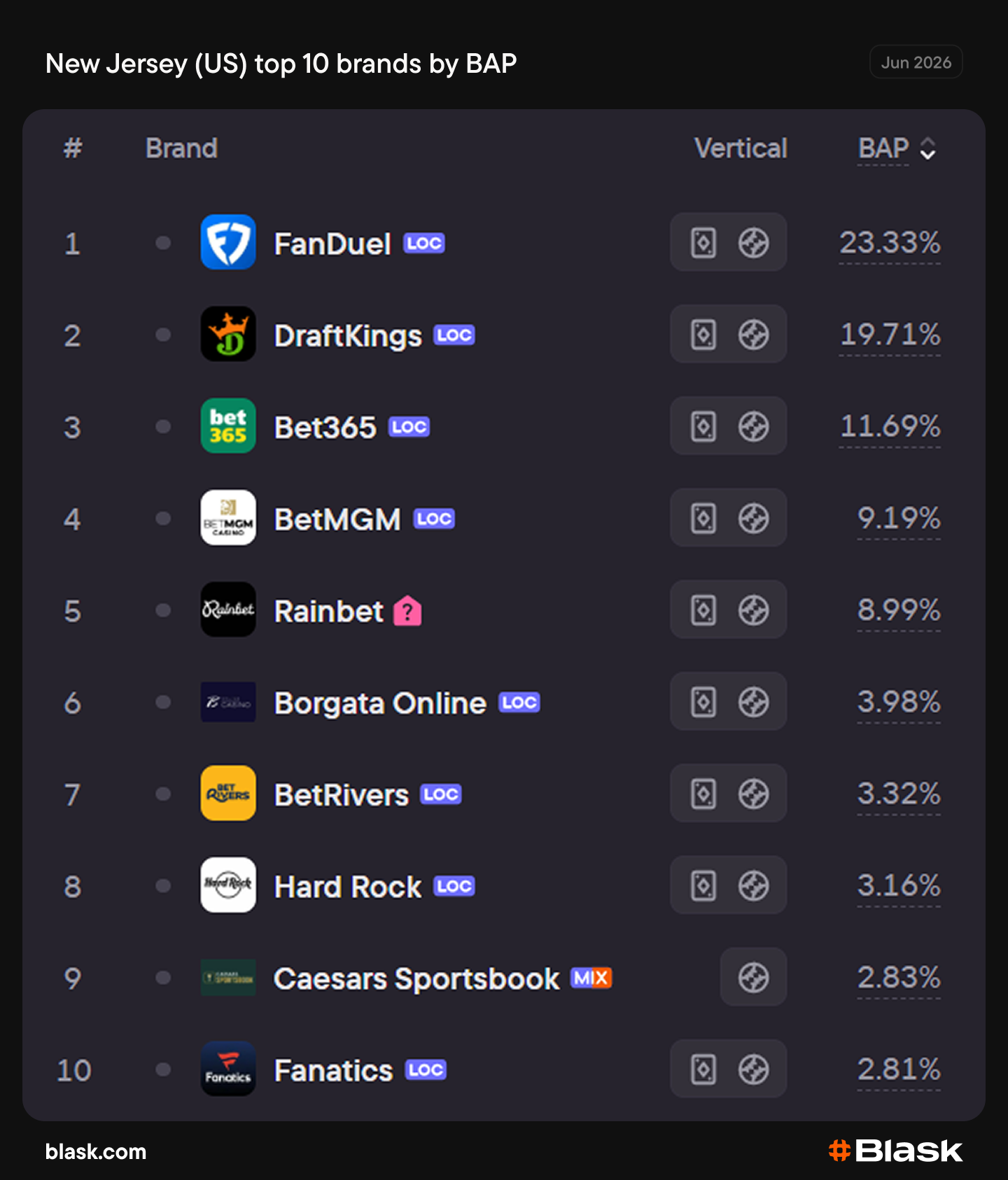
That supply shape matches the public unit-economics story: sports acquired, casino compounds. As was previously written in the article, DraftKings has attributed 62% of casino handle to sportsbook users — why the US is the reference market for aggressive multi-product conversion. For example, the 20–25% class when CRM, wallet and timing are aligned, while industry-average sports-to-casino penetration still sits closer to ~10% when the two verticals stay siloed.
US motivations explain the skill barrier: 44% of sports bettors cite “demonstrate my expertise”, and 65% say betting “makes sport more exciting”, while casino motivations tilt to earn-money (70%) and trying new games (48%).
4 things that kill cross-sell — and how to fix them
1. Separate wallets
If the player must re-deposit to use the casino, most will not. DraftKings’ Super App framing and FanDuel’s shared-wallet stack both treat one account / one wallet / one loyalty layer as the prerequisite. Unified balance is table stakes.
2. Cross-selling on day one
Let the player form a habit in the acquisition vertical — typically after 3–5 successful sessions — then bridge. Optimove’s timing data shows organic second-product probability collapsing from ~5% to ~1% as months pass without a nudge. Firing too early burns trust, firing too late misses the window.
3. Irrelevant offers
A sports CRM blast of generic Egyptian slots is why players learn to ignore casino tiles. Match the offer to the identity: live dealer and blackjack for skill-perception bettors; sports-themed slots or casino bet-builder mechanics for fans who want the jersey.
4. Ignoring seasonality
Casino’s job in a sports-led stack is to absorb the calendar. When sports handle softens 40–50% between seasons, that is the campaign season for sports-to-casino. Blask Index seasonality and brand-level BAP make those troughs measurable by market. Operators who only push casinos on Super Bowl Sunday are leaving the quiet weeks untouched, where the incremental session actually exists.
Cross-sell is a timing and product problem
Whether to cross-sell is no longer an interesting question. An iGaming cross-sell strategy 2026 is a timing, wallet-design and market-fit problem. A UK player already lives in a multi-vertical culture; a Brazilian player already mixes sports and live casino at high rates; a US sportsbook user is the classic high-CAC acquisition who only pays back if casino frequency arrives without a second signup.
Blask Customer Profile shows where the audience already overlaps. Blask brand rankings show which competitors already win as dual-product shops in that GEO. Together they answer the operator question that matters: where is cross-sell a product completion problem, and where is it still an education problem?
Book a Blask demo — or start with the Blask Customer Profile product page — to see multi-vertical strength and audience overlap in your markets before the next CRM sprint.