- Updated:
- Published:
Spain iGaming seasonality: From La Liga to Lotería de Navidad

Spain’s iGaming market follows a clear seasonal rhythm — here’s what Blask Index data reveals about its peaks, troughs, and timing.
Patterns are clear — the year starts strong with February’s knockout football peak, softens through the summer break (May-July), then builds again with autumn football intensification (August-December) as Champions League action collides with Christmas lottery fever. Let’s break down what drives these patterns.
What Is Blask Index?
An AI-driven metric for the iGaming industry that tracks real-time market volume and brand share. Read more
The year in review: 2025’s roller coaster
From January to December 2025, the Spanish market’s trend line traced a pronounced ‘M-shape’ — rising from approximately 8.4M in early January to a peak near 9M in March-April, dipping through the summer months, recovering strongly through August-September, before a late-year normalization. Over the full year, Blask Index rose by roughly 5.3%, reflecting measured but sustained market growth despite regulatory headwinds and post-tournament cooldowns.
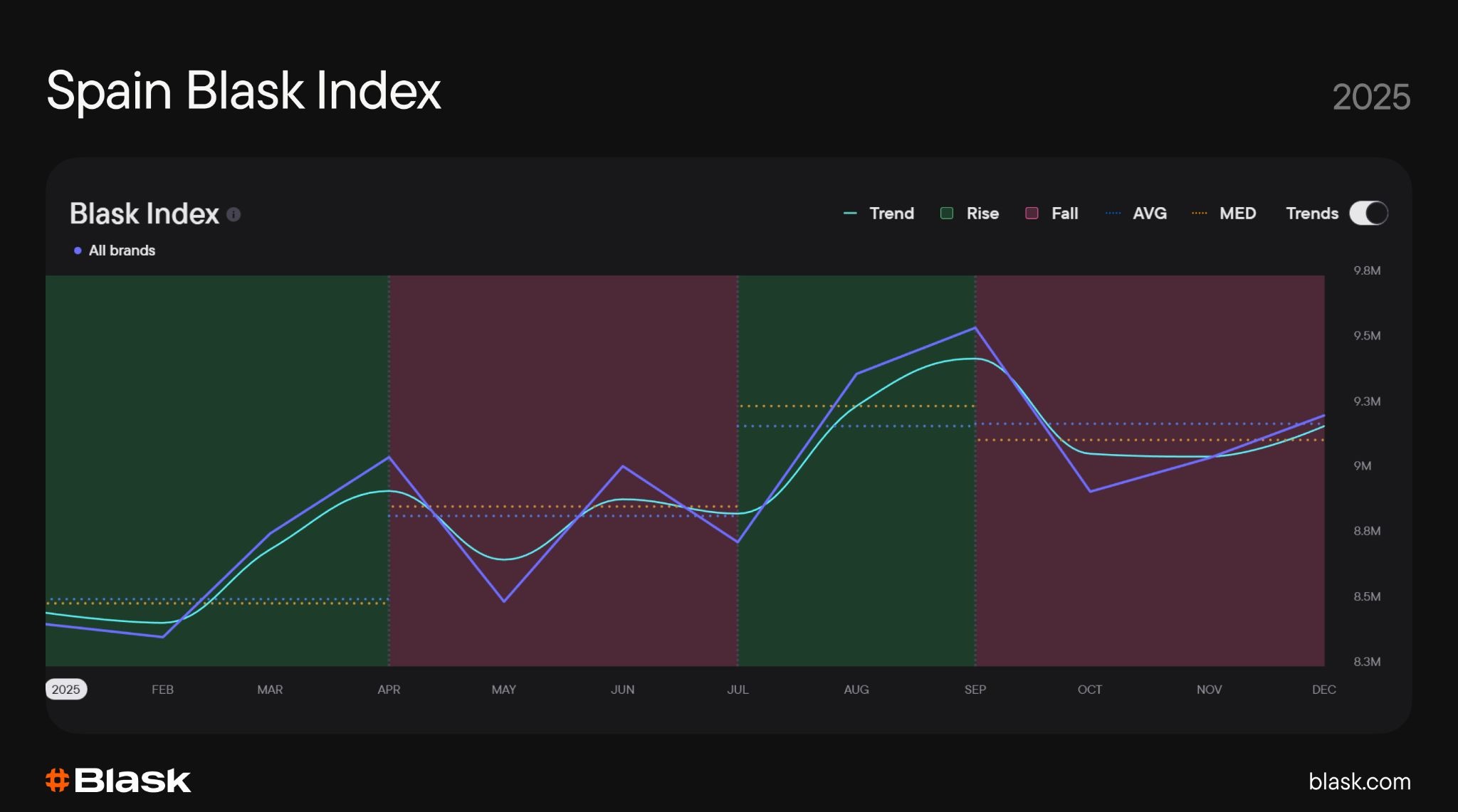
The late-2025 softening reflects several converging factors: a 6% reduction in operator marketing spend (per DGOJ Q3 data), FIFA international breaks diluting club-weekend inventory, and the November 25 announcement of €33+ million in sanctions against 32 operators dampening promotional activity into year-end.
Compare Spain’s 2025 trends with nine other European markets in the Europe iGaming Pulse report.
Six dates stand out as attention spikes throughout 2025:
- April 26: Copa del Rey final — Barcelona versus Real Madrid, the first Clásico cup final since 2014, won 3-2 by Barcelona after extra time;
- June 8: UEFA Nations League finals weekend;
- August 16: LaLiga 2025-26 season opener;
- November 16: FIFA international window with World Cup qualifiers;
- December 6 and 13: Champions League matchdays combined with Lotería de Navidad ticket-buying frenzy.
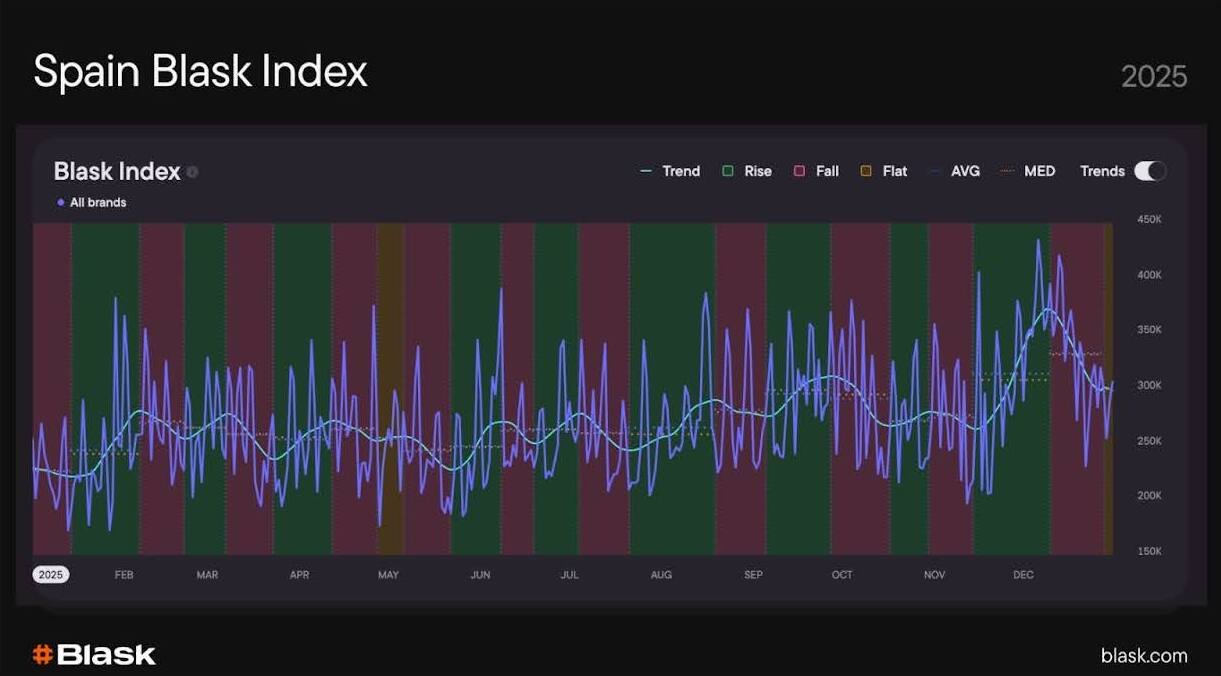
These peaks predominantly fall on Saturdays and Sundays — Spain’s traditional match scheduling slots — confirming the market’s tight linkage to football fixtures.
Peaks and troughs: why autumn runs hot
The Spanish iGaming calendar’s hottest stretch runs from late August through early December, driven by a convergence of domestic and continental football. LaLiga’s 2025-26 season kicked off on August 15-17, immediately injecting weekly match inventory back into the market.
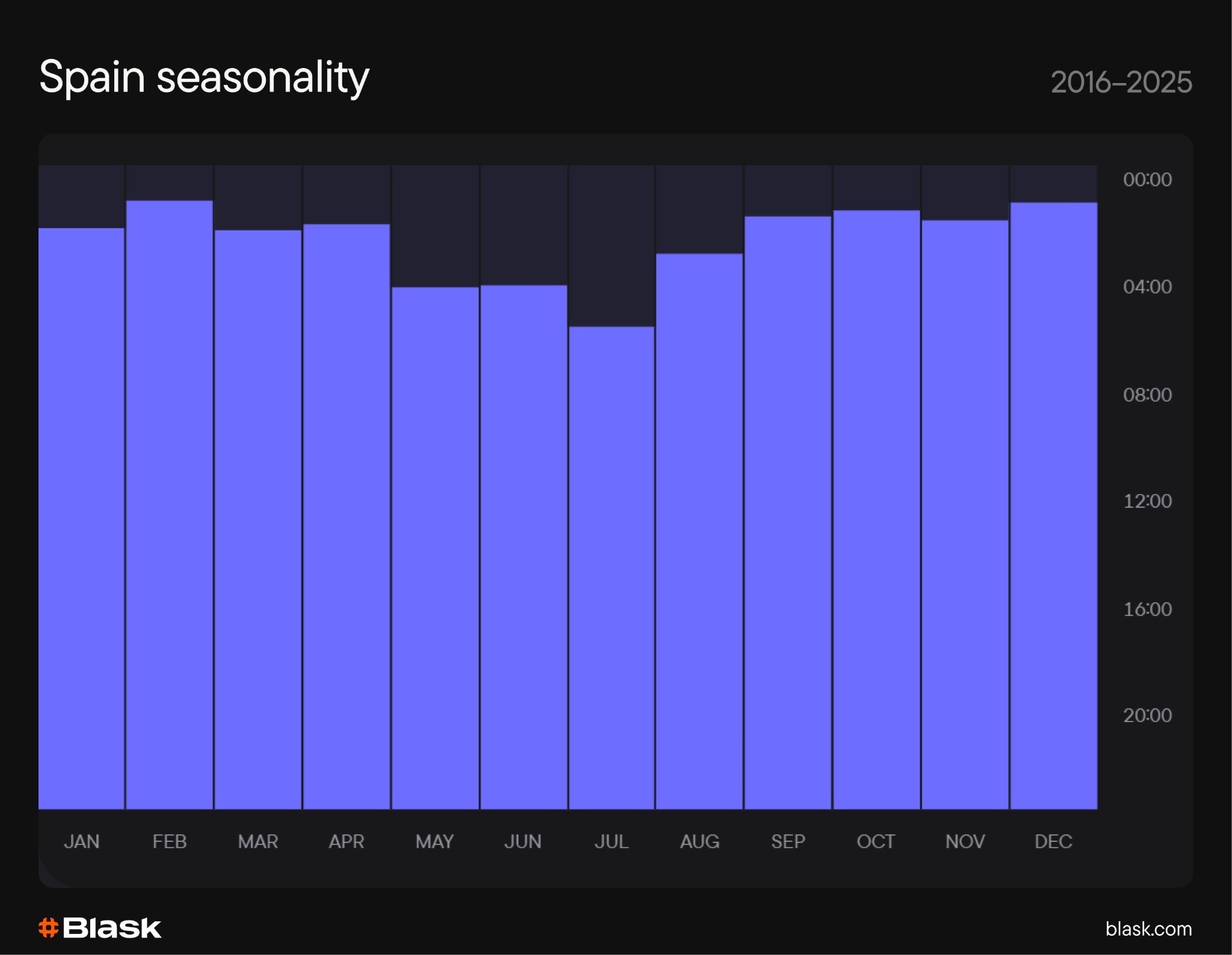
The league runs through late May, but the autumn period concentrates maximum value: El Clásico typically falls in late October (this season on October 26), while Champions League delivers midweek fixtures from September through December.
February emerges as the historically strongest month in the seasonality heatmap, averaging 9.44M — the highest monthly index on record. This reflects the Champions League knockout phase play-offs (typically mid-February), Copa del Rey quarter-finals and semi-finals, and tight LaLiga title races entering the decisive second-half stretch.
January and October-November form a close cluster as secondary peaks, each driven by Spanish Super Cup fixtures (held in Saudi Arabia in early January), LaLiga resumption after winter break, and the autumn domestic-continental football overlap.
Spain’s public holiday calendar amplifies these peaks. Constitution Day (December 6) and Immaculate Conception (December 8) create a long weekend that coincides with Champions League fixtures and Lotería de Navidad purchasing. National Day (October 12) similarly falls during peak La Liga and Champions League action.
The May-July dip: a repeatable hollow
Blask Index consistently bottoms out between May and July — a pattern visible year after year.
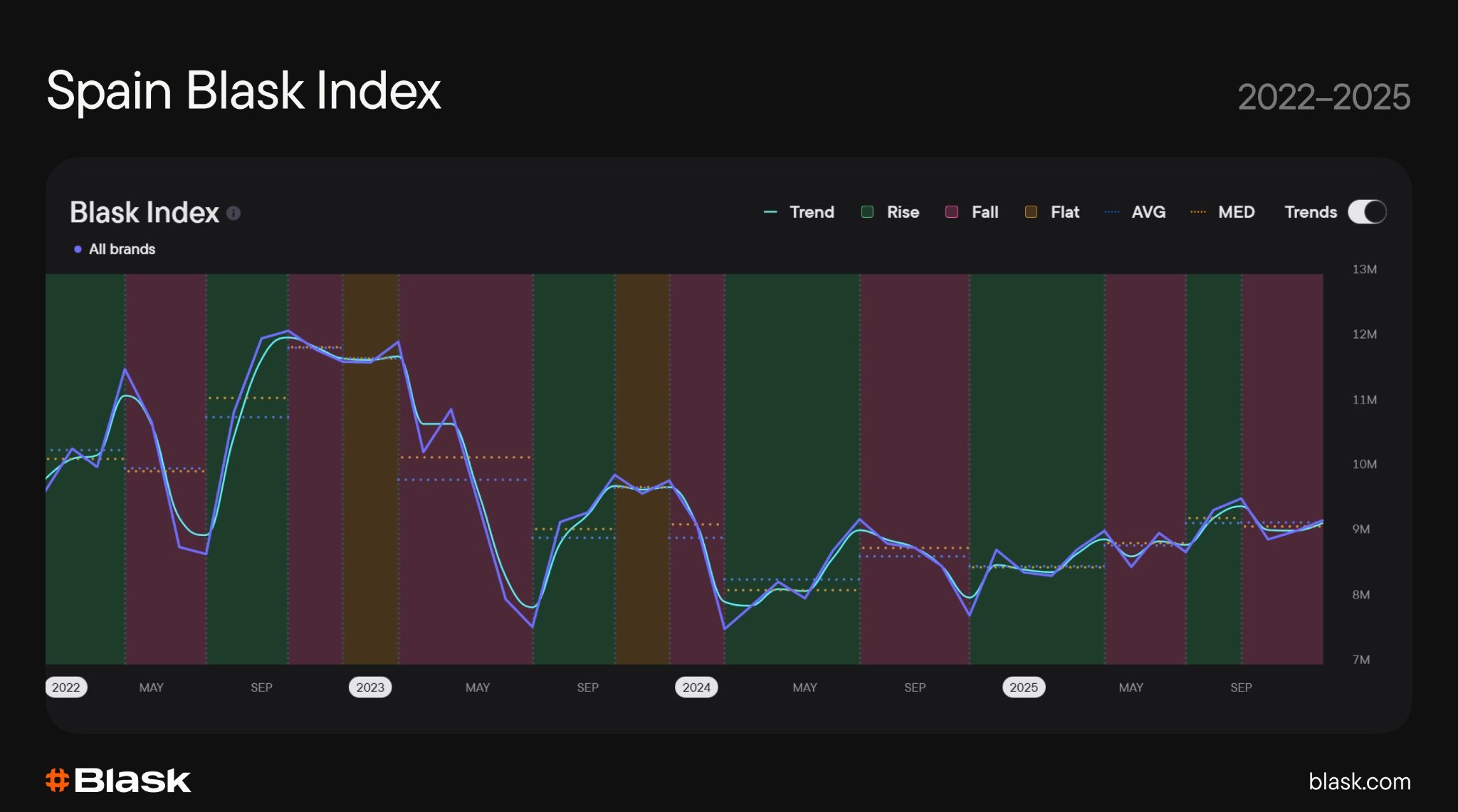
July records the lowest historical average at approximately 8.5M — a structural trough with clear causes. LaLiga concludes in late May (2024-25 season ended May 25), and Champions League finals wrap by early June, leaving approximately six weeks without top-tier domestic or European club football.
The 2023 market collapse visible in multi-year data warrants specific explanation. The Blask Index fell from approximately 12M in early 2023 to below 8M by mid-year — a roughly 35% decline. This coincided with the full enforcement of Royal Decree 958/2020 on Commercial Communications, which imposed severe advertising restrictions:
- TV and radio ads limited to 1-5 AM;
- Welcome bonuses prohibited;
- Celebrity endorsements and sports sponsorship banned.
Market research documented a 55% decline in new account registrations between 2020 and 2023 directly attributable to these measures. The market has since stabilized at a ‘new normal’ floor around 8-9M, with modest recovery visible in 2024-2025 following partial Supreme Court annulments of the most restrictive provisions in April 2024.
Inside the week and the clock
The hourly heatmap reveals a striking concentration: Friday at midnight UTC (1:00 AM local Spanish time) ranks as the single hottest hour of the week.
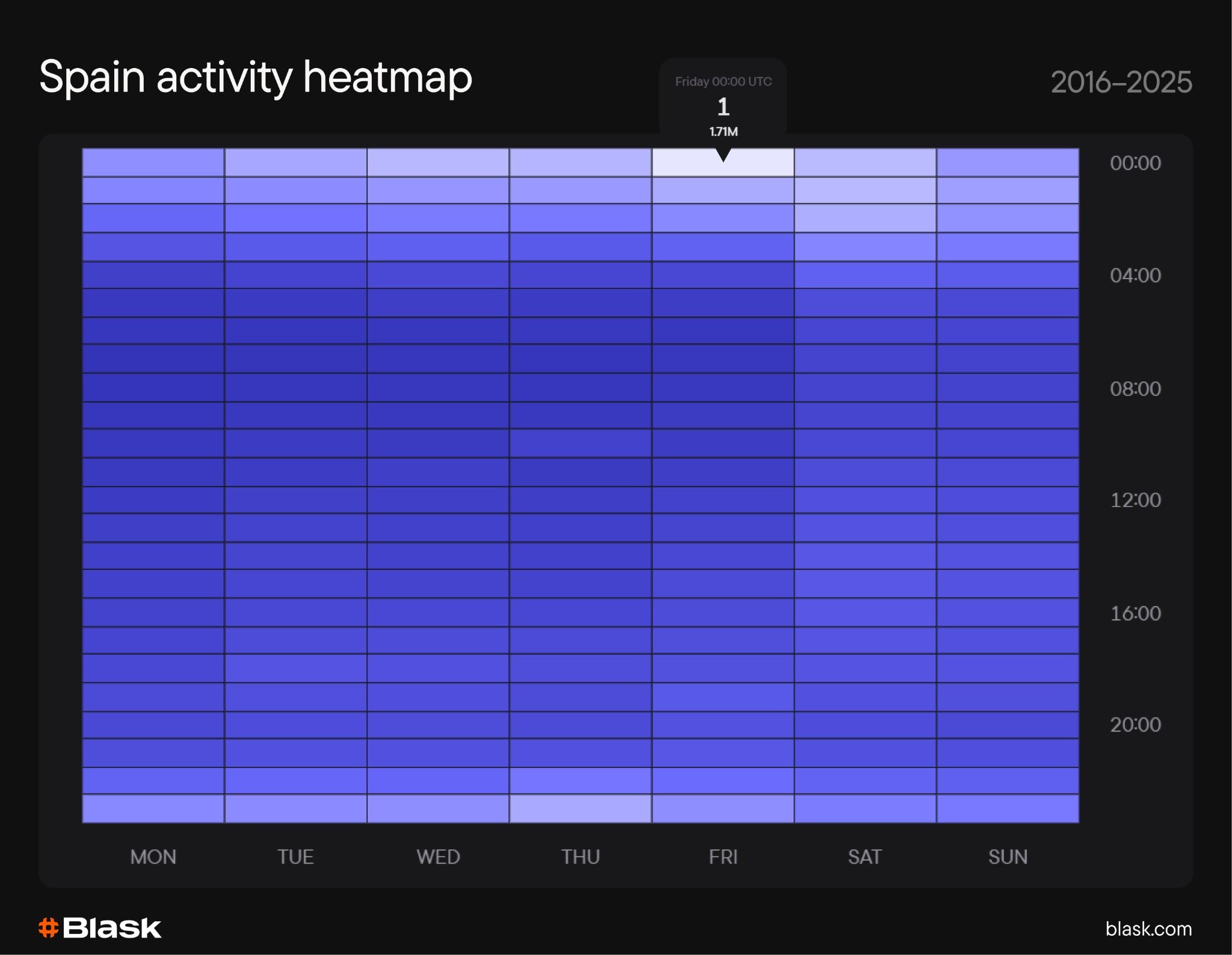
The broader ‘hot window’ extends across Friday evening through Sunday night, with particular intensity in the 00:00-04:00 UTC band (1-5 AM local). This mirrors LaLiga’s typical match scheduling — Friday night openers, Saturday afternoon and evening fixtures, Sunday evening closers — and explains why operators concentrate promotional intensity on these hours.
Bottom line
Spain’s iGaming market moves to a predictable beat: autumn football convergence and February knockout rounds drive the peaks, summer break creates the trough, and the Christmas lottery captures December spend. These rhythms repeat year after year — the calendar is the playbook.